





Key takeaways
- Hiring in Mexico requires detailed compliance planning: Your employment contracts, working hours, statutory leave, payroll withholding, social security, and employee classification need to follow labor laws in Mexico.
- There are several hiring models to choose from: You can hire through a subsidiary or registered branch, use an employer of record, or engage independent contractors.
- Employment costs go beyond salary: When you hire employees in Mexico, you need to budget for statutory benefits, employer contributions, recruiting expenses, legal setup, and other costs that vary by location, hiring model, and business operations.
Mexico offers access to professionals across a wide range of industries, including automotive, aerospace, technology, and electronics. Home to over 131 million people, Mexico is also the largest Spanish-speaking country in the world. Hiring employees in Mexico can help you expand into new markets while gaining talent with specialized skills your company needs.
Before hiring in Mexico, there's a lot you need to know. The country has unique labor and employment laws, payroll requirements, benefits obligations, and worker classification rules. Learn everything about hiring employees and contractors in Mexico, from choosing a hiring model to understanding the costs of building your team.
What to know before hiring in Mexico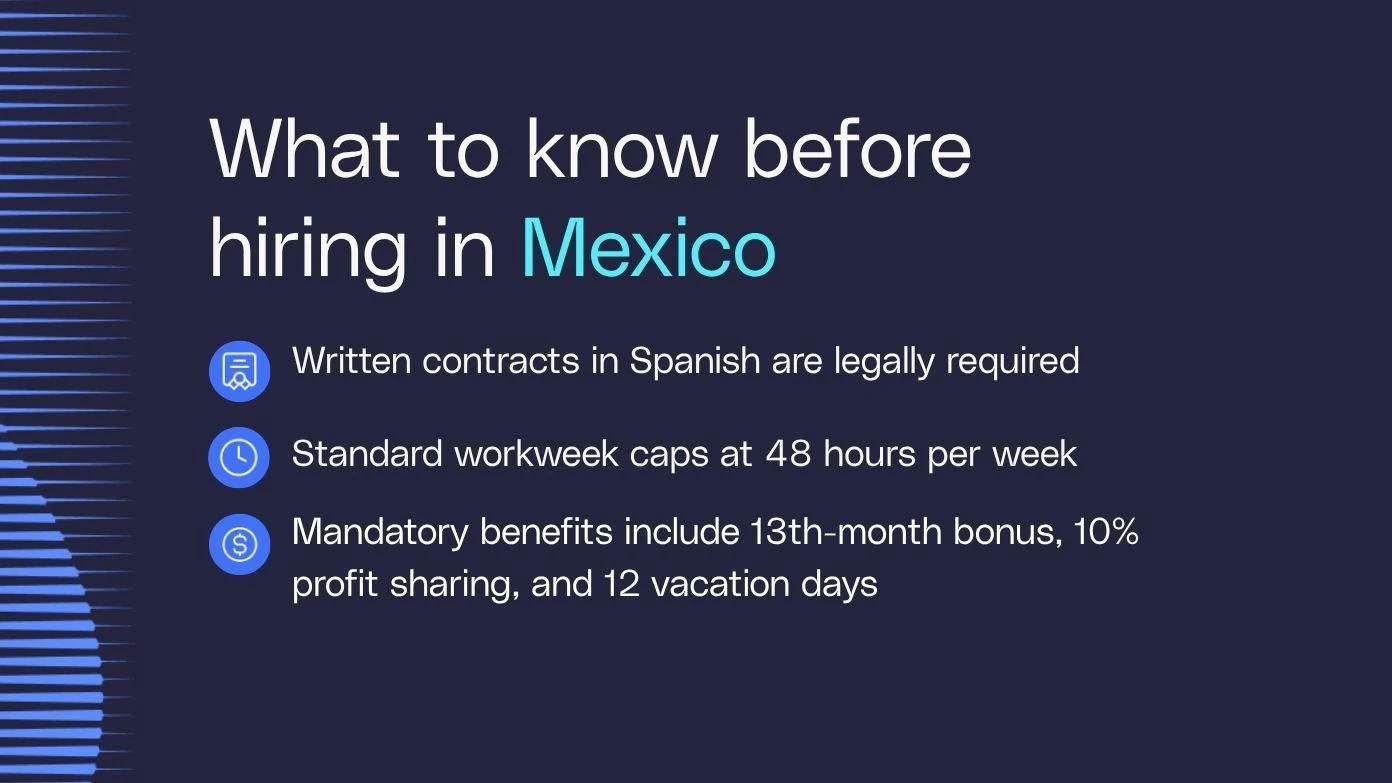
Building a workforce in Mexico can help you tap into a new market while using local talent to grow your business. However, before you do, you need to understand several legal requirements. Mexican hiring laws and norms shape many aspects of the employer-employee relationship.
If you want to start hiring quickly, G-P Gia™, an AI-powered global HR agent, can help you navigate compliance across 50+ countries, including Mexico, and all 50 U.S. states. Get answers to compliance questions, save time, and reduce compliance costs by up to 95%.
Let's take a look at several things you need to know before hiring employees in Mexico.
1. Language diversity
According to INALI, Mexico has 69 different national languages, including Spanish. For companies like yours looking to expand with Spanish-speaking professionals, hiring in Mexico is a strategic move. More than 519 million people speak Spanish worldwide, and it’s the dominant workplace language in Mexico.
Language expectations can vary by role. However, it's often best to make job descriptions, contracts, onboarding materials, and more available in Spanish.
2. Employment contracts
Verbal agreements can establish an employment relationship and protect employee rights, but the terms and conditions of employment must be documented in a written contract that provides details about the role, compensation, working conditions, and duration. Indefinite-term employment is the default when there's no duration specified. However, they can also be seasonal, fixed-term, and project-based. What's important is that those details are in writing.
Laws strictly regulate probationary periods and termination in Mexico. To be legally valid, probation must be established in writing, with strict time limits based on the role—typically up to 30 days, or up to 180 days for managerial or technical positions.
During probation, employees retain full salary, benefits, and social security rights. Terminating an employee at the end of probation requires documented evidence that they failed to meet job requirements, evaluated in coordination with the company’s Joint Productivity and Training Commission (Comisión Mixta de Capacitación y Adiestramiento).
Mexican Labor Law protects workers, and any contract term that waives or limits an employee’s statutory rights is invalid. G-P offers an Employment Contract Generator to help you create locally compliant agreements that meet legal requirements and align with hiring practices in Mexico.
3. Workweek and minimum wage
Mexico's Federal Labor Law defines three different working shifts:
- Day shift - up to 8 hours per day
- Night shift - up to 7 hours per day
- Mixed shift - up to 7.5 hours per day
The day shift usually runs 48 hours per week spread across six days. Employees are entitled to one rest day per week and one 30-minute break each workday. Some companies try to condense 48 hours into five days, or offer work contracts with fewer than the standard 48 weekly hours.
A 2026 constitutional reform provides for a gradual reduction of the maximum workweek. The maximum remains at 48 hours per week in 2026, with the gradual reduction starting in 2027 and reaching 40 hours per week by 2030. The reform also dictates that this transition cannot result in a reduction of salary or benefits.
Employees who work beyond their regular legal hours receive overtime pay under Mexico's Federal Labor Law, subject to statutory limits set by federal law.
Mexico also maintains statutory minimum wage laws. For 2026, the general minimum wage is MXN 315.04 per day, while in the Northern Border Free Zone, it is MXN 440.87 per day.
4. Required leave
When you hire employees in Mexico, you need to consider required leave granted to all workers under Federal Labor Law. Currently, Mexico has seven mandatory rest days every year, including national holidays like Christmas Day and Revolution Day. The law also provides a mandatory rest day every six years for the presidential transition. Election law may also designate additional days when federal or local elections occur.
Beyond the required rest days, employees you hire in Mexico are entitled to 12 days of paid vacation after one year of service. The law requires you to provide an additional two vacation days per year until the employee reaches 20 vacation days. After six years of service, vacation days increase by two every five years.
When your team members go on vacation, they should receive both their normal salary and prima vacacional. Prima vacacional is a bonus that needs to be at least 25% of their standard pay. When on sick leave, eligible employees can receive an IMSS sickness benefit based on a portion of their registered salary. For general illness, that's usually 60% of their registered salary starting on the fourth day of their leave.
Managing statutory leave can create challenges when you hire in Mexico. With G-P EOR, you can easily administer benefits in accordance with local law. Our in-house experts can help you meet country-specific regulations and norms.
5. Annual bonus and profit sharing
In Mexico, employers are required to provide an annual Christmas bonus. Called "aguinaldo" or "13th salary," you must provide it by December 20 of every year. The bonus must equal at least 15 days' wages. Employees who work only part of the calendar year—including those hired mid-year or who depart prior to December 20—are legally entitled to a prorated aguinaldo based on the total days worked.
The employees you hire in Mexico are also entitled to a profit-sharing bonus. Eligible employers generally distribute 10% of taxable profits to their employees under Mexico’s profit-sharing rules. However, newly created companies are exempt during their first year of operation, and other statutory exemptions may also apply.
6. Paycheck withholdings
When hiring in Mexico, it's your responsibility to withhold and remit income tax from all your employees' paychecks. This tax, known as impuesto sobre la renta (ISR), is a progressive income tax. How much you need to withhold depends on a team member's taxable compensation. That could include base wages, bonuses, and other taxable benefits.
You then remit the withheld ISR to the Mexican Tax Administration Service (SAT), generally on a monthly basis.
There are also social security contributions to calculate. Both employers and employees contribute. Typically, employers provide the larger share. Exact contributions vary based on salary, contribution limits, and the company's occupational risk classification.
Staying on top of these withholdings is vital as a company hiring in Mexico. You need to withhold the right amount, remit payments on time, and manage payroll correctly to meet local requirements.
7. Digital platform worker classification
Mexico has created a specialized labor and social security regime specifically for digital platform workers, including passenger transport and delivery drivers. When workers fall within this covered regime, digital platforms assume employer-style obligations, including providing written terms of working conditions and handling IMSS enrollment and reporting.
Eligibility for full social security coverage is based on monthly net income. Workers who earn a net monthly income equivalent to at least one monthly minimum wage qualify for full IMSS benefits. Workers earning below this threshold are not treated as standard independent contractors; while managed differently for full social security coverage, platforms must still fulfill core obligations, including providing coverage for work-related risks and personal accidents.
The framework originated with a mandatory IMSS pilot program launched on July 1, 2025, with broader mandatory implementation continuing into 2026.
The current regime began Jan. 1, 2026, following a mandatory pilot in 2025.
8. Supplemental benefits:
Beyond the statutory benefits, many companies that hire in Mexico offer supplemental perks. They can help attract top talent and retain professionals. Before you start building your team, you can consider what types you want to offer. Some popular options include:
- Grocery vouchers (Vales de Despensa): Typically provided through SAT-approved cards
- Company savings fund (Fondo de Ahorro): Savings funds that include employer-matched contributions
Offering any of these supplemental benefits can strengthen your total compensation package when hiring employees in Mexico.
Hiring models for global companies in Mexico
When hiring employees in Mexico, what's right for your company depends on your talent needs and expansion plans. Each option comes with unique costs, compliance obligations, and administrative duties. Here are four common hiring models to consider.
Direct employer registration
If you want to manage the hiring process and logistics directly, you can establish a subsidiary or registered branch in Mexico and register as an employer. A subsidiary operates as a separate legal entity from your company, while a branch extends your existing operations into Mexico.
This route gives your company greater control and oversight. However, you’ll need to handle local obligations, including registration with authorities such as SAT and IMSS, payroll, employment contracts, tax withholding, statutory benefits, and ongoing compliance.
Employer of record
One alternative to direct employer registration is to use an employer of record (EOR). With an EOR like G-P EOR, you can hire professionals and build a team in Mexico without setting up a local entity. The Mexico EOR serves as the legal employer, managing core responsibilities such as contracts, payroll, taxes, and statutory benefits.
An EOR also navigates the complexities of local compliance. This model can help you enter the Mexican market quickly while reducing the administrative burden on your company compared with establishing a local entity.
Independent contractor
Independent contractors can give you access to specialized talent without establishing a standard employment relationship. You can hire contractors in Mexico to bring in specific niche skills for a project without taking on a new employee.
The working arrangement must reflect a genuine contractor status. There are still legal requirements to follow, and misclassifying someone as a contractor, when managing them like an employee, can create significant financial and legal risks.

Top hiring hubs in Mexico
Some Mexican cities are known for particular industries. Knowing what each city has to offer can help you channel your hiring efforts to the right place.
Here are the top talent hubs in Mexico:
- Mexico City is the capital and largest city. It has a large and diverse workforce and is the central finance and business hub. Key industries include technology, e-commerce, and manufacturing.
- Monterrey has a strong industrial base. It’s a major center for manufacturing, particularly in the automotive, machinery, consumer electronics, glass, steel, and cement sectors.
- Guadalajara is one of Mexico’s leading tech hubs. The city has a strong reputation in technology and innovation, software development, electronics manufacturing, and call centers.
- Tijuana is an important city for manufacturing with a strong concentration of export-oriented production. It’s known for maquiladoras, facilities that produce goods for international markets. Key sectors include electronics, medical devices, aerospace, and automotive manufacturing.
- Querétaro is growing quickly in the aerospace, automotive, and technology sectors. The city attracts national and international companies and has a strong talent base in engineering.
- Puebla is a key center for the automotive and manufacturing industries, with major plants from Volkswagen and Audi.
[Suggested Visual: Map of Mexico with the six talent hubs marked]
Key industries in Mexico
Understanding Mexico’s main industries helps you benchmark salaries and benefits. You can use this insight to make smarter choices about where to invest and grow your workforce. Some of Mexico’s strongest industries include:
- Automotive manufacturing: Mexico is one of the world's largest producers of vehicles and auto parts. Vehicles are one of Mexico’s largest export categories. Major car manufacturers like General Motors, Ford, Volkswagen, Nissan, Toyota, BMW, and Mercedes-Benz have plants and research facilities in the country. Key roles in this sector include manufacturing engineers, electrical engineers, and mechanical engineers.
- Aerospace: The aerospace industry is growing, especially in Querétaro, where companies make aircraft parts and offer maintenance services. Bombardier has production and engineering operations in the state. Important roles include engineers, welders, and assemblers.
- Electronics and electrical equipment: Mexico exports electronics, such as televisions, computers, and telecommunications gear. Companies like Samsung, LG, and Sony have manufacturing plants in Mexico. This field requires various engineering specialists.
- IT: Information technology is expanding, with many companies focusing on software development, mobile applications, cloud services, and cybersecurity. Guadalajara is a key tech center. Important roles include software developers, data scientists, and cloud architects.
- Oil and gas: Mexico has large oil reserves and a well-established petroleum industry, which includes extraction, refining, and petrochemicals. PEMEX is the most significant player in this sector. Key roles include engineers, geologists, and drilling and well operations specialists.
The cost of hiring an employee in Mexico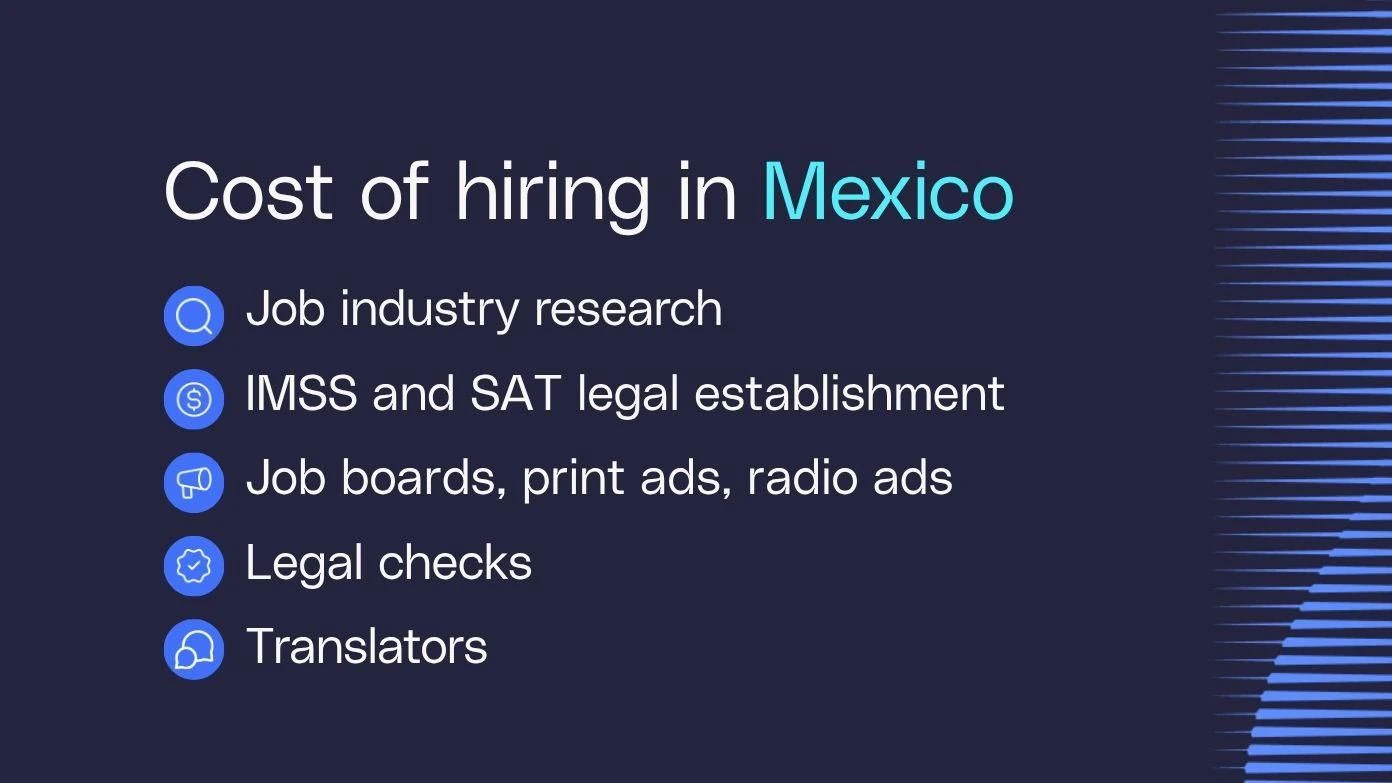
When hiring in Mexico, salary and statutory benefits aren't your only costs. There are other expenditures to cover when building your team. The amounts can vary based on your goals and legal setup, but here are a few expenses to budget for.
- Research: Determine where in Mexico you want to establish your business, and research the legalities that relate to employment practices there. You also need to understand any relevant requirements for your industry.
- Legal establishment: If you plan to hire directly through your own Mexican operation, you may need to establish a local entity. That could be a subsidiary or branch. Depending on your structure, your company may need registrations with the IMSS and the SAT. Those can all add costs. An employer of record (EOR) offers another option by letting you build a workforce in Mexico without establishing a local entity for your company.
- Job boards: To attract talent, you need to post job ads. You can do so on either public job boards or industry-specific ones. Both can cost you, but there are free options you can also take advantage of.
- Legal checks: Background checks are legal in Mexico, but you need to comply with Mexican privacy and anti-discrimination laws. Newer private-sector data protection laws also apply. Taking time to check applicants’ paperwork and ensure they have a legal right to work in Mexico can also add to your total cost.
- Translator: If you’re evaluating applications and interviewing candidates who speak Spanish and this isn’t your first language, consider enlisting the help of a translator. A translator can help with in-person and virtual communication, but this adds to your hiring costs.
According to G-P Verified Sources from Gia, the total annual employer burden rate in Mexico, which includes costs triggered on top of salaries, is between 24% and 38%. The exact rate depends on the employee’s salary, the employer’s occupational risk classification, and the state payroll tax rate. Gia draws on more than 13 years of G-P global employment experience, along with insights from almost a million real-world scenarios, to provide accurate, up-to-date employment law information.
What does a company need to hire employees in Mexico?
Before you hire employees in Mexico, ensure your company has the appropriate legal structure, documentation, registrations, and permits in place. Failing to consider the following could lead to added costs and compliance issues.
- A branch or subsidiary: If you want to establish a legal presence in Mexico, you can set up a branch or subsidiary. A branch is an extension of your company, while a subsidiary functions more independently. To hire full-time employees in Mexico without setting up your own entity, use G-P EOR, which can manage core employment responsibilities.
- Legal documents: Depending on your company’s structure, you may need incorporation documents, translated materials, notarization, and other formal records. Many required documents and instructions are in Spanish. If you don’t have an employee who can create these documents and read the instructions from the Mexican government, you’ll need a translator. In some cases, documents will also need legalization or apostille.
- Registrations: You’ll have to register your business with several government agencies. These could include the Mexican Tax Administration Service (SAT), the Mexican Social Security Institute (IMSS), and the National Workers Housing Fund Institute (INFONAVIT). There’s also the Public Registry of Commerce and the National Registry of Foreign Investments. Exact registration requirements depend on your company’s legal structure and business activities.
- Permits: Depending on your location and your industry, you may also need national, state, and local permits. Check the requirements that apply to your operations before you begin hiring.
Steps to hiring in Mexico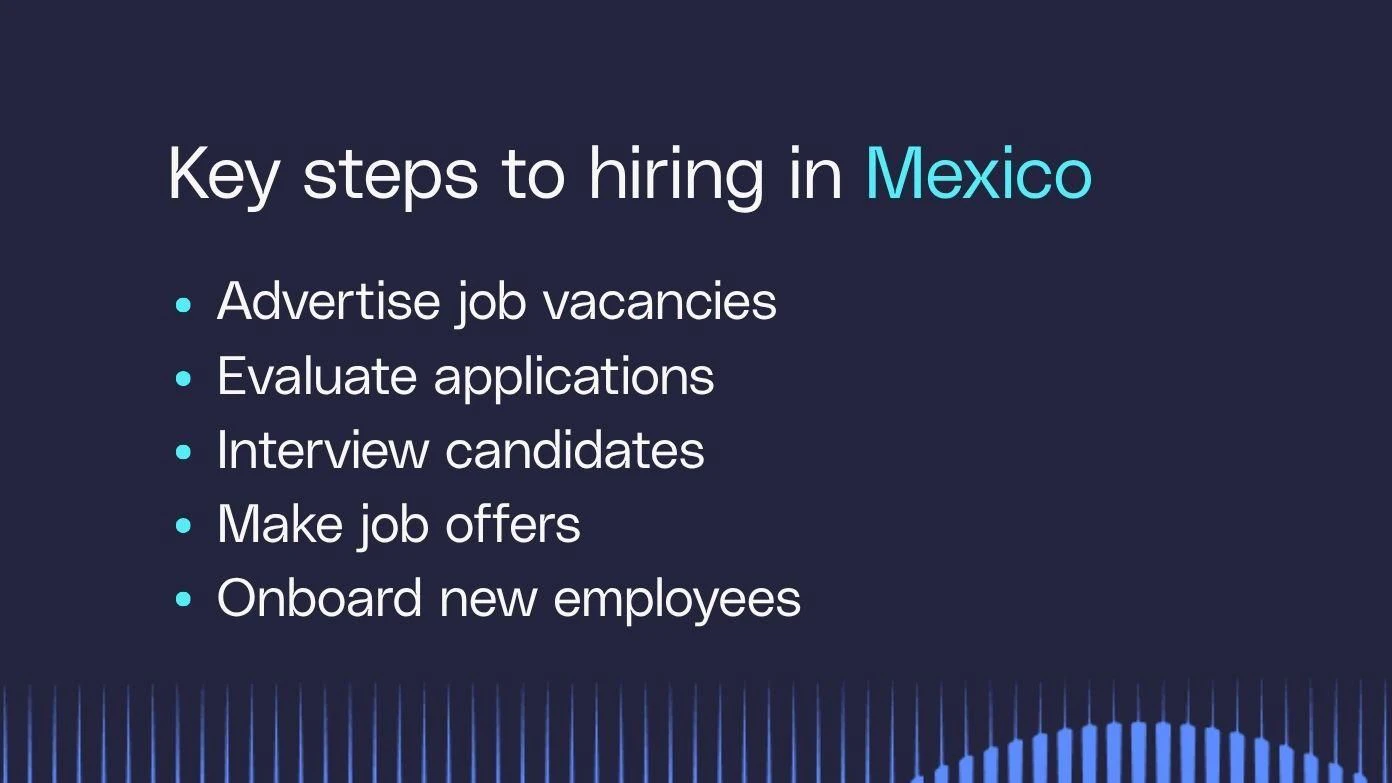
The hiring process in Mexico follows a familiar structure, but local employment requirements will shape every step. From posting ads to onboarding new team members, you need to account for language and compliance with Mexico's federal labor laws.
1. Post job ads
First, create a job ad that outlines the position details. You should provide information about whether it’s a remote or in-office job, expected duties, required qualifications, and more. Include language requirements or preferences. Post your job ad in various spots, including online job boards.
2. Evaluate applications
As applications come in, you can begin screening and determine who you’ll contact for an interview. You can use software or an agency to assist with this step to streamline the process.
3. Interview candidates
Next, interview the candidates who made your shortlist. You can conduct interviews virtually or in person. Phone or video interviews are especially helpful if you’re hiring remote employees in Mexico and want to avoid traveling there. However, you may need language interpreters.
When scheduling remote interviews, consider the time difference. Mexico has four standard time zones. Find out if there’s a time difference with the job applicant, and schedule the interview accordingly.
4. Make the job offer and create a contract
Once you choose a candidate, send a formal job offer and prepare a written employment contract.
Contracts are a critical aspect of employment in Mexico, and federal laws require well-documented terms. Contracts should cover key details like compensation and benefits, role requirements, and working conditions.
5. Onboard your new hire
Then, you can begin the onboarding process. Ask new hires to fill out all the necessary paperwork, both for the Mexican government and for your organization. You’ll use this information to add new hires to payroll. You can streamline the entire employee lifecycle for your team members in Mexico with G-P EOR. Pay your global teams in 150+ currencies and easily add bonuses, commissions, and exceptions in just a few clicks.
Hiring contractors in Mexico
Hiring contractors in Mexico can be a cost-effective way to test the market, build a presence, and access specialized skills without the commitment of full-time employees. This model works well for project-based hiring or short-term needs.
However, the work arrangement needs to be legitimate. Before you hire contractors in Mexico, consider the following:
1. Employees vs. independent contractors
Employees and independent contractors have different working relationships with your company. You can hire employees in Mexico to work under your direction. In return, you pay them a regular salary. They also receive statutory benefits and employment protections.
Independent contractors operate differently. They provide services independently under the terms of a negotiated contract. Unlike employees, contractors typically have more control over how and when they work. They may also use their own equipment or provide specific services for a project.
2. Penalties for misclassification
Classifying an employee as an independent contractor can lead to severe administrative, financial, and legal penalties. Non-compliance with IMSS registration and social security contribution obligations can result in fines of 20 to 350 times the UMA per infraction, surcharges ranging from 40% to 100% of omitted contributions, and full employer liability for any medical and social security benefits provided to unregistered workers. Additionally, serious cases involving deliberate fraud or non-remittance of withheld contributions can trigger criminal prosecution with penalties of up to nine years' imprisonment
3. How to pay contractors in Mexico
G-P Contractor™ streamlines the time-consuming process of hiring and paying independent contractors. You can create and issue contracts, manage payments, and support contractor relationships across multiple countries. It reduces manual work and simplifies contractor administration.
“G-P Contractor gives us the confidence that our international workers are classified correctly, reducing our risk as we scale.”
Georgia Uebergang
CFO at Seminal Artist Group
Hire employees and contractors in Mexico with G-P
Our SaaS and AI-powered products, G-P EOR, Contractor, and Gia, help companies of all sizes hire, onboard, and manage global teams in 180+ countries. Together, these solutions can reduce the complexity and administrative burden of global hiring. They can also give you one platform to manage team members and contractors in Mexico and beyond.
With more than a decade of experience, a large team of HR, legal, and compliance experts, and a global proprietary knowledge base, G-P is the recognized leader in global employment.
Make your expansion to Mexico easier with G-P. Contact us or book a demo today.

Frequently asked questions (FAQs)
What should employment contracts include?
Employment contracts in Mexico should document key terms of the working relationship. This includes information about the role, compensation, working conditions, benefits, and contract duration. If you use a probationary period, you need to establish it in writing. All contract terms must comply with Mexico's Federal Labor Law.
How are social security contributions managed?
Your company must calculate and withhold employee social security contributions through payroll. You also need to make your employer contributions. Exact amounts vary based on salary, occupational risk classification, contribution limits, and other factors. Employers must register eligible workers with IMSS and remit required contributions on time.
What are the rules regarding overtime and working hours?
Mexico's Federal Labor Law sets maximum working hours based on the shift an employee works. In 2026, the maximum remains 48 hours, but recent reforms will gradually reduce that maximum to 40 hours by 2030. Team members who work beyond their regular legal hours are entitled to overtime pay, subject to statutory limits.
What are the mandatory benefits in Mexico?
Mandatory benefits in Mexico include paid vacation, a vacation bonus, the annual aguinaldo bonus, profit-sharing for eligible employees, social security contributions, and statutory rest days. Additional benefits may apply based on the professional's role, leave status, and length of service.
How do I ensure compliance with data protection laws?
When hiring in Mexico, you need to handle candidate and employee data in accordance with applicable privacy laws. That means using clear privacy notices, collecting only the information you need, following applicable consent requirements, and taking steps to protect sensitive data. Background checks and other hiring processes need to comply with Mexico's data protection rules.