


Key takeaways
- The importance of compliance: When you hire in Norway, you must comply with complex laws and regulations, including the WEA, the Holidays Act, collective agreements, the National Insurance scheme, OTP scheme, and mandatory employment contracts.
- A choice of hiring models: The main hiring models used by global companies operating in Norway include using an employer of record (EOR), establishing a subsidiary or branch, and hiring independent contractors.
- The differences between employees and independent contractors: When hiring independent contractors in Norway, be aware of strict rules against misclassification and the penalties that could apply.
Hiring employees in the Scandinavian country of Norway gives you access to a skilled and well-educated workforce, including professionals in shipping, maritime engineering, finance, IT, and biotechnology. This guide covers the key requirements and steps involved in hiring in Norway.
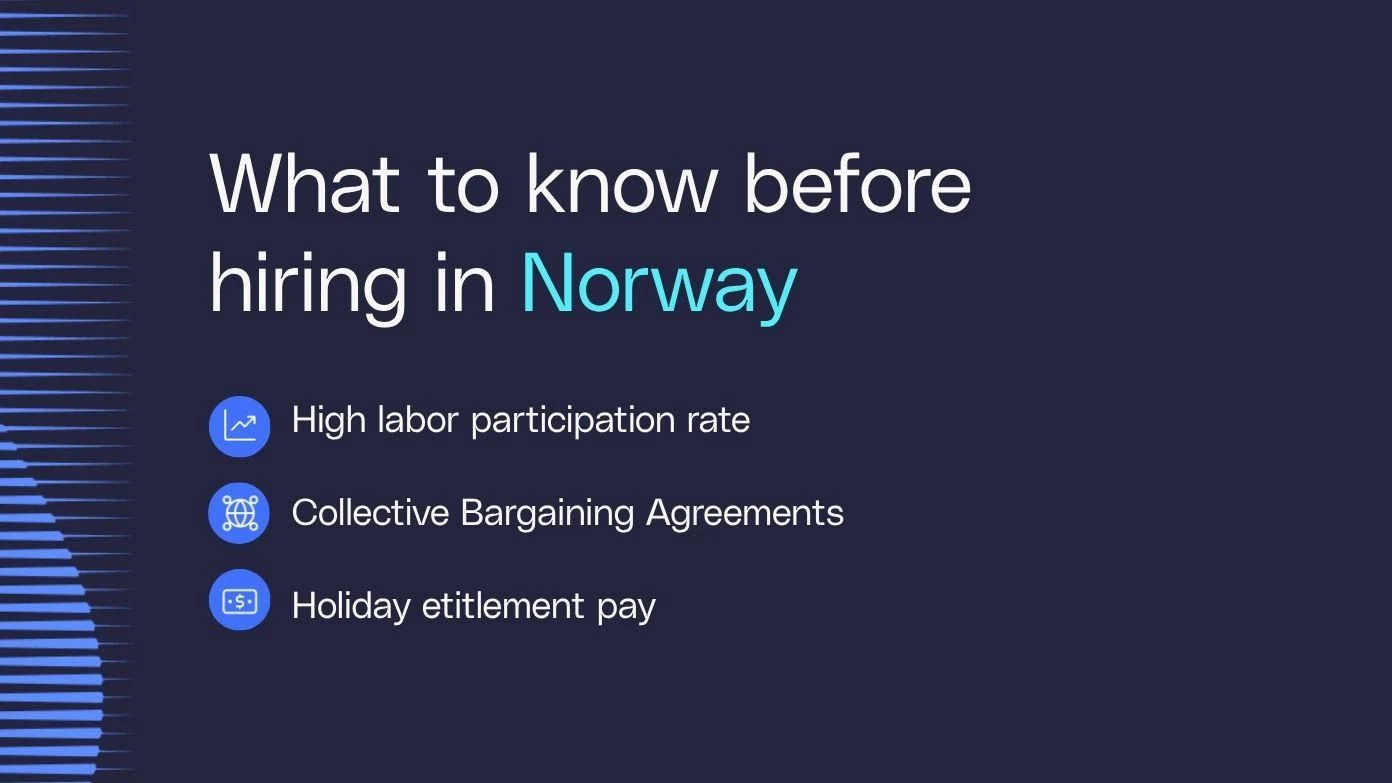
What to know before hiring in Norway
If you’re expanding your business into Norway for the first time, you must know and comply with the country’s legal requirements. These norms and laws influence hiring practices in Norway and many aspects of the employer-employee relationship.
If you’re unsure where to begin, G-P Gia™, our AI-powered global HR agent, can answer your toughest compliance questions across 50 countries — including Norway — and all 50 U.S. states. Reduce your reliance on outside counsel and cut the time and cost of compliance by up to 95% with Gia.
Let’s take a look at six things to know about hiring in Norway.
1. The Norwegian labor market
Norway has a thriving economy and an impressive labor participation rate of 73.5%. As a point of reference, the U.S.’ labor participation rate is 61.4%. Employees in Norway also enjoy high levels of job satisfaction. A July 2026 report revealed that nearly 80% of the employees in Norway who were surveyed were satisfied with their jobs.
The country’s workforce is also well educated, mainly due to Norway’s tuition-free public universities. In Norway, 38.3% of the population has completed higher education.
If you’re expanding to Norway, you’ll need a competitive benefits package to attract top talent. You can easily administer benefits plans with G-P EOR. Our in-house experts continuously monitor employment laws to meet country-specific regulations and norms.
2. Common languages
The two official languages in Norway are Norwegian and Sami. Sami is an indigenous language mostly spoken in certain regions of northern Norway. Norwegian is far more common. You may encounter two written forms of Norwegian: Bokmål, the more common form that’s based on written Danish, and Nynorsk, which is mainly based on regional dialects in western Norway.
Norway also has high English proficiency rates. Almost 90% of the population speaks English at a basic level.
3. Employment regulation
Employers operating in Norway must comply with the Working Environment Act (WEA) and the Holidays Act. Collective Bargaining Agreements (CBAs) are also common sources of employment regulation. Two of the most significant collective organizations in Norway are the Confederation of Norwegian Enterprise and the Norwegian Confederation of Trade Unions.
Employers must create written employment contracts for employees within the first seven days for work that lasts more than a month. For arrangements of less than one month, contracts must be available on the first day.
The termination process in Norway is one of the most complex in Europe. Employee protections are strong, even during the probation period. G-P EOR has an Employment Contract Generator to help you draft compliant employment contracts that meet all legal requirements and best practices in Norway.
4. Working hours and minimum wage
The WEA limits workdays to nine hours within any 24-hour period. The average workweek in Norway is 34.22 hours. Employees are also entitled to a lunch break if they work more than 5.5 hours in one day. Employees can work more than 40 hours a week. Overtime must be compensated with a minimum pay supplement of 40% above the normal hourly wage.
There’s no national minimum wage in Norway. However, specific sectors have introduced minimum wages due to collective agreements. Norway’s national currency is the Norwegian Krone (NOK). Use this currency to specify employees’ salary in their employment contract.
5. Taxes on income
Employers must deduct income tax from employees’ paychecks. Norway uses a progressive tax system. The system is divided into a base tax and a step or bracket tax. The base tax rate is currently 22% and applies to all employees, regardless of their income level. The step or bracket tax applies higher tax percentages to portions of income that fall into higher tax brackets.
Employees and employers each make National Insurance contributions. Employees pay National Insurance contributions based on their salary, and companies pay the corresponding employer contributions. Employer rates vary by municipality or zone and can range from 0– 14.1% in 2026. These contributions, along with taxes, fund Norway’s National Insurance Scheme. This provides employees with several benefits, including retirement, disability, unemployment, and sick leave. Employers must also provide employees with a supplementary pension scheme known as the Mandatory Occupational Pension Scheme (OTP).
6. Vacation entitlement
In addition to public holidays, full-time employees are entitled to a minimum of 25 days off each year. This generally equals four weeks and one day. Employees over age 60 get an additional week, while many collective agreements provide a fifth week.
Holiday leave is generally unpaid. Instead, employees get holiday pay based on the previous year’s earnings. The statutory rate is typically 10.2%, increasing to 12% when a fifth week is provided under a CBA.
In Norway, employees get sickness benefits for up to 52 weeks during three years. If an employee takes sick leave, returns to work, and then becomes ill again, the separate sick periods will be added up and combined if the gap between them is less than 26 weeks. Once the 52-week limit is reached, employees must wait 26 weeks before receiving benefits again.
Employers and the Norwegian Labor and Welfare Administration (NAV) both pay for sick leave. The employer pays for the first 16 calendar days. After this, the NAV pays sickness benefits directly to the employee.
Hiring models for global companies in Norway
The main hiring models for global companies in Norway include:
- Direct employer registration: Registering as a local Norway business and employing people directly.
- Employer of record: Using an employer of record (EOR) to serve as the legal employer of professionals in Norway, offloading payroll, pensions, and benefits.
- Subsidiary or branch: Incorporating a Norway business entity for full control, but be aware that it can take two to four months.
- Independent contractor: Hiring contractors to test the market and handle specialized projects, but keep in mind Norway’s strict misclassification laws and avoid misclassifying employees as independent contractors
Top hiring hubs in Norway
Some Norwegian cities are known for particular industries. Knowing what each city has to offer can help you channel your hiring efforts to the right place and fill roles faster.
- Oslo is the capital of Norway and the country's main economic center. It’s home to many banks, insurance companies, and investment firms. You can find skilled workers in financial services, accounting, insurance brokering, and fintech.
- Bergen plays a key role in marine education and research. The University of Bergen, Norway's largest marine studies institute, is located here. The city has a large talent pool in marine science, ocean exploration, and aquaculture.
- Stavanger is Norway's energy capital. Many companies working off of Norway’s North Sea coastline, including the national energy company Equinor, have offices here. As the energy sector evolves, Stavanger is also emerging as a hub for digitalization and renewable energy projects.
- Trondheim is often referred to as Norway’s tech and knowledge capital. Home to the Norwegian University of Science and Technology, the city is a leader in engineering, IT, and innovation.
- Tromsø is the largest city in northern Norway. It’s a center for Arctic-related research and education, especially in areas like fisheries and environmental sciences. Tromsø is also home to a growing startup scene, encouraged by incubators and co-working spaces.
Key industries in Norway
You can benchmark salaries and benefits based on your knowledge of Norway’s main industries. Use this insight to make smart choices about where to invest and grow your workforce. The main industries in Norway include:
- Oil and gas: The country has strong skills in exploration, extraction, processing, and the technology related to these sectors. Norway is also investing heavily in offshore wind, hydrogen, and carbon capture and storage. Specialist talent includes petroleum engineers, geologists, and technicians for offshore operations and maintenance.
- Maritime: Norway's extensive coastline and seafaring tradition support a maritime industry that includes shipping, shipbuilding, marine equipment, and ocean technology. Specialist talent includes naval architects, shipping and logistics professionals, and marine biologists.
- Technology and digitalization: Norway's tech industry is thriving, particularly in Oslo and Trondheim. The country's large energy and maritime sectors are seeking ways to modernize and innovate through digitization. Specialist talent includes software engineers, developers, cloud architects, and cybersecurity experts.
- Finance: Norway has a stable and well-regulated financial sector. Digital tools and fintech solutions are in high demand. Specialist talent includes financial analysts, investment professionals, and fintech developers.
- Advanced manufacturing: Norway excels in specialized, high-tech manufacturing, particularly maritime equipment and oil and gas components. Specialist talent includes various engineering fields.
The cost of hiring an employee in Norway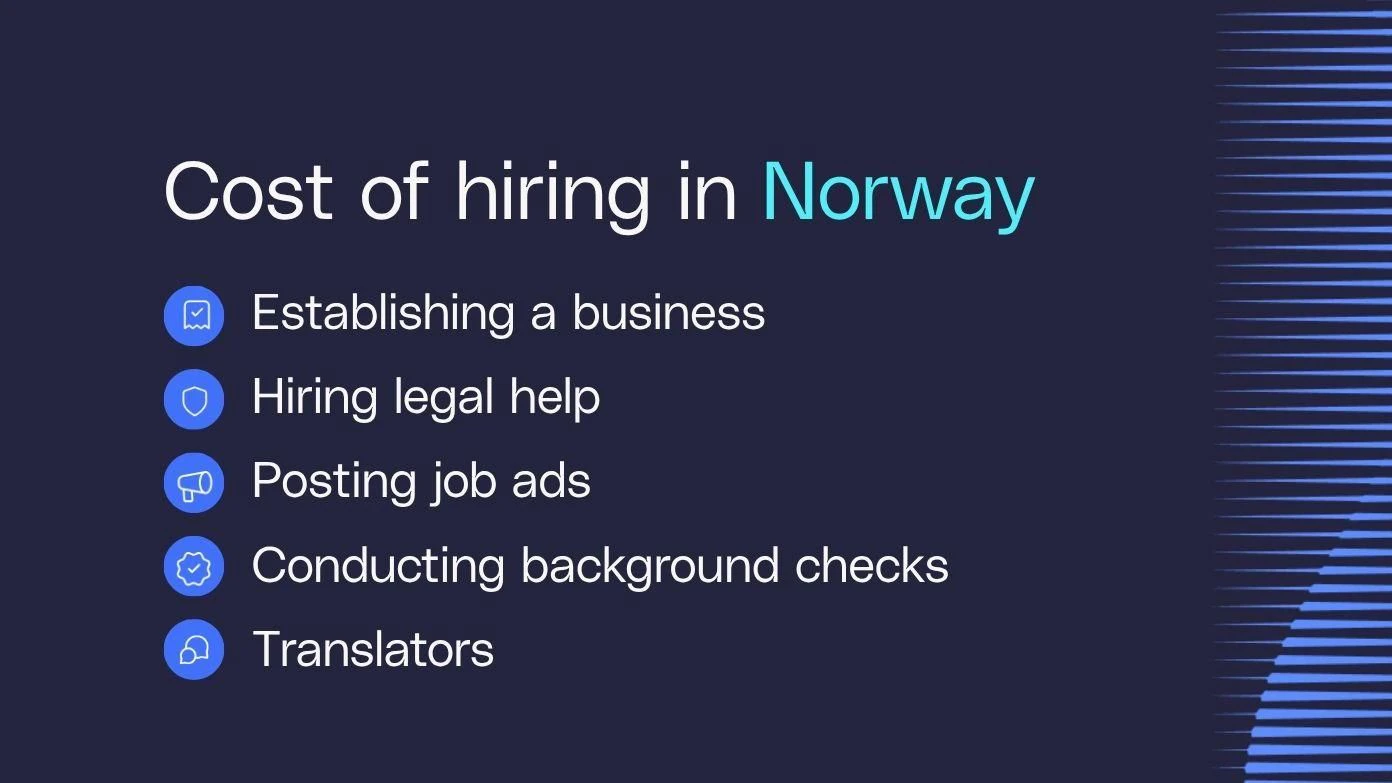
Whether you’re hiring just one employee or an entire team in Norway, expenses are inevitable. Budget for the following:
- Research: Determine where in Norway you want to establish your business, and research the legalities that relate to employment practices there, as well as any industry-specific requirements.
- Entity setup: Unless you work with an employer of record (EOR), you’ll have to set up a branch or subsidiary in Norway and cover the related costs.
- Employer National Insurance rate by zone: Your contribution rate by zone or municipality can range from 0–14.1%.
- Mandatory OTP: In areas in which OTP applies, you can expect to pay around 2%.
- Holiday Pay Accrual: Employees accrue holiday pay at rates ranging from 10.1–12%.
- Mandatory Occupational Injury Insurance: Your costs will depend on your industry and risk level.
- Travel: If you have to travel to Norway to recruit or set up your new office, you should factor in these costs.
- Job advertisements: Advertising your job online or in print can add to your recruitment expenses.
- Translator: If you’re evaluating applications and interviewing candidates who speak Norwegian, and this isn’t your first language, consider hiring a translator. A translator can help with in-person and virtual communication, but it adds to your hiring costs.
According to G-P Verified Sources from Gia, the total annual employer burden rate in Norway, which includes costs triggered on top of salaries, is around 25%.
What does a company need to hire employees in Norway?
Make sure you cover these essentials before expanding your team in Norway:
- Register your business as a private limited company, subsidiary, or Norwegian-registered foreign enterprise, or use an EOR.
- Open a bank account, deposit the required capital, which is at least NOK 30,000 for a private limited company, and get approval from an independent auditor before registration.
- Register with the Central Coordinating Register for Legal Entities and get an organization number.
- Register your company name with the Register of Business Enterprises.
- Register with the national VAT register once VAT-liable turnover exceeds NOK 50,000 within 12 months.
- Set up payroll processes, retrieve employee tax cards, withhold payroll tax, and report employment and salary information each month.
- Enroll in mandatory occupational injury insurance.
- Arrange a pension scheme for employees where OTP requirements apply, and enroll those who are eligible beginning their first working day.
- Verify each employee’s legal right to work in Norway, especially for non-EU/EEA nationals.
- Draft and provide a compliant written employment contract within the statutory deadline.
This process and the research that goes into understanding employment, tax, and business laws are a major investment of time and money.
Use G-P EOR to onboard full-time employees in Norway without setting up your own entity. Build your team in Norway at a lower cost and with peace of mind that you’re doing so compliantly.
Steps to hiring in Norway
There are five basic steps for hiring in Norway. We’ve summarized them below, along with tips based on local customs and requirements that govern hiring practices in Norway.
1. Notify the NAV of vacancies and post job ads
Notify the Labor and Welfare Administration (NAV) of your company’s vacant positions. You have to notify existing employees as well (if you have them). Then, create a job ad in either Norwegian, English, or both, and post it on popular job boards.
Professionals in Norway mostly look for jobs online. Some of the most popular job sites in Norway are Arbeidsplassen, EURES, Gule Sider, and FINN. LinkedIn is also popular in the country, especially among certain age groups.
2. Screen applicants
If you want applicants to submit their CV or other materials in a certain language, specify that in your job ad. As applications come in, your hiring manager or applicant tracking system will find the most qualified candidates.
You may also consider conducting background checks. They are allowed in Norway, as long as you’re not looking into applicants’ personal lives. This includes their religion, ethnicity, sexual orientation, or disability. You’re only allowed to conduct credit checks if they’re relevant to the job.
3. Interview the best candidates
Interview candidates from your shortlist. You can conduct interviews virtually or in person. Phone or video interviews are especially helpful if you’re hiring remote employees in Norway and want to avoid traveling there.
During interviews, avoid questions that may be considered discriminatory. This includes questions about a candidate’s health, for example. Only ask questions that are relevant to the job. Gia can help you create questions that follow anti-discrimination laws in Norway, so you can find the best fit for the role while complying with local regulations.
When scheduling virtual interviews, consider the time difference if you’re outside Central European Time (CET).
4. Send offer letters
Once you’ve identified the candidates you want to hire, send offer letters. These letters usually outline what will be included in the employment contract, or you can provide a full copy of the contract at this time. Prospective hires may negotiate their salary or other aspects of the employment arrangement before agreeing to work for your company.
5. Onboard your new hires
During onboarding, familiarize new employees with their job duties and your company culture. Provide any essential paperwork for payroll setup and walk them through their contracts. Written employment contracts should, at the least, include:
- Work location
- Job title or description
- Employee’s start date
- Trial period information, if applicable
- Expected duration in the case of temporary positions
- Holidays and holiday pay information
- Notice period
- Salary and other remuneration information
- General work schedule and break allowances
- Special working-hour arrangements, if applicable
- Collective agreements, if applicable
Onboard your team members in Norway in minutes with G-P EOR. We’ll handle the legal and administrative tasks, so you can start working faster. Simple, self-guided workflows ensure a smooth process for you and your new hires.
Hiring contractors in Norway
Working with independent contractors in Norway can be a cost-effective way to test the market and build a presence. Contractors based in Norway understand local consumer behavior, rules, and business practices. They’ll be ready to start working quickly with their own equipment and established work processes. However, be aware that Norway has a presumption that workers are employees unless you can prove that their contractor status is highly probable.
Hiring contractors allows you to adjust your workforce based on your business needs.
Before you enter an agreement with an independent contractor in Norway, consider the following:
1. Employees vs. independent contractors
In Norway, employers hire employees to do work and, in return, pay them a regular salary or wage. Independent contractors run their own businesses and provide services. Unlike employees, contractors set their schedules, provide their own equipment, and work on specific projects rather than having ongoing jobs.
To be considered contractors, they must typically work for their own account, have multiple clients, and be responsible for results rather than simply providing labor. While setting their schedules and having specific projects are good indicators of contractor status, classification depends on the entire working reality.
2. Penalties for misclassification
Classifying someone as a contractor when they’re actually an employee can lead to severe penalties. If this misclassification occurs, you may need to:
- Pay back wages, overtime, holiday pay, and other statutory benefits.
- Pay fines for inaccurate or late submission of the monthly a-melding report, with a daily fine of NOK 134 per employee, up to a maximum of 1,345,000 in 2026.
- Pay compensation for wrongful termination, which is assessed on a case-by-case basis. Reinstatement may also be a remedy.
3. How to pay contractors in Norway
G-P Contractor™ takes away the messy, time-consuming process of hiring and paying international independent contractors. You can create and issue contracts and pay contractors with just a few clicks, all while ensuring a compliant process.
Hire employees and contractors in Norway with G-P
Our Global Employment Platform and its AI-powered products, EOR, Contractor, and Gia, enable companies of all sizes to build and manage global teams.With more than a decade of experience, the largest team of HR, legal, and compliance experts, and a global proprietary knowledge base, G-P is the recognized leader in global employment.
Make your expansion to Norway easier with G-P. Contact us or book a demo today.
Frequently asked questions
What are the legal requirements for hiring international workers in Norway?
International workers need valid work and residence permits. Non-EU/EEA nationals must have a residence permit before starting employment. Requirements vary according to the worker's nationality, role, and length of stay.
What are the documentation and record-keeping requirements in Norway?
You must maintain thorough records, including employment contracts, work permits, and tax registration documents. Your records should be readily available for inspection by Norwegian authorities.
What are the wage standards and equal treatment regulations?
Norwegian law mandates equal pay and working conditions for national and international employees performing equivalent roles. Collective bargaining agreements establish minimum wages and employment terms.
What are the employer's tax and registration obligations in Norway?
You must register employees through the a-melding system and verify their Norwegian identification number. You must also withhold income tax using a tax deduction card.
What are the penalties for non-compliance in Norway?
Non-compliance can result in fines, revocation of work permits, and reputational damage. You can avoid these risks by adhering to all legal requirements.