


Key takeaways
- South Korea’s top hiring hubs include Seoul, Busan, Daejeon, Ulsan, and Daegu.
- Leading industries in South Korea include ICT, automotive and future mobility, biotechnology, shipbuilding, and financial services.
- Options for hiring in South Korea include partnering with an employer of record (EOR), hiring independent contractors, establishing a subsidiary, or direct employer registration.
South Korea is an excellent prospect for global business expansion. The country has a large economy, a highly educated population, and free trade agreements with the U.S., U.K., and European Union.
Before expanding to South Korea, you’ll need a solid understanding of the tax laws, working hours, paid holidays, and other requirements under the Labor Standards Act. Our guide will tell you everything you need to know about hiring in South Korea.
What to know before hiring in South Korea
If you’re unsure where to begin, G-P Gia™, our AI-powered global HR agent, can answer your toughest compliance questions across 50 countries — including South Korea — and all 50 U.S. states. Reduce your reliance on outside counsel and cut the time and cost of compliance by up to 95% with Gia.
7 things to know about hiring in South Korea
1. Employment contracts
The Labor Standards Act lays out specific standards for employment contracts.
Employment contracts generally aren’t required to be in Korean. But a Korean or bilingual contract is strongly recommended to ensure employee understanding and reduce disputes.
Fixed-term employment is capped at two years, subject to exceptions. If employment continues beyond that limit without an applicable exception, the employee is generally treated indefinite-term.
Part-time employees in South Korea generally get statutory entitlements proportionate to their contractual working hours. However, employees averaging fewer than 15 contractual hours per week may be excluded from certain statutory entitlements.
Employment contracts should contain the following information:
- Job duties and place of work
- Wages, including components, calculation method, and payment timing
- Contractual working hours, including start/end times and breaks
- Holidays
- Annual paid leave
Statutory requirements relating to termination and notice apply regardless of whether they’re reflected in the contract. However, it’s best practice to include these provisions regardless.
G-P EOR has an Employment Contact Generator to help you draft compliant employment contracts that meet all legal requirements when hiring in South Korea.
2. Payroll taxes
Payroll deductions in South Korea include income taxes and the four major social insurance programs. For 2026, the general rates are:
| Item | Employee share | Employer share |
|---|---|---|
| National Pension | 4.75% | 4.75% |
| National Health Insurance | 3.595% | 3.595% |
| Long-Term Care Insurance | 13.14% of the health-insurance premium | Same |
| Employment Insurance | 0.9% | 1.15–1.75% total |
| Workers’ Compensation Insurance | None | Industry-based rate |
When considering these deductions, remember you can streamline the entire employee lifecycle — including payroll — for your team members in South Korea with G-P EOR. Pay your global teams in 150 currencies and easily add bonuses, commissions, and exceptions in just a few clicks.
3. Minimum wage and working hours
Employees in South Korea work an average of 1,877 hours per year. South Korea ranks sixth among OECD countries for longest average work hours.
For workplaces with five or more employees, employees can work a maximum of 52 hours per week — 40 standard hours and up to 12 overtime hours. Exceptions may apply to certain industries, approved emergency overtime, flexible working-hour systems, and narrowly defined exempt roles.
Overtime work is compensated at a premium rate of at least 150% of the employee’s regular hourly wage. South Korean law also requires companies to give employees at least one paid day off per week, generally Sunday.
As of Jan. 1, 2026, the national minimum wage in South Korea is KRW 10,320 per hour, equivalent to KRW 2,156,880 per month based on 209 hours.
4. Paid holidays
May 1 — Labor Day — is a mandatory paid holiday in South Korea. In practice, most employers treat other national holidays as paid holidays. Those holidays include:
- New Year’s Day
- Seollal (Lunar New Year) — the day before, the holiday itself, and the following day
- Independence Movement Day
- Children’s Day
- Buddha’s Birthday — eighth day of the fourth lunar month
- Memorial Day
- Liberation Day
- Chuseok — the day before, the holiday itself, and the following day
- National Foundation Day
- Hangeul Day
- Christmas Day
- Certain nationwide election days, including regularly scheduled presidential, National Assembly, and local elections
Employees who work at least 80% of their scheduled days a year can take 15 days of paid annual leave after completing one year of service. For every two years of continuous work, employees earn one extra day of leave, up to a maximum of 25 days.
5. Paid sick leave
South Korean law doesn’t mandate sick leave for non-work-related illness or injury, although employers can provide it under contracts or workplace policies. Work-related injuries and diseases are subject to separate statutory protections and benefits, mainly through the Industrial Accident Compensation Insurance system.
6. Maternity and paternity leave
Employees in South Korea are entitled to maternity leave:
- 90 calendar days for a single birth, with at least 45 days after childbirth
- 120 calendar days for multiple births, with at least 60 days after childbirth
- Qualifying premature births may receive 100 days
Payment responsibility is shared between employers and Employment Insurance, depending on the employer’s classification and the employee’s eligibility.
As of February 2025, fathers are entitled to 20 days of paid paternity leave. This leave can be taken within 120 days following the child's birth and can be divided into three periods to accommodate needs. Employers must pay the employee's wage.
The standard parental leave entitlement is up to 12 months per parent, per child. It increases to 18 months only where:
- Both parents take at least three months of parental leave for the same child.
- The employee is a single parent.
- The employee has a child with a qualifying severe disability.
The government provides financial support during this leave, with compensation rates varying over the duration of the leave.
7. Employment termination
South Korea isn’t an at-will employment country. You need a just cause to terminate an employee’s contract. Companies can either provide 30 days of notice or pay the employee at least 30 days of ordinary wages in lieu of notice.
Employees are entitled to severance after one year of employment. The standard amount of severance pay is one month’s salary for each year of service.
Employees who believe they’ve been unfairly dismissed can file a claim with the Labor Relations Commission. If successful, they could be reinstated in their position or awarded monetary compensation.
Hiring models for global companies in South Korea
There are a few options for expanding your business into South Korea, each with their own distinct pros and cons. These options include:
- Direct employer registration: registering your company with South Korea’s government, while handling payroll and other services independently.
- Employer of record (EOR): A South Korea EORhandles all administrative and payroll processes on behalf of your company.
- Subsidiary or branch: establishing an entity in South Korea, which will function as a separate entity under local law.
- Independent contractor: hiring independent contractors in South Korea doesn’t require establishing a local entity or branch. There are significant penalties for misclassified workers, so strict guidelines must be followed when hiring them.
Top hiring hubs in South Korea
Some South Korean cities are known for particular industries. Knowing what each city has to offer can help you channel your hiring efforts to the right place and fill roles faster.
The top talent hubs in South Korea are:
- Seoul is the largest city and capital of South Korea. It’s the country's main center for business, finance, and technology. Major companies, such as Samsung, SK Hynix, and Hyundai Mobis, are based here. This creates a large talent pool in industries like semiconductors, electronics, and software development.
- Busan is South Korea's largest port city and the world's sixth-largest container port by volume. It’s a key center for shipbuilding, shipping, and logistics. The workforce here includes naval architects, marine engineers, logistics specialists, and supply chain experts.
- Daejeon is often referred to as South Korea's Silicon Valley. It hosts KAIST (Korea Advanced Institute of Science and Technology), numerous government research institutes, and Daedeok Innopolis, a major hub for science and technology.
- Ulsan is South Korea's main industrial city. It excels in industries like petrochemicals, steel, shipbuilding, and automotive manufacturing.
- Daegu is a top hub for robotics, automotive parts manufacturing, and textiles.
Key industries in South Korea
Understanding South Korea’s main industries helps you benchmark salaries and benefits. You can use this insight to make smart choices about where to invest and grow your workforce. The main industries in South Korea include:
- ICT: South Korea is a global leader in high-tech manufacturing and digital technology. Major companies, such as Samsung, LG, and SK, are based here. The country offers high-speed internet access, talent development initiatives for high-tech industries, and incentives for international experts. Specialist talent includes cybersecurity experts, machine learning engineers, and software developers.
- Automotive and future mobility: South Korea is a leading producer of cars, with Hyundai and Kia as its primary brands. The industry is rapidly transitioning towards electric vehicles (EVs), autonomous vehicles, and Urban Air Mobility (UAM). Specialist talent includes engineers for EVs and batteries, autonomous driving, and robotics.
- Biotechnology and biohealth: Strong investment from both the government and private companies is fueling industry growth. The sector mainly focuses on pharmaceutical drugs, biopharmaceuticals, medical devices, and health technology. Cities like Daejeon are key centers for this industry. Specialist talent includes bioprocess engineers, research scientists, and clinical research professionals.
- Shipbuilding and maritime: South Korea is one of the world's leading countries in shipbuilding. It’s known for extensive shipyards, including HD Hyundai Heavy Industries and Samsung Heavy Industries. The industry’s focus is on high-value ships, smart ships, and eco-friendly technologies. Specialist talent includes welders, logistics and supply chain experts, and naval architects.
- Financial services: South Korea has a well-developed financial market. While large local banks have traditionally dominated, the government is encouraging digitalization and innovation in fintech. Specialist talent includes fintech developers, cybersecurity experts, and financial risk professionals.
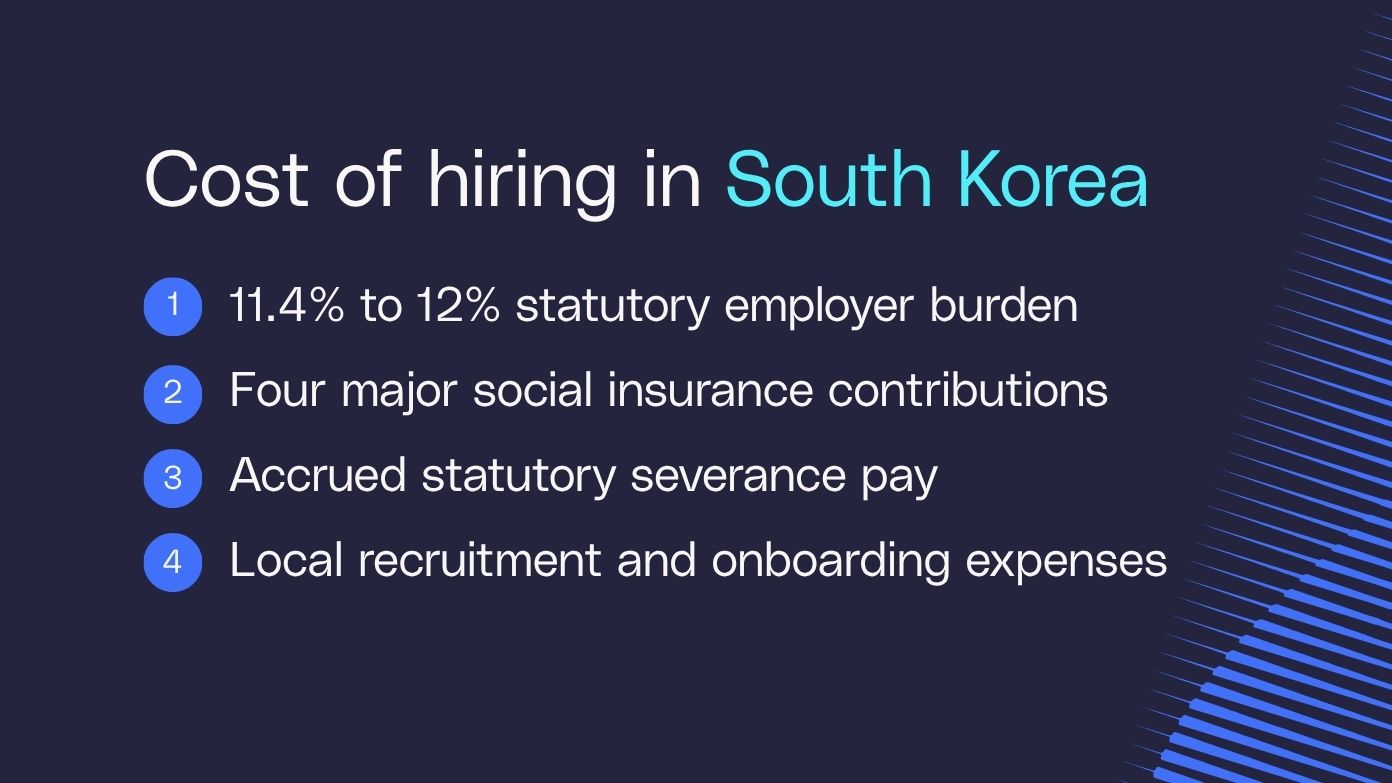
Cost of hiring an employee in South Korea
- Entity setup (unless you partner with an employer of record)
- Job advertisements
- Labor costs for applicant review
- Traveling to and from South Korea, including hotel stays, meals, and transportation (if applicable)
- Partnering with a translator to draft documents or facilitate conversations (if applicable)
- Drafting compliant employment contracts, legal review, and consultation with HR and legal experts
- Costs for providing computers, phones, and software licenses
- Expenses for onboarding materials and initial training
- Costs for maintaining required tax and payroll records and documentation
According to G-P Verified Sources from Gia, the total annual employer burden rate in South Korea, which includes costs triggered on top of salaries, is between 11.4-12%. This can be more in high-risk sectors due to the different compensation premiums.
What does a company need in order to hire employees in South Korea?
- Choose your method of incorporation.
- Develop a company seal.
- Open a bank account.
- Register your company.
- Register for social insurance.
- Select and open an office (if applicable).
- File rules of employment (if the workplace regularly employs 10 or more workers)
Setting up a subsidiary in South Korea can take weeks or months. Use an EOR in South Korea to hire employees without setting up your own entity. Build your team at a lower cost and with peace of mind that you’re doing so compliantly.
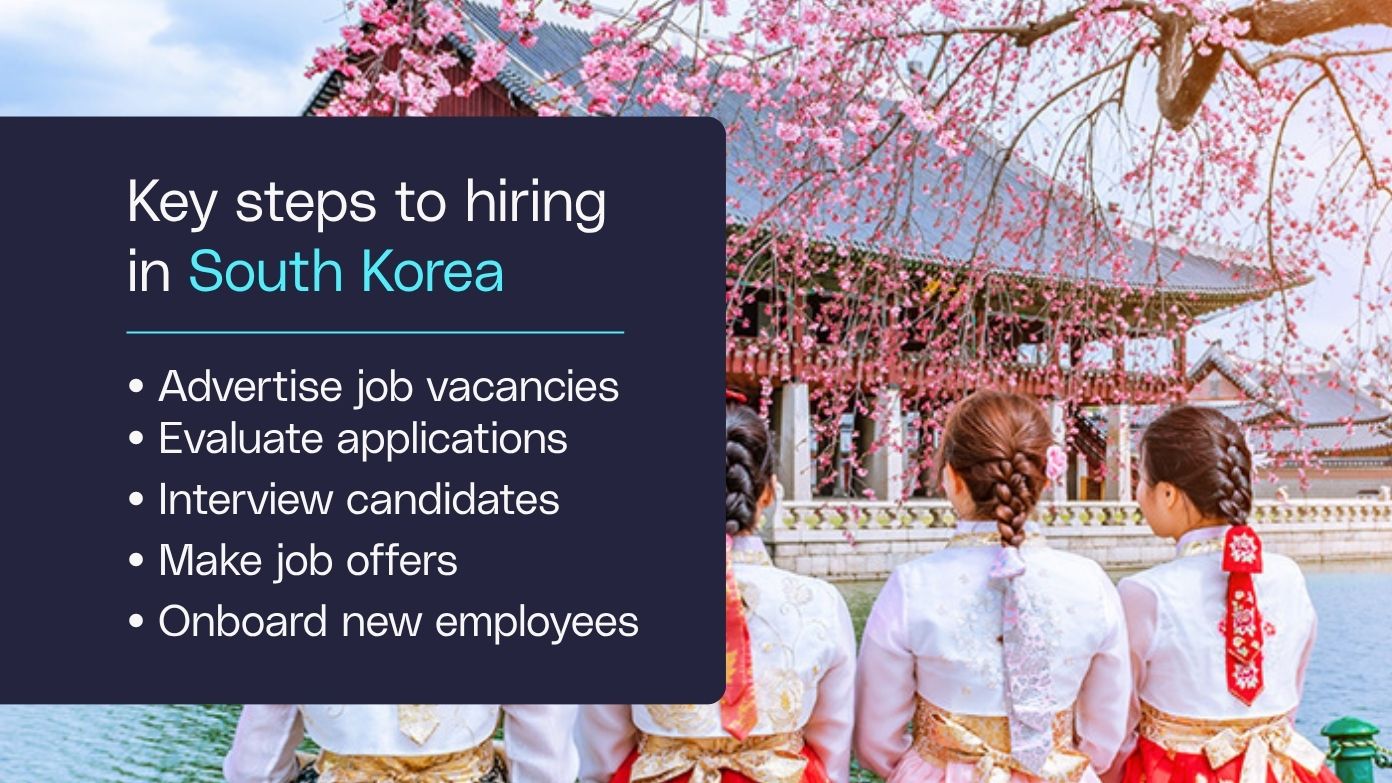
The steps to hiring in South Korea
The hiring process in South Korea is similar to the one you’re likely familiar with in your own country. Here are the five basic steps:
1. Advertise job openings
South Korea’s anti-discrimination laws like the Labor Standards Act and the Equal Employment Opportunity and Work-Family Balance Assistance Act protect job seekers during the hiring process. Employers can’t discriminate based on gender, age, nationality, religion, social status, marital status, pregnancy, disability, or employment status. Make sure job postings focus solely on job-related qualifications.
South Korea passed a blind hiring act that restricts the questions companies can ask in employment interviews. Prospective employers with 30+ employees must refrain from inquiring into the following topics or face penalties of up to KRW 5M:
- National origin
- Marital status
- Family members
- Property ownership status
- Physical appearance, including weight and height, unless relevant to the job duties
Popular job platforms include JOBKOREA and Saramin.
2. Evaluate applications
Screen applications and conduct interviews in compliance with anti-discrimination laws.
Employers must follow the Personal Information Protection Act (PIPA) and, where applicable, the Fair Hiring Procedure Act when handling applicant data.
Key requirements:
- Collect only job-relevant information.
- Give applicants a privacy notice explaining what data is collected, why it’s needed, how long it will be retained, and whether it will be shared.
- Obtain valid consent where required.
- Avoid collecting Korean resident registration numbers unless legislation specifically authorizes it.
- Limit background checks. Criminal, credit, health, and other sensitive checks require a clear, proportionate, job-related basis and appropriate authorization. General criminal-record checks aren’t routine.
- Restrict internal access to recruiters and decision-makers who genuinely need the information.
- Delete or return unsuccessful applicants’ documents after the recruitment purpose and required retention period end. The Fair Hiring Procedure Act also gives applicants rights concerning the return of certain submitted documents.
- Keep decisions job-related. Interview notes should document objective selection criteria rather than subjective or protected personal characteristics.
3. Interview candidates
Interview candidates who made it onto your shortlist. You can do these interviews in person or virtually. Use structured, non-discriminatory interview questions. Gia can help you create questions that follow anti-discrimination laws in South Korea, so you can find the best fit for the role while complying with local regulations.
4. Making job offers
Contact your chosen candidate to offer them a position with your company. The offer should clearly identify the employing entity, position, duties, work location, employment type, start date, compensation, working hours, probation period, benefits, and acceptance process.
Make sure to clearly distinguish guaranteed wages from discretionary bonuses, commissions, and equity.
5. Onboard new employees
Now you can onboard new employees. You can make the process easier by meeting these requirements:
- Verify work authorization before a non-national performs any work.
- Deliver the mandatory written employment contract before or at commencement.
- Include complete wage, hours, holiday, leave, workplace, and duties information.
- Add the required particulars for fixed-term and part-time employees.
- Register the employee for applicable social insurance and payroll withholding.
- Issue a compliant itemized payslip each payday.
- Apply PIPA controls to employee data.
- Provide applicable safety, workplace-policy, harassment, security, and role training.
- Avoid at-will or automatic probation-termination language.
With G-P EOR, you won’t have to worry about the administrative burden of onboarding. We’ll streamline the process, so you can focus on training your new hire and integrating them into your company culture.
Hiring independent contractors in South Korea
Hiring independent contractors in South Korea can be a cost-effective way to test the market and build a presence without the commitment of full-time employees.
Contractors based in South Korea understand local consumer behavior, rules, and business practices. They’ll be ready to start working quickly with their own equipment and established work processes.
Hiring contractors in South Korea allows you to easily adjust your workforce based on your business needs, without the complexities and costs of employment. Before you enter an agreement with an independent contractor in South Korea, consider the following:
1. Employees vs. independent contractors
It’s important to understand the difference between employees and independent contractors. In South Korea, the Labor Standards Act (LSA) governs employees. The LSA provides statutory protections and benefits to employees, including severance pay, paid leave, and social insurance enrollment. Contractors operate under the Civil Code.
Worker classification depends on the substance of the relationship. Authorities and courts consider factors such as:
- Control over work methods, hours, and location
- Ability to accept or refuse assignments
- Provision of tools and equipment
- Ability to delegate or subcontract
- Method of payment
- Financial risk and opportunity for profit
- Integration into the client’s business
- Exclusivity, continuity, and economic dependence
2. Penalties for misclassification
Classifying someone as a contractor when they’re not can lead to severe penalties. If misclassification occurs, you may need to:
- Pay backdated employee benefits, including social insurance contributions, severance pay, paid leave, and health insurance.
- Face administrative fines and tax penalties.
- Deal with reputational damage that can hurt your ability to attract talent.
3. How to pay contractors in South Korea
G-P Contractor™ takes away the messy, time-consuming process of hiring and paying international contractors. You can create and issue contracts and pay contractors with just a few clicks, all while ensuring a compliant process.
Hire employees and contractors in South Korea with G-P
Our Global Employment Platform and its AI-powered products — EOR, Contractor, and Gia — enable companies of all sizes to build and manage global teams.
G-P is the recognized leader in global employment with more than a decade of experience, the largest team of HR, legal, and compliance experts, and a global proprietary knowledge base.
Make your expansion to South Korea easier with G-P. Contact us or book a demo today.
 Frequently asked questions
What should employment contracts include in South Korea?
According to the Labor Standards Act, employers in South Korea must provide all employees with written employment contracts that detail:
Job duties and place of work
Wages, including components, calculation method, and payment timing
Contractual working hours, including start/end times and breaks
Holidays
Annual paid leave
What questions are prohibited during interviews?
To comply with anti-discrimination laws, avoid questions related to personal details such as gender, age, marital status, family background, and physical appearance, unless directly relevant to the job.
What is the minimum wage in South Korea?
As of Jan. 1, 2026, the national minimum wage in South Korea is KRW 10,320 per hour, equivalent to KRW 2,156,880 per month based on 209 hours.
What are the requirements for hiring international workers in South Korea?
All international workers must comply with the Employment Permit System and obtain the appropriate work visa, a Certificate for Confirmation of Visa Issuance (CCVI), and other documentation.
How should employers handle data privacy during recruitment?
Employers must follow the Personal Information Protection Act (PIPA) and, where applicable, the Fair Hiring Procedure Act when handling applicant data.