



Key takeaways
-
Federal structure, local rules: While federal laws (like the Labor Act and Code of Obligations) set baseline employment standards, specific tax rates, public holidays, and administrative processes vary across Switzerland’s 26 cantons.
-
Strict work permit rules for non-EU/EFTA talent: To hire employees in Switzerland from non-EU/EFTA workers, you’ve to demonstrate local labor market priority, hit strict national quotas, and get multi-tiered permit approval.
-
Employer burden rate runs 10%–20%: Beyond base salaries, employers have to budget for mandatory and customary contributions when you hire in Switzerland. This includes social security (AHV/IV/EO), unemployment insurance, occupational pensions (BVG), accident insurance, and 13th-month salaries.
-
Misclassification carries five year retroactive penalties: Misclassifying employees as contractors when hiring in Switzerland can trigger financial penalties, including five years of backdated employer and employee social security payments, plus interest.
Switzerland’s population of 8.9 million is a combination of Swiss, German, French, Italian, Portuguese, and Kosovo. Each canton uses the same national currency — the Swiss franc. Top sectors include finance and banking, medical equipment, and engineering.
Favorable corporate tax laws and cultural accessibility are two reasons many multinationals expand to Switzerland. Our guide will tell you everything you need to know about hiring in Switzerland.
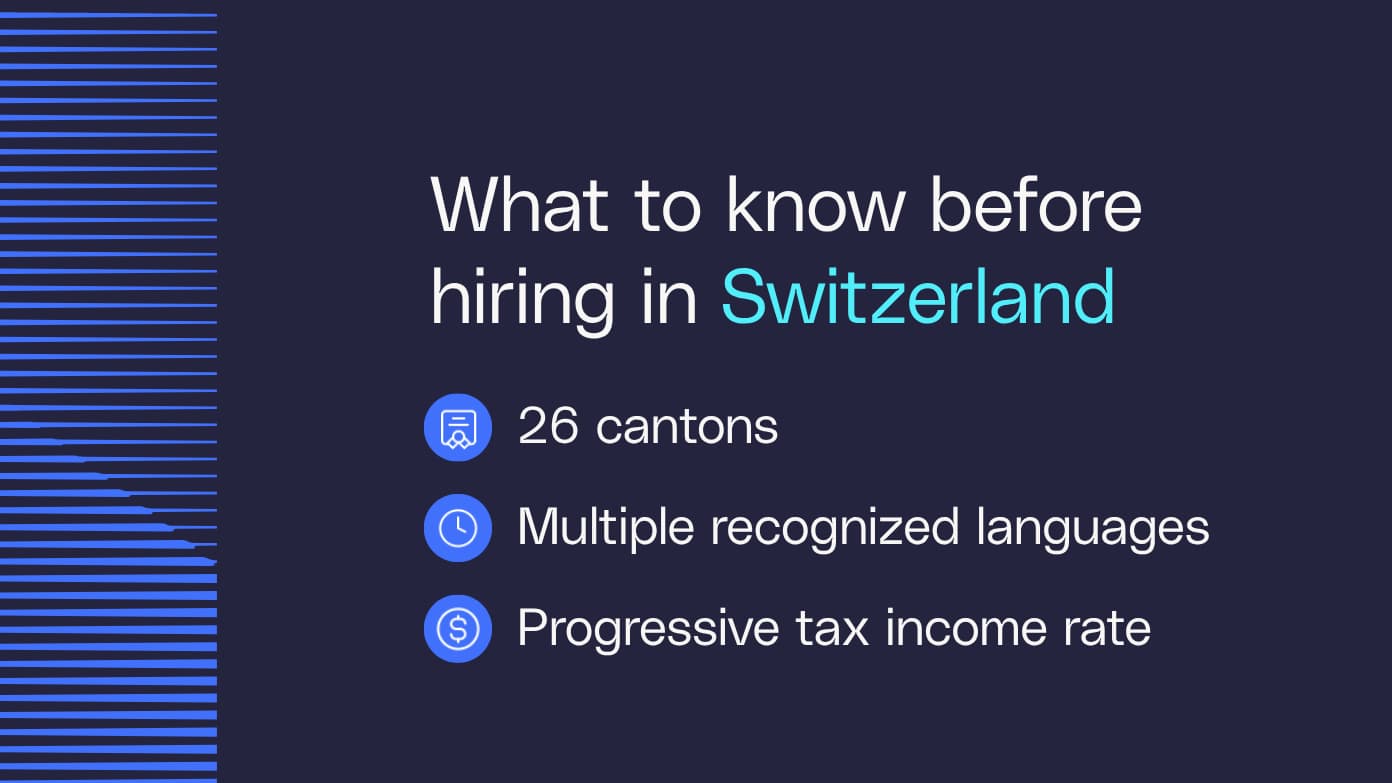
What to know before hiring in Switzerland
If you’re expanding your business into Switzerland for the first time, there are important legal requirements to be aware of. These norms and laws influence hiring practices in Switzerland.
If you’re unsure where to begin, G-P Gia™, our AI-powered global HR agent, can answer your toughest compliance questions across 50 countries — including Switzerland — and all 50 U.S. states. Reduce your reliance on outside counsel and cut the time and cost of compliance by up to 95% with Gia.
Let’s take a look at eight things to know about hiring in Switzerland.
1. Employer-employee statutes
All employer-employee relationships must abide by the following statutes:
-
SR 151.1 — The Federal Act on Gender Equality
-
SR 220 — The Code of Obligations
-
SR 822.11 — The Labor Act
-
SR 822.14 — The Workers’ Participation Act
-
SR 823.11 — The Federal Act on Employment Services and the Hiring of Services
-
SR 823.20 — The Posted Workers Act
Switzerland recognizes trade unions as long as they meet all legal requirements.
2. Cantons in Switzerland
Switzerland is divided into 26 cantons. Though they all fall under the Swiss national umbrella, they’re powerful entities on their own. Each canton has unique traditions and culture. They also have their own ways of self-governing, including laws, constitutions, and governmental structure.
When hiring employees in Switzerland, be aware of the canton you’re advertising your position in. Candidates’ canton-of-residency will give you insight into translation expectations, tax rates to include in your employment contracts, and considerations on which holidays they are entitled to.
Communes — smaller governmental bodies residing within each canton — determine how to hire in Switzerland.
3. The labor market in Switzerland
More than 5 million people are active in the Swiss labor market. The employment rate is 80.6%. For comparison, the EU rate is 75.8%. Workers are highly skilled and hold degrees from higher learning institutions. In terms of early childhood education and secondary schools, the Swiss education system varies between cantons. The IMD World Talent Ranking 2024 named Switzerland the #1 country for fostering homegrown talent in the world.
4. Languages in Switzerland
Multilingualism is a core component of Swiss culture, largely due to the Languages Act. This act recognizes German, French, Italian, and Romansh as national languages. German, French, and Italian are also the official languages of the Confederation. Romansh is used officially in communications with Romansh speakers. Roughly two-thirds of the country’s residents speak more than one language. Swiss children learn at least two of the national languages during their early education years.
Swiss-German is the most widely spoken across cantons. French is common in western cantons and Italian in the south. Romansh is a lesser-used language that derives from the Rhaetian people, early inhabitants of the Alps region. Some cantons and demographics also have their own dialects and colloquialisms.
All employment contracts, interviews, and assignments should consider the interviewee or employee’s first language. It’s good practice to have all documents translated and to hire an interpreter when necessary.
5. Working hours and time off
The Swiss Labor Act regulates working hours and time off laws. The maximum workweek is 45 hours for employees in industrial enterprises, office staff, technical personnel, and sales staff in large retail companies. For all other employees, it’s 50 hours. Daily working hours, including breaks and overtime, shouldn’t exceed 14 hours. In practice, the typical working time in Switzerland is 12.5 hours.
Overtime is only allowed under extraordinary circumstances. It must be compensated with a 25% wage premium or equivalent time off. Employees must have at least 11 consecutive hours of rest each day. This can be reduced to 8 hours once a week, as long as the average rest over two weeks is at least 11 hours. Workers get a continuous break of at least 35 hours each week, including Sunday.
Employees are entitled to three weeks of sick leave within the first year of employment with a company. Each canton has its own paid time off and sick leave restrictions.
Pregnant employees get 14 weeks of paid maternity leave, and fathers are entitled to two weeks of paternity leave.
Regardless of their canton, every employee gets four weeks of vacation time each year, or five if the employee is 20 or younger. Employees and employers can negotiate additional time off in their contracts if desired.
Cantons have their own local and public holidays. National Day on August 1 is the only federal holiday. If National Day falls on a Tuesday or Thursday, it’s common to give employees a long weekend. Switzerland also celebrates New Year’s Day, Easter, and Christmas Day, but specific regulations for those times vary between employers. Employees can choose extra salary instead of taking a paid holiday.
6. Employment contracts
Employees can be temporary, agency-supplied, part-time, or full-time. The first month of employment is considered the probationary period. You can extend this to a maximum of three months in your employment contract. If at any point you choose to end the working relationship, you must give at least a seven-day notice.
Employment contracts aren’t required but are common and highly recommended since some terms are only legally recognized if they’re in writing. Contracts are binding. Employers can’t go against the terms of the agreed-upon contract. Switzerland has several laws to protect trade unions and certain employees, like women or minors. Employers are required to have a written letter detailing the start date, job function, wage, and number of hours employees will work each week.
Indefinite contracts are common in Switzerland. “Chain” contracts are viewed unfavorably by Swiss courts. Chain contracts are a series of fixed-term contracts initiated back-to-back with the same employee. The practice can be considered an abuse of rights if used to circumvent the protections of permanent employment, such as job security and notice periods. Once the last day of the contract is finished, the employee-employer relationship is over, with no notice required.
You and your team member can agree upon an equal duration for giving a departure or termination notice. This notice shouldn’t be less than one month in the first year of employment, and two months for every length of employment up to nine years. Three months is customary beyond that. You can’t terminate employees if they’re pregnant, ill, or on maternity leave. You only need to pay severance if employees are 50 or older and have worked for you for 20+ years.
G-P EOR has an Employment Contact Generator to help you draft compliant employment contracts when you hire employees in Switzerland that meet all legal requirements and best practices.
7. Compensation and benefits
The Swiss Federal Act on Gender Equality (GEA) requires all companies with 100 or more employees to conduct an internal audit to ensure pay equality is enforced.
Switzerland doesn’t have a single federal minimum wage. Minimum pay obligations can come from cantons or municipalities, CBAs, or employment contracts for specific sectors. Otherwise, pay is set by contract and market practice. Employees are paid once at the end of the month.
Statutory overtime includes time worked over the maximum number of legal working hours. Statutory overtime is different from contractual overtime and is only permitted during day or evening shifts on workdays. It must be compensated with a wage supplement of at least 25%.
Employees can also choose time off instead of the wage increase. Statutory overtime should never exceed two hours per day and may never exceed 170 hours for 45-hour weeks or 140 hours for 50-hour workweeks. Some exceptions can be granted in emergencies.
Employers typically pay 80% — with a yearly limit — of an employee’s salary if they have suffered a work-related injury. The amount may differ depending on the industry or specific insurance plan. Employers are responsible for establishing a social security relationship between their employees and their canton’s social security office. Social security includes contributions to Maternity Leave Insurance (MSE), Disability Insurance (DI), Child Benefits Insurance (FZ), and pension, or Old Age and Survivors Insurance (OASI). Social security rates are 6.4% for the employer and 6.4% for the employee.
Bonuses and 13th-month salary are not required but are common. Employers may award bonuses contractually or at their discretion. Note that Switzerland has strict bonus guidelines for the financial industry. This is to prevent excessive risk-taking and ensure that compensation practices don’t undermine financial stability.
If an employee has been with your company for longer than three months, works at least eight hours each week, and meets income requirements, they can participate in an employer-sponsored pension fund. The current minimum for AHV pension is CHF 1,260. Employers are also responsible for accident insurance.
You can easily administer benefits plans with G-P EOR. Our in-house experts continuously monitor employment laws to meet country-specific regulations and norms. Build and manage benefits plans through our platform to provide a smooth employee experience.
8. Taxes
Switzerland's federal income tax rate is progressive, with a maximum rate of 11.5% for the highest income bracket. It's important to note that cantonal and municipal taxes also apply. This can greatly impact your total tax amount, depending on where you’re based. The federal VAT rate is 8.1%.
9. Equality, data privacy, and recruitment practices
Recruitment and employment practices have to comply with the Federal Gender Equality Act. This prevents direct and indirect gender-based discrimination across the employment lifecycle, including:
-
Hiring
-
Pay
-
Allocation of duties
-
Promotion
-
Training
-
Harassment
-
Dismissal.
Employers have to make sure equal pay for work of equal value. Objective, job-related criteria for recruitment, compensation, promotion, and termination decisions have to apply.
Employers with 100 or more employees in Switzerland need to do an internal equal pay analysis using a scientifically valid method. Analysis has to be independently verified and the results communicated to employees within the required timeframe. This is separate from the general equal pay obligation for all employers.
Candidate personal data has to be collected and processed in accordance with Swiss data protection requirements. This includes the Federal Act on Data Protection and the employment-specific limits in the Swiss Code of Obligations. Recruitment data has to be:
-
Limited to what’s necessary to assess suitability for the role
-
Handled transparently and securely
-
Kept only as long as needed.
Background checks can only be done when proportionate, job-relevant, and properly disclosed.
Hiring models for global companies in Switzerland
The best model when you decide to hire employees in Switzerland depends on your overall business goals.
| Model | Best for | Key points | Main risks |
|---|---|---|---|
| Direct employer registration | Hiring in Switzerland without a local entity. | Register with Swiss social security and tax authorities. Run Swiss payroll. Manage permits, benefits, and employment compliance. | High admin burden. Cantonal process differences. Risk of payroll, tax, or permit errors. |
| Employer of Record, like G-P EOR | Fast process to hire in Switzerland without setting up an entity. | EOR is the legal employer. Provider manages payroll, benefits, and contracts. Have to be properly licensed for staff leasing. | Unlicensed provider risk. Less direct control. Clients can still have workplace and supervision duties. |
| Subsidiary or branch | Long-term operations in Switzerland. | Creates a formal local presence. Supports direct hiring and local management. Best for larger or permanent teams. | Higher setup and maintenance cost. More corporate, tax, payroll, and HR compliance duties. |
| Independent contractor | Short-term, specialist, project-based work. | Contractors have to work independently. Use deliverable-based terms. Verify self-employed status where possible. | Misclassification risk. Back social security and tax exposure. Employment rights can apply retroactively. |
Top hiring hubs in Switzerland
Some Swiss cities are known for particular industries. Knowing what each city has to offer can help you channel your hiring efforts to the right place and fill roles faster when you hire in Switzerland.
The top talent hubs in Switzerland are:
-
Zurich is the largest city in Switzerland. Its main financial and business center is known for banking, technology, and professional services. Major banks like UBS, Julius Baer, and ZKB are located here.
-
Geneva is an international hub with many global non-profits and companies in finance and trade. It’s home to important international organizations like the United Nations European Headquarters, WHO, WTO, and the Red Cross.
-
Basel is famous for its pharmaceutical, chemical, and life sciences industries. It has a strong financial presence and is the headquarters for major companies like Roche and Novartis and many smaller biotech firms and research institutions.
-
Bern is a hub for government, administration, and service industries. Many federal government jobs and roles in healthcare, education, and manufacturing are based here.
-
Lausanne is known for education and technology. This French-speaking city excels in teaching and research related to life sciences, IT, and sports management.
Key industries in Switzerland
Understanding Switzerland’s main industries helps you benchmark salaries and benefits when hiring employees in Switzerland. You can use this insight to make smart choices about where to invest and grow your workforce.
The main industries in Switzerland include:
-
Financial services: Switzerland is well-known for its banking, insurance, and asset management. The country’s political stability, confidentiality laws, and expertise attract clients worldwide. Major global banks like UBS have their headquarters here. Specialist talent includes financial advisors, wealth planners, and investment analysts.
-
Pharmaceuticals and life sciences: Switzerland hosts many top pharmaceutical, biotechnology, and medical device companies. Global leaders such as Roche and Novartis are based there. The sector focuses on high-value products, such as vaccines, specialized drugs, and serums. Specialist talent includes R&D professionals, scientists, and engineers.
-
Machinery, precision instruments, and engineering: Switzerland leads the world in high-precision machinery, watches, and instruments. Specialist talent includes various engineering positions like mechanical, electrical, and manufacturing engineers.
-
Information technology and communications: Switzerland is a leader in blockchain technology and cryptocurrency, attracting startups and established decentralized finance companies. Specialist talent includes software developers, data scientists, and cloud architects.
-
Chemicals: The chemical industry features major companies in the aroma and fragrance sector, such as Givaudan and DSM-Firmenich. Specialist talent includes R&D professionals, engineers, and scientists.
Cost of hiring an employee in Switzerland
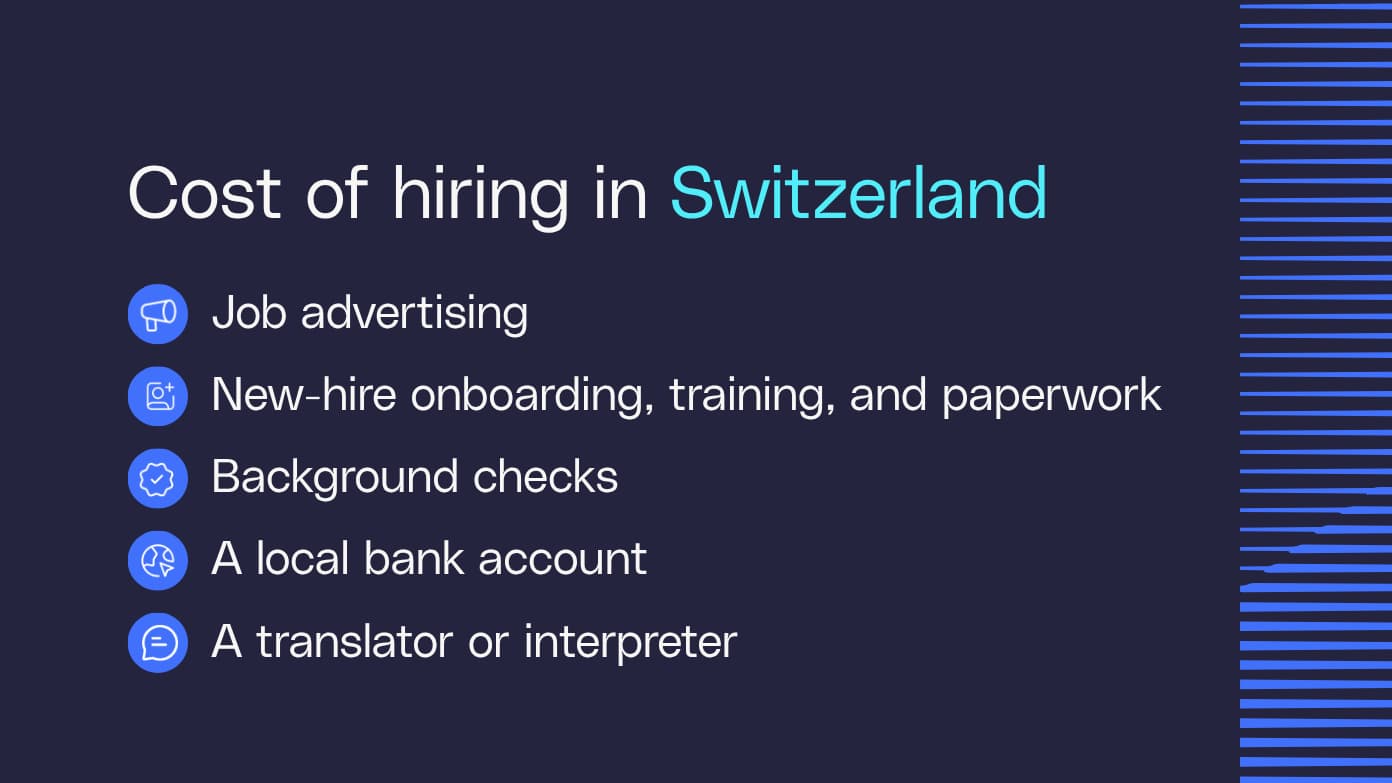
Whether you’re hiring one employee or an entire team, the process of hiring in Switzerland comes with inevitable expenses.
Budget for the following:
-
Job advertising
-
Onboarding, training, and paperwork
-
Applicant tracking software
-
Background checks
-
Any special equipment for employees
-
A translator or interpreter (if applicable)
-
Travel expenses for traveling to and from Switzerland, if necessary
-
AHV/IV/EO
-
Unemployment insurance
-
Occupational accident insurance
-
Family allowance contributions
-
Sickness daily allowance insurance
-
Employee vacation entitlement
-
Employee paid time off and sick time entitlement
According to Gia, the total annual employer burden rate in Switzerland, which includes costs triggered on top of salaries, is between 10% and 20% of gross salary. Rates will depend on the employee’s salary, industry, and canton. Gia leverages G-P’s 13+ years of global employment experience, along with insights from almost a million real-world scenarios, to provide accurate, up-to-date employment law information.
What does a company need to hire in Switzerland?
EU/EFTA vs. non-EU/EFTA workers
Thanks to the Agreement on the Free Movement of Persons (AFMP), hiring citizens from EU/EFTA member states involves few administrative hurdles. Employers don’t need to give priority to local Swiss workers or justify why an EU/EFTA candidate was selected. For short-term contracts (up to 90 days per calendar year), companies only need to submit an online notification before the employee begins work. For longer arrangements, the employee registers with their local Swiss commune of residence to get a residence/work permit (such as an L or B permit). This gives them immediate access to the Swiss labor market.
Non-EU/EFTA nationals
Hiring candidates from non-EU/EFTA countries (including the UK and U.S.) is more regulated. Under the Federal Act on Foreign Nationals and Integration (FNIA), employers have to prove that local recruitment efforts failed. Non-EU/EFTA permits are restricted almost exclusively to personnel like managers, senior specialists, or university graduates with specialized experience.
Permit quotas and administrative timeline
The Swiss government has a strict annual national quota on work permits for non-EU/EFTA nationals. The work permit needs a multi-tiered approval process involving cantonal labor authorities and the State Secretariat for Migration (SEM). Employers have to start the permit application in advance. The employee can’t begin work until formal authorization.
It’s in your best interest to establish a relationship with a canton’s local economic offices or embassy. You don’t need a legal entity to hire in Switzerland, but if you choose to start a Swiss company, you can choose between:
-
A single-owner sole proprietorship
-
A general partnership
-
A limited partnership
-
A corporation or joint-stock company
-
A limited liability company
-
A subsidiary
-
A local branch
Branches are a common route for international companies, and require you to pay local taxes and maintain at least one Swiss resident with legal authority. You must have all legal documentation, contracts, and established financial accounts prepared.
Hire employees in Switzerland without setting up your own entity with G-P EOR. Build your team in Switzerland at a lower cost and with peace of mind that you’re complying with each canton’s unique requirements.
Steps to hiring in Switzerland
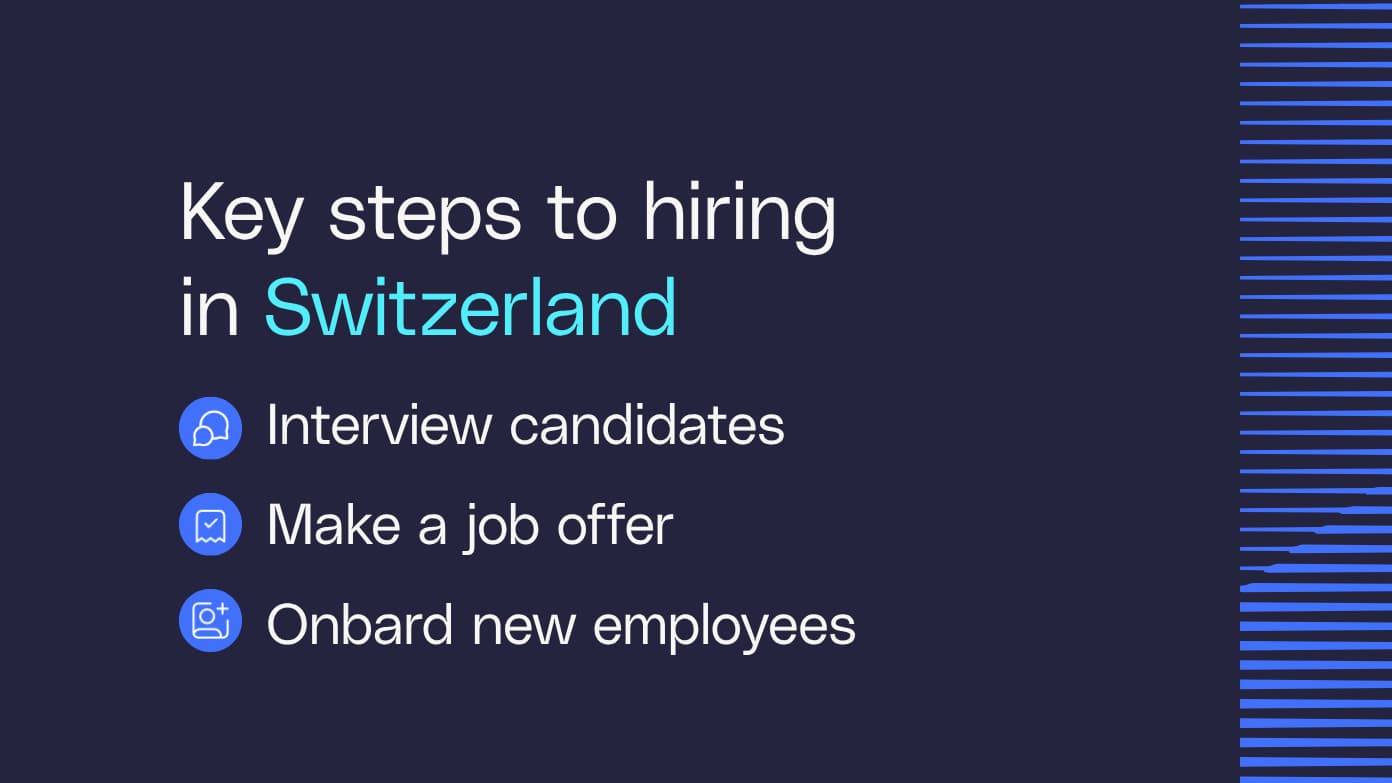
The process of hiring in Switzerland follows five basic steps: advertising the job, evaluating applications, interviewing candidates, sending job offers, and onboarding new employees.
1. Advertise job vacancies
First, create a detailed job description. Define the role, responsibilities, and qualifications you need. For certain professions with higher unemployment rates, employers are legally required to notify the cantonal employment offices of vacancies before advertising them publicly. This ensures priority access for registered job seekers and compliance with the Federal Act on Employment Services.
2. Evaluate applications
Once job seekers apply for your new positions, you can evaluate their applications and determine which candidates are the best fit for the position. Swiss law prohibits discrimination based on gender, age, origin, race, religion, disability, sexual orientation, or other protected characteristics at all stages of recruitment. This is outlined in the Swiss Federal Constitution and the Gender Equality Act.
Double-check that job advertisements, selection criteria, and interview questions are free from bias.
3. Interview candidates
Next, interview candidates who made it onto your shortlist. Use job-relevant selection criteria and structured interviews to ensure fairness and consistency. Gia can help you create interview questions that follow anti-discrimination laws when hiring employees in Switzerland, so you can find the best fit for the role while complying with local regulations.
It’s best practice to keep documentation of the recruitment process, including interview notes and selection decisions, for at least five years.
4. Make job offers
Now it’s time to notify your chosen candidate. Draft a written employment contract that complies with Swiss labor law. The contract should include essential terms such as job title, duties, salary, working hours, notice periods, and any applicable Collective Bargaining Agreements (CBAs).
5. Onboard new employees
Register the new employee with the Swiss social security system (AHV/AVS), accident insurance, pension fund (BVG/LPP), and, if applicable, with relevant tax authorities. Set up payroll to ensure correct salary payments, deductions for social security, pension contributions, and taxes.
Hiring contractors in Switzerland
Working with independent contractors in Switzerland can be a cost-effective way to test the market and build a presence without the commitment of full-time employees. Contractors based in Switzerland understand local consumer behavior, rules, and business practices. They’ll be ready to start working quickly with their own equipment and established work processes.
Hiring contractors allows you to easily adjust your workforce based on your business needs, without the complexities and costs of employment.
Before you enter an agreement with an independent contractor in Switzerland, consider the following:
1. Employees vs. independent contractors
It’s important to understand the difference between employees and independent contractors. In Switzerland, employment contracts for employees often include exclusivity clauses and specify working hours, location, and duties. Services agreements for contractors focus on deliverables and outcomes, emphasizing the worker’s autonomy and independence.
Companies hire employees to do work and, in return, pay them a regular salary or wage. Contractors must arrange their own social security and retirement plans. Unlike employees, contractors set their schedules, use their own equipment, and work on specific projects, rather than having an ongoing role.
2. Penalties for misclassification
Classifying someone as a contractor when they’re not can lead to severe penalties. If misclassification occurs during your efforts of hiring in Switzerland, you may need to:
-
Pay both the employer's and employee's share of social security contributions retroactively for up to five years. This includes contributions to Old Age and Survivors’ Insurance (OASI), disability insurance, and unemployment insurance.
-
Pay interest charges and penalties calculated based on the amount owed and the duration of the delay.
-
Face conduct audits and compliance reviews from Swiss authorities, such as the State Secretariat for Economic Affairs (SECO), which can lead to further enforcement actions if misclassification is detected.
3. How to pay contractors in Switzerland
G-P Contractor™ takes away the messy, time-consuming process of hiring and paying international contractors. You can create and issue contracts and pay contractors with just a few clicks, all while ensuring a compliant process.
Hire employees and contractors in Switzerland with G-P
Our SaaS and AI-powered products – EOR, Contractor, and Gia – help companies of all sizes build and manage global teams.
With more than a decade of experience, the largest team of HR, legal, and compliance experts, and a global proprietary knowledge base, G-P is the recognized leader in global employment when you need to hire employees in Switzerland.
Make your expansion to Switzerland easier with G-P. Contact us or book a demo today.