







Key takeaways
- Expansion path: Companies can use an EOR for eligible hires to test the market before setting up a company in Singapore. Work-pass and direct-employer requirements should be reviewed carefully.
- Ownership and governance: Singapore permits 100% foreign shareholding but a company has to have at least one director who lives in Singapore.
- Attractive tax regime: Entities benefit from a flat 17% headline corporate tax rate, three-year tax exemption schemes for startups, and access to over 80 double taxation agreements (DTAs).
- Speed to market: Local incorporation can be completed within a few business days for straightforward cases. An EOR can help accelerate onboarding for eligible local talent.
Singapore ranks among the top countries for doing business. It welcomes international companies with open policies and clear regulations.
Growing your business in Singapore gives you access to a skilled workforce, global connectivity, competitive taxation, and Southeast Asia's markets. This makes Singapore a top choice for business expansion. Here's how to set up a company in Singapore.
Key considerations before expanding
Before you expand into Singapore, consider:
- Workforce skills and availability: Assess talent availability in Singapore relevant to your industry. Research the costs associated with attracting and retaining qualified employees.
- Cost of doing business: Evaluate corporate tax rates, employment costs, and property expenses.
- Market entry strategy: While setting up a company in Singapore offers long-term benefits, using an employer of record (EOR) can minimize initial investment and administrative burdens. Partnering with an EOR is a good way to test the market before committing to an entity.
If you're not sure where to start, G-P Gia™, our AI-powered global HR agent, can answer your toughest compliance questions across 50 countries — including Singapore — and all 50 U.S. states.
Get the jurisdiction-specific guidance you need to expand to Singapore with confidence.
Two ways to set up a company in Singapore
There are two main approaches to setting up a company in Singapore — establish a local entity or use an EOR. Both let you hire a local team with legal and tax trade-offs.
Local entity
Here's what you can expect from a traditional entity setup:
- Legal considerations: You’ll need at least one local resident director (Citizen, PR, or eligible pass holder) to incorporate. Global individuals or companies can generally own up to 100% of the shares, subject to sector-specific restrictions. The headline corporate tax is 17%.
- Operational needs: You must maintain a legally registered office and appoint a qualified company secretary. Other requirements include keeping and updating statutory records, filing annual returns and annual general meeting, preparing financial statements, and meeting audit and accounting obligations.
- Payroll and benefits: You must pay Central Provident Fund (CPF) contributions for Singapore citizens and permanent residents and file taxes to meet employment law obligations.
A traditional entity setup lets you open corporate bank accounts in your company name. Your business may also qualify for government grants available only to registered Singapore entities with local equity. However, you’ll have to manage the setup process and running costs, including payroll, local director services, and accounting.
Compliance requirements after incorporation in Singapore
After incorporation, you’ll need to manage ongoing compliance to keep your company in good standing. Key post-incorporation responsibilities include:
- Maintain statutory records: Keep updated registers and company records (such as shareholding and director-related information) and make sure they reflect any changes.
- File annual returns: Submit filings to Accounting and Corporate Regulatory Authority (ACRA) on time to confirm your company’s current details.
- Hold annual general meeting (AGM): Hold an AGM and document resolutions properly (if your company type requires it).
- Prepare financial statements: Keep proper accounting records and prepare financial statements in line with Singapore requirements.
- Audit and tax compliance: Schedule audits where applicable and meet corporate tax filing obligations with the Inland Revenue Authority of Singapore (IRAS).
- Director and governance upkeep: Make sure your director information stays accurate and compliant.
- Employment compliance (if you hire locally): Register as an employer where needed, manage payroll, and meet obligations such as CPF contributions.
- License renewals and industry approvals: If your business operates under specific licenses, track renewal dates and ongoing conditions to avoid interruptions.
EOR
The second option is partnering with an EOR in Singapore. The EOR acts as the legal employer on your behalf and allows you to operate legally without needing to set up a company in Singapore directly. You can hire quickly, avoid incorporation costs, and reduce compliance risk. The EOR handles:
- Payroll
- Tax withholding
- Statutory benefits
- Employment contracts
- Local HR administration
- Termination processes
G-P EOR eliminates the cost, complexity, and risk of global employment. Onboard and hire new team members in days instead of weeks. Backed by over a decade of HR, legal, and compliance expertise, G-P EOR delivers the speed, confidence, and competitive edge you need to expand anywhere with ease.
Can foreigners set up a company in Singapore?
Yes. Foreign individuals and companies can set up a Singapore company if they meet Singapore’s incorporation requirements. At least one director has to live in Singapore. This can include:
- a Singapore citizen
- a Singapore permanent resident
- an eligible pass holder who meets the applicable requirements.
If all founders or shareholders are foreign or non-resident, the company will need a qualifying Singapore-resident director.
Singapore allows foreign individuals and corporate entities to hold shares in a company, depending on the company type and any applicable conditions. The key is to confirm your intended ownership and board structure early so your incorporation application fits with the director and shareholder qualification rules from the start.
Business structure and compliance for small companies
Choosing the right business structure directly impacts your future compliance responsibilities. For example, a private limited company (Pte. Ltd.) is a separate legal entity. This can be a strong fit for long-term operations. But it comes with ongoing requirements such as keeping statutory records, filing annual returns, and meeting accounting and tax obligations.
To test the market before full incorporation, some companies use an EOR for eligible hires in Singapore. This can reduce early administrative burden while you confirm demand.
Whatever structure best matches with your goals and budget, you’ll need to stay on top of the needed compliance and recordkeeping.
Types of business entities in Singapore
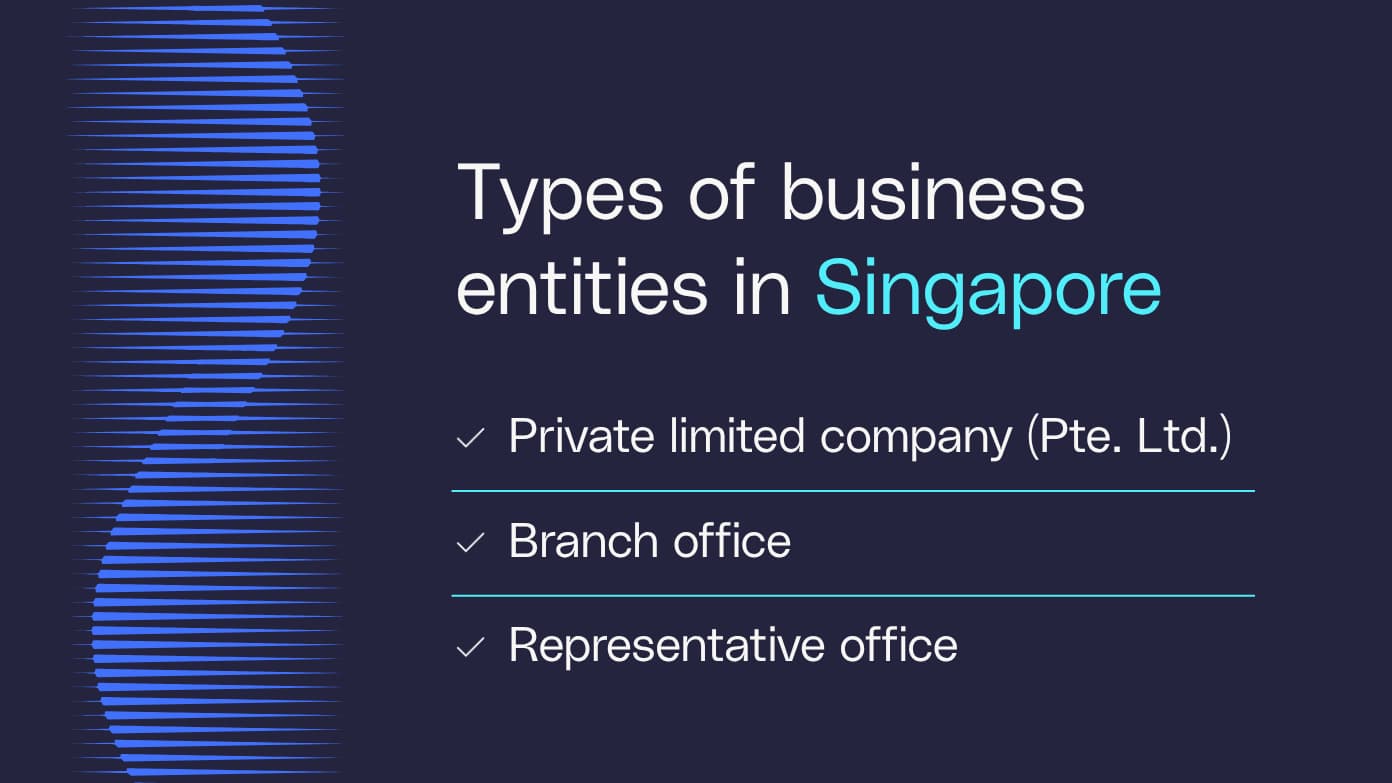
The business structure you choose affects liability, taxes, compliance, and operations. There are three common options for international companies setting up a company in Singapore:
- Private limited company (Pte. Ltd.): As a separate legal entity, a Pte. Ltd. limits stakeholders' investment liability. You have full ownership and pay corporate tax on profits in Singapore — new startups may qualify for a tax exemption. This structure suits long-term operations and companies wanting local credibility, such as a tech firm establishing a development hub. International companies often set up a Pte. Ltd. company as a subsidiary to gain local benefits and incentives.
- Branch office: A branch office is an extension of a parent company, not a separate legal entity. Branch offices pay tax on local income and are a good option for companies expanding sales or services without creating a new entity. You must register with the ACRA and operate under the parent company’s name. As a nonresident entity, branch offices may not qualify for tax exemptions and benefits. You must appoint at least one citizen of Singapore as an authorized representative of your company.
- Representative office: A representative office is a temporary setup (typically up to three years) used only for market research or study.. It’s not a legal entity and can’t engage in profit-generating activities or sign contracts. This structure works for businesses exploring the market, such as a manufacturing firm studying local demand.
| Feature | Pte. Ltd. | Branch office | Representative office |
|---|---|---|---|
| Legal status | Separate legal entity | Extension of the parent company | Not a legal entity |
| Liability | Shareholders have limited liability | Parent company is liable | Parent company is liable |
| Taxation | Corporate tax on local profits. Eligible for local tax exemptions | Corporate tax on local profits. Not eligible for local tax exemptions | Not taxable/no revenue |
| Operational scope | Full business activities | Same as the parent business | Market research and study purposes only |
| Industry suitability | Any sector | Regulated and nonregulated | All sectors for research use |
| Compliance | Must file annual returns | Must file branch accounts | Must renew yearly |
What do you need for business formation in Singapore?
There are a few legal steps to set up a company in Singapore.
1. Reserve your company name and registered address
Reserve your unique company name on BizFile+. This is the electronic filing and information retrieval system for the Accounting and Corporate Regulatory Authority (ACRA). Your name must be unique. It can’t be obscene, offensive, or prohibited by the Minister for Finance.
After the name is approved, it'll be reserved for 120 days. If you don't register and incorporate your company within that time frame, the registration expires, and the name becomes available for other entities to use.
You must establish your company’s legal location in Singapore. A registered Office Address (which must be a physical address) is a mandatory requirement for registration with ACRA, and you must demonstrate your legal right to do business at that address. Registration with ACRA may not be lodged without this critical piece of information.
2. Formalize your incorporation
Choose a company structure to incorporate, which can be either private or public. Most company types have limited liability for shareholders, meaning liability is limited to the capital invested.
- Exempt Private Company (EPC): EPCs are the most common company type. They can have up to 20 shareholders, but no shareholder can be a corporate entity.
- Private Company Limited by Shares: This type can have up to 50 shareholders, and they can include corporate entities.
- Public company limited by shares: Can have more than 50 shareholders. This type must register with the Monetary Authority of Singapore (MAS) before going public.
- Public company limited by guarantee: This type is used for non-profits or charitable organizations. It has no official shareholders since it has no share capital; members act as guarantors
Companies may also be unlimited, meaning shareholders are personally liable for all debts and losses the company incurs. Unlimited companies can be private, exempt private, or public.
3. Submit your registration with BizFile+
File the incorporation application through BizFile+. All business partners must indicate their consent to register the company. Some companies choose legal or accounting experts to handle registration for them. A law firm, accounting firm, or corporate secretarial firm can submit the paperwork on your behalf to save time and ensure regulatory compliance.
As of 2025, the fee for a name application is SGD 15, and registering a new business entity costs SGD 300. When the process is approved, you get an official certificate of incorporation.
4. Get your unique entity number (UEN)
Singapore businesses get a randomly assigned UEN to use for transactions with government agencies, including tax filing, contracts, and invoices. Businesses have the option to purchase a Special UEN (SUN), which offers an easy-to-identify and memorable number; however, SUNs are available at a higher cost.
5. Download your ACRA business profile
After your business registration is complete, download your business profile from BizFile+. This essential document provides key company details, including your UEN, registered address, directors, shareholders, and share capital. It is required for critical steps such as opening a bank account, license applications and due diligence checks.
6. Open a bank account
The next essential step is to set up a corporate account with an institution that has full bank status in Singapore, to facilitate legal business transactions. You will typically need to provide the following documentation:
- Completed and signed bank account application forms.
- Proof of residential addresses for directors, signatories, and ultimate beneficiary owners.
- Certified copy of your business profile from ACRA.
- Official certificate of incorporation.
- Certified copy of the Company’s Constitution (formerly known as the Memorandum and Articles of Association.
- Resolution from the board of directors authorizing the account opening.
- Certified copies of directors' passports or SingPasses.
- Official certificates of incumbency and good standing for offshore accounts (required primarily for corporate shareholders of offshore entities).
7. Get a CorpPass
CorpPass is the official corporate digital identity that allows you to perform transactions like filing taxes, applying for licenses, and interacting with the Singaporean government.
Your company must appoint a CorpPass administrator to set up the account and manage access for functions like CPF submission, license applications, and tax filing. The steps are slightly different depending on whether you have a local UEN or you're an international entity, such as a foreign branch office.
8. Apply for licenses and approvals
All companies must check for licenses, as certain industries need special business licenses and approvals to legally operate in Singapore. For example, if you own a food service business, you might need a food shop license, food stall license, liquor license, or halal certificate. Use the GoBusiness Licensing portal to check what you need. Be sure to submit your applications early, as processing times can vary.
9. Sign up for CPF contributions
As a Singapore employer, you are legally required to contribute to the Central Provident Fund (CPF) on behalf of all eligible employees every month. You must complete this step before you begin recruiting and hiring any local staff.
This application is typically done online, using your UEN and CorpPass information. When your application is approved, you get a CPF submission number (CSN), an Application for a General Interbank Recurring Order (GIRO), and payment advice through Form CPF91.
How long does it take to set up a company in Singapore?
A Singapore private limited company can be set up within 1–3 business days once all required information and documents are ready. The online ACRA process depends on:
- name approval
- complete director/shareholder details
- a Singapore registered address
- required consents.
It can take longer if:
- the proposed company name needs review by another authority
- the structure involves foreign shareholders or complex ownership
- due diligence by a corporate service provider or bank takes extra time.
Opening a bank account is separate and can add additional days or weeks.
Tax benefits of incorporating in Singapore
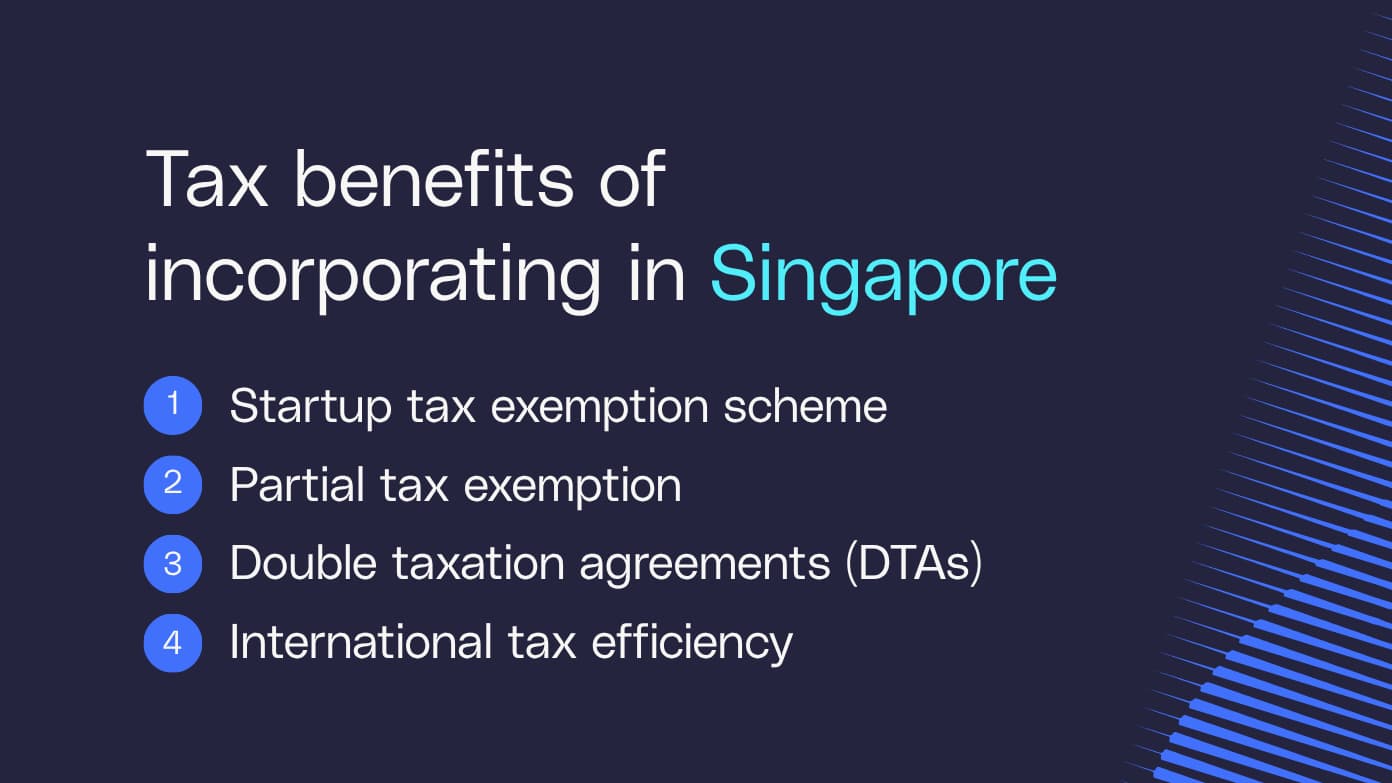
Singapore encourages new business formation and international expansion with competitive tax policies.
- Startup tax-exemption scheme: New companies may qualify for a three-year partial startup tax exemption if they're a tax resident in Singapore, have 20 or fewer shareholders, and meet specific ownership requirements.
- Partial tax exemption: Companies are eligible for partial tax exemption on a portion of their normal taxable income, which lowers the effective corporate tax rate. This scheme is usually claimed by companies that do not qualify for the Startup tax-exemption scheme or have passed its three-year eligibility period.
- Double taxation agreements (DTAs): Singapore has DTAs with over 80 jurisdictions, preventing the same income from being taxed twice. These agreements may also eliminate or reduce withholding taxes on cross-border dividends, interest, and royalties.
- International tax efficiency: Companies often use Singapore's DTA network, single-tier tax system, and lack of capital gains tax to structure operations. Tax residency certificates from the Inland Revenue Authority of Singapore are often needed to claim benefits under a DTA.
Simplify company setup in Singapore with G-P™
As the recognized leader in global employment, G-P helps companies of all sizes hire, onboard, and manage international teams in 180+ countries, regardless of entity status. Our AI-powered global employment products and EOR solutions are backed by the largest team of in-country HR, legal, and compliance experts to streamline the entire global employment lifecycle.
Contact us today to learn how to set up a company in Singapore or simplify your expansion into other international locations.

Is Singapore a good country to start a business?
Yes. Singapore is a leading global business hub. The country offers a stable regulatory environment, efficient company registration, strong legal protections, and a pro-business tax regime. Its strategic location and advanced infrastructure make it attractive for local and international businesses.
What are the most popular industries in Singapore?
The country's top industries include financial services, information technology, logistics and supply chain, biomedical sciences, advanced manufacturing, tourism and hospitality, and professional services.
Is it easy to set up a company in Singapore?
Yes. Most companies can incorporate online through ACRA within a few business days if their documentation is in order. The absolute fastest and easiest option is partnering with an EOR such as G-P. You can bypass entity setup, and we’ll handle compliance, payroll, and HR administration on your behalf.
How much does it cost to set up a subsidiary in Singapore?
As of 2025, it costs SGD 15 to apply for a business name and SGD 300 to register a new business entity. The minimum issued share capital is SGD 1. Some industries or business activities may need more capital.
What are the other business startup costs in Singapore?
Other startup costs to consider are your physical office, professional service fees, and special licenses or permits.
Can non-nationals start a company in Singapore?
Yes. Non-nationals can own 100% of a Singapore company. However, at least one director must be a local resident in Singapore — citizen, permanent resident, or Employment Pass holder. Non-nationals often appoint a local director or use a nominee service to meet this requirement.
How long does it take to register a company in Singapore?
Company registration is typically completed within 1-2 business days if all documents are in order and there aren't any regulatory complications. If you need to hire immediately, G-P can onboard employees in Singapore in a matter of minutes.
Do I need special permits and licenses to operate in Singapore?
It depends on the industry. Some business activities need extra permits or licenses, such as food and beverage, financial services, education, healthcare, and employment agencies. You can use the GoBusiness Licensing portal to check what you need. Gia can also help you check compliance requirements and provide up-to-date information.
What taxes do I have to pay in Singapore?
Companies pay a flat corporate income tax rate of 17% on chargeable income, meaning income sourced or received in Singapore, unless you have an exemption. There's no capital gains tax. Goods and Services Tax applies if your annual turnover exceeds SGD 1M. Employers must also make CPF contributions for Singapore citizens and permanent residents. Other taxes may apply depending on your business activities.