






Key takeaways
- Balance growth with financial discipline: Expanding internationally gives your midsize business access to talent and new customers, but success will depend on demand and your upfront costs.
- Choose a market entry strategy: An employer of record (EOR) lets you hire international professionals without establishing a local entity in every country.
- Manage compliance before hiring: Pay attention to local employment laws, payroll obligations, and worker classification rules before your first hire.
- Build systems that allow you to grow: Scale your business efficiently with centralized data and integrated HR technology.
Expanding your business will give you access to international talent, open new revenue opportunities, and reduce dependence on a single country. However, expanding your midsize business requires a different approach from starting a small business or growing a multinational corporation. You must balance speed, regulatory compliance, and capital efficiency. You also need to manage employment laws, taxes, and payroll across borders.
The most effective strategies for expanding internationally combine financial planning, compliant hiring, and centralized technology. With the right infrastructure, like an EOR, you can build an efficient international team and test new markets, all while maintaining control over costs.
Why midsize businesses face unique global expansion hurdles
Learning how to expand your small business starts with low-commitment exports, selling through digital channels, or working with independent contractors.
A growing midsize business, though, is more complex. You need a formal operational scale, such as repeatable hiring processes, consistent compliance guidelines, and reliable payroll. This complexity comes into play because you don’t have the dedicated legal departments or capital reserves of multinational conglomerates.
Here are three specific risks:
- Capital lockup: Establishing a subsidiary involves accounting systems, registration fees, legal support, and a dedicated HR team. A traditional entity setup can cost USD 50,000–250,000 upfront, depending on the market and business requirements.
- Regulatory delays: Forming a local entity, registrations, banking, and employment setup can take 3-12 months per country. These delays can prevent you from hiring immediately.
- Operational drag: Managing employment contracts, taxes, payroll, and benefit providers across different countries increases administrative work. Your HR and finance teams will spend more time coordinating systems across countries than supporting the company’s expansion.
For additional tips, explore our tips for corporations expanding internationally.
How to assess organizational readiness and balance sheet health
Successful strategies for expanding internationally start with an honest assessment of your company's current position. Before your midsize business expands into a new country, review these four areas.
Evaluate market demand and competitive whitespace
Analyze local consumer spending data and purchasing behavior rather than making assumptions about market size. Identify fragmented markets where local competitors have slow service, outdated technology, or limited product offerings. These gaps create opportunities for your business.
Continue your research with distributor conversations, customer interviews, and small-scale sales initiatives. Review your local pricing and buying expectations before committing fully. Then, focus on a market where your business can solve a customer problem, and you can compete effectively.
Audit operational bandwidth and supply chains
Expanding internationally puts pressure on existing domestic systems. Before adding new markets, confirm that your back-office systems, such as HR, customer support, and supply chain systems, can handle the additional operational complexity.
Identify processes that still depend on manual spreadsheets or individual employees. If you are a service-based company, make sure your technology can support customers across time zones and languages. Assign teams for market entry, financial reporting, compliance, and hiring before expanding.
Model foreign exchange volatility and receivables terms
When exchange rates fluctuate, it affects profit margins, revenue, payroll expenses, and supplier payments. Build financial forecasts that account for details like exchange rate changes, delayed commercial invoicing terms, and late customer payments. For example, a customer who pays an invoice after 60 days creates a different cash flow from one who pays within 30 days.
Create different scenarios, such as slower collections or weaker local demand. Your goal is to maintain enough liquidity to support an international expansion.
Access structured export financing programs
You don’t need to finance every step of your expansion with new equity or your profit margins. Government-backed export agencies and development institutions offer non-dilutive financing and trade credit insurance. These programs can help protect your domestic cash reserves and reduce the financial impact of any delayed customer payments or currency fluctuations.
For example, Export Development Canada offers direct lending solutions for eligible businesses and international transactions. Explore comparable programs in your local market and review eligibility and repayment obligations.
Core strategies for expanding internationally without local entities
Choosing the right market entry model is one of the most important strategies for expanding internationally. Traditional approaches include joint ventures, licensing, and direct incorporation.
What is a joint venture?
A joint venture means you share resources and market knowledge with a local partner. Licensing lets another company sell or distribute your products in exchange for royalties or licensing fees. And direct incorporation involves setting up a legal entity in that country. It gives you greater control but comes with costs and administrative obligations. Review these international market entry strategies when comparing your options. If you’re evaluating how to expand globally, an employer of record offers another route.
What is an employer of record?
An employer of record (EOR) lets you hire international employees without setting up a local entity. The EOR manages localized employment contracts, statutory benefits, payroll taxes, and employment compliance. With employer of record solutions from G-P, you can hire and manage professionals in 180+ countries without establishing local legal entities. G-P EOR also creates compliant employment contracts within minutes. This centralized model helps you enter new markets quickly and seamlessly.
Direct subsidiary vs. G-P EOR infrastructure
|
Factor |
Direct subsidiary |
G-P EOR |
|---|---|---|
|
Setup timeline |
3-12 months on average |
Generate compliant contracts in seconds and onboard professionals in minutes. |
|
Upfront capital |
Entity setup costs roughly USD 50,000–250,000 upfront |
No local entity setup required; platform pricing starts at USD 599 per professional per month |
|
Annual administration |
Approximately USD 25,000–60,000 in average entity administration costs |
Platform-based employment management; employment costs and applicable fees remain |
|
Exit flexibility |
Entity closure involves lengthy local legal, tax, and administrative procedures |
G-P EOR manages compliant offboarding, statutory notice periods, and mandatory severance under local laws without entity dissolution. |
|
Compliance |
Your company assumes all legal liability, regulatory filings, and ongoing compliance risks under local labor laws. |
G-P EOR assumes legal employer responsibilities, applying 10,000+ digitized labor laws through the Global Compliance Engine (GCE). |
|
Employment relationship |
Your company acts as the sole legal employer, managing HR administration, payroll, and daily work. |
G-P EOR manages HR, payroll, and benefits, while your company directs daily work and performance. |
Understanding the phased graduation model
An EOR doesn’t need to be a permanent solution. A phased approach allows you to match your business to market demand. For example, an EOR is ideal for 1 to 15 team members in a new country. As your local team expands to 15-25 full-time professionals, compare ongoing EOR fees with the cost of establishing a local entity using this ROI calculator.
The right transition depends on operational requirements, local revenue, and your long-term business objectives. A local entity makes sense when your revenue justifies the fixed overhead.
Managing global compliance, employment laws, and tax nexus
Understanding how to expand globally means understanding the employment compliance and tax rules that apply in each country. For a midsize business, neglecting these rules can interfere with your expansion plans.
- Statutory employee protections: Employment requirements change from country to country. You need to account for mandatory notice periods, termination severance rules, and statutory benefits. Some countries also require a 13th-month salary. Employer costs can vary, too. For example, Brazil carries substantial additional payroll burdens, while employer social contributions in France can reach about 45% of gross salary. Avoid relying on averages when preparing your hiring budgets. Calculate the full employment cost before making an offer.
- Permanent Establishment (PE) exposure: A local sales professional who regularly closes contracts on behalf of your company can create a taxable business presence, known as a permanent establishment (PE), in that country. Having an EOR doesn’t eliminate this risk. Make sure to review local commercial activities with qualified tax advisers.
- Worker misclassification risk: Independent contractors offer flexibility if you have project-based work. However, treating a professional as an independent contractor when the working relationship meets local employment criteria can expose your business to retroactive taxes and penalties. G-P Contractor™ simplifies contractor management with automated classification checks and an AI-driven misclassification engine. The platform also supports payments in 130+ currencies, helping you hire and pay international contractors through a centralized process.
- Automated compliance intelligence: Employment rules change across countries. But manually checking each rule and coordinating local advisers adds time and work to your HR team. G-P Gia™ gives HR teams AI-powered guidance. The platform automates routine compliance tasks and helps you research employment regulations, review policies, and manage compliance rules under one centralized system. The system also encodes 10,000+ labor regulations, helping HR teams efficiently research employment requirements.
Consolidating your tech stack and global operations
Fragmented technology becomes expensive and hard to keep track of as your midsize business expands. The average midsize company uses over 110 SaaS applications, creating overlapping subscriptions, inconsistent reporting, disconnected records, and data blind spots. In addition, fragmented tools and context switching cost employees up to five work weeks annually. Although actual productivity losses vary by organization, these figures show the scale of the problem.
The best strategies for expanding internationally involve a centralized approach, where fragmented technology is combined into one platform. With one platform, you can avoid duplicate data entry and reporting errors.
Rather than managing isolated payroll spreadsheets, midsize teams can connect G-P with their core HR information systems using prebuilt partner integrations for platforms such as Workday, ADP, and SAP.
With G-P EOR, automated payroll approval and execution can reduce the time HR spends on payroll tasks by 80%. The benefit is straightforward: less administrative work for your HR and finance teams, a centralized platform, and better data visibility.
Four-stage operational roadmap to expand globally
The best approach to how to expand globally is to build your international presence in phases. These four stages combine practical strategies for expanding internationally with financial and operational checkpoints.
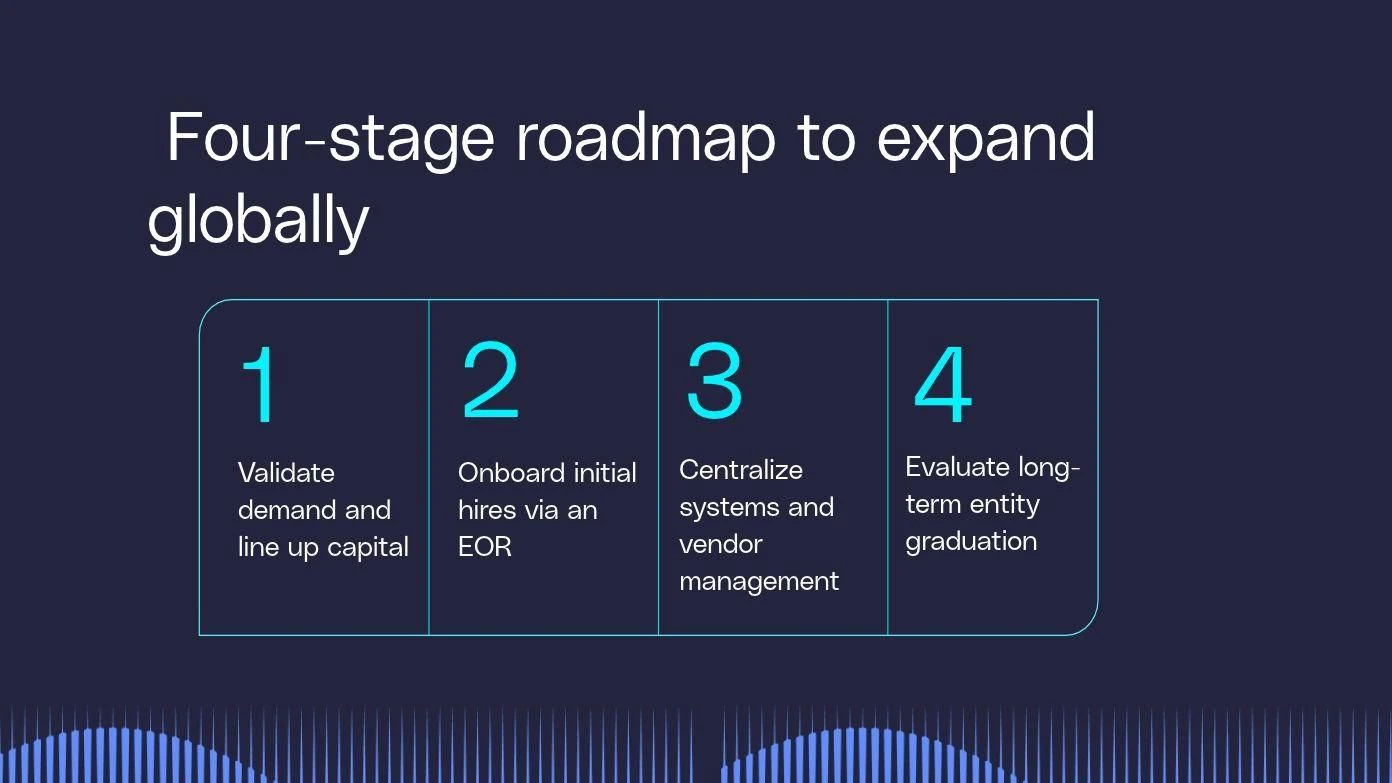
Stage 1: Validate demand and line up capital
Start by testing the market appetite. Evaluate customer demand, pricing, distribution channels, and the competition. Test local messaging and packaging before committing fully. Create a financial forecast that includes hiring costs, sales targets, and working capital. Use our global expansion resources to evaluate market entry requirements and build your initial plan. Set concrete milestones for profitability and revenue.
Stage 2: Onboard initial hires via an EOR
Next, hire local professionals who understand the local market. Start with customer-facing specialists, commercial leaders, and technical professionals. G-P EOR lets you generate employment contracts in minutes. Keep commercial contract signing at headquarters to help reduce permanent establishment risk. This approach lets you hire quickly without establishing a local entity.
Stage 3: Centralize systems and vendor management
As your international team grows, connect your employment platform to your primary HR information system. Standardize onboarding workflows, compensation approvals, and workforce reporting. A centralized system lets you review vendor performance regularly, including payroll accuracy, and maintain consistent data governance.
Stage 4: Evaluate long-term entity graduation
Review your market performance regularly. Look at profitability, administrative costs, and headcount. When your local workforce approaches 15-25 professionals, do a detailed cost comparison of using an EOR versus establishing a local entity. Transition to a local entity when your business activity justifies the administrative overhead. Otherwise, continue using an EOR in smaller markets where you need flexibility.
Build an international business that can scale
If you’re expanding internationally, you don’t need to start with an expensive local entity or fragmented local operations. With the right strategies for expanding internationally, your midsize business can start with a clear market opportunity and then build financial and operational readiness.
Choose an employment model that matches your current needs, then reassess this model as your business grows. At G-P, we help you turn international hiring plans into reality by allowing you to hire internationally within minutes.
G-P EOR supports compliant hiring and workforce management in 180+ countries, while G-P Contractor and Gia help simplify contractor administration and global HR compliance research.
Explore G-P EOR to build your international team without establishing a legal entity in every country.
 FAQs
How does a midsize business expand internationally?
A midsize business expands internationally by choosing a market entry model, evaluating customer demand, assessing if the business is financially ready, and testing the new market. An employer of record lets you hire professionals in new countries without establishing local entities.
What are the most effective strategies for expanding internationally?
Some effective strategies for expanding internationally include doing extensive market research, hiring through an EOR, getting export financing, and combining your HR technology into a centralized platform. A phased approach lets you invest only as demand grows.
How can a midsize business avoid permanent establishment risk?
To avoid permanent establishment risk, review your local business activities before entering a new market. Check who can sign contracts, who handles local sales, and what local tax rules apply. While an EOR can help your operating structure, it doesn’t guarantee protection from permanent establishment exposure.
When should a mid-market company transition from an EOR to an owned entity?
Consider transitioning when the local headcount approaches 15-25 professionals. Compare EOR costs to the costs of an owned entity. Transition when your revenue and business needs justify the administrative overhead.