






Key takeaways
- France’s top hiring hubs are Paris, Lyon, and Toulouse.
- Top industries in France include fashion, luxury goods, aerospace, automotive, and aviation.
- Companies hiring in France have multiple setup options, including partnering with an employer of record (EOR), hiring contractors, establishing a subsidiary, or direct employer registration.
France is the largest country in the EU. It has the third biggest economy in Europe and a GDP of approximately EUR 18T. The country has a highly skilled talent pool in the aerospace, automotive, and agri-food and wine industries.
Before expanding into France, you’ll need to understand contracts, taxes, wages, benefits, and other employment laws. Our guide will tell you everything you need to know.
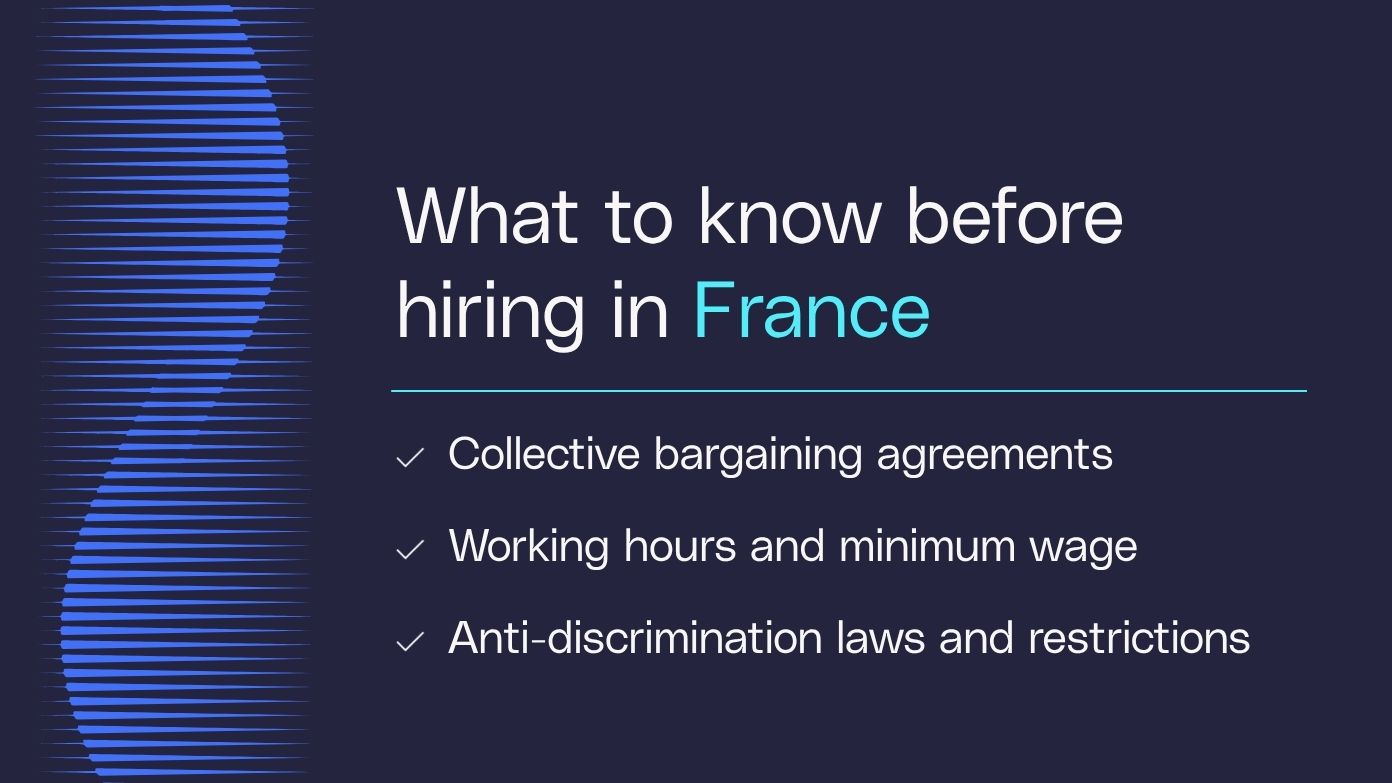
What to know before hiring in France
If you’re expanding your business into France, there are important legal requirements to be aware of. These norms and laws influence hiring practices and many aspects of the employer-employee relationship, including compensation and benefits.
Here are five things to know about hiring in France:
1. Collective Bargaining Agreements (CBAs)
CBAs are common in France. These agreements are made between labor unions and employers. They cover working conditions and benefits. CBAs can apply to one company, a group of companies, or an entire industry.
CBAs can apply to your company even if you're not part of an employer's association. Before hiring in France, check to see if a CBA applies to your industry.
 2. Working hours and minimum wage
In France, a standard workweek is 35 hours. Employees can't work:
- Over 10 hours daily
- More than 48 hours weekly
- Over 44 hours per week averaged over a 12-week period
A 20-minute break is required after six hours of work. Employees also must be free to rest for 11 consecutive hours daily, meaning they can’t be scheduled for back-to-back shifts. Once a week, they’re entitled to a 35-hour rest period, where the 11 hours of mandatory rest is combined with a full 24 hours off.
Employees in France are paid once at the end of each month. Overtime pay is required when working over 35 hours per week. The first eight overtime hours are paid at 125% of the employee’s standard hourly rate. Any hours after that are paid at 150%. CBAs can set higher rates, but never less than a 10% premium.
The overtime limit is 220 hours per employee annually. CBAs can change these limits and overtime pay rules.
As of June 1, 2026, the national minimum wage in mainland France is EUR 12.31 per hour or EUR 1,867.02 per month. CBAs can set a higher minimum wage.
3. Paid holidays
Employees get at least five weeks of paid vacation annually. More time off is possible based on seniority or CBAs.
France has 11 national holidays. Labor Day on May 1 is the only compulsory national holiday that all employees have off. However, paid holidays are negotiated by CBAs, so most employees get all 11 national holidays off, including:
- New Year's Day
- Easter Monday
- Labor Day
- Victory in Europe Day
- Ascension Day
- Whit Monday
- Bastille Day
- Assumption Day
- All Saints' Day
- Armistice Day
- Christmas Day
4. Paid sick leave
Sick employees need to get a doctor's note within 48 hours. Without one, their sick leave is unjustified. Sick pay usually starts on the fourth day of illness. Both social security and the employer cover sick pay. The amount is based on length of service.
Since 2024, non-occupational sick leave accrues at two working days per month and is capped at 24 working days per year. Time off due to work-related illnesses or accidents still accrues at the normal rate.
5. Maternity and paternity leave
All pregnant employees are entitled to maternity leave, regardless of contract type or length of service.
- For the first or second child: 16 weeks (six weeks before birth and 10 weeks after)
- For the third child or more: 26 weeks (eight before and 18 after)
- For twins: 34 weeks (12 before and 22 after)
- For triplets or more: 46 weeks (24 before and 22 after)
French Social Security (CPAM) pays maternity leave allowances. Dismissal protection applies from the moment the employer is notified of the pregnancy, throughout maternity leave, and for 10 weeks after return.
Fathers or second parents (including spouses, PACS (pacte civil de solidarité) partners, or cohabiting partners) get:
- Three working days of birth leave paid by the employer
- 25 calendar days of paternity and childcare leave (32 for multiple births) paid by Social Security
The first four days of paternity leave are mandatory and must follow the birth leave. The remaining days can be split into two periods of at least five days each. They must be taken within six months of the birth.
Either parent with at least one year of service at the time of birth or adoption can take parental leave. Parental leave is for up to one year and can be renewed twice until the child’s third birthday or three years after adoption. Parental leave is usually unpaid.
6. Taxes and social welfare programs
France has a progressive income tax system, meaning higher earners pay a larger percentage of their income in taxes. Employers deduct this tax from employees' paychecks.
Employees and employers contribute to France's comprehensive social security system. This covers healthcare, family benefits, unemployment, workplace accidents, and pensions. Employees contribute around 22% of their gross salary. Employers contribute 43%. These rates can vary.
France's healthcare system is mainly government-funded through social security. While the state covers most healthcare costs, patients pay a portion. This is reimbursed by private health insurance. Employers are required to give supplementary health insurance to all employees. Employers have to pay at least 50% of the premium to cover out-of-pocket expenses.
2026 employee expectations in France
Employees in France report one of the lowest job concern levels among our surveyed countries. Only 56% of employees in France are worried about job loss due to economic factors. To put it into perspective, that number jumps to 85% in Singapore. Only 36% of France-based professionals are actively searching or plan to search for a new job in 2026. This lower anxiety is linked to strong social safety nets.
Hiring models for global companies in France
There are a few options for expanding your business into France, each with their own distinct pros and cons. These options include:
- Direct employer registration: registering your company with France’s government, while handling payroll and other services independently.
- Employer of record (EOR): G-P EOR handles all administrative and payroll processes on behalf of your company.
- Subsidiary or branch: establishing an entity in France, which will function as a separate entity under French law.
- Independent contractor: hiring independent contractors in France doesn’t require establishing a local entity or branch. There are significant penalties for misclassified workers, so strict guidelines must be followed when hiring them.
Top hiring hubs in France
Some cities in France are known for particular industries. Knowing what each city has to offer allows you to focus your hiring efforts in the right place and fill roles faster.
The top talent hubs in France are:
- Paris is the capital and largest city in France. Paris and its surrounding regions have the highest volume of jobs. It’s the country’s top center for finance, technology, fashion, luxury goods, and international business.
- Lyon is a major economic and skilled talent hub in southeastern France. It’s known for its banking, pharmaceuticals, biotech, and digital industries. Lyon is consistently ranked as a top city for living and working in France.
- Toulouse is known as the aerospace capital of Europe. Airbus, Thales, and the CNES Space Center are located here. It’s a top hiring spot for engineers.
- Bordeaux is a UNESCO-listed city famous for wine. Agri-food, aerospace, and digital technology are other strong sectors in the city. Renowned companies like Ford and Michelin have operations here.
- Marseille is France’s largest port city. It’s known for logistics, shipping, trade, and tourism, with growing opportunities in the tech and services industry.
Key industries in France
Understanding France’s main industries allows you to benchmark salaries and benefits. You can use this insight to make smart choices about where to invest and grow your workforce.
The main industries in France include:
- Aerospace and aviation: France is a global leader in aerospace. The country is known for manufacturing commercial aircraft, satellites, and defense equipment. Airbus and Dassault Aviation are major companies located in France. Specialist talent includes engineers, technicians, and R&D specialists.
- Automotive: France produces vehicles, automotive parts, and is active in research and development for electric and autonomous vehicles. Renault, Peugeot, and Citroën are major manufacturers here. Specialist talent includes engineers, designers, and supply chain experts.
- Luxury goods and fashion: France is a global leader in luxury goods, fashion, and cosmetics industries. LVMH, Chanel, Hermès, and L’Oréal are leading world brands. Specialist talent includes creative designers, luxury brand management experts, and product development and merchandising specialists.
- Agri-food and wine: France is a major producer and exporter of agricultural products and processed foods. It’s especially famous for its wine and cheese industries. Large farms in northern France produce wheat and other grains. Specialist talent includes agronomists, food scientists, and biotechnologists.
- Pharmaceuticals and healthcare: France has a strong pharmaceutical and biotechnology sector. The country is a leader in medical research and healthcare services. Sanofi and Servier are big companies located here. Specialist talent includes pharmaceutical researchers, quality assurance and control professionals, and medical device engineers.
The cost of hiring an employee in France
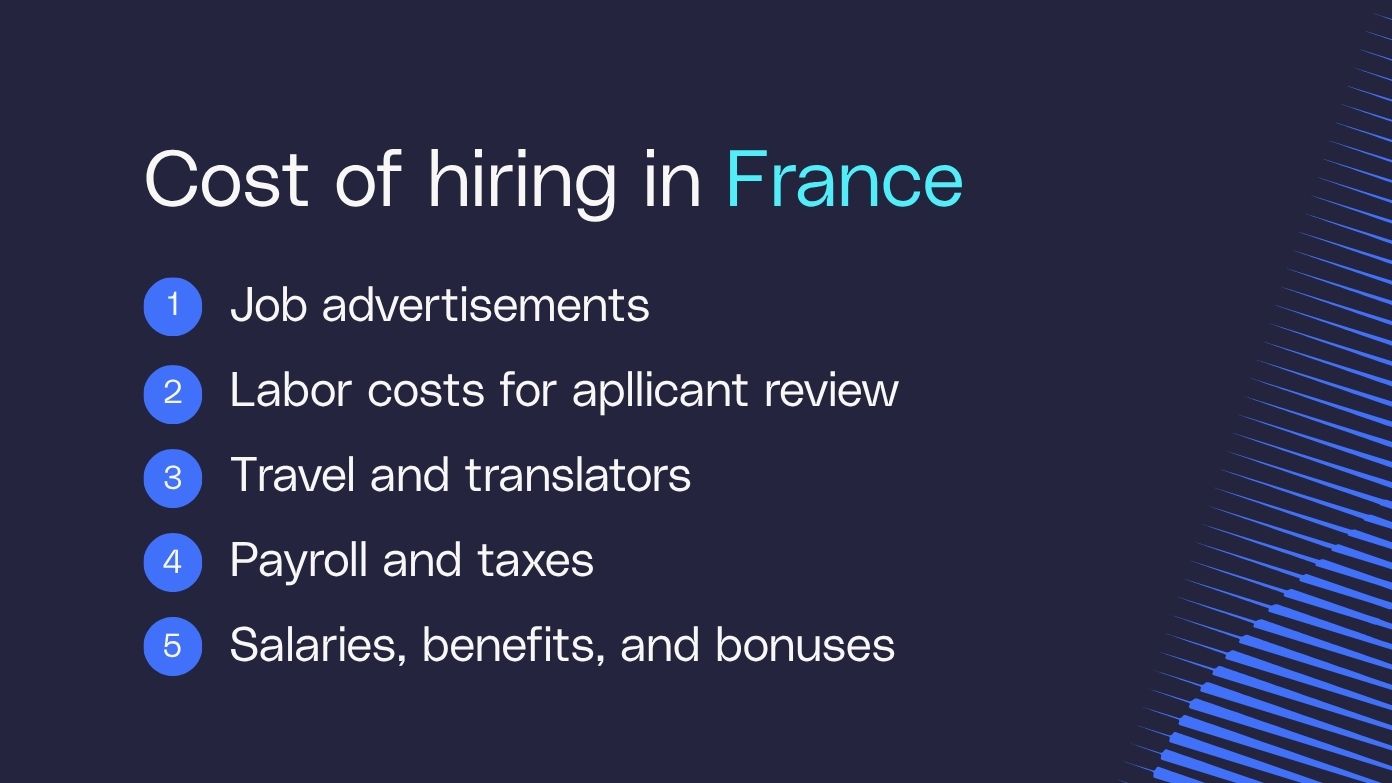
Whether you’re hiring one employee or an entire team in France, expenses are inevitable. Budget for the following:
- Setting up an entity (unless you partner with an employer of record)
- Advertising job positions
- Paying referral bonuses to employees with connections in France
- Paying an in-house hiring committee
- Traveling to and from France, including hotel stays, meals, and transportation
- Partnering with a translator to draft documents or facilitate conversations (if applicable)
- Using a background check service for screening candidates
- Drafting compliant employment contracts, legal review, and consultation with HR and legal experts
- Costs for providing computers, phones, and software licenses
- Expenses for onboarding materials and initial training
- Costs for maintaining required tax and payroll records and documentation
According to G-P Verified Sources from Gia, the employer burden rate in France, which includes costs triggered on top of salaries, ranges from 40–45%, excluding accident insurance.
 What does a company need to do to hire employees in France?
Make sure you cover these essentials before expanding your team in France:
- Get a SIREN (company registration number) and a SIRET (establishment identification number) from the French National Institute of Statistics and Economic Studies (INSEE).
- Register with the relevant social security body (URSSAF for most sectors, MSA for agriculture).
- Open a local bank account.
- Submit a DPAE (Déclaration Préalable à l’Embauche) to URSSAF before the employee starts work at your company.
- Verify each employee’s right to work before employment begins.
- Maintain an accurate Registre Unique du Personnel for each workplace.
- Set up compliant payroll and complete DPAE and DSN reporting.
- Get workplace accident insurance to cover employees in case of work-related injuries.
- Establish internal regulations if your company has over 50 employees.
- Identify and apply the correct collective bargaining agreement (CBA).
- Get all required written employment terms within applicable deadlines.
- Provide mandatory employee benefits and social protections.
- Maintain DUERP, occupational health, safety training, and risk-prevention compliance.
- Partner with an accredited occupational health service to arrange mandatory health checks for employees.
Setting up a subsidiary in France can take weeks or months. Use an EOR in France to hire employees without setting up your own entity. Build your team at a lower cost and with peace of mind that you’re doing so compliantly.
The steps to hiring in France
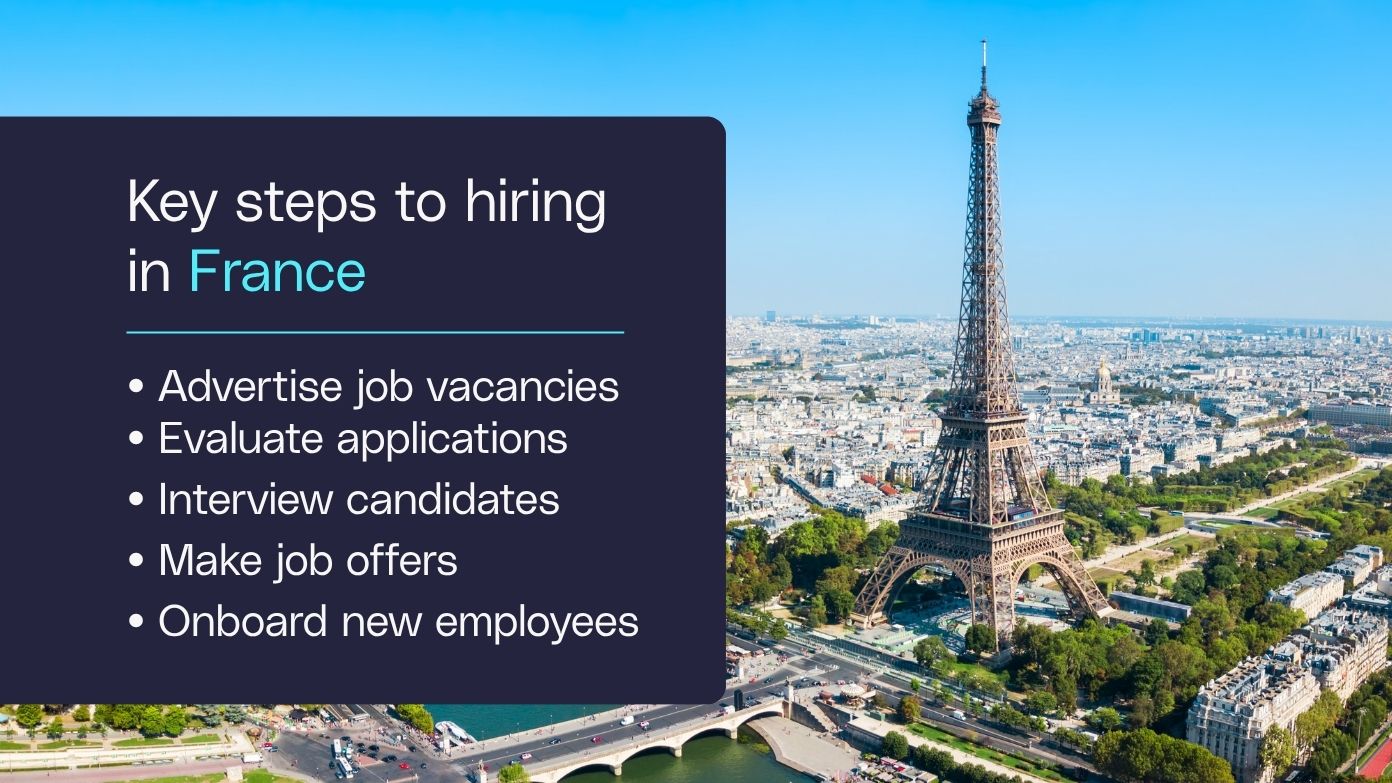
The hiring process in France is similar to the one you’re likely familiar with in your own country. Here are the five basic steps:
1. Advertise job openings
There’s no legal obligation to publicly advertise job vacancies in France. However, advertising is strongly recommended as a best practice for transparency and equal opportunity. Popular job platforms include France Travail, APEC (for executive roles), and other international job boards like LinkedIn.
Make sure your job ad is clear, objective, and free from discriminatory language. Job ads can’t contain any direct or indirect discrimination based on origin, sex, age, sexual orientation, gender identity, family situation, pregnancy, health, disability, religion, political opinions, trade union activity, physical appearance, place of residence, or other protected characteristics.
Since June 2026, EU law has required pay range disclosure in job ads or before interviews. All job advertisements for roles performed in France must be in French. You can include translations, but the French version must be equally prominent.
2. Evaluate applications
Screen applications and conduct interviews in compliance with anti-discrimination laws. All questions and selection criteria have to be relevant to the job and not relate to protected characteristics such as age, gender, and religion. Collect and process candidate data in accordance with GDPR and French data protection laws.
3. Interview candidates
Interview candidates who made it onto your shortlist. You can do these interviews in person or virtually. Use structured, non-discriminatory interview questions. Gia can help you create questions that follow anti-discrimination laws in France, so you can find the best fit for the role while complying with local regulations.
4. Making job offers
Contact your chosen candidate to offer them a position with your company. Written contracts are mandatory for fixed-term, part-time, and temporary agency roles in France, and are strongly recommended for permanent (CDI) positions. The contract has to be in French and include job title, remuneration, working hours, applicable CBA, probation period (if any), and for fixed-term contracts, the reason and duration.
5. Onboard new employees
Now you can onboard new employees. Submit the mandatory DPAE (Déclaration Préalable à l’Embauche) declaration to URSSAF (or MSA for agricultural roles) before the employee starts work. This registers the employee for social security, unemployment insurance, and occupational health coverage.
Arrange for the required occupational health visit within three months of hiring, or before starting, as required for certain roles. Register the employee with supplementary pension and health insurance schemes as required.
With G-P EOR, you won’t have to worry about the administrative burden of onboarding. We’ll streamline the process, so you can focus on training your new hire and integrating them into your company culture.
Hiring contractors in France
Working with independent contractors in France can be a cost-effective way to test the market and build a presence without the commitment of full-time employees.
Contractors based in France understand local consumer behavior, rules, and business practices. They’ll be ready to start working quickly with their own equipment and established work processes.
Hiring contractors allows you to easily adjust your talent pool based on your business needs, without the complexities and costs of employment.
Before you enter an agreement with an independent contractor in France, consider the following:
1. Employees vs. independent contractors
It’s important to understand the difference between employees and independent contractors. In France, employers hire employees to do work and, in return, pay them a regular salary and benefits. Independent contractors provide services. Unlike employees, contractors set their schedules, use their own equipment, and work on specific projects, rather than having an ongoing role.
2. Penalties for misclassification
Classifying someone as a contractor when they’re not can lead to severe penalties. If misclassification occurs, you’ll have to:
- Reclassify the working arrangement as an employment contract, potentially retroactively.
- Pay the employer and employee social security contributions for up to three years prior, or five years if misclassification was intentional. This includes penalties and interest.
- Pay extra damages for lost employment rights, pension contributions, back wages, overtime, paid leave, CBA benefits, termination notice, severance, and other damage suffered by the worker.
- Face individual fines of up to EUR 45,000 and company fines of up to EUR 225,000. There can also be a prison sentence of up to three years.
3. How to pay contractors
G-P Contractor™ takes away the messy, time-consuming process of hiring and paying international contractors. You can create and issue contracts and pay contractors with just a few clicks, all while ensuring a compliant process.
Hire employees and contractors in France with G-P
Our Global Employment Platform and its AI-powered products, EOR, Contractor, and Gia, enable companies of all sizes to build and manage global teams.
G-P is the recognized leader in global employment with more than a decade of experience, the largest team of HR, legal, and compliance experts, and a global proprietary knowledge base.
Make your expansion to France easier with G-P. Contact us or book a demo today.
Frequently asked questions
What is the minimum wage in France?
As of June 1, 2026, minimum wage in mainland France is EUR 12.31 per hour or 1,867.02 for a 35-hour workweek.
What steps must be completed before an employee starts work in France?
Employers must submit a DPAE (Déclaration Préalable à l’Embauche) to the appropriate social security body (URSSAF or MSA) before the employee starts work. This registers the worker for social security, unemployment insurance, and occupational health coverage. Failure to submit the DPAE can result in civil, administrative, and criminal penalties.
What are the main anti-discrimination and data protection rules for recruitment in France?
French law prohibits recruitment discrimination based on origin, sex, age, religion, and other protected characteristics. All interview questions and selection criteria must relate directly to the role.
Under GDPR and the French Labor Code, candidate data must be collected lawfully and stored only as long as necessary for hiring purposes.
What language do employment contracts in France have to be in?
All employment contracts must be written in French. An international employee may request a translation into their preferred language, but the French version remains legally binding in disputes.
What are the top employee obligations under French law?
Employees must act in good faith, maintain confidentiality, follow internal workplace rules, and carry out their duties diligently. They’re required to comply with health and safety standards and inform their employer of relevant personal status changes. Any non-compete clauses must be reasonable and include financial compensation.