
Puntos clave
- APEC Business Travel Card (ABTC): An ABTC simplifies and speeds business travel for citizens of participating Asia-Pacific Economic Cooperation (APEC) economies. The main benefits are fast-track airport access and visa-free travel in participating countries.
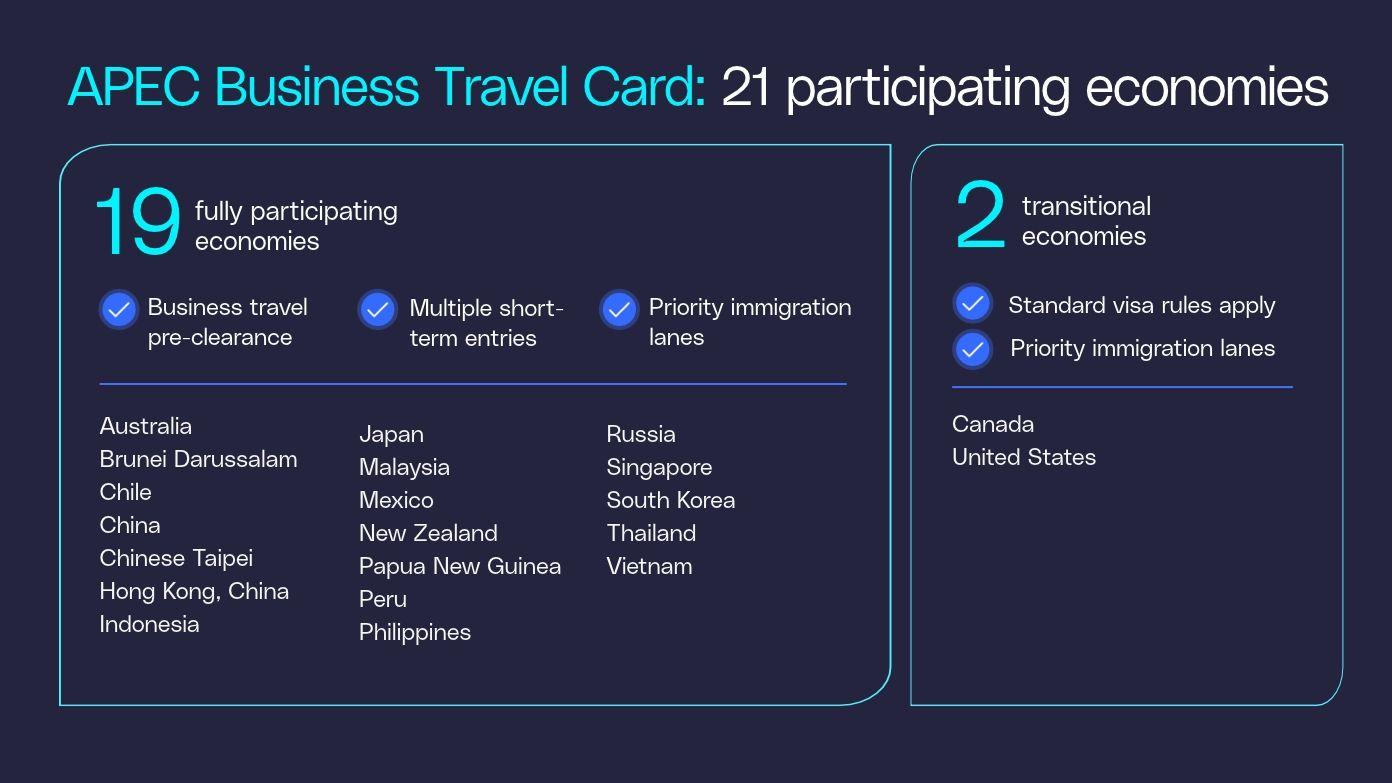
- Participating economies: The ABTC has 19 participating economies. Canada and the U.S. are transitional members.
- How to apply: Applicants must meet their home economy’s eligibility rules and apply through the issuing authority.
- Cover your bases: Track stay durations and update the card if your passport details change.
Don’t let a delayed visa stop a deal. The APEC Business Travel Card (ABTC) simplifies and speeds travel between participating economies. This blog explains how the ABTC works, who the member regions are, and what you need to keep business trips easy and compliant.
¿Qué es la Tarjeta de Viaje de Negocios APEC?
The Asia-Pacific Economic Cooperation (APEC) is a regional forum where 21 economies work together to promote economic cooperation and trade. APEC facilitates:
- Free trade between participating economies
- Investment that supports regional growth
- Business mobility to streamline international travel
The ABTC makes it easier for eligible travelers — business people and senior government officials — to move between participating APEC economies.
En lugar de aplicar una nueva visa para cada viaje, los titulares aprobados obtienen autorización previa para viajes de negocios a corto plazo. Muchos aeropuertos también ofrecen carriles de inmigración APEC dedicados para los titulares de tarjetas.
¿Qué países ofrecen las Tarjetas de Viaje de Negocios APEC?
Aunque 21 economías son afiliadas a APEC, no todas ofrecen los mismos privilegios de viaje de ABTC.
Membresía participante completa vs. membresía transitoria
- In fully participating economies, pre-clearance means cardholders don’t need to apply for a separate short-term business visa each time they visit.
- In transitional economies, the card gives access to fast-track airport immigration lanes, but it doesn't waive visa or entry requirements.
Hay 19 economías que participan plenamente en el programa ABTC
Estas economías emiten ABTC y pueden conceder la autorización previa a la inmigración:
- Australia
- Brunéi Darussalam
- Chile
- China
- Taipéi Chino (Taiwán)
- Hong Kong, China
- Indonesia
- Japón
- Corea
- Malasia
- México
- Nueva Zelanda
- Papúa Nueva Guinea
- Perú
- Singapur
- Tailandia
- Filipinas
- La Federación Rusa
- Vietnam
APEC business travel card country list and stay allowances
The APEC business travel card country list includes 21 economies in the Asia-Pacific region. However, travel privileges differ by destination. Before booking a business trip, check your pre-clearance status, your destination’s entry requirements, and the maximum stay allowed.
Full participating economies vs. transitional members
Of the 21 APEC economies, 19 are full participants in the ABTC program. These economies grant immigration pre-clearance to approved cardholders, allowing short-term business visits without separate visa applications.
The United States and Canada are transitional members. They don’t provide reciprocal visa waivers under the ABTC program. You must still meet their standard entry requirements, including obtaining a visa or electronic travel authorization when required.
However, cardholders can receive priority fast-track immigration lanes at participating airports. This reduces time spent at border checkpoints.
Comprehensive member economy breakdown table
The table below lists all 21 participating economies, their ABTC status, maximum stay allowances, and important border entry conditions.
|
Member Economy |
Economy Code |
Participation Status |
Maximum Permitted Stay |
Border Entry Conditions |
|---|---|---|---|---|
|
Australia |
AUS |
Fully Participating |
Up to 90 Days |
Full pre-clearance entry; express lanes at international hubs |
|
Brunéi Darussalam |
BRN |
Fully Participating |
Up to 90 Days |
Valid pre-clearance required; designated checkpoints |
|
Canadá |
CAN |
Transitional Member |
Standard Entry Rules |
No visa waiver; valid eTA/visa required; priority CBSA lanes |
|
Chile |
CHL |
Fully Participating |
Up to 90 Days |
Reciprocal entry across international air and sea borders |
|
China |
CHN |
Fully Participating |
Up to 60 Days |
Short-term commercial visits; vABTC accepted nationwide |
|
Hong Kong, China |
HKG |
Fully Participating |
Up to 60 Days |
Express travel clearance across all regional entry points |
|
Indonesia |
IDN |
Fully Participating |
Up to 60 Days |
Authorized commercial transit at major international ports |
|
Japón |
JPN |
Fully Participating |
Up to 90 Days |
Commercial visitor activities; priority lanes available |
|
Malasia |
MYS |
Fully Participating |
Up to 90 Days |
Pre-cleared business visits; designated international checkpoints |
|
México |
MEX |
Fully Participating |
Up to 90 Days |
Multiple short-term entries for verified business purposes |
|
Nueva Zelanda |
NZL |
Fully Participating |
Up to 90 Days |
Multi-entry commercial authority; priority arrival lanes |
|
Papúa Nueva Guinea |
PNG |
Fully Participating |
Up to 60 Days |
Commercial entry clearance across authorized border points |
|
Perú |
PER |
Fully Participating |
Up to 90 Days |
Commercial business visits; designated airport processing |
|
Filipinas |
PHL |
Fully Participating |
Up to 90 Days |
Express border processing for authorized trade activities |
|
Rusia |
RUS |
Fully Participating |
Up to 90 Days / 180 Days |
Multi-entry commercial access subject to cycle limits |
|
Singapur |
SGP |
Fully Participating |
Up to 60 Days |
Automated clearance lanes for verified trade visitors |
|
Corea del Sur |
KOR |
Fully Participating |
Up to 90 Days |
Commercial visit authorization at primary arrival ports |
|
Taipéi Chino (Taiwán) |
TWN |
Fully Participating |
Up to 90 Days |
Full access for trade, investment, and operational reviews |
|
Tailandia |
THA |
Fully Participating |
Up to 90 Days |
Multi-entry commercial privileges through international airports |
|
Estados Unidos |
EE. UU. |
Transitional Member |
Standard Entry Rules |
No visa waiver; valid ESTA/visa required; fast-track CBP lanes |
|
Vietnam |
VNM |
Fully Participating |
Up to 60 Days |
Pre-cleared commercial delegates; dedicated APEC lanes |
Estados Unidos y Canadá tienen un estatus transitorio
Canada and the U.S. don’t offer pre-clearance — travelers must meet standard visa entry requirements. But they do offer faster airport processing through ABTC lanes.
Todos los países ABTC que pueden visitar los titulares de la tarjeta sin visa aparecen en la parte trasera de la tarjeta.
Beneficios de la Tarjeta de Viaje Empresarial APEC
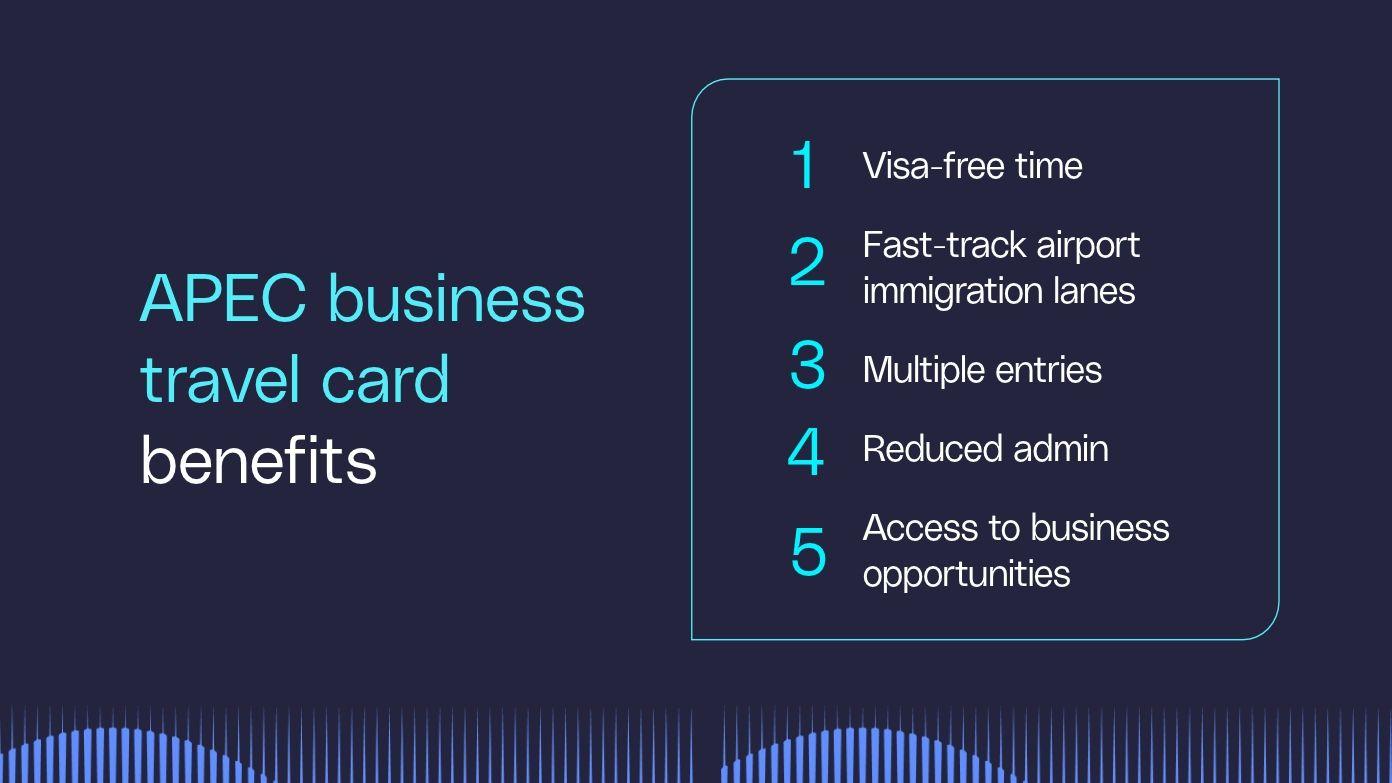
Los ABTC te dan acceso a estos beneficios:
1. Viaje sin visa
With pre-clearance, cardholders can travel to 19 APEC economies for short-term business travel. You don’t need to apply — or pay — for multiple visa entries.
2. Carriles rápidos
Fast-track lanes can help save time at customs and immigration checkpoints in all 21 APEC member economies’ major airports. When you’re rushing to make a business meeting, every minute counts. Many ABTC holders travel across the region four to six times a year. During peak periods at New York’s JFK Airport, wait times extend past three hours. An ABTC saves you time at immigration, especially during peak periods.
3. Múltiples inscripciones
Fully participating ABTC economies allow multiple entries during a 60- to 90-day period. This saves businesses time, money, and admin when plans change. If your team flies to Singapore to discuss a deal and a potential business partner needs them back two weeks later to sign, you can book the trip without waiting for new visa applications.
4. Reducción administrativa
Instead of dealing with paperwork for multiple visas, apply for the card once, and then use it across multiple economies and business trips. No more repeat admin for your team and fewer bureaucratic headaches before and during every trip.
5. Acceso a oportunidades de negocio
Con una entrada simplificada y menos requisitos de visa, tu equipo puede viajar para reuniones, negociaciones y nuevas colaboraciones.
Criterios para la tarjeta de visita de APEC
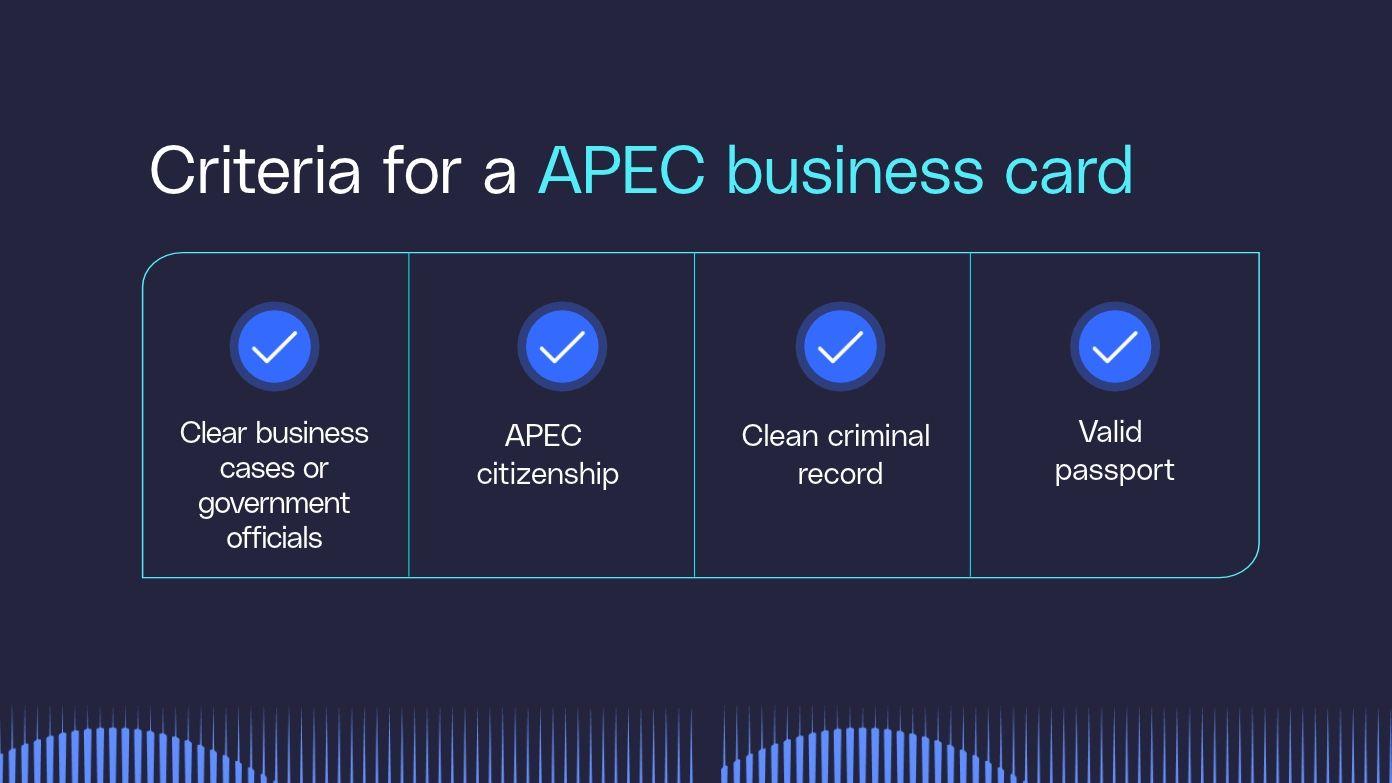
Each APEC economy sets its own application criteria. Generally, applicants must meet the following requirements across all participating countries, but additional conditions may apply, depending on the country.
1. Caso empresarial claro o estatus de funcionario gubernamental
Los solicitantes del ABTC deben demostrar que viajan por motivos empresariales legítimos. Deben presentar pruebas de:
- Empleo en una compañía consolidada y registrada fiscalmente (se requiere verificación)
- Un puesto que requiere viajes frecuentes por las economías de APEC.
- Actividad empresarial en la región de APEC vinculada a la financiación, el comercio, la adquisición de materias primas, la inversión o los servicios profesionales
Los altos funcionarios gubernamentales que viajan frecuentemente dentro de la región APEC para realizar funciones oficiales pueden obtener un ABTC, sujeto a la aprobación de su gobierno.
2. Ciudadano económico de APEC
Los solicitantes deben ser ciudadanos de una economía de APEC.
- Excepción: Los residentes de Hong Kong deben poseer un documento de identidad permanente de Hong Kong.
3. Sin antecedentes penales
Los solicitantes no pueden tener antecedentes penales.
4. Pasaporte válido
Applicants need a valid passport from their home APEC economies.
- Excepción: Los residentes de Hong Kong deben poseer un pasaporte de la Región Administrativa Especial de Hong Kong y una tarjeta de identidad permanente de Hong Kong.
Cómo aplicar un ABTC
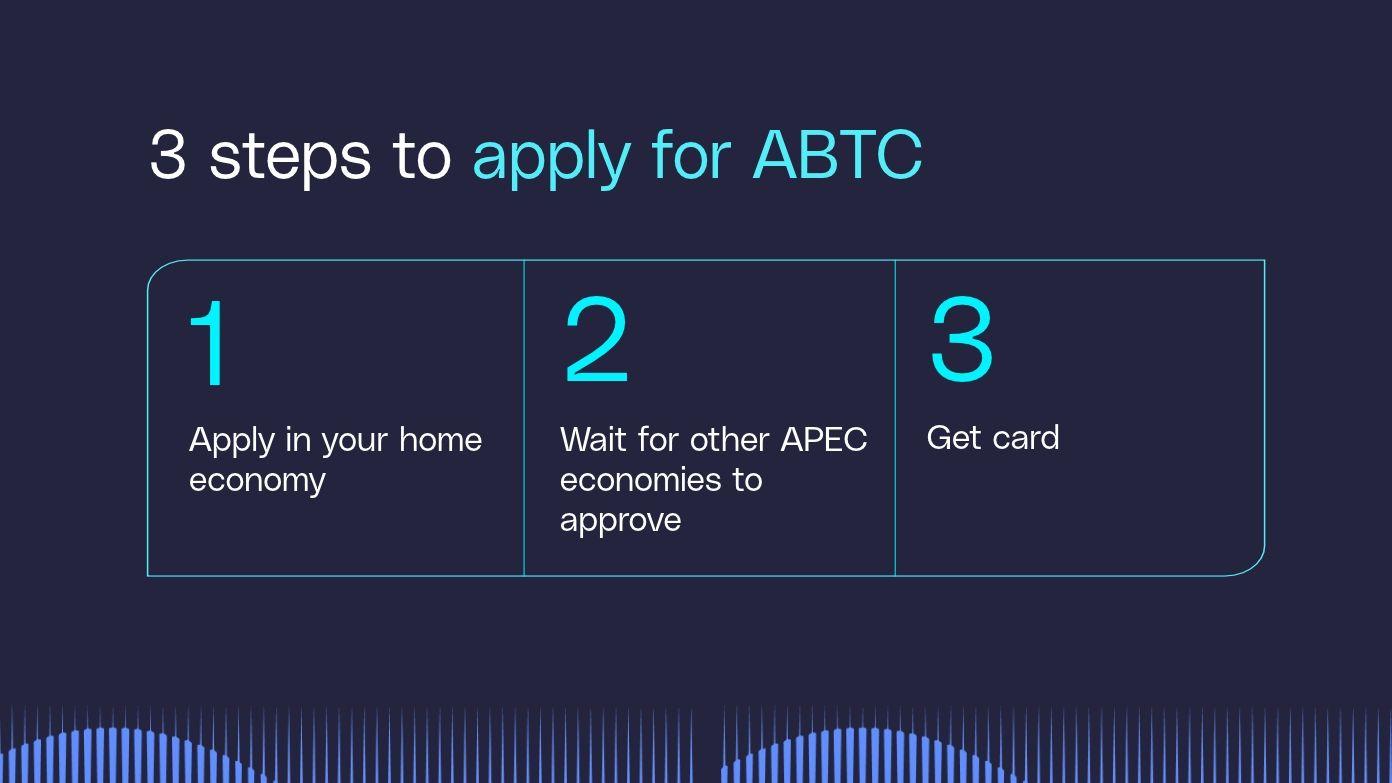
Puedes aplicar una APEC Business Travel Card en tres pasos.
Paso 1: Aplicar en tu economía de origen
Presenta una solicitud ante la autoridad emisora de tu economía APEC de origen. Esto suele hacerse en línea a través de una agencia de inmigración o de fronteras.
Necesitarás:
- Un pasaporte válido.
- Comprobante de empleo
- Documentos que confirman tu propósito de viajar por negocios
Some economies may also need extra verification, such as membership in a trusted traveler program.
Paso 2: Esperar a que otras economías de APEC aprueben
Once your home economy approves the application, it sends these details to other participating economies for pre-clearance. Each economy makes its own decision. Eligibility rules and review criteria differ by region.
Paso 3: Consigue la tarjeta
Your home economy issues an ABTC after approvals are done. Some economies provide a physical card, and others support a virtual ABTC through a mobile app.

Lista de verificación de cumplimiento ABTC para equipos Recursos Humanos
Estos pasos ayudarán a los empleados a emplear la ABTC de forma adecuada y evitar problemas de inmigración o regulación durante los viajes de negocios.
Verificación de elegibilidad
Confirmar:
- Citizenship and passport validity
- Background status
- A documented business need for repeat short-term travel in the APEC region
Documentación precisa
Presenta documentación precisa, incluyendo:
- Formulario de solicitud
- Passport copy
- Criminal record certificate
- Business person certificate
- Employer verification letter
Canal autorizado de envío
En algunas economías de APEC, las personas no pueden presentar solicitudes directamente a las oficinas gubernamentales de inmigración o pasaportes. En su lugar, los solicitantes deben pasar por asociaciones empresariales o cámaras de comercio específicas y autorizadas para gestionar estas solicitudes.
Se aplican tasas administrativas y el procesamiento puede tardar varios meses.
Recuerda a los empleados que:
- They need to present their passport and ABTC when traveling.
- The ABTC doesn’t replace U.S. or Canada visa requirements.
- The length of stay in each participating economy is typically 60 to 90 days per visit.
- They shouldn’t overstay or misuse the card for nonbusiness purposes.
Validez de pasaporte y tarjeta
Haz un seguimiento de las fechas de caducidad del pasaporte y del ABTC. El ABTC está vinculado al pasaporte y deben mostrar el mismo número de pasaporte. Renueva ambos a tiempo para evitar interrupciones en el viaje.
Renovaciones y actualizaciones
Un ABTC suele ser válido durante cinco años o hasta que expire el pasaporte vinculado.
Inicia las renovaciones al menos seis meses antes de la expiración y actualiza la ABTC si cambian los datos del pasaporte.
Registro
Mantenga registros de todas las solicitudes, documentos justificativos y comunicaciones para cumplir con los requisitos de cumplimiento y auditoría.
Cartas perdidas o robadas
Reporta inmediatamente las tarjetas perdidas o robadas. Inicia el proceso de sustitución a través de la asociación empresarial original.
APEC business travel card vs. Global Entry: key differences
Understanding the APEC Business Travel Card vs. Global Entry differences can help you choose the right program for your business travel needs.
Both programs speed up airport immigration processing. However, they serve different purposes. The APEC Business Travel Card facilitates short-term business travel across 21 APEC economies, and the Global Entry is a U.S. Customs and Border Protection (CBP) program that speeds up entry into the United States for approved travelers.
Comparative structural breakdown
The table below compares both programs, including their eligibility requirements, geographic coverage, travel benefits, and application fees.
|
Program Feature |
APEC Business Travel Card (ABTC) |
U.S. Global Entry Program |
|---|---|---|
|
Governing Authority |
APEC Business Mobility Group & Sovereign States |
U.S. Customs and Border Protection (CBP) |
|
Geographic Scope |
21 Asia-Pacific Economic Cooperation Economies |
U.S. Ports of Entry & Select CBP Preclearance Hubs |
|
Visa Pre-Clearance |
Short-term business entry and reciprocal entry across 19 member destinations |
Admissibility into the United States only |
|
Airport Fast-Track |
Priority APEC lanes at 21 member airports |
Biometric automated kiosks at U.S. arrival terminals |
|
Domestic Air Benefits |
No domestic security benefits |
Includes full TSA PreCheck benefits |
|
Validity Period |
Up to 5 Years (aligned with passport validity) |
5 Years |
|
Standard Government Fee |
Varies by economy (USD 70 for U.S. citizens) |
USD 120 non-refundable application fee |
How North American travelers use both programs
U.S. citizens must hold an active CBP Trusted Traveler membership to qualify for an ABTC. Eligible programs include Global Entry, NEXUS, and SENTRI.
You can apply through two workflows:
- Sequential application: Apply for Global Entry, NEXUS, or SENTRI first. Once you’re approved, submit your ABTC application through the CBP Trusted Traveler Programs portal.
- Concurrent application: Apply for Global Entry and the ABTC during the same application process. CBP will review your Trusted Traveler eligibility as part of the approval process.
For U.S. applicants, the combined application fees for Global Entry and the ABTC total USD 190. The process for Canadian citizens is a little different. They must be a NEXUS member to qualify for the Canadian ABTC program.
For example, if you are a U.S.-based business leader who has an ABTC and is traveling to Singapore for meetings, you can use designated APEC priority immigration lanes in Singapore. However, the ABTC doesn’t provide visa-free entry, so you must still meet Singapore’s entry requirements.
When returning home, Global Entry provides expedited immigration processing, and TSA PreCheck speeds up security screening at participating U.S. airports.
If your HR team travels frequently, combining these programs can significantly reduce airport delays.
Cómo ayuda G-P Gia™
La ABTC facilita los viajes de negocios a corto plazo.
For HR teams managing cross-border travel, staying on top of changing entry rules and local requirements can be challenging. With G-P Gia, you get instant, country-specific guidance on travel regulations, visa requirements, and employment considerations across 50 countries so you can make informed decisions quickly and confidently.
If you need guidance tailored to a specific country or scenario, ask Gia.
 Preguntas frecuentes
¿Qué países están incluidos en el ABTC?
La Tarjeta de Viaje Empresarial de APEC (ABTC) incluye 21 economías de APEC.
19 fully participating economies grant immigration pre-clearance: Australia, Brunei Darussalam, Chile, China, Chinese Taipei (Taiwan), Hong Kong (China), Indonesia, Japan, Korea, Malaysia, Mexico, New Zealand, Papua New Guinea, Peru, the Philippines, the Russian Federation, Singapore, Thailand, and Vietnam.
2 transitional economies: The U.S. and Canada have transitional status. They offer expedited airport immigration processing through ABTC lanes but don't provide visa-free entry under the program.
¿Sigo necesitando visado para entrar en EE. UU. si tengo el ABTC?
Yes. APEC Business Travel Card USA rules mean that the ABTC does not replace U.S. visa or entry requirements. The U.S. participates under transitional status.
¿Cuánto tiempo es válido el ABTC?
Most APEC Business Travel Cards are valid for up to five years from the issue date (the card will show the exact expiration date). Some APEC economies may issue ABTCs valid for longer periods, such as for specific government roles.
¿Quién es elegible para la APEC Business Travel Card?
While rules vary by issuing economy, general eligibility criteria require applicants to:
Be a citizen of an APEC economy (or a Hong Kong permanent resident holding a permanent ID card), hold a valid passport, have no prior criminal history, and demonstrate a legitimate business need for frequent short-term travel within the APEC region (or be an eligible senior government official).
¿Cuánto tiempo tarda el proceso de solicitud y qué documentos se requieren?
Processing typically takes two to three months, depending on the applicant's home economy and review priority. To ensure proper timing, apply at least six months before your first trip. For renewals, submit re-applications at least three months prior to expiration. Required documentation generally includes an application form, passport copy, proof of employment, employer verification letter, business person certificate, and a criminal record certificate.
I'm a citizen of a full participatory country. Do I still need a passport to enter another APEC country?
Yes. The ABTC does not replace a passport. Entry and pre-clearance remain at each economy's discretion. Both documents must match and show the same passport number. If you renew or replace your passport, you must update or renew your ABTC as well.