
Puntos clave
-
AI in HR can amplify your team: G-P’s agentic AI supports multi-step HR workflows, including cross-border hiring, generating customized and compliant international contracts, country-specific analytics, ongoing compliance monitoring, automated onboarding at scale, and day-to-day lifecycle management. This reduces research time so your team can focus on strategy, culture, and people.
-
Prioritize human judgment: Automate tasks, not decisions. Human oversight is important when evaluating how to implement AI responsibly in HR, especially for choices impacting employment, pay, or legal standing.
-
Global compliance needs verified data: General AI tools risk compliance errors. Use expert-vetted, proprietary tools like G-P Gia™ to ensure compliance.
For more insights, watch the webinar: "AI, HR strategy, and the evolving global workforce"
Si eres un profesional de RRHH o un líder empresarial que gestiona una fuerza de trabajo global, sabes que mantenerte al día con el cumplimiento es un trabajo a tiempo completo. Hoy en día, la conversación no se limita a encontrar formas de cumplir todos los requisitos legales; Se trata de tomar decisiones tecnológicas inteligentes.
Understanding how to use AI in HR is transforming the industry by making everyday tasks easier and faster. Simplification and speed help HR teams quickly adapt to shifting environments and regulations. But don't worry about being the fastest adopter — the goal is simply to keep up.
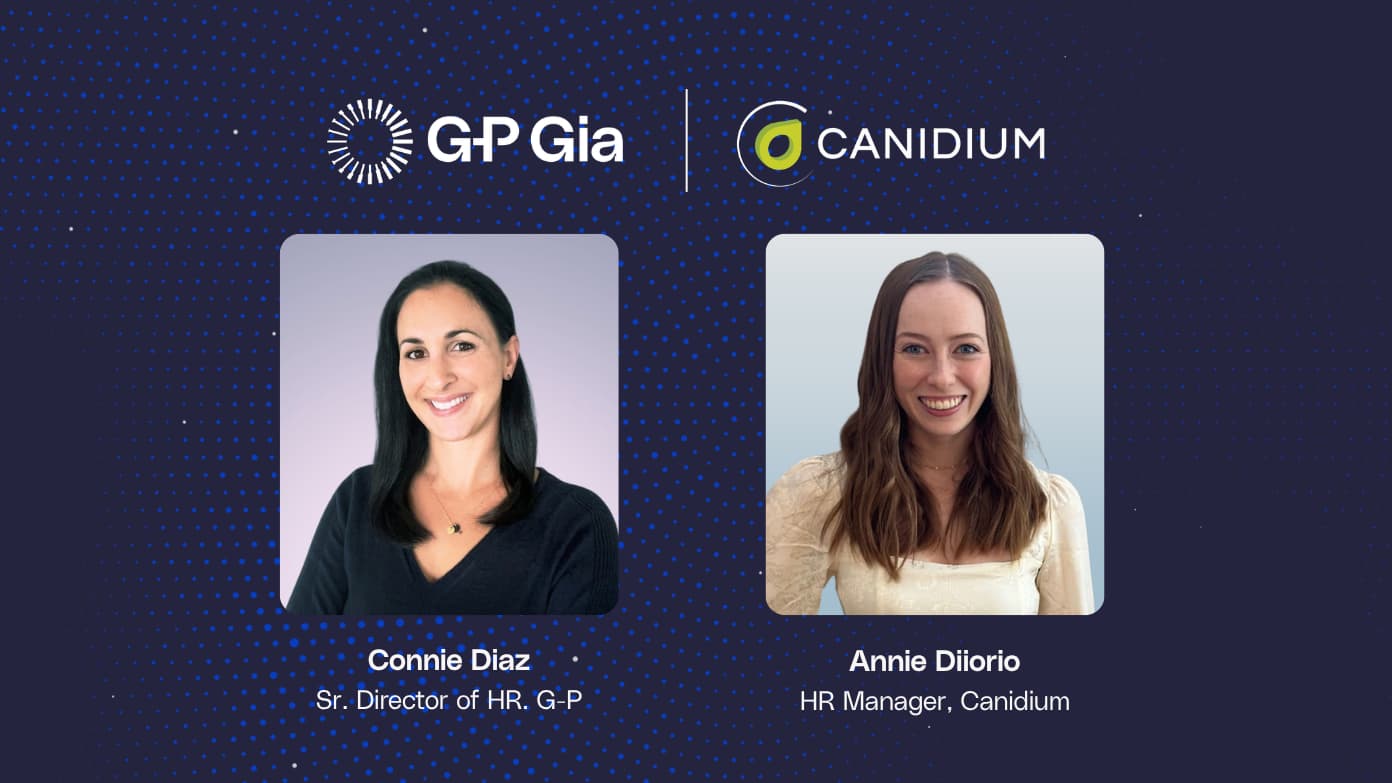
Connie Diaz, directora senior de Recursos Humanos en G-P, y Annie Diiorio, responsable de Recursos Humanos en Canidium, son expertas en introducir la inteligencia artificial en las fuerzas de trabajo en movimiento. Pasaron varios años ayudando a sus equipos a superar el "miedo a la inteligencia artificial" para implementar herramientas que reduzcan tareas y devuelven al humano a Recursos Humanos. A partir de esa experiencia, descifraron el código para la integración de inteligencia artificial.
How AI tools help HR teams
AI tools act as a force multiplier for HR teams by handling the heavy lifting of administrative tasks. By absorbing high-volume responsibilities like initial resume screening, manual data sorting, and routine policy questions, AI speeds up daily operations. This reduces the repetitive workload that can strain growing teams.
For example, Gia can quickly generate a Japan employment contract that reflects important local labor-law considerations for HR review. In Japan’s labor laws (like the Labor Standards Act), contracts have to explicitly state details like working hours, overtime rules, and severance rules in a specific format. If you use a generic US-style offer letter, some provisions can be ineffective or difficult to enforce under Japanese employment law.
Without an AI tool like Gia, an HR manager sitting in New York or London would have to:
-
Spend hours researching Japanese labor laws
-
Pay expensive outside legal counsel
-
Wait days for a local partner to draft the document.
Instead, because AI tools like Gia can do multi-day, high-cost tasks much quicker, HR teams have more time to focus on work that needs human judgment.
Benefits of AI in HR
The benefits of AI in HR lies in helping teams work more efficiently, strategically, and confidently. This is especially true when managing contractors, employees and compliance across borders.
Here’s what that looks like in practice. Let’s say your team needs to relocate a senior manager from the U.S. to the UK. Traditionally, this would require days researching local labor laws or paying expensive outside counsel. Using AI in HR changes the process:
-
Faster HR and compliance workflows: G-P’s global compliance engine generates a UK-localized employment agreement that includes minimum notice periods, benefits, and paid annual leave entitlements.
-
More consistent global employee support: G-P Assist gives relocated staff instant answers regarding local benefits, leave, and onboarding, while automatically sending complex cases to in-country human experts.
-
Proactive, context-aware decisions: Gia can flag UK pension auto-enrolment obligations and tax or payroll considerations that HR can address before the transfer is finalized.
-
Fewer administrative gaps: G-P’s agentic AI global employment platform uses multi-step, cross-border workflows to reduce manual research loops and data errors.
Start here: the “AI adoption continuum”
For many leaders, learning how to use AI responsibly in HR is overwhelming. Annie notes that adoption follows a continuum: "It starts with indifference, and then it goes to fear, and then embarrassment, confidence, and transformation."
El truco para no quedar atrás es sencillo: prueba las herramientas, de la forma que sea adecuada para ti y tu equipo. Una vez que empiezas, te das cuenta de lo fácil que es, y eso rápidamente genera confianza.
"I think people are worried about AI taking their job, and what we should be more worried about is somebody that knows how to use AI taking the job." — Annie Diiorio, HR manager, Canidium.
Paso 1: Encuentra tus pérdidas de tiempo de recursos humanos
AI can be woven into every aspect of HR. It acts as a "coworker" to make operations smoother, personalize employee experiences, and uncover new insights. AI isn't replacing HR professionals – it's magnifying their abilities, automating high-volume tasks, and freeing them up to focus on strategy, culture, and real human interaction.
|
Función de RRHH |
How to use AI in HR |
|
Reclutamiento y contratación global |
Makes the talent funnel easier to manage: It screens resumes, generates job descriptions and interview questions, and automates the scheduling process. For a small department, Annie says AI, "can be like a coworker and a sounding board to run things through." |
|
Incorporación global |
Guides new hires: It can take new employees through paperwork, schedule training, and answer common questions via chatbots. For example, Annie uploaded all open enrollment resources into a tool and shared it with employees, allowing them to ask questions specific to the U.S. like, "Which plans have an HSA (Health Savings Account)?" A major timesaver for Annie and her team. |
|
Aprendizaje y desarrollo (L&D) |
Shifts L&D from one-size-fits-all to personalized: It highlights individual learning needs and recommends relevant courses. |
|
Gestión del rendimiento |
Brings data-driven objectivity to the table: It analyzes data to create comprehensive reports for reviews, and can even help employees generate thoughtful self-reviews. |
|
Análisis de datos e insights |
Chews through massive datasets: It can identify trends in performance, compensation, and turnover that would otherwise be invisible. |
|
Apoyo al empleado |
Offers 24/7 support for employees: AI-powered chatbots are now frontline tools that instantly answer common employee questions about payroll, benefits, or policy. This frees up HR staff to focus on strategies with greater impact. |
Paso 2: Adopta un enfoque de "humano en el bucle"
To use AI in HR, you have to first recognize its limitations. The way to handle the risks – like bias, privacy, or "hallucinations" – is with human oversight.
Connie shared a real-life example of using AI in HR to calculate new hire satisfaction scores:
"Descargué los datos en bruto de Workday y los puse en Géminis. Decía 38%. Yo pensé, no. Eso no tiene sentido. Necesitabas que ese humano supiera realmente el contexto para poder decir que eso no suena del todo bien."
Más allá de la precisión, la inteligencia artificial no puede reemplazar la conexión. Annie contó una historia sobre un familiar más joven que empezó a usar la inteligencia artificial generativa como "amigo", solo para dar de sus limitaciones cuando no recordaba sus interacciones.
"Nada reemplaza la conexión humana. IA significa inteligencia artificial", dijo Annie Diiorio, responsable de Recursos Humanos y socia de personal ejecutivo en Canidium. "No tiene sentimientos. No le importas tú."
Today, AI in HR is a tool that frees up time to build genuine connection, not a stand-in for it.
Common HR activities that should not be fully automated
Understanding how to implement AI responsibly in HR means knowing where to draw the line. In a recent SHRM survey, three in five workers (59%) had confidentiality concerns about discussing issues through an HR technology system instead of with an HR representative.
SHRM’s data also highlighted key areas that survey respondents believed should never be automated. These included using AI for recommending discipline or layoff decisions (50%) and auto tracking a worker's mood or mental health (49%). Another no-go area was assessing performance.
As a general rule, AI shouldn’t be used when the outcome will impact an employee’s job, pay, access to work, or legal rights. For example, in July 2026, dozens of Meta employees have sued the company, alleging that AI tools targeted them for layoffs after they requested leave or disability accommodations.
Here are some common HR activities that you should avoid automating:
-
Final hiring or rejection decisions: AI screening can create discrimination or accessibility risks.
-
Final promotion, pay, bonus, or job-leveling decisions: These need context, equity review, and defensible business reasoning.
-
Final performance ratings and disciplinary action: AI can miss context like workload changes, protected leave, disability accommodations, manager bias, or team dynamics.
-
Termination, redundancy, or layoff selection: High-risk decisions should always involve human, legal, and HR review.
-
Employee relations investigations: AI can summarize notes but credibility assessments, findings, and corrective action require human judgment.
-
Harassment, discrimination, or retaliation complaints: These involve legal rights, confidentiality, and nuanced fact-finding.
-
Final leave eligibility or return-to-work decisions: AI can support intake but HR should review medical, statutory, and policy factors.
-
Payroll/timekeeping corrections that affect pay: Automated systems can help identify discrepancies but employers remain responsible for accurate pay, overtime, and hours-worked records.
-
Employee monitoring or productivity scoring: AI-driven monitoring can raise privacy, wage-hour, labor rights, and discrimination risks.
La diferencia G-P y por qué Recursos Humanos global necesita inteligencia artificial verificada
The stakes are high for HR leaders managing employees around the world. An AI "hallucination" isn't just an error – it's a compliance risk. General AI tools pull directly from the internet, which is full of conflicting, outdated, and incorrect information.
This is where an expert-vetted AI becomes increasingly important. "I never Google things anymore about international employment law because there's so much out there, and I don't know what to trust,” explains Annie. “So it’s really helpful just to use G-P Gia™ as the AI source for international questions."
Y por eso G-P construyó a Gia. A diferencia de la IA de propósito general, Gia se basa en una base de conocimientos propietaria para ofrecerte orientación en leyes laborales en la que puedas confiar. Ofrece respuestas verificadas y cita sus fuentes, lo que da a los líderes de Recursos Humanos la confianza que necesitan para tomar decisiones de alto riesgo.
But what’s verification without speed to match? With Gia, you don’t have to wait for answers. Our agentic AI was designed to save HR professionals hours of work. The true power of verified agentic AI in HR is turning high-risk compliance research into a two-minute task.
Paso 3: "Pruébalo, pero léelo"
Los líderes de Recursos Humanos que avanzan hacia un entorno de trabajo impulsado por inteligencia artificial deberían tener un objetivo: usar el criterio respecto a los resultados.
AI tools are easy to build and use, helping you quickly move from "fear" to "confidence." The winning strategy for adoption and integration? Just dive in. "Anyone that hasn’t given AI a try, just try it, and you’ll see how much it can do for you,” says Annie.
The process is simple, but Annie also cautions the importance of the human touch for any AI user. For example, many jobseekers use AI to tailor resumes to job descriptions. While it’s an acceptable practice, candidates don’t always review the output and leave in AI prompts like “[insert your skills here]” in the final document.
“I think AI is an incredibly helpful tool," explains Annie. "But if candidates aren’t going to proofread it, it just throws it out the window for me because that shows a lack of attention to detail." The future of AI in HR needs human judgment, contextual awareness, and compliance expertise. AI is the tool that helps HR professionals deliver on that promise.
What agentic AI in HR means in practice
Instead of only summarizing a policy, agentic AI in HR can help verify employee data, surface potentially applicable policies and regulations, draft responses, route items for approval, and track follow-up tasks.
For example, if an employee requests workplace leave, agentic AI in HR can help:
-
collect the initial request
-
identify which company policies and local rules may apply
-
flag missing information
-
draft an employee response
-
create a manager checklist
-
route the case to HR for review.
AI can help organize the workflow but HR should still make the final decision.
Ver a Gia en acción
Descubre cómo nuestra inteligencia artificial de agentes para el cumplimiento global te ofrece respuestas verificadas a tus preguntas más difíciles de Recursos Humanos en 50 países y todos 50 estados de EE. UU.