




Puntos clave
- Gran alcance en el mercado: El Sudeste Asiático ofrece más de 670 millones de personas y una base de consumidores en rápido crecimiento. Expandir aquí abre nuevas fuentes de ingresos en el mercado global asiático y diversifica tu negocio más allá de un solo país.
- Fortalezas económicas diversas: Adapta tu estrategia a tus objetivos empresariales en Asia. Puedes emplear centros de alto crecimiento como Vietnam y Filipinas para la fabricación y la escalabilidad tecnológica, o aprovechar mercados maduros como Singapur para sedes regionales y seguridad de propiedad intelectual.
- Conectividad comercial estratégica: La ASEAN se encuentra en rutas marítimas cercanas a China. Emplear acuerdos comerciales como el RCEP ayuda a agilizar las cadenas de suministro transfronterizas y reducir los costos operativos en toda la economía del Sudeste Asiático.
- Rápido, contratación conforme a la ley: Trabajar con leyes locales distintas de impuestos, nóminas y trabajo en cada país puede ralentizarte. Asociar con una entidad empleadora de registro (Plataforma global de empleo (Employer of Record)) te permite contratar y gestionar rápidamente a los mejores talentos regionales sin el costo ni la demora de crear entidades legales locales.
El Sudeste Asiático ofrece al mercado global asiático cadenas de suministro resilientes, una base de consumidores conectada y diversas bases de talento. Con una estrategia global de empleo inteligente, puedes aprovechar estas oportunidades y moverte rápido mientras proteges tu negocio de riesgos financieros y de cumplimiento.
Exploremos seis países con oportunidades atractivas para el negocio en el Sudeste Asiático, además de consejos de contratación para construir una fuerza de trabajo dinámica que crece contigo.
¿Por qué expandir al sudeste asiático?
Los países afiliados a la Asociación de Naciones del Sudeste Asiático (ASEAN) albergan a más de 670 millones de personas. Se estima que 140 millones de nuevos consumidores en el sudeste asiático para 2030 Estos grandes mercados de talento y consumidores apoyan la estabilidad empresarial. La proximidad a las principales bases de suministro y a las densas rutas marítimas también acorta los tiempos de entrega y reduce el riesgo logístico para cualquier compañía asiática.
Diferentes industrias del sudeste asiático están atrayendo inversionista globales, especialmente sectores como la tecnología e infraestructura de datos, la fabricación y electrónica, el comercio electrónico y los pagos, la sanidad y las energías renovables.
La economía del sudeste asiático es innegable. Las compañías que se expandan a la región pueden esperar:
- Crecimiento y diversificación del mercado: Los múltiples centros de demanda reducen la dependencia de un solo país. Puedes equilibrar los ingresos entre centros maduros como Singapur y mercados de rápido crecimiento como Vietnam y Filipinas.
- Disponibilidad de talento: Grandes grupos de talentos expertos en tecnología apoyan los roles de ingeniería, operaciones, finanzas y clientes. Un estable dominio del inglés y una cultura de mejora de habilidades permiten una contratación rápida y rentable para tu negocio asiático.
- Ubicación estratégica y conectividad global: La ubicación estratégica de la ASEAN cerca de China y de las principales rutas comerciales del Indo-Pacífico posiciona a la región como una plataforma atractiva para las compañías que buscan acceso a mercados de consumo de rápido crecimiento y cadenas de suministro integradas. Marcos como la Asociación Económica Integral Regional (RCEP) pueden facilitar el comercio y la inversión regional apoyando compromisos arancelarios, reglas comunes de origen y un comercio transfronterizo más ágil, sujeto a requisitos específicos de productos, sectores y países. A medida que las compañías siguen estrategias de China Plus One, la ASEAN puede ofrecer opciones diversificadas para la producción, el abastecimiento y la distribución en una variedad de mercados. Un modelo plausible de hub y radios puede incluir establecer una sede central o centro comercial en Singapur, mientras se localizan operaciones de fabricación en Vietnam o Tailandia y se atiende a clientes en toda la ASEAN y mercados globales más amplios. Con una planeación adecuada, esta estructura puede mejorar los tiempos de entrega, reducir el riesgo de concentración e informar la selección regional de sitios, la estrategia de la cadena de suministro y la asignación de inversiones.
- Alineación regulatoria: Aunque las normas varían según el país, los equipos legales pueden estandarizar las políticas básicas basar en las normas de la ASEAN y luego adaptar contratos, nóminas y beneficios a la legislación local.
Visión comparativa: el panorama macro del SEA6
Elegir dónde establecer tu negocio en el sudeste asiático depende de tus objetivos. Algunos mercados ofrecen oportunidades de rápida escala, mientras que otros ofrecen estabilidad a largo plazo.
|
País |
Crecimiento anual proyectado de producto bruto interno (2026–2035) |
Principal beneficio para tu negocio |
|---|---|---|
|
Vietnam |
6.2% |
Fabricación a alta velocidad y expansión tecnológica |
|
Filipinas |
5.8% |
Operaciones escalables de clientes y servicios de TI |
|
Indonesia |
5.4% |
Acceso al gran mercado de consumidores |
|
Malasia |
4.3% |
Infraestructura avanzada de datos y talento en ingeniería |
|
Singapur |
2.7% |
Sedes regionales estratégicas y fuerte protección de la propiedad intelectual |
|
Tailandia |
2.2% |
Cadenas de suministro industriales establecido y logística |
Fuente: https://www.dbs.com/newsroom/Southeast_Asias_fortunes_remain_intertwined_as_region_enters_decade_of_divergence_Bain_n_Company_DBS_Bank_and_Vriens_n_Partners
La economía del sudeste asiático no es una sola entidad. Encontrarás mercados de rápido crecimiento junto a centros financieros maduros. Si quieres un alto potencial de ingresos en el mercado global asiático, fíjate en potencias emergentes como Vietnam y Filipinas. Ofrecen bases de consumidores en rápido crecimiento y Talento tecnológico.
Si necesitas estabilidad de mercado, Singapur y Malasia ofrecen sistemas legales maduros e infraestructuras de clase mundial. Te ayudan a proteger la propiedad intelectual y a gestionar las operaciones regionales con confianza. Al equilibrar mercados de rápido crecimiento con centros regionales estables, proteges tus ingresos mientras escalas a tu propio ritmo.
Los principales 6 países del sudeste asiático para expansión global
Si estás listo para conectar con el grupo de talentos del sudeste asiático, aquí tienes seis países que merece la pena explorar.
1. Singapur
Singapur ofrece una fuerte protección de propiedad intelectual y licencias rápidas, lo que ayuda a las compañías a iniciar operaciones con rapidez. Contratar talento senior es sencillo bajo el marco COMPASS para los Pases de Empleo. La red logística del país, que incluye el Puerto de Singapur y el Aeropuerto de Changi, apoya operaciones urgentes para cualquier negocio de Asia.
Los costos operativos son más altos que en otros países de la ASEAN, pero los mercados financieros profundos y una extensa red de acuerdos de libre comercio, incluido el RCEP, pueden ayudar a compensarlos. Muchas compañías operan en Singapur y sitúan equipos sensibles a los costos en mercados cercanos.
2. Malasia
Malasia combina talento cualificado y con dominio del inglés con costos competitivos y una amplia infraestructura de datos para apoyar las crecientes necesidades empresariales asiáticas.
Las compañías que operan en Malasia deben gestionar los datos personales bajo la Ley de Protección de Datos Personales. Las aprobaciones de inversión se gestionan a través de la Autoridad de Desarrollo de Inversiones de Malasia, con incentivos específicos para sectores prioritarios. Las compañías deben planear las contribuciones legales a:
- El Fondo de Previsión de Empleados
- La Organización de la Seguridad Social
- El sistema de seguro de desempleo
Kuala Lumpur y Penang cuentan con equipos experimentados de ingeniería y finanzas, mientras que Johor ofrece proximidad a Singapur con menores gastos inmobiliarios y laborales.
3. Indonesia
Como actor dominante en la economía del sudeste asiático, la gran y creciente población de Indonesia la convierte en un mercado atractivo. La Lista de Inversiones Positivas abrió más sectores a la propiedad internacional.
Los equipos de Recursos Humanos deben tener en cuenta:
- Salarios mínimos provinciales
- Contribuciones al programa de salud y empleo Sosial Badan Penyelenggara Jaminan
- Normas laborales detalladas, incluyendo el límite de horas extra de cuatro horas al día o 18 horas por semana
Las compañías que establecen un negocio en el sudeste asiático a través de Indonesia deben contar con planes de gestión de riesgos, controles estables de nóminas y asesoramiento legal en el país.
4. Vietnam
Vietnam es un centro de fabricación y tecnología para proveedores de electrónica, confección y ensamblaje de dispositivos en el mercado global asiático. Los salarios competitivos y la mejora de la infraestructura atraen inversión extranjera directa. Hanói y Ciudad Ho Chi Minh aportan talento creciente en ingeniería y operaciones. Antes de mudarte a Vietnam, cerciórate de investigar sobre el seguro social, sanitario y de desempleo obligatorio, límites de horas extra y colaboración sindical.
G-P Gia™, una plataforma inteligente de cumplimiento de Recursos Humanos Global y agente artificial inteligente, ofrece orientación instantánea de cumplimiento experto. Gia responde a complejas cuestiones de cumplimiento en 50 países —incluido Vietnam— y en todos 50 estados de EE. UU.
5. Tailandia
Tailandia cuenta con sectores fuertes en automoción, electrónica y procesamiento de alimentos, y está bien conectada con la región en general. La Junta de Inversiones concede exenciones fiscales y facilitación de visas para proyectos aprobados, y el Corredor Económico del Este se centra en incentivos para la industria avanzada.
Los empleadores contribuyen al Fondo de Seguridad Social y siguen un calendario estructurado de indemnización basado en la antigüedad.
6. Filipinas
Filipinas es líder en tecnología de la información y gestión de procesos de negocio (IT-BPM) y operaciones de clientes. El país tiene altos índices de dominio del inglés y una gran fuerza de trabajo para cualquier negocio asiático. Los requisitos de nómina incluyen:
- Salario obligatorio 13del tercer mes
- Contribuciones a la seguridad social
- Contribuciones de la Corporación de Seguros de Salud de Filipinas
- Aportes del Fondo Mutuo para el Desarrollo de la Vivienda
- Primas por turno de noche y festivos
Con la tecnología adecuada, orientación específica por país y procesos consistentes, las compañías pueden contratar rápida y de forma cumplida en estos países de la ASEAN.
Cómo simplificar la contratación en el sudeste asiático 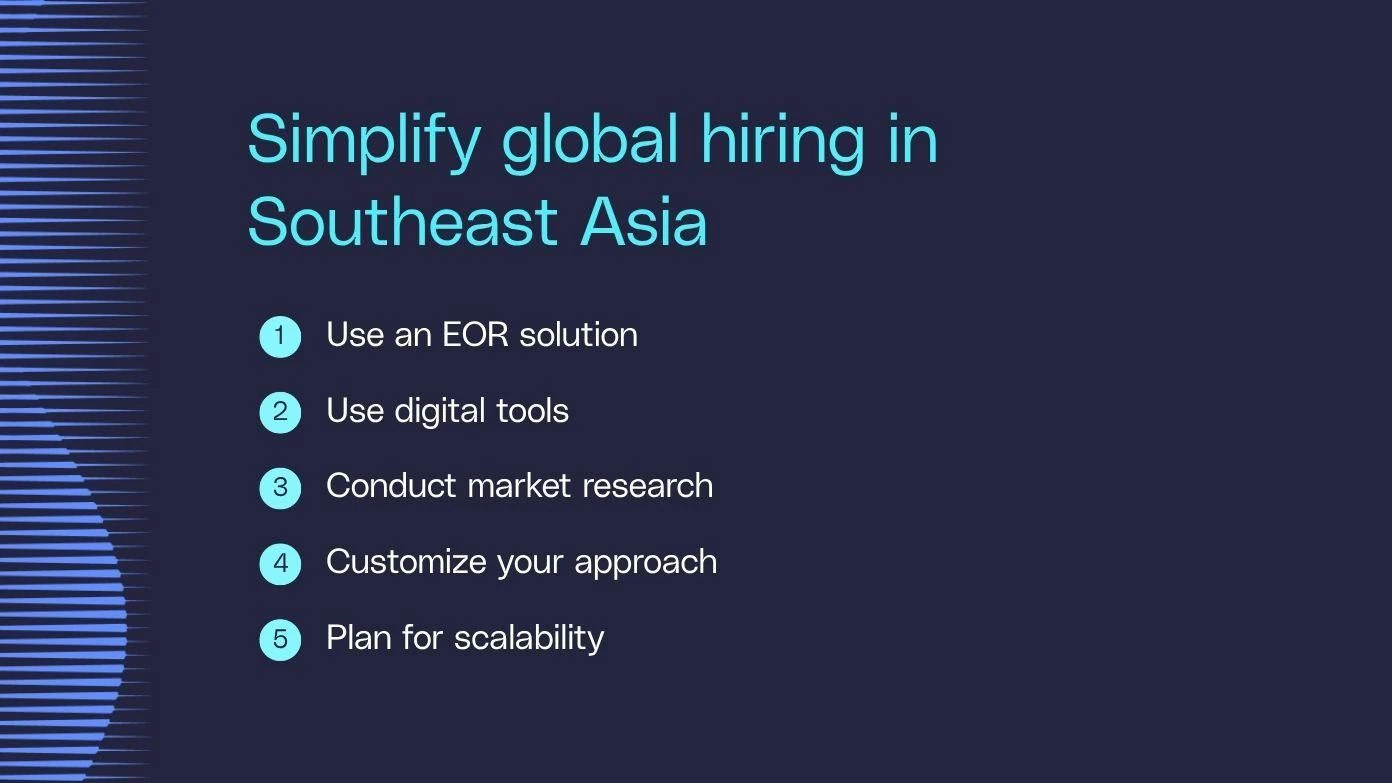
Estos consejos te ayudarán a contratar y hacer crecer tu negocio en el Sudeste Asiático:
- Emplea una solución de Plataforma global de empleo (Empleador de Registro): Contrata talento en los países objetivo sin crear una entidad de empleo asociándote con una entidad empleadora de registro (Plataforma global de empleo). Una Plataforma global de empleo (Empleador de Registro) garantiza el pleno cumplimiento de las leyes laborales locales y de las normativas fiscales.
- Emplea herramientas digitales: Elige una plataforma global fácil de usar para agilizar la contratación, la nómina, los beneficios y la gestión de la fuerza de trabajo.
- Realiza investigación de mercado: Evalúa entornos empresariales, grupos de talento y entornos regulatorios con un agente global de Recursos Humanos con inteligencia artificial como Gia.
- Personaliza tu enfoque: Adapta contratos, beneficios, políticas de Recursos Humanos y prácticas de colaboración a los requisitos locales y las expectativas del equipo. Los estilos de comunicación y toma de decisiones pueden variar según la compañía y el contexto, así que escucha primero y evita suposiciones. Construye confianza mediante presentaciones respetuosas, construcción de relaciones y un seguimiento fiable. Los gestores de tren, involucran a Recursos Humanos locales antes del despliegue, proporcionan derechos de cumplimiento para festivos públicos en cada ubicación y programan cuidadosamente en función de las principales observancias religiosas y culturales.
- Planee la escalabilidad: comience con uno o dos países y luego expandir con el tiempo.
Factores a tener en cuenta antes de expandir al sudeste asiático
Considera estos factores antes de expandirte al mercado global asiático:
- Disponibilidad de mano de obra y habilidades: Elige un mercado con las habilidades que necesitas para alcanzar tus objetivos. Por ejemplo, el sector IT-BPM de Filipinas está en camino de emplear a 25 millones de personas, lo que indica una fuerte oferta de habilidades en estas áreas. Una Plataforma global de empleo (Empleador de Registro) con presencia local permite análisis precisos de costo-beneficio para comparar las oportunidades para tu negocio asiático entre los países de la ASEAN.
- Facilidad para hacer negocios: Los tipos impositivos de sociedades, las capacidades laborales base y los costos de hacer negocios en el sudeste asiático varían entre países.
- Estrategia de entrada al mercado: Crear una entidad local puede ser lento, costoso y arriesgado. Una Plataforma global de empleo contrata talentosos, agiliza la nómina y beneficios, y mantiene el cumplimiento de las leyes laborales locales — no se necesita ninguna entidad.
Construye tu equipo global con G-P™
G-P es la #1 Plataforma global de empleo (Empleador de Registro) según todos los reportes de analistas del sector. G-P permite a compañías de todos los tamaños contratar, integrar y gestionar equipos globales en 180+ países, independientemente de su estatus de entidad. G-P productos globales de empleo y las soluciones Plataforma global de empleo combinan tecnología artificial con el mayor equipo de Recursos Humanos del país, expertos legales y de cumplimiento para agilizar el ciclo de vida global del empleo.
Contáctanos hoy mismo para expandir tu negocio al sudeste asiático.
Preguntas frecuentes
¿Cómo influye Asia en las tendencias empresariales globales?
Asia impulsa la economía global a través de sus cadenas de suministro manufactureras, la innovación tecnológica y su gran base de consumidores. Al expandirte a la región, pones tu negocio en el centro del comercio mundial y del crecimiento futuro del mercado.
¿Cuáles son los principales riesgos de hacer negocios en Asia?
Trabajar en las leyes laborales locales que cambian rápidamente y gestionar el cumplimiento normativo complejo presenta los mayores obstáculos. Debes planear en función de las interrupciones en la cadena de suministro y las fluctuaciones políticas o monetarias entre diferentes jurisdicciones.
¿En qué difieren las culturas empresariales entre países asiáticos?
La comunicación y la toma de decisiones van desde lo consensuado e indirecto en mercados como Japón o Vietnam hasta lo directo y acelerado en centros como Singapur. Construir confianza requiere que adaptes tu estilo de liderazgo, respetes las normas locales del lugar de trabajo y priorices la construcción de relaciones a largo plazo.
¿Qué define hoy la economía del sudeste asiático?
El Sudeste Asiático es un motor dinámico de crecimiento a dos velocidades impulsado por la adopción digital, las exportaciones manufactureras y la creciente demanda de la clase media. Ofrece un equilibrio entre mercados emergentes de alto crecimiento y centros financieros estables y de clase mundial.
¿Cuáles son los mejores mercados para entrar en el sudeste asiático?
Singapur, Vietnam, Malasia, Indonesia, Filipinas y Tailandia lideran la región. Elige economías de alto crecimiento como Vietnam para escalar la producción o centros maduros como Singapur para operaciones regionales y protección de propiedad intelectual.