



주요 요점
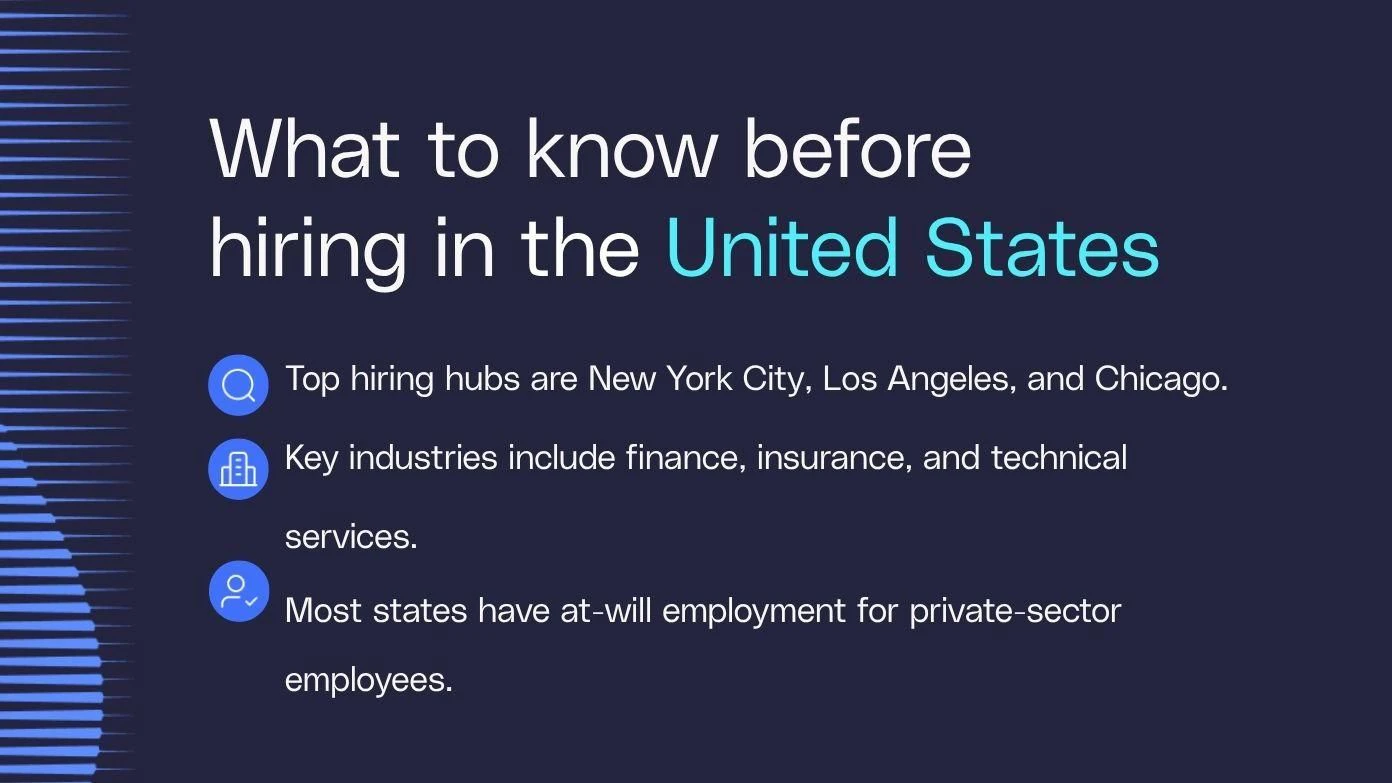
- The United States' top hiring hubs are New York City, Los Angeles, and Chicago.
- Top industries in the U.S. include finance, insurance, technical services, and healthcare.
- Companies hiring in the United States have various options for setup, including partnering with an employer of record (EOR), hiring contractors, establishing a subsidiary, or direct employer registration.
The U.S. is the world's largest economy by nominal GDP (approximately USD 32.6T) in 2026. The United States also represents the largest consumer market in the world. It continues to be a global leader in technology, finance, and innovation, from Silicon Valley and Wall Street, offering access to venture capital and a high-income customer base.
Before expanding into the U.S., you'll need to understand contracts, taxes, wages, benefits, and other employment laws. Our guide will tell you everything you need to know about hiring in the U.S.
미국에서 채용하기 전에 알아야 할 사항
If you're expanding your business into the U.S. for the first time, there are important legal requirements to be aware of. These norms and laws influence hiring practices in the U.S. and many aspects of the employer-employee relationship, including compensation and benefits.
G-P Gia™, our AI-powered global HR agent, can answer your toughest compliance questions across 50 countries — including the U.S. — and all 50 U.S. states. Reduce your reliance on outside counsel and cut the time and cost of compliance by up to 95% with Gia.
Here are five things to know about hiring in the U.S.:
1. At-will employment and termination
Most U.S. states have at-will employment for private sector, non-union employees. Employers can terminate employees at any time, for any legal reason, or no reason at all. Employees cannot be terminated as retaliation or for protected reasons. Contracts, collective bargaining agreements, workplace policies, and state regulations may have additional policies for compliant termination.
Notice and severance pay aren't legally required in most cases, though many employers provide them as a courtesy or for higher-level roles. Sometimes, federal WARN and mini-WARN laws require that employees be notified about upcoming major layoffs or job site closings. Other exceptions include employment contract terms, company policies, or collective bargaining agreements. There are also state-specific requirements in New Jersey and Maine.
At-will employees can leave their jobs at any time, for any reason, without legal penalty. However, in some cases, there may be a required notice period, repayments, confidentiality agreements, or other obligations.
Employment contracts aren't standard for most U.S. employees, except for executives or specialized positions. Most workers are hired without a formal contract. Public sector and unionized employees may have additional due process or just cause protections.
Montana is the only state that doesn't follow the at-will doctrine. After a 12-18 month probationary period, employees can only be terminated with good cause. Exceptions to at-will employment still apply, such as terminations that violate anti-discrimination laws, public policy, or an existing employment contract.
2. 급여 및 세금
Employers have to add employees to payroll, withhold federal and usually state income taxes, and deposit these to the IRS and state or local tax agencies. Federal income tax withholding works on a bracketed system. For employees earning up to $184,500, both employers and employees contribute 6.2% of wages to social security for 2026. The maximum social security tax is $11,439 for each party.
Employees are subject to federal income tax withholding, which uses a bracketed system. Withholding is based on taxable wages, pay frequency, and W-4 forms. State income tax rates and brackets vary by state and are based on work location, residence, reciprocity agreements, and local rules. Some states have no income tax, while others have flat or progressive rates.
Employers and employees each contribute 1.45% to Medicare. For employees earning over USD 200,000, regardless of filing status, there is an additional 0.9% employee-only Medicare tax. There are additional thresholds based on income and filing status. There is no annual wage cap on Medicare contributions.
3. Standard working hours
The culturally standard workweek in the U.S. is 40 hours, spread across eight hours per day, five days per week. The Fair Labor Standards Act (FLSA) doesn't cap working hours or require an eight-hour workday. An FLSA workweek is defined by a 168-hour period, not seven consecutive 24-hour periods.
Alternative schedules in healthcare and other industries are common. Some companies offer shorter workweeks or part-time roles.
For overtime, the U.S. law distinguishes between exempt and nonexempt employees under the FLSA:
- Exempt employees, who meet certain duties tests, don't get overtime pay.
- Covered, nonexempt employees are entitled to overtime pay at 1.5 times their regular rate of pay after working 40 hours in a workweek. For example, an employee making USD 10 per hour would make USD 15 per hour in overtime.
State and local regulations can include additional overtime requirements, rules for meal and rest breaks, split-shift premiums, and more.
4. Employee benefits
There are no federal mandates for private-sector employers to provide paid vacation, paid sick leave, or paid parental leave. However, state and local laws may require employers to provide paid leave. There are also exceptions for federal contractors and under certain employment contracts and CBAs.
The Affordable Care Act (ACA) requires employers with 50 or more full-time employees or full-time equivalents in the prior calendar year to offer affordable, minimum essential health coverage. This coverage must be offered to at least 95% of eligible workers and their dependents. The ACA affordability threshold is 9.96%.
Smaller employers may be eligible for the Small Business Health Options Program (SHOP) and related tax credits. Employer-sponsored health insurance is a big part of compensation. Out-of-pocket annual healthcare costs for U.S. employees are currently among the highest in the world, averaging up to USD 14,885 per person.
The Family and Medical Leave Act (FMLA) provides up to 12 weeks of unpaid, job-protected leave for certain family and medical reasons, but only for employees at companies with 50 or more employees within 75 miles. Employees must also meet eligibility requirements, including 12 months of service and working 1,250 hours.
The U.S. has 11 federal holidays. Private employers aren't required by law to provide these days off or pay extra for work on holidays.
5. State and federal regulations
U.S. employment regulations are a blend of state and federal laws. For instance, federal law imposes a minimum wage, currently USD 7.25 per hour for covered, non-exempt employees. However, individual states can impose higher minimum wage laws if they choose, and rates may be different for tipped industries.
Federal law requires employees to prove they're eligible to work in the U.S. No matter what state they plan to work in, employees have to be prepared to show proof of identity and work verification documents.
2026 미국 내 직원 기대치
Stress levels are creeping up for employees in the U.S. Our research found that 70% of U.S. workers are concerned about job loss due to macroeconomic factors, and 64% are worried their skills won't cut it in an AI-powered workplace.
약 55%의 직원이 향후 6개월 내에 새로운 일자리를 적극적으로 찾고 있거나 찾을 가능성이 높습니다. 미국에서 채용하는 기업에게 있어 고용 안정성과 전문성 개발은 유지와 채용에 중요한 요소입니다. 기업의 안정성을 강조하고, 기술 노후화 우려를 해결하기 위해 강력한 인공지능(AI) 역량 강화 프로그램을 구축하세요.
Hiring models for global companies in the U.S.
There are a few options for expanding your business into the U.S., each with their own pros and cons. These options include:
- Direct employer registration: forming a U.S. entity or registering a non-national entity. You will independently manage payroll, tax withholding, statutory insurance, and federal, state, and local employer obligations.
- 기록상 고용주(EOR): G-P EOR acts as the legal employer, handling administrative and payroll processes on behalf of your company, including contracts, withholding, contributions, and mandatory benefits. In the U.S., EOR rules and licensing vary by state. Clients can retain joint-employment, co-employment, or other obligations and liabilities.
- Subsidiary or branch: a subsidiary will function as a separate legal entity, while a branch will function as an extension of your parent company. Regulations for branch registration and subsidiary qualifications vary from state to state.
- Independent contractor: hiring independent contractors in the U.S. generally doesn't require establishing a local entity or branch. However, there are significant penalties for misclassified workers, so federal and state tests must be followed when hiring them. Hiring contractors may still trigger registration, nexus, reporting, or other liabilities.
미국 최고의 채용 허브
미국의 일부 도시는 특정 산업으로 유명합니다. 각 도시가 제공하는 서비스를 파악하면 적재적소에 채용 노력을 집중하고 더 빠르게 직책을 채울 수 있습니다.
미국 최고의 인재 허브는 다음과 같습니다:
- New York City: the largest U.S. city and a global center for finance, technology, healthcare, media, and professional services.
- Los Angeles: a hub for entertainment, technology, healthcare, and global trade.
- Chicago: known for its finance, manufacturing, logistics, and healthcare sectors.
- Houston: a leader in energy, healthcare, aerospace, and manufacturing.
- Dallas-Fort Worth: a fast-growing region in technology, finance, and logistics.
- San Francisco Bay Area: the center of the tech industry, including San Francisco, San Jose, and Oakland.
- Atlanta: a big center for logistics, media, technology, and corporate headquarters.
- Boston: known for healthcare, education, biotechnology, and finance.
- Seattle: home to major employers like Amazon, Microsoft, and Boeing.
- Washington DC Metro Area: includes DC, Northern Virginia, and Maryland, and has strong government, tech, and consulting sectors.
- Miami: a gateway for global business, tourism, and finance.
- Austin: a fast-growing tech and innovation center.
미국의 주요 산업
미국의 주요 산업을 이해하면 급여와 복리후생을 벤치마크할 수 있습니다. 이 인사이트를 활용하여 어디에 투자하고 인력을 성장시킬지 현명한 선택을 할 수 있습니다.
미국의 주요 산업은 다음과 같습니다:
- Finance, insurance, and real estate: This industry is the largest GDP contributor in the U.S. This includes commercial banking (USD 1.42T), health insurance (USD 1.54T), property/casualty insurance, and commercial real estate market (USD 1.48T).
- Professional, scientific, and technical services: This industry includes legal, accounting, consulting, engineering, and architectural services.
- Healthcare and social assistance: The U.S. healthcare industry is one of the largest single industries by revenue globally. Hospitals and medical insurance generate trillions of dollars.
- Information Technology (IT): While only a portion of the overall service sector, the information sector (which includes software, data processing, and IT services) is important to every other industry.
- Energy and mining: The U.S. is the world's largest producer of petroleum and natural gas.
미국에서 직원을 고용하는 비용
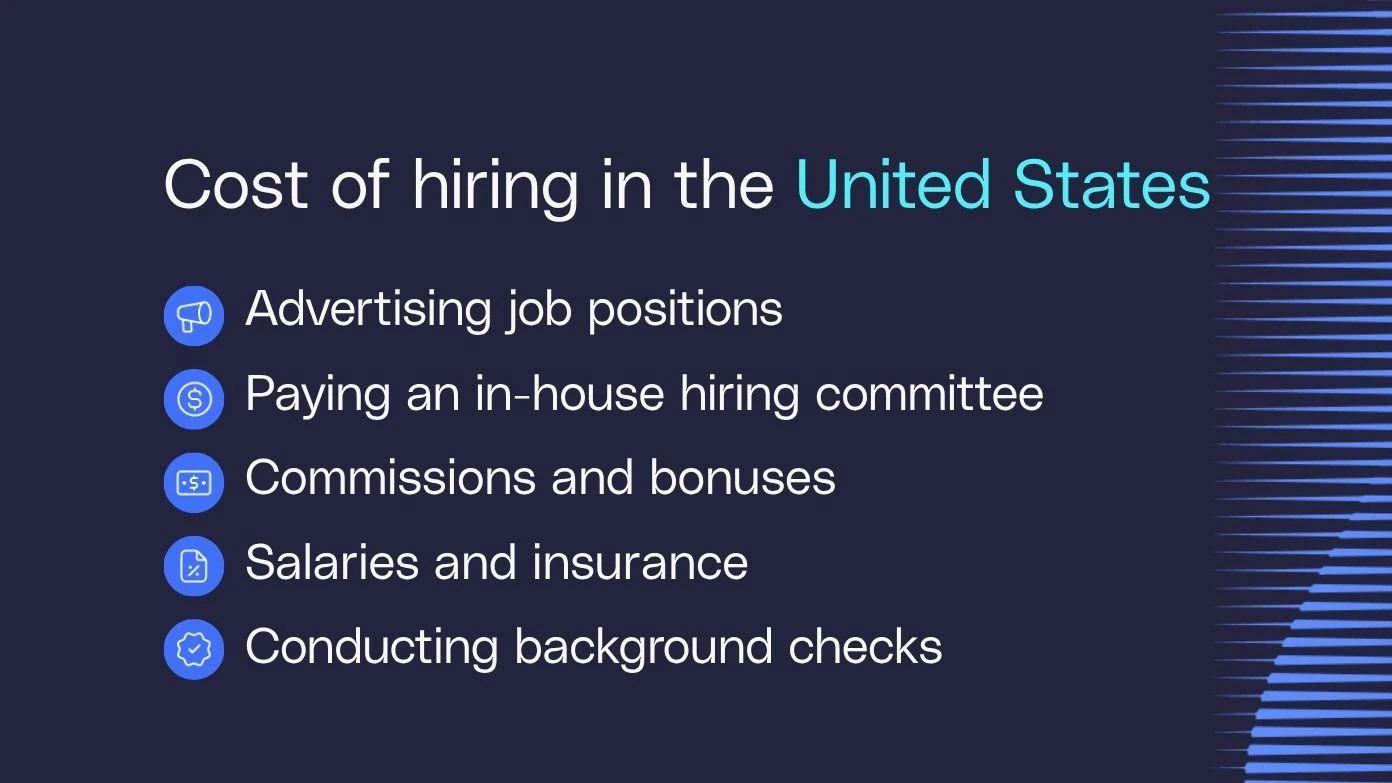
Whether you're hiring one employee or an entire team in the U.S., expenses are inevitable. Budget for the following:
- 법인 설립 (단, 공식 고용주 와 제휴하는 경우는 제외)
- 구인 광고
- 지원자 검토를 위한 인건비
- 급여
- 세금
- 월급
- 혜택
- 보너스
- 수당
- 보험
- 여행
According to G-P Verified Sources from Gia, the employer burden rate in the U.S., which includes costs triggered on top of salaries, is approximately 7.65–10%.
기업이 미국에서 채용 직원을 채용하려면 무엇이 필요한가요?
미국에서 팀을 확장하기 전에 이러한 필수 사항을 반드시 확인하세요:
- Choose a hiring model.
- 파일 설립 문서.
- 고용주 식별 번호(EIN)를 받으세요.
- 주 세무 당국에 등록하세요.
- 지방세 등록(일부 시/군에서는 추가 등록이 필요합니다).
- 연방 및 주 소득세, 사회보장제도, 메디케어를 계산, 원천징수, 납부 시스템을 구축하세요.
- 실업 보험에 등록하세요.
- Register for workers' compensation insurance.
- 규정준수 제안서 및 고용 계약서 초안 작성.
- 직원 핸드북 및 정책을 개발하세요.
- 각 채용예정자9 양식 I- 작성 및 문서 보관.
- 신입 사원은 주 정부에 신고하세요. 대부분의 주에서는 채용 후 20 일 이내에 보고해야 합니다.
Setting up a U.S. subsidiary can take weeks or months. Use G-P EOR to hire full-time employees in the U.S. without setting up your own entity. Build your team in the U.S. at a lower cost and with peace of mind that you're doing so compliantly.
미국에서 채용을 위한 단계들
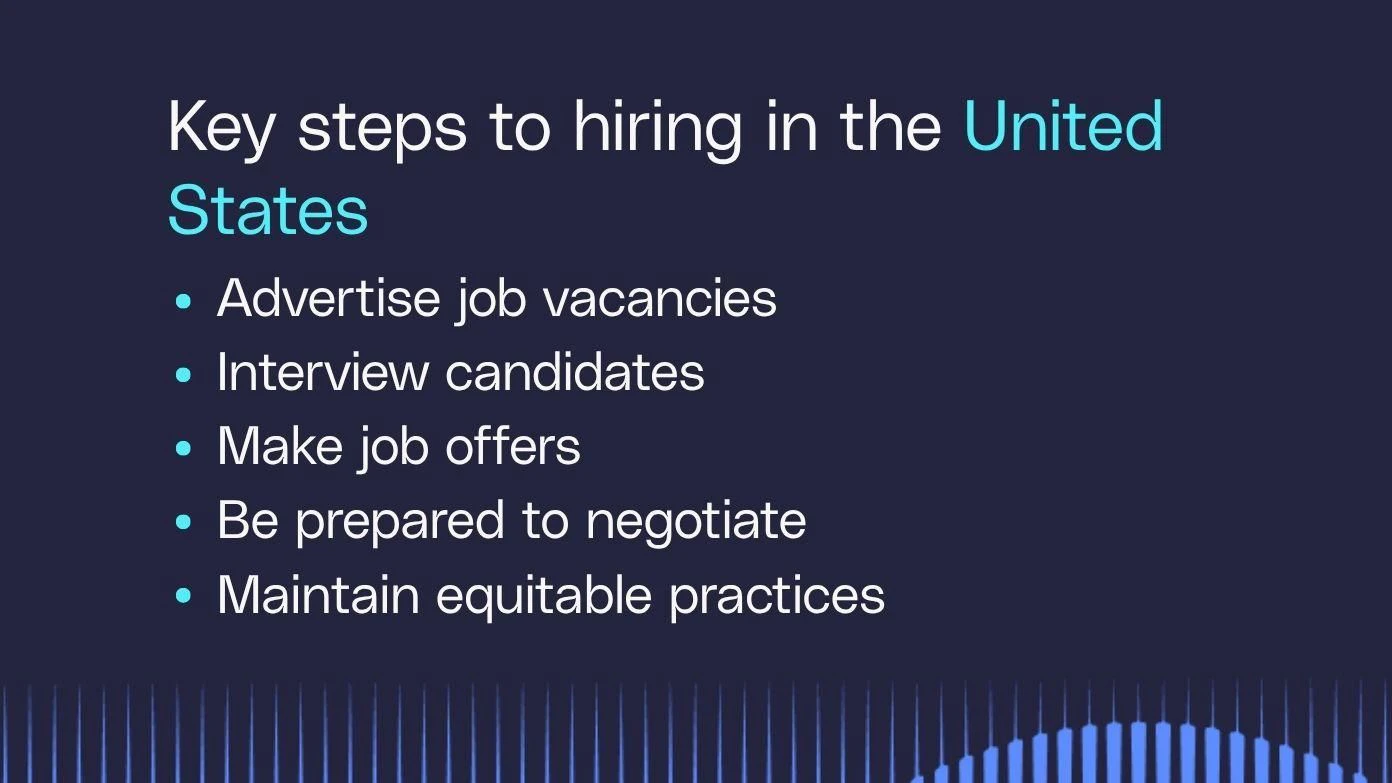
The hiring process in the U.S. is similar to the one you're likely familiar with in your own country. The hiring process follows five basic steps: advertising the job, evaluating applications, interviewing candidates, sending job offers, and onboarding new employees.
1. 공석 광고
Create a detailed job description and define the role based on responsibilities and qualifications. Write a clear job description outlining duties, qualifications, and skills needed. Determine compensation and benefits. It's best practice to include an Equal Opportunity Employer (EOE) statement to signal your commitment to fair hiring.
주 및 지방 법률에 따라 구인 공고에서 월급 범위 공개를 요구할 수 있습니다(예: 캘리포니아, 콜로라도, 뉴욕, 뉴저지 2025년 6월 기준). Indeed와 LinkedIn은 미국에서 인기 있는 구직 사이트입니다.
2. 지원서 평가
Collect applications and review resumes. Screen candidates based on their qualifications, experience, and fit for the role. Employers with 15+ employees must provide reasonable accommodations to applicants with disabilities, such as accessible application formats or interpreters for interviews.
3. 입사 후보자 면접
Interview candidates who made it onto your shortlist. You can do these interviews in-person or virtually. Use structured, nondiscriminatory interview questions. Gia can help you create questions that follow anti-discrimination laws in the U.S., so you can find the best fit for the role while complying with local regulations.
4. 채용 제안하기
Contact your chosen candidate to offer them a position with your company. Have the employee complete Form I-9 (work eligibility verification) and Form W-4 (tax withholding). Provide any state-required forms and notices. Report the new hire to the state's new hire registry (needed in all states, usually within 20 days).
5. 신규 직원 온보딩
Now you can onboard new employees. Set up payroll and benefits. Provide orientation, your employee handbook, and required labor law posters.
If you're working with an EOR like G-P™, you won't have to worry about the administrative burden of onboarding. We'll streamline the process, so you can focus on training your new hire and integrating them into your company culture.
미국에서 계약자 고용하기
Working with independent contractors in the U.S. can be a cost-effective way to test the market and build a presence, without the commitment of full-time employees. Contractors based in the U.S. understand local consumer behavior, rules, and business practices. They'll be ready to start working quickly with their own equipment and established work processes.
독립계약자를 고용하면 고용의 복잡성과 비용 부담 없이 비즈니스 요구에 따라 인력을 쉽게 조정할 수 있습니다.
미국에서 독립 독립계약자와 계약을 체결하기 전에 다음 사항을 고려하세요:
1. 직원 대 독립계약자
It's important to classify workers correctly when hiring employees and independent contracts. A worker is classified as an employee when your company controls how, when, and where they work, assigns them ongoing duties, or supplies the tools they need. An independent contractor operates an independent business, controls their own work, uses their own equipment, and completes a defined project or service.
State and federal tests can differ when determining if a worker is a contractor or an employee. For legal classification, contract terms are not as important as the worker's level of control over their work and whether their services form a core part of your business.
Use G-P Contractor™ to hire and pay contractors in 190+ countries compliantly. Get peace of mind that your contractors are correctly classified with AI contract checks that deliver guidance on what to change.
2. 잘못된 분류에 대한 처벌
독립계약자가 아닌 사람을 독립계약자로 분류하는 것은 심각한 처벌로 이어질 수 있습니다. 오분류가 발생하면 다음과 같이 해야 합니다.
- 잘못 분류된 근로자에게 지급해야 할 체불 임금, 초과근무 수당, 복리후생.
- Pay unpaid payroll taxes, such as social security, Medicare, and unemployment insurance, plus interest and penalties.
- 추가 주 차원의 벌금(벌금)을 상대해야 합니다.
3. 계약자에게 지불하는 방법
G-P Contractor는 해외 계약직 직원을 고용하고 급여를 지급하는 복잡하고 시간 소모적인 과정을 없애줍니다. 몇 번의 클릭만으로 계약을 생성 및 발행하고 계약자에게 비용을 지불할 수 있으며, 이 모든 과정에서 규정준수 절차를 준수할 수 있습니다.
G-P를 통해 미국 내 직원 및 계약자를 고용하세요.
당사의 글로벌 고용 플랫폼 ™ (글로벌 채용 플랫폼)과 인공지능(AI) 기반 제품인 기록상 배치(EOR), Contractor, Gia 기업이 글로벌 팀을 구축하고 관리할 수 있도록 지원합니다.
G-P 10년 이상의 경험을 보유한 글로벌 고용 분야의 선도 기업으로 인정받고 있으며, 인사, 법률 및 규정 준수 전문가로 구성된 최대 규모의 팀과 글로벌 독자 지식 기반을 갖추고 있습니다.
Make your expansion to the US easier with G-P. Contact us or book a demo today.
FAQ
미국에서 신규 직원을 채용하려면 어떤 서류가 필요한가요?
New hires have to complete Form I-9 for employment eligibility verification and Form W-4 for federal tax withholding. State-specific forms may also be required.
미국에서 근로계약서를 제공해야 하나요?
Most U.S. employees are hired "at-will" and do not need a formal contract, except for executives or specialized roles. Offer letters are standard practice.
미국의 최저 임금은 얼마인가요?
The federal minimum wage is USD 7.25 per hour, though many states and cities enforce higher local minimums.
미국에서 고용주들은 어떤 급여세와 기여금을 납부하나요?
Employers must withhold and pay social security, Medicare, federal and state income taxes, and unemployment insurance. Specific rates vary by state.
미국에서 고용주는 복지 혜택을 제공해야 하나요?
Federal law does not mandate paid vacation, sick leave, or health insurance for small employers. However, the Affordable Care Act requires companies with 50 or more full-time employees to offer health insurance coverage.