



主要心得​​ 

瑞士人口為8 . 9百萬,其族裔包括瑞士人、德國人、法國人、義大利人、葡萄牙人和科索沃人。每個州都使用同一種國家貨幣—瑞士法郎。重點產業包括金融和銀行業、醫療設備和工程業。​​ 

有利的公司稅法和文化可及性是許多跨國企業擴張至瑞士的兩個原因。 我們的指南將告訴您在瑞士租房所需的一切資訊。​​ 

在瑞士招聘前需知​​ 

What to know before hiring in Switzerland?​​ 

如果您是首次將業務拓展至瑞士,有一些重要的法律規定需要注意。這些規範和法律影響著瑞士的雇傭實務。​​ 

If you’re unsure where to begin, G-P Gia™, our AI-powered global HR agent, can answer your toughest compliance questions across 50 countries — including Switzerland — and all 50 U.S. states. Reduce your reliance on outside counsel and cut the time and cost of compliance by up to 95% with Gia.​​ 

讓我們來看看在瑞士雇用員工的八大注意事項。​​ 

1.雇主-員工章程​​ 

所有雇主-員工關係必須遵守下列規範:​​ 

只要符合所有法律要求,瑞士就承認工會。​​ 

2.瑞士各州​​ 

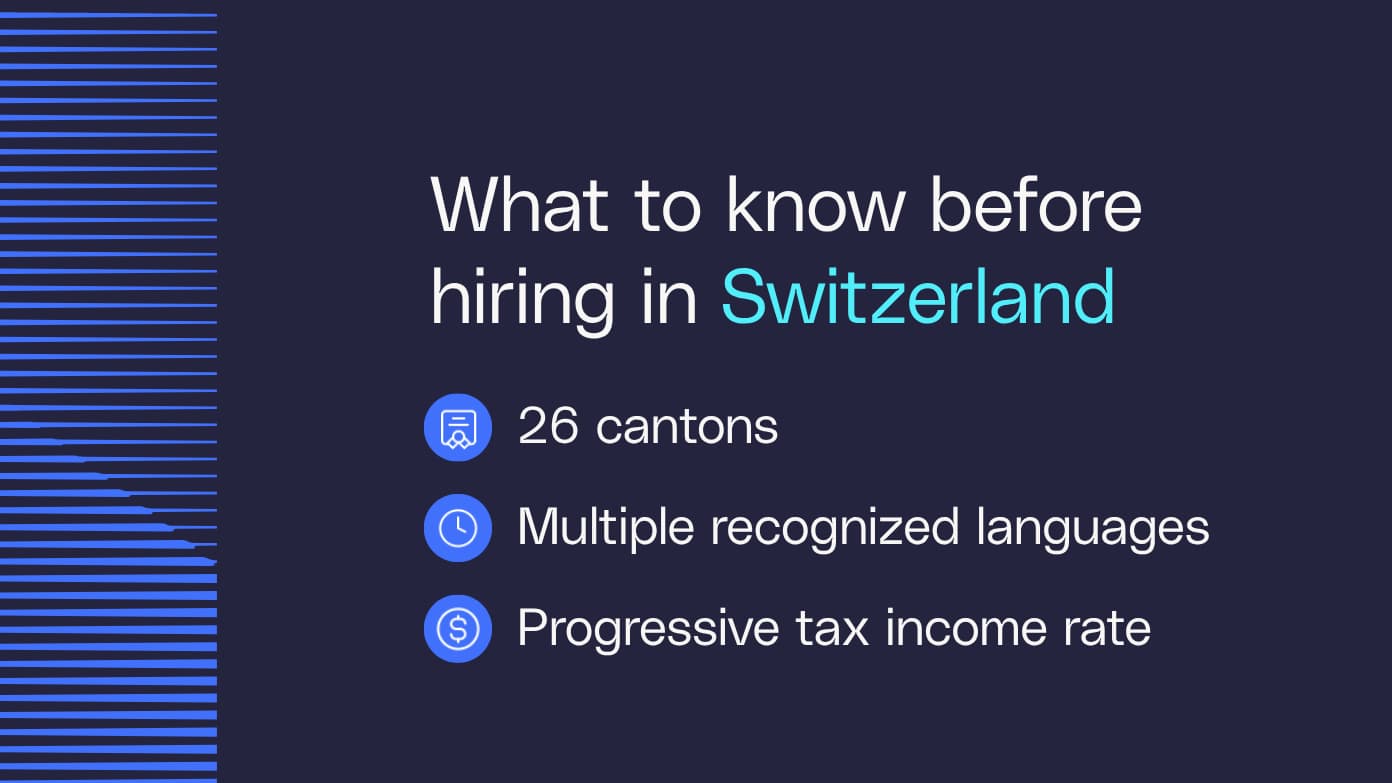
Switzerland is divided into 26 cantons. Though they all fall under the Swiss national umbrella, they’re powerful entities on their own. Each canton has unique traditions and culture. They also have their own ways of self-governing, including laws, constitutions, and governmental structure.​​ 

When hiring employees in Switzerland, be aware of the canton you’re advertising your position in. Candidates’ canton-of-residency will give you insight into translation expectations, tax rates to include in your employment contracts, and considerations on which holidays they are entitled to.​​ 

市鎮是每個州內較小的政府機構,決定如何在瑞士聘僱。​​ 

3.瑞士勞工市場​​ 

More than 5 million people are active in the Swiss labor market. The employment rate is 80.6%. For comparison, the EU rate is 75.8%. Workers are highly skilled and hold degrees from higher learning institutions. In terms of early childhood education and secondary schools, the Swiss education system varies between cantons. The IMD World Talent Ranking 2024 named Switzerland the #1 country for fostering homegrown talent in the world.​​  

4.瑞士的語言​​ 

Multilingualism is a core component of Swiss culture, largely due to the Languages Act. This act recognizes German, French, Italian, and Romansh as national languages. German, French, and Italian are also the official languages of the Confederation. Romansh is used officially in communications with Romansh speakers. Roughly two-thirds of the country’s residents speak more than one language. Swiss children learn at least two of the national languages during their early education years.​​ 

瑞士德語是各州使用最廣泛的語言。法語在西部各州很常見,義大利語在南部很常見。羅曼什語是一種使用較少的語言,源自雷蒂亞人,他們是阿爾卑斯山地區的早期居民。一些州和地區也有自己的方言和俚語。​​ 

所有僱傭合約、面試和工作分配都應考慮面試者或員工的第一語言。 良好的做法是翻譯所有文件,並在必要時聘僱傳譯員。​​ 

5.工作時數和休假​​ 

The Swiss Labor Act regulates working hours and time off laws. The maximum workweek is 45 hours for employees in industrial enterprises, office staff, technical personnel, and sales staff in large retail companies. For all other employees, it’s 50 hours. Daily working hours, including breaks and overtime, shouldn’t exceed 14 hours. In practice, the typical working time in Switzerland is 12.5 hours.​​  

只有在特殊情況下才允許加班。必須以25% 薪資保費或等值請假補償。 員工每天必須至少連續休息11 小時。只要兩週的平均休息時間至少達到11 小時,就可以減少到每週一次8 小時。工人每週至少連續休息35 小時,包括星期天。​​  

Employees are entitled to three weeks of sick leave within the first year of employment with a company. Each canton has its own paid time off and sick leave restrictions.​​  

Pregnant employees get 14 weeks of paid maternity leave, and fathers are entitled to two weeks of paternity leave.​​  

Regardless of their canton, every employee gets four weeks of vacation time each year, or five if the employee is 20 or younger. Employees and employers can negotiate additional time off in their contracts if desired.​​  

Cantons have their own local and public holidays. National Day on August 1 is the only federal holiday. If National Day falls on a Tuesday or Thursday, it’s common to give employees a long weekend. Switzerland also celebrates New Year’s Day, Easter, and Christmas Day, but specific regulations for those times vary between employers. Employees can choose extra salary instead of taking a paid holiday.​​ 

6.勞動契約​​ 

Employees can be temporary, agency-supplied, part-time, or full-time. The first month of employment is considered the probationary period. You can extend this to a maximum of three months in your employment contract. If at any point you choose to end the working relationship, you must give at least a seven-day notice.​​  

僱傭合約不是必需的,但卻很常見,而且強烈建議您簽訂,因為有些條款只有在書面形式下才會被法律承認。合約具有約束力。雇主不能違背協定的合約條款。瑞士有多項法律保護工會和某些員工,例如婦女或未成年人。雇主必須出具書面信函,詳細說明開工日期、工作職能、薪資以及員工每週的工作時數。​​ 

Indefinite contracts are common in Switzerland. “Chain” contracts are viewed unfavorably by Swiss courts. Chain contracts are a series of fixed-term contracts initiated back-to-back with the same employee. The practice can be considered an abuse of rights if used to circumvent the protections of permanent employment, such as job security and notice periods. Once the last day of the contract is finished, the employee-employer relationship is over, with no notice required.​​ 

You and your team member can agree upon an equal duration for giving a departure or termination notice. This notice shouldn’t be less than one month in the first year of employment, and two months for every length of employment up to nine years. Three months is customary beyond that. You can’t terminate employees if they’re pregnant, ill, or on maternity leave. You only need to pay severance if employees are 50 or older and have worked for you for 20+ years.​​ 

G-P EOR has an Employment Contact Generator to help you draft compliant employment contracts when you hire employees in Switzerland that meet all legal requirements and best practices.​​ 

7.報酬和福利​​ 

The Swiss Federal Act on Gender Equality (GEA) requires all companies with 100 or more employees to conduct an internal audit to ensure pay equality is enforced.​​ 

Switzerland doesn’t have a single federal minimum wage. Minimum pay obligations can come from cantons or municipalities, CBAs, or employment contracts for specific sectors. Otherwise, pay is set by contract and market practice. Employees are paid once at the end of the month.​​  

Statutory overtime includes time worked over the maximum number of legal working hours. Statutory overtime is different from contractual overtime and is only permitted during day or evening shifts on workdays. It must be compensated with a wage supplement of at least 25%.​​  

員工也可以選擇請假來代替薪資增加。 法定加班時間每天不得超過兩小時,45- 小時的工作周不得超過170 小時,50- 小時的工作周不得超過140 小時。在緊急情況下,可以准予某些例外。​​ 

Employers typically pay 80% — with a yearly limit — of an employee’s salary if they have suffered a work-related injury. The amount may differ depending on the industry or specific insurance plan. Employers are responsible for establishing a social security relationship between their employees and their canton’s social security office. Social security includes contributions to Maternity Leave Insurance (MSE), Disability Insurance (DI), Child Benefits Insurance (FZ), and pension, or Old Age and Survivors Insurance (OASI). Social security rates are 6.4% for the employer and 6.4% for the employee.​​ 

Bonuses and 13th-month salary are not required but are common. Employers may award bonuses contractually or at their discretion. Note that Switzerland has strict bonus guidelines for the financial industry. This is to prevent excessive risk-taking and ensure that compensation practices don’t undermine financial stability.​​ 

If an employee has been with your company for longer than three months, works at least eight hours each week, and meets income requirements, they can participate in an employer-sponsored pension fund. The current minimum for AHV pension is CHF 1,260. Employers are also responsible for accident insurance.​​  

You can easily administer benefits plans with G-P EOR. Our in-house experts continuously monitor employment laws to meet country-specific regulations and norms. Build and manage benefits plans through our platform to provide a smooth employee experience.​​  

8.稅務​​ 

Switzerland's federal income tax rate is progressive, with a maximum rate of 11.5% for the highest income bracket. It's important to note that cantonal and municipal taxes also apply. This can greatly impact your total tax amount, depending on where you’re based. The federal VAT rate is 8.1%.​​ 

9. Equality, data privacy, and recruitment practices​​ 

Recruitment and employment practices have to comply with the Federal Gender Equality Act. This prevents direct and indirect gender-based discrimination across the employment lifecycle, including:​​ 

Employers have to make sure equal pay for work of equal value. Objective, job-related criteria for recruitment, compensation, promotion, and termination decisions have to apply.​​ 

Employers with 100 or more employees in Switzerland need to do an internal equal pay analysis using a scientifically valid method. Analysis has to be independently verified and the results communicated to employees within the required timeframe. This is separate from the general equal pay obligation for all employers.​​ 

Candidate personal data has to be collected and processed in accordance with Swiss data protection requirements. This includes the Federal Act on Data Protection and the employment-specific limits in the Swiss Code of Obligations. Recruitment data has to be:​​ 

Background checks can only be done when proportionate, job-relevant, and properly disclosed.​​ 

Hiring models for global companies in Switzerland​​ 

The best model when you decide to hire employees in Switzerland depends on your overall business goals.​​  

模型​​  最適合​​  Key points​​  主要風險​​ 
直接雇主註冊​​  Hiring in Switzerland without a local entity.​​  Register with Swiss social security and tax authorities. Run Swiss payroll. Manage permits, benefits, and employment compliance.​​  High admin burden. Cantonal process differences. Risk of payroll, tax, or permit errors.​​ 
Employer of Record, like G-P EOR​​  Fast process to hire in Switzerland without setting up an entity.​​  EOR is the legal employer. Provider manages payroll, benefits, and contracts. Have to be properly licensed for staff leasing.​​  Unlicensed provider risk. Less direct control. Clients can still have workplace and supervision duties.​​ 
Subsidiary or branch​​  Long-term operations in Switzerland.​​  Creates a formal local presence. Supports direct hiring and local management. Best for larger or permanent teams.​​  Higher setup and maintenance cost. More corporate, tax, payroll, and HR compliance duties.​​ 
獨立約聘人員​​  Short-term, specialist, project-based work.​​  Contractors have to work independently. Use deliverable-based terms. Verify self-employed status where possible.​​  Misclassification risk. Back social security and tax exposure. Employment rights can apply retroactively.​​ 
 

瑞士頂級招聘中心​​ 

Some Swiss cities are known for particular industries. Knowing what each city has to offer can help you channel your hiring efforts to the right place and fill roles faster when you hire in Switzerland.​​  

 瑞士的頂尖人才樞紐有​​ 

瑞士的主要產業​​ 

Understanding Switzerland’s main industries helps you benchmark salaries and benefits when hiring employees in Switzerland. You can use this insight to make smart choices about where to invest and grow your workforce.​​  

 瑞士的主要產業包括:​​ 

在瑞士雇用員工的成本​​ 

Cost of hiring in Switzerland​​ 

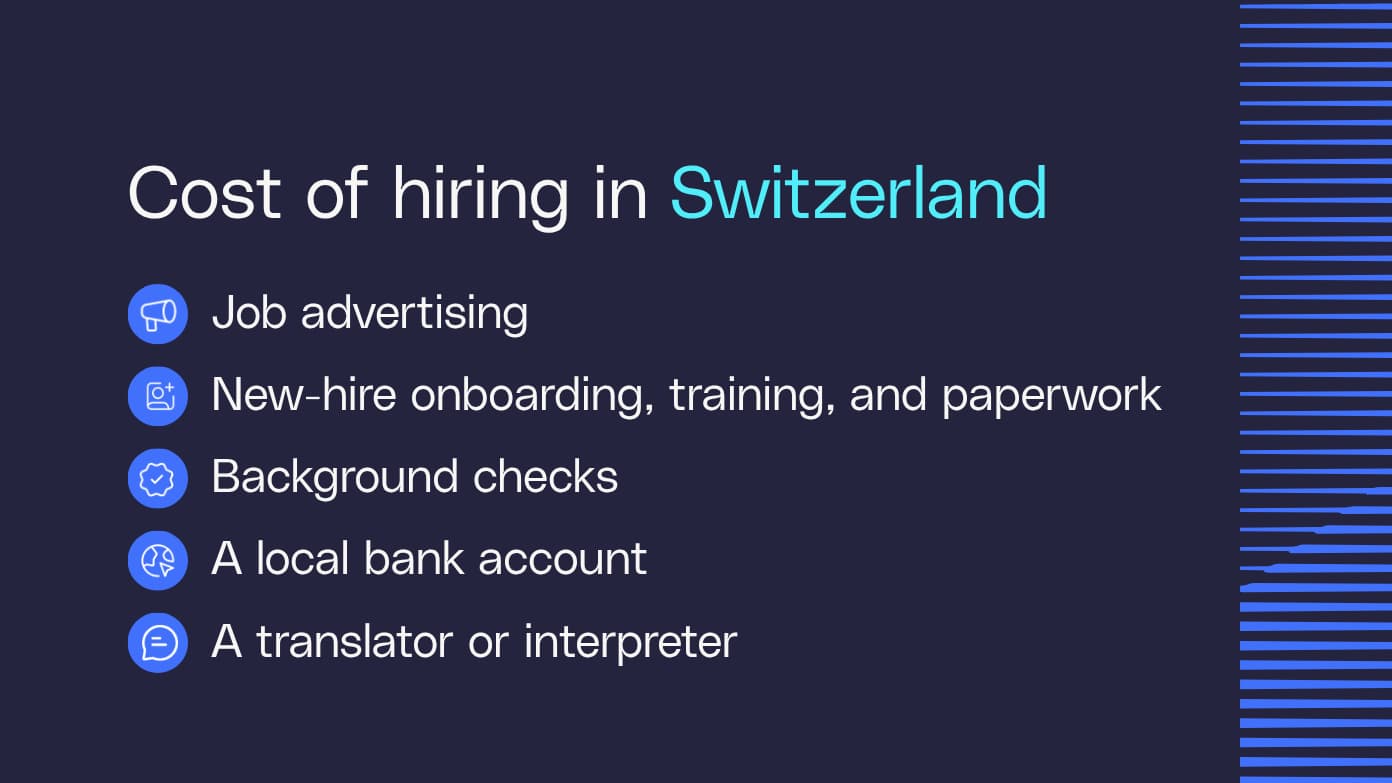
Whether you’re hiring one employee or an entire team, the process of hiring in Switzerland comes with inevitable expenses.​​  

Budget for the following:​​ 

According to Gia, the total annual employer burden rate in Switzerland, which includes costs triggered on top of salaries, is between 10% and 20% of gross salary. Rates will depend on the employee’s salary, industry, and canton. Gia leverages G-P’s 13+ years of global employment experience, along with insights from almost a million real-world scenarios, to provide accurate, up-to-date employment law information.​​ 

在瑞士,公司聘僱需要哪些條件?​​ 

EU/EFTA vs. non-EU/EFTA workers​​  

Thanks to the Agreement on the Free Movement of Persons (AFMP), hiring citizens from EU/EFTA member states involves few administrative hurdles. Employers don’t need to give priority to local Swiss workers or justify why an EU/EFTA candidate was selected. For short-term contracts (up to 90 days per calendar year), companies only need to submit an online notification before the employee begins work. For longer arrangements, the employee registers with their local Swiss commune of residence to get a residence/work permit (such as an L or B permit). This gives them immediate access to the Swiss labor market.​​ 

Non-EU/EFTA nationals​​ 

Hiring candidates from non-EU/EFTA countries (including the UK and U.S.) is more regulated. Under the Federal Act on Foreign Nationals and Integration (FNIA), employers have to prove that local recruitment efforts failed. Non-EU/EFTA permits are restricted almost exclusively to personnel like managers, senior specialists, or university graduates with specialized experience.​​ 

Permit quotas and administrative timeline​​ 

The Swiss government has a strict annual national quota on work permits for non-EU/EFTA nationals. The work permit needs a multi-tiered approval process involving cantonal labor authorities and the State Secretariat for Migration (SEM). Employers have to start the permit application in advance. The employee can’t begin work until formal authorization.​​ 

It’s in your best interest to establish a relationship with a canton’s local economic offices or embassy. You don’t need a legal entity to hire in Switzerland, but if you choose to start a Swiss company, you can choose between:​​ 

Branches are a common route for international companies, and require you to pay local taxes and maintain at least one Swiss resident with legal authority. You must have all legal documentation, contracts, and established financial accounts prepared.​​  

Hire employees in Switzerland without setting up your own entity with G-P EOR. Build your team in Switzerland at a lower cost and with peace of mind that you’re complying with each canton’s unique requirements.​​ 

在瑞士招募的步驟​​ 

Key steps to hiring in Switzerland​​ 

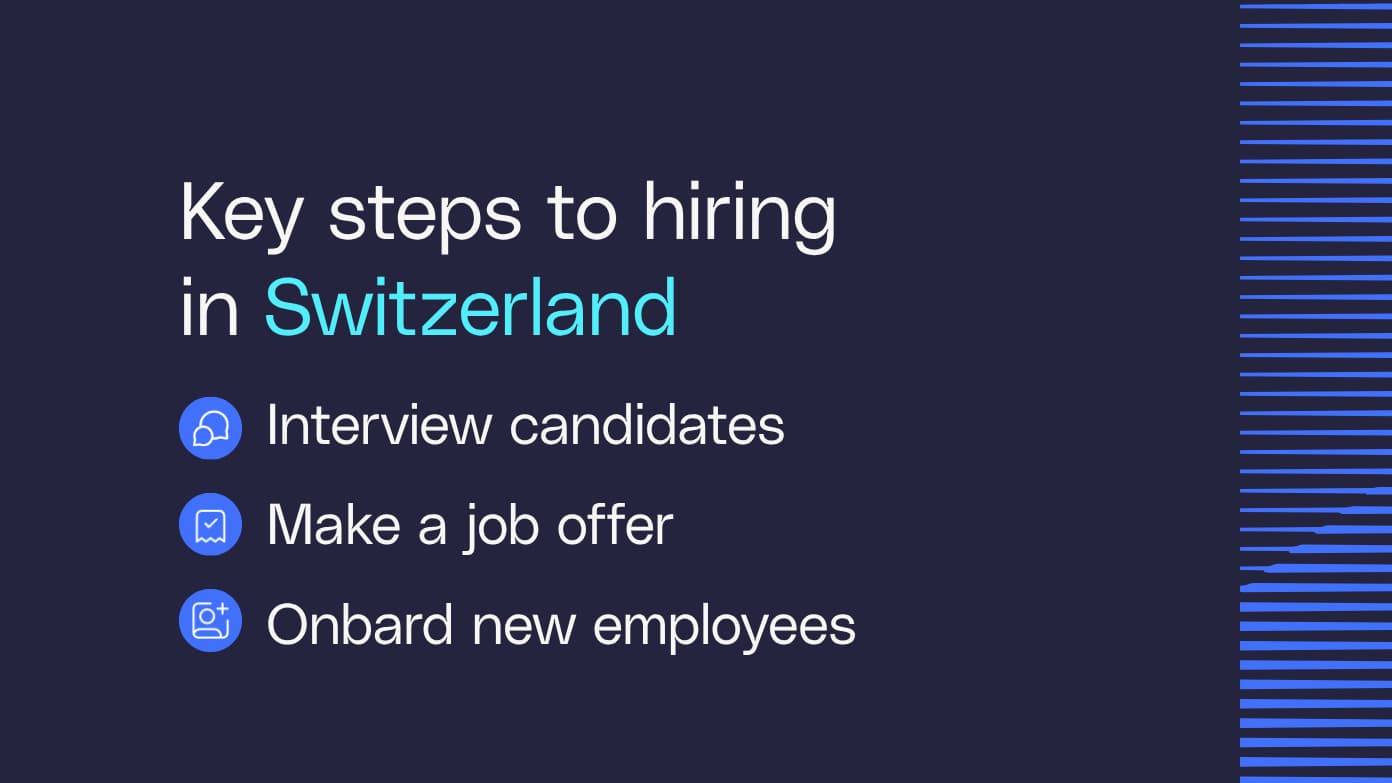
 The process of hiring in Switzerland follows five basic steps: advertising the job, evaluating applications, interviewing candidates, sending job offers, and onboarding new employees.​​ 

1.廣告職缺​​ 

首先,撰寫一份詳細的職位說明。明確所需職位、職責和資格。對於某些失業率較高的行業,法律規定雇主在公開招聘前必須先通知州就業辦公室職位空缺情況。這確保了已註冊求職者享有優先權,並符合聯邦就業服務法。​​ 

2.評估應用程式​​ 

一旦求職者申請您的新職位,您就可以評估他們的申請,並決定哪些求職者最適合該職位。瑞士法律禁止在所有招募階段中,基於性別、年齡、出身、種族、宗教、殘障、性取向或其他受保護特性的歧視。這在《瑞士聯邦憲法》和《性別平等法》中有所概述。​​  

仔細查徵招募廣告、篩選標準和麵試問題是否帶有偏見。​​  

3.面試候選者​​ 

Next, interview candidates who made it onto your shortlist. Use job-relevant selection criteria and structured interviews to ensure fairness and consistency.  Gia can help you create interview questions that follow anti-discrimination laws when hiring employees in Switzerland, so you can find the best fit for the role while complying with local regulations.​​  

最佳做法是將招募過程的文件(包括面試記錄和甄選決定)保留至少五年。​​ 

4.提供工作機會​​ 

現在是時候通知您選擇的候選者了。 起草一份符合 Swiss 勞工法的書面勞動契約。 合約應包括基本條款,例如工作職稱、職責、薪水、工作時間、通知期,以及任何適用的集體談判協定 (CBA)。​​ 

5.讓新員工入職​​ 

向瑞士社會安全系統 (AHV/AVS)、意外保險、退休基金 (BVG/LPP) 註冊新員工,並在適用的情況下,向相關稅務機關註冊。 設定薪資單,以確保正確的薪水付款、社會安全扣款、退休金供款及稅金。​​ 

在瑞士僱用承包商​​ 

在瑞士,與獨立承包商合作是一種極具成本效益的方式,可在無需全職雇員的情況下測試市場和建立據點。瑞士的承包商瞭解當地的消費者行為、規則和商業慣例。他們將準備好使用自己的設備和既定的工作流程快速開始工作。​​  

Hiring contractors allows you to easily adjust your workforce based on your business needs, without the complexities and costs of employment.  ​​ 

在您與瑞士的獨立約聘人員簽訂協議之前,請考慮以下事項:​​ 

1.員工與獨立約聘人員​​ 

It’s important to understand the difference between employees and independent contractors. In Switzerland, employment contracts for employees often include exclusivity clauses and specify working hours, location, and duties. Services agreements for contractors focus on deliverables and outcomes, emphasizing the worker’s autonomy and independence.​​  

公司聘僱雇員工作,作為回報,付給他們定期的 薪水 或 薪資。 承包商必須自行安排社會安全和退休計劃。 與員工不同的是,承包商可以設定自己的時間表、使用自己的設備,並從事特定的專案,而非持續性的工作。​​ 

2.錯誤分類的罰款​​ 

Classifying someone as a contractor when they’re not can lead to severe penalties. If misclassification occurs during your efforts of hiring in Switzerland, you may need to:​​ 

3.如何在瑞士支付承包商​​ 

G-P Contractor™ takes away the messy, time-consuming process of hiring and paying international contractors. You can create and issue contracts and pay contractors with just a few clicks, all while ensuring a compliant process.​​ 

透過 G-P 在瑞士僱用員工和承包商​​ 

Our SaaS and AI-powered products – EOR, Contractor, and Gia – help companies of all sizes build and manage global teams.​​  

With more than a decade of experience, the largest team of HR, legal, and compliance experts, and a global proprietary knowledge base, G-P is the recognized leader in global employment when you need to hire employees in Switzerland.​​ 

Make your expansion to Switzerland easier with G-P. Contact us or book a demo today.​​ 

透過 G-P 進行聘僱​​