






Puntos clave
-
Vías flexibles de contratación para compañías globales: Puedes contratar talento en España empleando una Plataforma global de empleo (Empleador de Registro), trabajar con autónomos o abrir una filial local (como una Sociedad Limitada) para gestionar la nómina directa.
-
Los contratos de trabajo son el requisito por defecto: los contratos escritos son obligatorios para todos los empleados en España. Los contratos indefinidos son habituales. Los contratos de duración determinada se limitan a la producción temporal justificada o a la sustitución de trabajadores.
-
Altas cotizaciones a la seguridad social y normas fiscales: Los empleadores se enfrentan a las cotizaciones estándar de la seguridad social de 30.57% del salario de un empleado, limitado a 5EUR101.20 mensualmente. Los trabajadores entrantes elegibles pueden emplear la Ley Beckham (una tasa de impuesto fija del 24% sobre ingresos laborales de hasta 600EUR000 durante hasta seis años).
-
Licencias generosas y semanas laborales estándar de 40horas: La semana estándar de trabajo es de 40 horas. Los empleados disponen de un mínimo de 30 días naturales de vacaciones anuales remuneradas, además de 14 festivos. Cada padre también recibe 16 semanas de parto remunerado y licencia para el cuidado de hijos.
España es un destino turístico destacado y un atractivo centro de negocios. El país ofrece conexiones comerciales a los principales mercados de Oriente Medio, el norte de África y América Latina. España también cuenta con zonas horarias favorables, costos de contratación asequibles y leyes favorables para profesionales no comunitarios.
Antes de expandirte a España, necesitarás un estable conocimiento de los requisitos contractuales, impuestos, salarios, beneficios y otras consideraciones laborales. Nuestra guía te contará todo lo que necesitas saber sobre contratar en España.
Lo que debe saber antes de contratar en España
Si estás expandiendo tu negocio a España por primera vez, hay requisitos legales importantes que debes conocer. Estas normas y leyes influyen en las prácticas cotidianas a la hora de contratar empleados en España y en muchos aspectos de la relación entidad empleadora-empleado.
Si no sabes por dónde empezar, G-P Gia™, nuestro agente global de Recursos Humanos con inteligencia artificial puede responder a tus preguntas de cumplimiento más difíciles en 50 países —incluida España— y en todos 50 estados de EE. UU. Reduce tu dependencia de abogados externos y reduce el tiempo y costo de cumplimiento hasta en un 95% con Gia.
Veamos siete cosas que debes saber sobre la contratación en España.
1. Contratos de empleo en España
Lo primero que hay que saber sobre contratar empleados en España es que existen leyes específicas que regulan los periodos de preaviso y los requisitos de despido. Tienes que redactar y firmar un contrato escrito para cada empleado e incluir:
-
Identificación del empleador y empleado
-
Fecha de inicio
-
Lugar de trabajo/ubicación
-
Tipo y duración del contrato, si es temporal.
-
Grupo/categoría profesional
-
Horario laboral y horario
-
Salario, complementos y frecuencia de pago
-
vacaciones anuales
-
Periodos de notificación
-
Applicable acuerdo colectivo de trabajo (acuerdo colectivo de trabajo)
-
Condiciones de trabajo remoto, si corresponde.
La ley española permite un periodo de prueba de dos meses para los empleados generales y un periodo de prueba de seis meses para los técnicos cualificados. Durante estos periodos de prueba, puedes despedir a un empleado si su rendimiento no cumple con tus estándares.
Hay ciertas normas que limitan la forma en que puedes rescindir contratos indefinidos que no tienen periodo de prueba. Generalmente puedes rescindir un contrato bajo las siguientes circunstancias:
-
El empleado renuncia voluntariamente
-
Entidad empleadora y empleado acuerdan mutuamente la separación
-
El motivo de la rescisión está incluido en el contrato como motivo de despido
-
La empresa tiene motivos para un despido disciplinario justificado
-
La empresa está despidiendo a empleados colectivamente por motivos técnicos, económicos, de producción u organizacionales
-
Otra causa objetiva y legalmente permisible
Las compañías generalmente llegan a un acuerdo mutuo con el empleado con bajo rendimiento para disolver el contrato. Puedes terminar durante la libertad condicional sin causa ni aviso, pero no por motivos discriminatorios o protegidos, como embarazo, protecciones relacionadas con maternidad/paternidad, discriminación por enfermedad u otros motivos protegidos. La indemnización por despido improcedente es 33 días de salario por año de servicio, con un límite de 24 meses. También hay una penalización por no dar a los empleados el preaviso requerido (normalmente 15 días naturales). Los empleadores deben pagar al empleado por estos días en lugar de preaviso.
G-P Plataforma global de empleo dispone de un generador de contratos de trabajo para ayudarte a redactar contratos de cumplimiento que cumplan con todos los requisitos legales y mejores prácticas al buscar contratar en España.
Los empleadores deben:
-
Registra el empleado en la seguridad social de España antes de que comience el trabajo.
-
Comunique los detalles del contrato a SEPE dentro del plazo requerido.
-
Entrega una copia de los contratos escritos a los representantes de empleado, cuando corresponda.
-
Consulta el acuerdo colectivo de trabajo antes de finalizar la prueba, el salario, el tiempo de trabajo, el preaviso y los términos de clasificación laboral.
2. Tipos de contratos laborales en España
Los principales contratos laborales en España son:
-
contratos indefinidos
-
Contratos de duración determinada
-
contratos de formación
-
contratos a tiempo parcial
-
contratos fijos-discontinuos.
El empleo indefinido es la opción por defecto. Los contratos de duración determinada solo se permiten por razones específicas y justificadas, principalmente necesidades temporales de producción o la sustitución de otro trabajador.
Los contratos de formación en España incluyen contratos de alternancia entre trabajo y estudio y contratos de prácticas profesionales para recién graduados o trabajadores cualificados. Los contratos fijos discontinuos son contratos indefinidos que se emplean para trabajos recurrentes, estacionales o intermitentes. Esto abarca el turismo, la agricultura o la educación. Existen modalidades de trabajo a tiempo parcial, pero deben estar documentadas, incluyendo las horas de trabajo y la distribución de los fondos.
3. Nómina e impuestos
En España, las compañías deben pagar a la entidad empleadora seguridad social contribuciones por cada trabajador. Estos generalmente equivalen a 30.57% del salario del empleado, hasta 5EUR101.20 al mes. También se aplica progresivamente una contribución de solidaridad para pagar por encima de 5EUR ,101.20 al mes. Esto se comparte entre entidad empleadora y empleado.
Las compañías que operan en España también deben pagar impuestos locales y nacionales, entre ellos:
-
Impuesto a utilidades de las sucursales
-
Impuesto sobre el capital
-
Impuesto sobre los ingresos corporativos
-
Impuesto real sobre bienes
-
Impuesto a las transferencias
-
Impuesto al valor agregado (IVA)
-
Diversos impuestos locales
El tipo de IVA es del 21%, y el de impuestos corporativos es del 25%.
España tiene un sistema progresivo de impuesto sobre los ingresos, que aumenta con el salario del trabajador. Los no residentes también están sujetos a requisitos de retención fiscal que van desde el 19% en dividendos e intereses hasta el 24% en regalías.
Los trabajadores entrantes elegibles en España pueden beneficiarse de la Ley Beckham. Esto otorga un tasa de impuesto especial del 24% sobre ingresos laborales de hasta 600EUR000 para hasta seis años fiscales.
4. Sueldos y horas de trabajo
La semana estándar de trabajo en España es de 40 horas, con una media anual. Muchas compañías lo reducen a 37 o 38 horas mediante acuerdos colectivos o políticas de empresa. Sin un acuerdo, los empleadores pueden programar de forma irregular hasta un 10% de las horas anuales con cinco días de preaviso, cumpliendo las normas de descanso. Algunas semanas pueden superar las 40 horas y otras pueden ser más bajas. Las horas extra remuneradas suelen estar limitadas a 80 horas al año. Este límite no incluye las horas extra que se compensan con un descanso remunerado equivalente en un plazo de cuatro meses.
A fecha de 2026, el salario mínimo es de 1EUR221 al mes. Los CBA pueden exigir salarios mínimos más altos en sectores específicos.
España no exige bonificaciones anuales o 13específicas de quince mes, aunque muchos contratos de venta incluyen bonificaciones y comisiones.
5. Tiempo libre
España tiene 14 días festivos pagados, incluidos los nacionales, regionales y dos locales. Cada una de las comunidades autónomas de España 17 puede establecer hasta cuatro días festivos regionales, y los municipios suelen declarar dos días festivos locales al año. Los días festivos provinciales también son importantes. Cerciórate de investigar tu región y averiguar qué días adicionales se celebran.
Los empleadores en España deben conceder al menos 30 días naturales de vacaciones anuales remuneradas al año. Esto suele expresar como unos 22 días laborables en los CBAs. Esto se establece en cada acuerdo colectivo de trabajo aplicable. Hoy en día no se puede pagar como compensación extra, así que los empleados tienen un incentivo extra para cobrar su tiempo libre completo remunerado.
En España, si un empleado no puede trabajar debido a una enfermedad o lesión, puede recibir una capacidad temporal por incapacidad en lugar de un derecho separado a licencia por enfermedad. Para enfermedades comunes o lesiones no relacionadas con el trabajo, los tres primeros días no son remunerados, salvo que exista un acuerdo colectivo de trabajo o una política de empresa. Desde los días 4hasta15, la entidad empleadora paga directamente el 60% de la base regulatoria del empleado. Desde el día 16 en adelante, la seguridad social o la entidad mutua de seguros correspondiente es responsable del beneficio. Los empleadores pueden seguir pagando al empleado mediante pagos delegados y compensar la cantidad mediante contribuciones a la seguridad social. De los días 16a20, el beneficio suele ser del 60% de la base regulatoria, aumentando hasta el 75% desde el día 21. Los CBA pueden mejorar estas cantidades. La incapacidad temporal puede durar hasta 365 días, con una posible prórroga de 180días.
Las personas empleadas en España también pueden tomarse tiempo libre remunerado por diversas circunstancias familiares:
-
Un máximo de 15 días por matrimonio
-
Dos días por fallecimiento de familiar
-
Entre uno y dos días por mudanza
-
Entre tres y cuatro días por enfermedad de familiar
España otorga un marco unificado de nacimiento y licencia para el cuidado de hijos para ambos padres. Cada progenitor recibe 19 semanas de licencia remunerada, incluyendo seis semanas obligatorias inmediatamente luego del nacimiento, adopción o acogida en acogida. Las semanas restantes están disponibles para uso flexible.
La licencia no remunerada para el cuidado de hijos, conocida como excedencia por cuidado de hijo, está disponible hasta tres años por niño. Esto está disponible para cualquiera de los padres. Durante el primer año de licencia, el empleado tiene derecho a volver al mismo puesto. Tras el primer año, el empleado conserva el derecho a volver a un puesto en el mismo grupo profesional o en una categoría equivalente. Esto es independiente de la licencia por paternidad no remunerada de 8semanas, que puede emplear hasta que el niño cumpla ocho años.
España también tiene licencias de lactancia materna o de lactancia. Los empleados tienen derecho a descansos diarios de una hora hasta que el niño cumpla nueve meses. Las madres pueden tomar esta hora de forma continua, dividirla en dos periodos de media hora o reducir la jornada laboral al inicio o al final del turno. Desde el 2024de mayo, los empleados tienen derecho a acumular horas de licencia de lactancia materna en días laborables completos sin necesidad de acuerdo colectivo de trabajo o entidad empleadora.
Puedes gestionar fácilmente planes de beneficios con G-P Plataforma global de empleo (Empleador de Registro). Nuestros expertos internos monitorear continuamente las leyes laborales para cumplir con las normativas y normas específicas de cada país. Crea y gestiona planes de beneficios a través de nuestra plataforma para ofrecer una experiencia de empleado fluida.
6. Leyes y restricciones antidiscriminatorias
La ley española prohíbe la discriminación en la contratación y el empleo. No puedes discriminar a las personas candidatas por ninguna de las siguientes razones:
-
Edad
-
Género
-
Raza
-
Etnia
-
Orientación sexual
-
Estado civil
-
Condición social
-
Religión
-
Opinión política
-
Afiliación a un sindicato
-
Discapacidad: Además, si una entidad empleadora tiene más de 50 miembros del equipo, el 2% de esos empleados debe ser personas con discapacidad.
Parte de los esfuerzos de España contra la discriminación incluyen restringir a las empresas la realización de comprobaciones de antecedentes penales a las personas candidatas a un puesto de trabajo. El acceso al Registro Central de Condenas está limitado a sectores y roles específicos que estén legalmente justificados. Estos puestos implican trabajo con menores, administración pública, fuerzas del orden y roles financieros específicos. No puedes acceder a este registro sin una autorización legal explícita. Las personas candidatas pueden revelar voluntariamente su información de antecedentes penales si así lo desean.
7. Obligaciones del empleador en materia de seguridad en el lugar de trabajo
Los empleadores tienen el deber amplio, en virtud de la Prevención de Riesgos Laborales, de proteger la salud y la seguridad de los trabajadores. Esto significa que tienen que:
-
identificar y evaluar los riesgos en el lugar de trabajo
-
crear y mantener un plan de prevención
-
Establecer medidas preventivas
-
Promover la reducción de riesgos en origen o el uso de medidas de protección colectivas antes de recurrir a equipos de protección individual.
Los empleadores deben organizar recursos de prevención adecuados, tales como:
-
trabajadores capacitados designados
-
un servicio de prevención interna
-
un servicio externo de prevención acreditado.
El incumplimiento puede conllevar acciones de inspección laboral, multas administrativas, responsabilidad civil, recargos por beneficios de la seguridad social y responsabilidad penal.
Modelos de contratación para compañías globales que buscan contratar en España
El mejor modelo de contratación en España depende de los objetivos de tu negocio.
| Modelo | Mejor para | Puntos clave | Principales riesgos |
|---|---|---|---|
| Direct entidad empleadora registration | Contratar personal en España sin crear una entidad española, siempre que sea posible. | Regístrate como entidad empleadora en TGSS y obtén CCC. Informa del contrato a SEPE. Regístrate en AEAT para la retención IRPF. | Carga administrativa; nóminas, impuestos, seguridad social, PRL y cumplimiento laboral local permanecen en manos de la entidad empleadora. |
| Plataforma global de empleo (Employer of Record) | Contratación rápida, pilotos o entrada limitada al mercado. | La Plataforma global de empleo (Empleador Oficial) no es una categoría estatutaria distinta en España. Está estructurado cuidadosamente para que los empleadores locales gestionen la nómina, los contratos, la seguridad social y el cumplimiento normativo. | Riesgo de arrendamiento laboral ilegal si el cliente dirige a los trabajadores como la entidad real empleadora o acuerdo carece de estructura legal. |
| Filial o sucursal | Operaciones a largo plazo, presencia local, contratación local y equipos escalables. | Regístrate en el registro mercantil; Obtén registros fiscales y una configuración de entidad empleadora/seguridad social. |
Mayor costo de instalación y obligaciones continuas corporativas, contables, laborales y de gobernanza. |
| Contratistas independientes |
Trabajo autónomo por proyectos realizado por contratistas autónomos. |
Los contratistas operan fuera de las leyes laborales y gestionan su propia fiscalidad/seguridad social. |
Los indicadores de dependencia pueden desencadenar una clasificación errónea, reclasificación laboral y multas. |
Principales centros de contratación en España
Algunas ciudades españolas son conocidas por sus industrias particulares. Conocer lo que cada ciudad tiene para ofrecer puede ayudarte a canalizar tus esfuerzos de contratación hacia el lugar adecuado y cubrir puestos más rápido.
Los principales polos de talento en España son:
-
Madrid cuenta con una infraestructura excelente, lo que la hace atractiva para empresas consolidadas y startups. Como capital, la ciudad también se beneficia de la proximidad a instituciones gubernamentales y organismos reguladores. Madrid alberga varias universidades y centros de investigación de primer nivel, proporcionando una base constante de graduados.
-
Barcelona es reconocida como uno de los ecosistemas de startups líderes en Europa, lo que la convierte en una ubicación atractiva para cubrir roles en TI, ingeniería y digital. La ciudad atrae a profesionales de toda Europa y ofrece una fuerza de trabajo multilingüe y multicultural.
-
Valencia es la tercera ciudad más grande de España. Su economía en crecimiento se basa en la logística, la manufactura y la tecnología. El puerto de la ciudad es uno de los más activos del Mediterráneo, apoyando el comercio e industrias relacionadas. En comparación con Madrid y Barcelona, Valencia ofrece menores gastos de vida y operativo.
-
Sevilla es la ciudad más grande del sur de España y un importante motor económico de la región. Cuenta con un panorama tecnológico en crecimiento y sectores consolidados de energías renovables, aeroespacial y logística.
-
Bilbao cuenta con una estable base industrial, especialmente en acero, construcción naval y manufactura. La ciudad también cuenta con un dinámico sector financiero, tecnológico y de servicios.
-
Málaga alberga el Parque Tecnológico de Málaga, que alberga a numerosas compañías tecnológicas nacionales e internacionales. Esto posicionó a la ciudad como un centro líder en TI, ingeniería y digital.
Industrias clave en España
Comprender las principales industrias de España te ayuda a establecer un punto de referencia para salarios y beneficios. Puedes emplear esta información para tomar decisiones inteligentes sobre dónde invertir y hacer crecer tu fuerza de trabajo. Las principales industrias en España incluyen:
-
Automoción: España es un importante fabricante de automóvil, albergando plantas de producción de varias marcas globales. Muchos vehículos producidos en España se exportan, contribuyendo al balance comercial del país. El sector es una entidad empleadora importante y apoya muchos empleos directos e indirectos en los sectores de la manufactura, la ingeniería, la logística y servicios relacionados.
-
Agricultura y procesamiento de alimentos: España es uno de los principales productores europeos de frutas, verduras, aceite de oliva, vino y cereales. El clima y la geografía del país permiten la producción de diversos productos agrícolas. España exporta a nivel mundial, pero la UE es el mercado1 #. El sector de procesamiento de alimentos del país está altamente desarrollado, abarcando desde la fabricación de enlatados y envases hasta la producción de carnes procesadas, productos lácteos y alimentos listos para consumir. El talento especializado incluye gestores de granjas, hortícolas y científicos de alimentos.
-
Energía renovable: España es líder europeo en producción de energía eólica y solar. El país se sitúa consistentemente entre los primeros de Europa en capacidad instalada y generación a partir de renovables. La energía eólica representa una parte significativa de la generación eléctrica en España. El talento especializado incluye ingenieros, jefes de proyecto y expertos en redes inteligentes.
-
Servicios de TI y digitales: España forma muchos graduados en TI cada año. La industria abarca diversos servicios, incluyendo desarrollo de software, ciberseguridad, computación en la nube, inteligencia artificial, tecnología financiera, comercio electrónico y marketing digital.
-
Servicios financieros: Madrid y Barcelona son importantes centros económicos, que albergan bancos, empresas de seguros y firmas de inversión. España alberga algunos de los bancos más grandes e influyentes de Europa, como Banco Santander, BBVA y CaixaBank. Estas instituciones tienen una gran presencia internacional, especialmente en América Latina y Europa. El talento especializado incluye analistas financieros, contadores y contralor, así como analistas de crédito y riesgos.
Costo de contratar una persona empleada en España 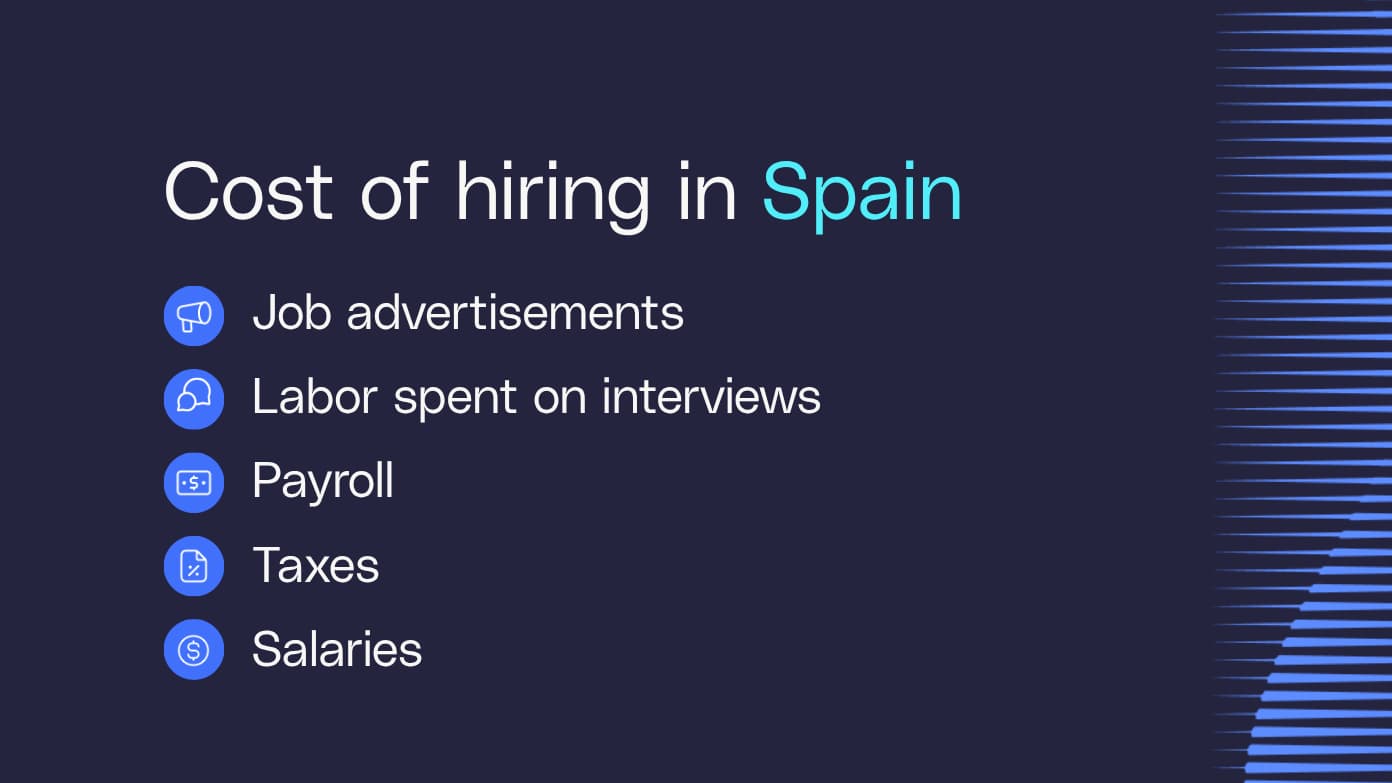
Tanto si contratas a un solo empleado como a todo un equipo en España, los gastos son inevitables. Presupuesto para lo siguiente:
-
Anuncios de trabajo
-
Horas de trabajo que se dedicaron a la revisión de las personas candidatas y a las entrevistas
-
Nómina
-
Impuestos
-
Salarios
-
Beneficios
-
Bonificaciones
-
Seguros
La mayoría de los empleados en España obtienen su seguro médico básico a través del programa nacional de seguro de salud. Las entidades empleadoras suelen ofrecer seguro médico complementario. La mayoría del personal ejecutivo, por ejemplo, recibe seguro de salud y vida complementario de sus entidades empleadoras.
Los costos para contratar a los empleados en España varían según la industria debido a los diversos requisitos de acuerdo colectivo de trabajo en distintos sectores. Según Gia, la tasa anual total de carga de la entidad empleadora en España, que incluye los costos derivados además de los salarios, es de alrededor del 30%.
¿Qué necesita contratar una empresa en España? 
La contratación en España puede ser similar a tu proceso de contratación, pero existen ciertas prácticas únicas de cada país:
-
Emplea el idioma y la moneda local: 989% de la población habla español. El siguiente idioma más común es el catalán. Solo sobre 11.7% de la población habla inglés. Emplea el español en tus comunicaciones de contratación para mostrar que tu compañía valora a los nuevos empleados y quiere que se sientan incluidos. Emplea euros en tus contratos y cartas de oferta.
-
Evita preguntas personales: Haz preguntas objetivas, razonables y aplicables al puesto. Las preguntas que afecten a asuntos personales pueden desencadenar reclamaciones por discriminación. Gia puede ayudarte a crear preguntas que cumplan con las leyes antidiscriminación en España, para que puedas encontrar la mejor opción para el puesto cumpliendo con la normativa local.
-
Revisa bien las normativas: Las leyes laborales españolas están muy reguladas. Pequeños errores pueden ser costosos. Investiga para cerciorarte de cumplir todas las leyes aplicables, o colabora con una Plataforma global de empleo (Employer of Record) para garantizar el cumplimiento.
-
Preparar para recibir numerosos solicitantes: España tiene la tasa de desempleo más alta de la UE: 10.4% a fecha de enero 2025. Por lo tanto, es posible que reciba más solicitudes de empleo de las que está acostumbrado.
-
Aprovecha la diversidad lingüística de España: Las principales ciudades de España albergan grandes comunidades de trabajadores internacionales. Si necesitas empleados bilingües, tienes muchas posibilidades de encontrar personas candidatas cualificadas.
Cerciórate de cubrir estos aspectos esenciales antes de ampliar tu equipo en España:
-
Crea una entidad o un socio con una Plataforma global de empleo (Employer of Record).
-
Paga tu capital mínimo de inversión de 3EUR000 (si eliges responsabilidad limitada privada).
-
Obtener la certificación del Registro Mercantil.
-
Obtener un número de identificación tributaria (NIF) provisorio.
-
Abrir una cuenta en un banco español.
-
Presentar una declaración contra el lavado de dinero y el financiamiento del terrorismo.
-
Firmar una escritura pública y hacerla certificar por un escribano.
-
Registrarse en el Registro de Comercio.
-
Nombrar de 3 a 12 directores, que deben presentar los estados financieros anuales en el Registro Mercantil.
Emplea G-P Plataforma global de empleo (Empleador de Registro) para contratar empleados a tiempo completo en España sin crear tu propia entidad. Construye tu equipo en España a un costo menor y con la tranquilidad de que lo haces de forma cumplida.
Contratación de contratistas en España
Trabajar con contratistas independientes en España puede ser una forma rentable de probar el mercado y consolidar presencia sin el compromiso de empleados de tiempo completo. Los contratistas con sede en España comprenden el comportamiento local del consumidor, las normas y las prácticas empresariales. Estarán listos para empezar a trabajar rápidamente con su propio equipo y procesos de trabajo establecido.
Contratar contratistas te permite ajustar fácilmente tu fuerza de trabajo según las necesidades de tu compañía, sin las complejidades ni los costos de empleo.
Antes de firmar un acuerdo con un contratista en España, considera lo siguiente:
1. Empleados vs. contratistas independientes
En España, los empleados trabajan bajo la dirección y supervisión de la entidad empleadora, siguen horarios establecido y reciben beneficios. Están integrados en las operaciones y la cultura principales de la empresa. Los contratistas no están sujetos al mismo control. Operan de forma independiente y tienen autonomía sobre cómo, cuándo y dónde realizan su trabajo. Los empleados tienen derecho a prestaciones de ley como licencias remuneradas, cobertura médica y prestaciones por desempleo. Los contratistas deben organizar sus propios seguros y planes de jubilación.
2. Penalidades por clasificación errónea
Clasificar a alguien como contratista cuando no lo es puede conllevar sanciones severas. Si se produce una clasificación errónea , puede que necesites:
-
Se pagan multas administrativas que van desde 3EUR750 hasta 12EUR000 por trabajador mal clasificado. Estas multas pueden aumentar según la gravedad y persistencia de la infracción.
-
Se enfrentan a penas de prisión de hasta seis años según el artículo 311 del Código Penal español.
-
Devuelva las cotizaciones a la seguridad social que no se retuvieron, con recargos que oscilen entre el 100% y el 150% de la cantidad adeudada.
3. Cómo pagar a los contratistas en España
G-P Contractor™ elimina el proceso complicado y que consume mucho tiempo de contratar y pagar a contratistas internacionales. Puedes crear y emitir contratos y pagar a los contratistas con solo unos clics, todo ello cerciorando un proceso de cumplimiento.
Contrata empleados y contratistas en España con G-P
Nuestros productos artificiales de Software como servicio e inteligencia – Plataforma global de empleo, Contractor y Gia – ayudan a compañías de todos los tamaños a construir y gestionar equipos globales.
Con más de una década de experiencia, el mayor equipo de Recursos Humanos, expertos legales y de cumplimiento, y una base de conocimientos exclusiva a nivel mundial, G-P es el líder reconocido en empleo global.
Haz que tu expansión a España sea más fácil con G-P. Contáctanos o reserva una demostración hoy mismo.