






Managing a global team through an employer of record (EOR) does more than simplify international hiring; it generates a tremendous amount of valuable operational data across borders. But for global HR and finance leaders, accessing clear answers from that data is an exhausting weekly drill.
In the past, responding to routine reporting requests — such as quarterly spend, active headcount numbers, or invoice breakdowns — required exporting multiple spreadsheets, writing VLOOKUP formulas, and spending hours reconciling pivot tables and currency totals manually.
That’s why we built agentic reporting inside G-P Assist, the AI-powered engine behind our Global Employment Platform.
Our engineering principle was simple: You should be able to ask for the report you need, not spend your week building it.
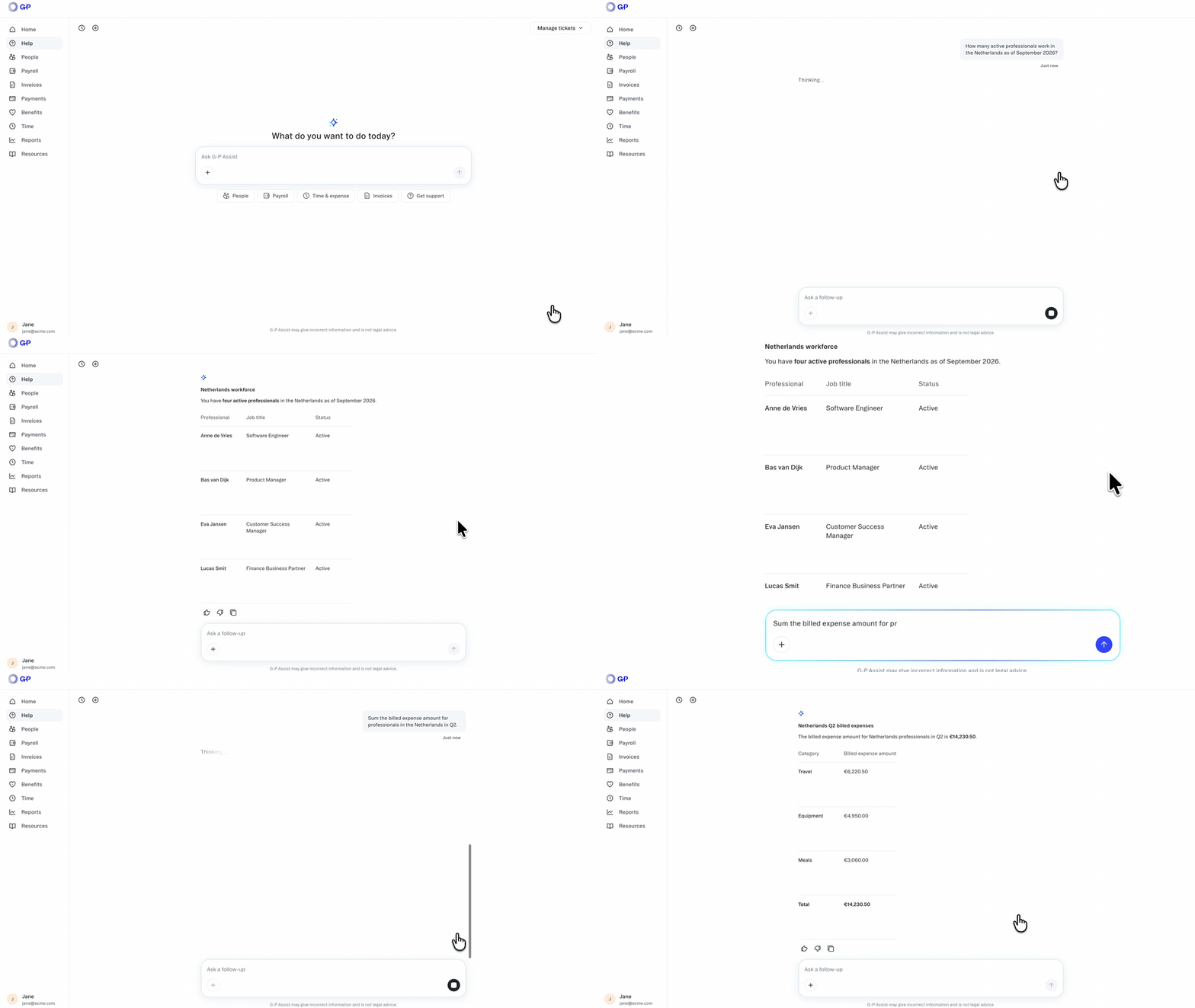
In this post, I’ll take you behind the build of agentic reporting to show how we engineered natural language questions answered by exact database calculations.
The risks of using generic AI models for spreadsheet math
While standard generative AI tools promise quick answers, relying on ungated models introduces real operational risk. Large language models (LLMs) are designed to predict language patterns rather than being relied on for exact arithmetic.
When general-purpose AI attempts to process large spreadsheets directly, it can miscalculate figures, drop critical rows, or approximate numbers. In global workforce management, an approximation is an audit risk.
Engineering for accuracy
To keep the model out of the arithmetic, we separated understanding your question from calculating the answer. G-P Assist’s agentic reporting uses AI to interpret user intent — extracting timeframes, filters, and entities — rather than performing math.
The model translates conversational prompts into structured queries that run deterministically against our data platform. The platform calculates counts and sums on your company's reporting data. G-P Assist is built to never add figures itself, ensuring numbers are never estimated or rounded. To maintain data integrity and enterprise security, we built clear operational boundaries directly into the system:
- Principled refusals: Knowing when not to answer is an engineering feature. When a query requires unsupported operations — such as calculating medians, predicting salary scenarios, or comparing month-over-month trends — the agent explicitly declines rather than allowing a language model to approximate the result.
- Currencies: Sums are isolated by individual currency and can’t be combined into arbitrary totals.
- Company scope: The server limits every query to your company's data, using your unique sign-in so that only approved reporting datasets can be queried.
- Role-based governance and privacy: Access is currently restricted to customer admins, with additional role-based access rolling out this year. The server hides any dataset or column a user isn’t permitted to see.
In addition to fast data retrieval, G-P Assist includes conversational report shaping and customization. Customer admins can use natural language in G-P Assist to add or remove columns and filter reports, roll up multiple categories into one column, and pivot raw line items into clean, one-row-per-person summaries. We continuously monitor G-P Assist’s performance through automated checks and human reviews to ensure ongoing accuracy and reliability.
Transforming daily reporting workflows
G-P Assist replaces manual report assembly with fast and easy self-service. Whether you need an invoice breakdown, a headcount check, or an expense total, you get exact figures or a structured CSV in seconds.
For customers, this means making business decisions using platform data instead of spending Friday afternoon reconciling spreadsheets.
For me, it represents the real purpose of product engineering in the AI era. The conversational front end makes the data accessible, but our deterministic query execution and calculations, plus built-in guardrails, make it dependable.
AI shouldn't create more homework for HR and finance leaders; it should deliver numbers you can trust from the very first prompt.