





Key takeaways
- Equity attracts global talent: Equity awards can help make your company more competitive and attract top talent as you expand globally.
- EOR equity requires careful structuring: When offering equity to professionals employed through an EOR, use separate documentation and review local employment, tax, securities, and reporting requirements.
- Local rules shape awards: Every country is different in its equity compensation laws and how it regulates these awards, so understanding local requirements is vital to providing workers with equity benefits that don't create unexpected compliance problems.
Equity compensation can be a powerful way to attract and retain talent. It gives potential employees another reason to stay with your company long-term and works as a high-value incentive without straining your cash flow, often allowing you to compete against more established companies.
This article discusses how equity compensation works, how you can offer it to your employees, and how an employer of record (EOR) can help.
What is equity compensation?
Equity compensation offers company ownership to employees through stock options, restricted stock, phantom stock, or other alternatives. It motivates employees to contribute to your long-term growth because they have a stake in its success.
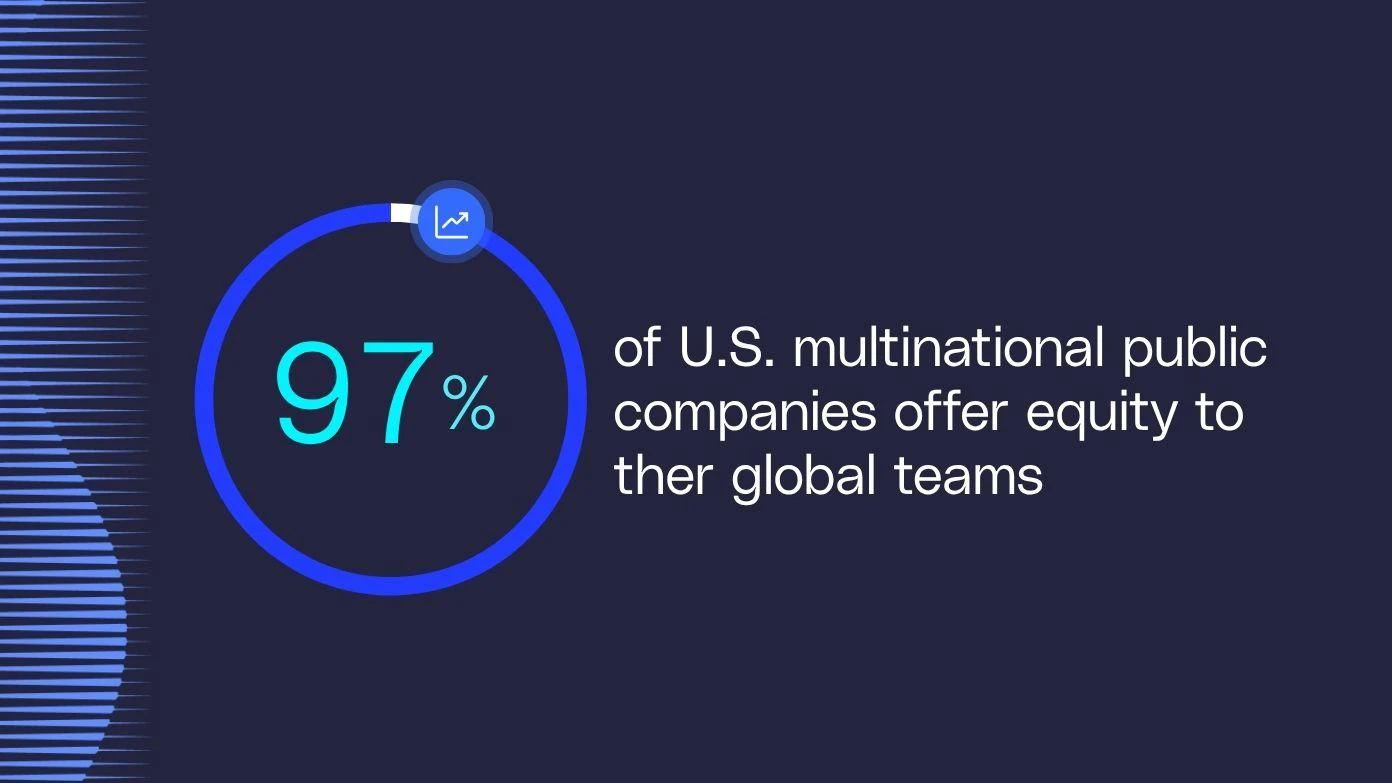
Public and private companies offer equity. This form of compensation can help global businesses attract top talent. According to the National Association of Stock Plan Professionals (NASPP), 97% of U.S. multinational public companies offer equity to their global teams.
Why offer equity to employees
An equity package creates mutual value for global employers and employees by:
- Boosting engagement and buy-in: The equity value is based on your company's market value or stock price. It gives employees extra motivation to excel when their benefits are tied to your company's success. Unlike fixed cash bonuses, equity can offer significant upside potential as the company's value grows.
- Attracting and retaining top international talent: Employers offering equity gain a competitive edge in attracting top talent. It can make job offers more appealing by adding value beyond salary. Plus, since equity is earned over time, it encourages long-term employment.
- Offering cost-effective rewards for startups and growing companies: Equity compensation can balance lower cash pay. Startups or growing companies can complement their salary structure with the potential of future gains, giving them an advantage against more established competitors.
Granting equity through an EOR
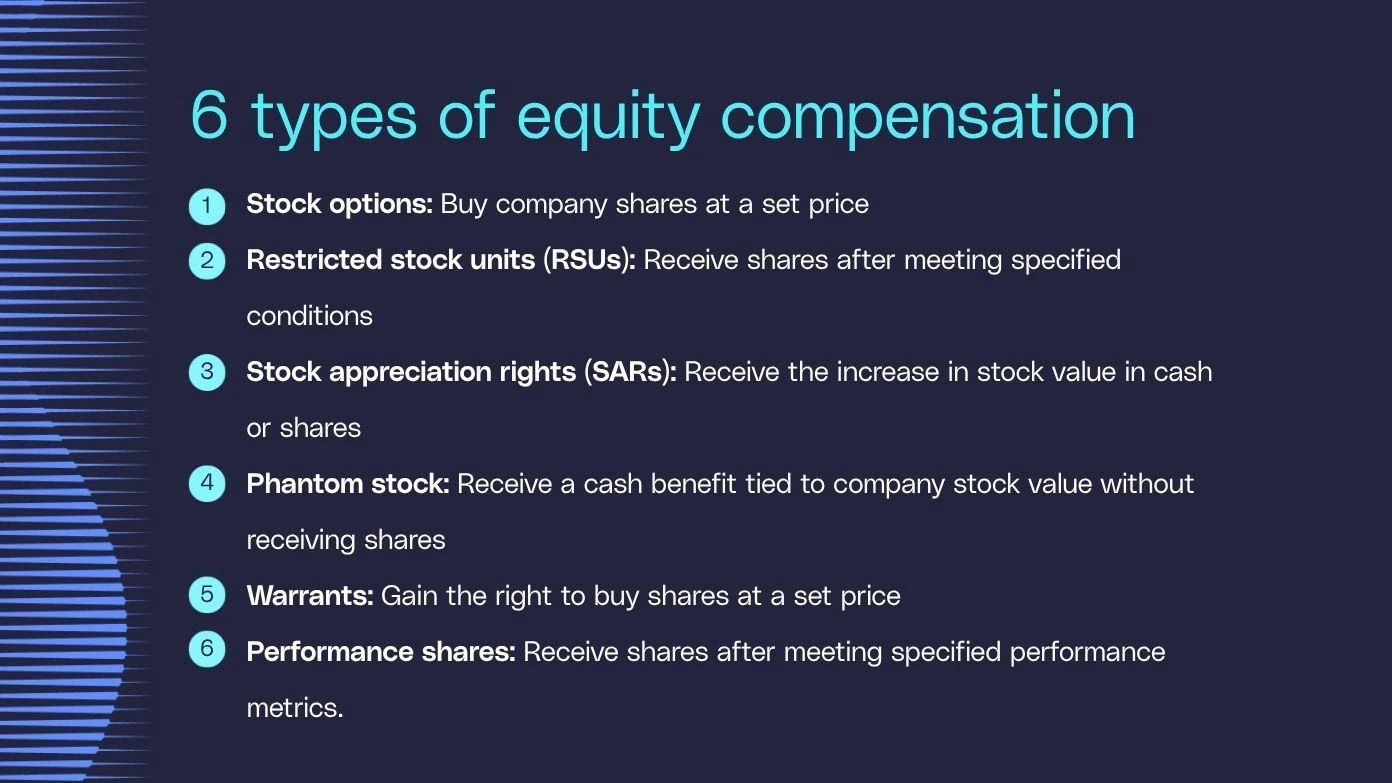
How you offer your workers equity depends on how you hire them, since the approach differs for direct employees versus those hired through an employer of record (EOR). When a worker joins your company through an EOR, you aren't the legal employer. The EOR is. And this is why you need to be extra careful in how you structure the equity package so you don't accidentally blur the line between your company and the EOR.
- Understanding the legal separation:
- The commercial contract exists between the client company and the EOR provider: You aren't actually hiring the worker. Instead, you hire an EOR to employ the worker on your behalf. The commercial contract between you and the EOR should be highly detailed and explain all responsibilities that fall to the EOR, including payroll, benefits, and employment compliance. Any equity that you offer the worker will usually sit outside of this commercial relationship.
- The employment agreement sits between the EOR provider and the individual: The employment agreement that the worker signs is between them and the EOR, not them and your company. By keeping the equity separate from this agreement, you're ensuring the worker understands the distinction between the EOR as the legal employer and your company as the one providing the equity.
- The equity grant comes directly from your company: Your company is the one granting the equity even though the EOR operates as the worker's legal employer. And it's because of this that you must decide what type of equity you want to offer and which structure (stock options, restricted stock units, phantom equity, etc.) to use to award the equity in a way that stays compliant with local tax, securities, and employment laws.
- The co-employment & misclassification trap:
- Providing equity directly can make the employment relationship less clear: It's crucial to have a thorough understanding of the country's views and rules on co-employment and worker classification. Even when an EOR is a worker's legal employer, local authorities may view the relationship differently if your company provides a direct equity award to the worker. The authorities may see the equity award as evidence that you are acting as the worker's employer.
- Potential consequences: If a local authority determines the award of equity to a worker hired through an EOR results in your company being treated as an employer, you may then become responsible for certain employment obligations that you initially didn't expect to take on. These obligations can range from backdated statutory benefits and severance payments to employment taxes or even permanent establishment (PE) tax concerns.
- Protective drafting best practices:
- Keeping the equity award completely independent of the local EOR employment agreement: Rather than adding the equity package to the worker's local employment contract, keep it separate by using a standalone equity agreement between your company and the worker. In doing so, it becomes easier to see where the EOR employment relationship begins and ends and how the equity award sits outside of that arrangement.
- Clearly explain that the equity award doesn't make the person your direct employee: When the law allows, create an equity agreement that states the following: Receiving stock options or other equity doesn't create an employment relationship between the worker and your company. But you must structure the agreement carefully and in accordance with local laws, or you may encounter co-employment or misclassification issues. Just because the agreement says you aren't the worker's employer, this doesn't necessarily prevent local authorities from viewing you as one. Using the correct language and structuring the equity agreement properly are vital to reducing these risks.
Types of equity compensation for global employees
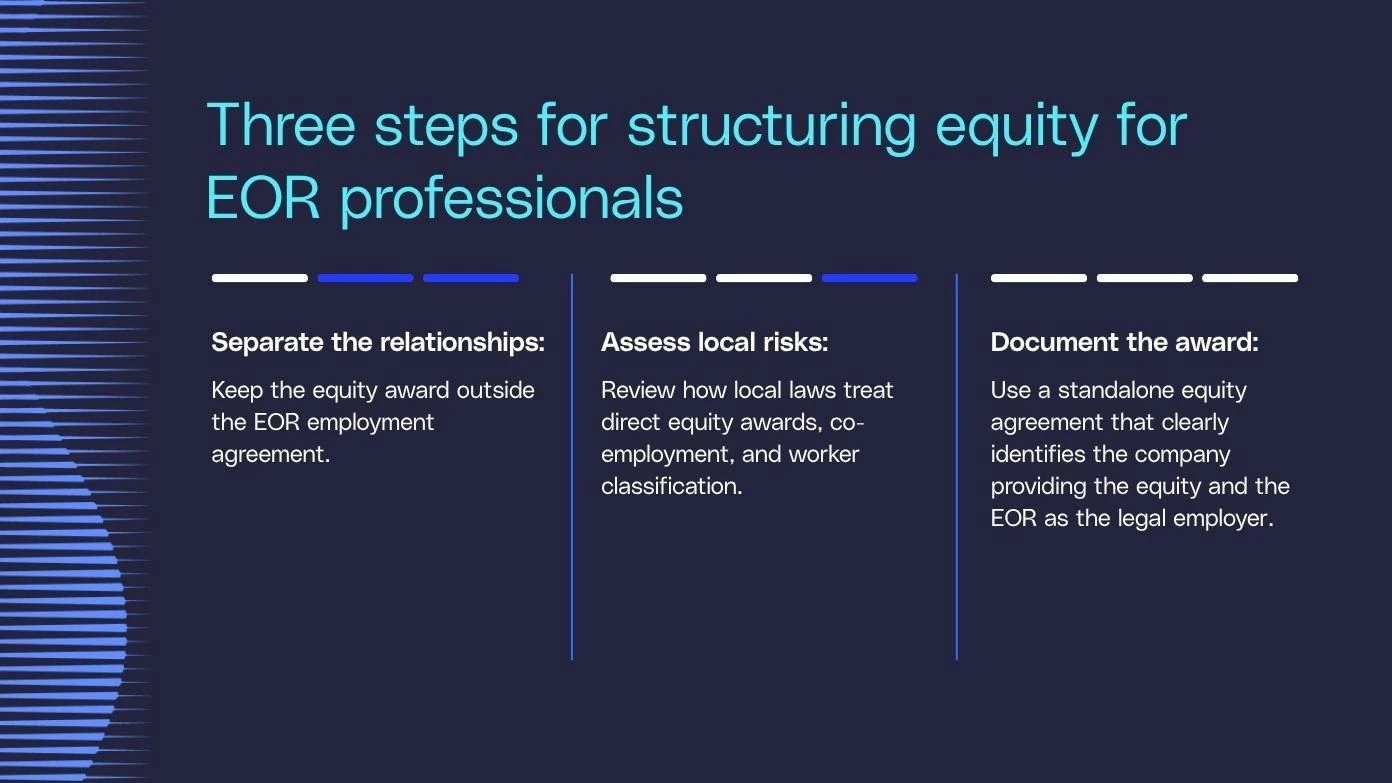
Some forms of equity compensation are more suitable than others, depending on your company's capacity and local regulations. The common types for global employees include:
- Stock options: Stock options let employees buy company shares at a set price after a specified time. You can offer an incentive stock option (ISO) or a nonqualified stock option (NSO), which vary in tax incentives. Professionals employed through an EOR may be eligible for NSOs. ISOs are generally available only to employees of the issuing corporation or a qualifying parent or subsidiary, so professionals employed through an independent EOR typically won't qualify.
- Restricted stock units (RSUs): An RSU is a commitment to grant shares at a future date or specific milestone. For instance, you may require employees to stay with you for a year and achieve a performance milestone before they get an RSU. Unlike stock options, employees won't need to buy the shares — shares are awarded to them.
- Stock appreciation rights (SARs): SARs are bonuses paid in cash or through shares. Employees get the right to receive the increase in monetary value of your company's stock within a specified time. Like RSUs, employees don't need to buy shares with SARs.
- Phantom stocks: Phantom stock is a promise to pay employees bonuses in the future with a value equivalent to the increase in value of the company stock or the full value of the entire stock. Unlike RSUs and SARs, employees don't get the actual shares of your company.
- Warrants: Warrants, suitable for Nordic countries, function similarly to stock options. With warrants, employees have the right, but not the obligation, to buy the shares at a set price after a specific time. Warrants have premiums, which are a percentage of the share price. Employees must also pay this small fee to get the right to buy the shares.
- Performance shares: Performance shares are a form of equity compensation given to employees once they meet certain metrics. For instance, you may set an earnings per share (EPS) or return on equity (ROE) target. Performance periods usually last for multiple years.
Global tax and regulatory compliance in equity compensation
You can offer global share equity benefits in most countries. However, you must understand its tax implications to avoid penalties and comply with varying jurisdictions. Here's what you can do:
- Research local laws and tax rules: First, you must research your tax responsibilities in your target countries. G-P Gia™, our AI-powered global HR agent, can help you research country-specific employment and statutory requirements that may affect equity compensation, including stock options and RSUs. Because tax treatment and reporting obligations vary by country and award structure, confirm the requirements with qualified legal and tax advisors before guiding employees on their obligations and entitlements. For instance, vested RSUs in the U.S. are generally treated as wage income based on their fair market value and may be subject to federal income tax withholding and FICA taxes. The applicable timing and reporting requirements depend on the award's structure.
- Review plan documents for employee eligibility language: When creating the terms for your equity plan, make sure it offers fair opportunities, where all targeted employees can participate. Employees should fully understand what's needed, when they can purchase the shares, and how they can sell them. Private companies have limited means of selling compared to public companies.
- Comply with country-specific regulations: Each country has differing regulations for equity compensation. For instance, the EU Prospectus Regulation may require you to issue a prospectus when you offer securities to employees unless an applicable exemption applies. This document contains your company information, finances, rights attached to the securities, and your reasons for offering them. In Brazil, the tax treatment of stock options depends on the structure of the plan. Recent Brazilian case law has treated qualifying stock option plans as commercial rather than compensatory arrangements for individual income tax purposes, with tax generally arising when shares are sold at a gain. Noncompliance can have legal and financial consequences.
- Access local compliance expertise through an EOR: An EOR simplifies many aspects of global employment. Use G-P EOR™ to generate compliant employment contracts and administer locally competitive benefits in 180+ countries. G-P EOR also offers other HR support features, such as equity payroll management and benefits analysis, making it easy to manage your global team.
Cross-border securities regulations and capital controls
Just because an equity package works great in one country doesn't mean it's suitable for workers in other countries. This is why your HR, finance, and legal teams must carefully research and verify rules relating to equity taxation, securities compliance, and moving money across borders for each country that you want to hire in. It's especially important to review local employment laws so you know whether hiring a worker through an EOR will impact how the equity award must be structured or treated.
- Loss of standard employee exemptions:
- SEC Form S-8 vs. Rule 701 (US): Companies in the United States have different ways to offer equity without completing a traditional public securities offering. Rule 701, which provides an exemption from certain federal securities registration requirements for compensatory awards, applies to eligible private companies. Form S-8, which allows eligible companies to register securities offered through employee benefit plans, applies to eligible reporting companies, not private companies relying on Rule 701. And even though both cover certain employees, consultants, and advisors, this doesn't necessarily mean all EOR workers will qualify. You must review the worker's relationship with your company and how it fits within the eligibility requirements before you can decide which option, if either, applies.
- EU Prospectus Regulation: In the EU, there are rules in place that provide a prospectus exemption for certain securities as long as they're offered to employees by their employer or an affiliated company. Still, even if you have an EOR providing you with workers, you can't automatically assume those workers will qualify for this exemption. You may need to take advantage of another exemption, like the small-offer exemption, which applies when securities are offered to fewer than 150 people per member state, excluding qualified investors.
- Strict Markets: Both Canada and Singapore have strict securities regulations in place to protect investors and regulate how securities can be offered and distributed. For example, in Canada, you must determine which securities-law exemption applies to the award and account for provincial or territorial requirements. In Singapore, you must assess whether the offer qualifies for an exemption, such as the small-offer exemption under Section 272A or the accredited-investor exemption under Section 275 of the Securities and Futures Act, and which securities offering and filing requirements apply. Whether one actually applies for a particular EOR worker and equity award depends on the specific terms of the arrangement.
- Foreign exchange & currency repatriation rules:
- India (FEMA): In India, the Foreign Exchange Management Act (FEMA) governs how money moves into and out of the country, including funds associated with overseas investments such as stock options and equity awards. Under India's overseas investment rules, certain shares acquired by eligible resident individuals through an employee stock ownership or benefit plan may qualify as Overseas Portfolio Investment (OPI) when the holding is less than 10% of the foreign entity's equity capital and does not provide control. In these cases, applicable OPI reporting requirements must be followed alongside any rules governing the equity plan itself. Mandatory repatriation timelines may also require proceeds from the sale of overseas shares to be brought back to India within a specified period.
- China (SAFE Circular 7): SAFE Circular 7 is a regulation that sets foreign exchange requirements for Chinese residents participating in equity incentive plans offered by overseas-listed companies, like stock options, restricted stock, or other equity awards. Even though an EOR can legally employ workers in China, your company may need to take additional steps to determine whether those workers can participate because SAFE registration generally must go through a qualifying domestic agency. If you determine a worker can't meet the registration requirements for owning or exercising foreign equity, you can consider other compensation options, like cash-settled phantom equity or stock appreciation rights (SARs).
How to offer global equity compensation
Here's how you can offer competitive compensation through equity benefits:
- Understand local regulations and consult experts: Experts help you learn your target country's employment, securities, and tax laws. Careful planning helps you avoid noncompliance penalties, double taxation, and lawsuits.
- Create a unified, competitive, and clear plan: Use simple and clear language so employees fully understand the value and terms of their awards. A unified plan across regions prevents confusion from differing local policies. For global talent, competitiveness is about offering fair, transparent, and meaningful terms in every market.
- Choose the right equity type for each jurisdiction and employment model: Think about where and how you operate when selecting the right equity. For instance, remote employees through an EOR typically can't opt for ISOs. You can offer NSOs or RSUs instead.
- Collaborate with your EOR for setup and administration: EORs help you manage your global workforce through payroll, tax, and benefits support.
- Educate employees and communicate milestones, vesting, and tax events: Employees should understand how they can benefit from your equity package. Work with your EOR to inform employees of key milestones and time frame requirements, and explain how they can receive assistance regarding tax filings.
Streamline equity compensation with G-P
G-P is your partner in global employment. With G-P EOR, you can hire, onboard, and manage professionals in 180+ countries without setting up local entities. Our global employment products support payroll, benefits administration, and employment compliance, so you can focus on scaling your business and building your team. In supported countries, G-P can also help you provide equity-based compensation and manage the associated payroll reporting and tax withholdings.
Contact us to learn more about our global employment products and EOR solutions or book a demo today.

FAQs
Can employees hired through an EOR receive stock options or equity compensation?
Yes, employees hired through an Employer of Record (EOR) can receive stock options through Non-Qualified Stock Options (NSOs). Other available forms of equity compensation include:
Restricted Stock Units (RSUs) Stock Appreciation Rights (SARs) Phantom stocks Warrants Performance shares
Availability and administration depend on local laws, your equity plan structure, and the EOR's capabilities in each country. Always review local compliance, tax, and reporting requirements before offering equity to EOR employees.
How does an EOR help with global equity compensation compliance?
EORs simplify global equity compensation compliance by providing legally compliant employment contracts across 180+ countries in multiple languages. Specialized features — such as equity payroll management solutions — help businesses provide equity-based compensation while handling payroll reporting, tax withholdings, and local legal standards.
What's the difference between NSOs and RSUs?
NSOs (nonqualified stock options) grant employees the right to purchase company shares at a predetermined price after a specified time, meaning the employee faces upfront purchasing costs. RSUs (restricted stock units) are a commitment to grant shares in the future; employees do not buy these shares, as the company awards them directly once conditions are met.