
Fast international hiring without a local entity: Compare your options
Key takeaways
- Start with employment fit: Consider an employer of record first when you need employment without a new local entity, provided the arrangement fits the candidate’s country and role.
- Confirm readiness before setting dates: Base the start date on work authorization, agreed employment terms, and completed payroll and benefits setup—not contract-generation speed.
- Match support to employer responsibilities: Choose legal-employer support if you need an employer in the destination, rather than assuming payroll processing supplies one.
- Compare complete employment budgets: Include compensation, statutory employer costs, benefits, and optional services alongside the service fee to understand the cost of the hire.
For international hiring without a local entity, an employer of record is often your most direct route to compliant employment when the country and proposed role permit it. An employer of record (EOR) is an organization that legally employs team members on behalf of another business.
You’ve already found the person you want to hire. As a U.S.-based founder or HR leader, you need to turn that commitment into a credible first working day in another country. Comparing employment routes helps you identify which setup work you can avoid—and what still needs to happen.
Match your international hiring route to the working relationship
The right employment route depends on how you intend to work with the candidate and how much local infrastructure your business wants to own. Your immediate hiring need and longer-term market plans may point to different choices.
These routes address different needs:
|
Route |
Employment responsibility |
Setup implication |
Best fit |
|---|---|---|---|
|
EOR employment |
The EOR is the legal employer. |
Uses existing employment infrastructure. |
Hiring without your own local entity. |
|
Direct employment through a new entity |
Your local entity employs the person. |
Adds incorporation and local employment setup. |
Long-term market commitment and ownership of local infrastructure. |
|
Non-resident employer registration |
Your business remains the direct employer. |
Non-resident employer registration is registration with local authorities that permits direct employment without local incorporation, where available. |
Operating your own employment administration without establishing an entity. |
|
Genuine independent contracting |
The person provides services independently. |
The actual relationship must support independent status under destination rules. |
Independent work rather than an intended employee relationship. |
Buying payroll processing alone doesn’t establish non-resident employer registration. Payroll-only services administer payments, while a conventional professional employer organization (PEO) uses a co-employment relationship rather than the EOR model. Neither automatically supplies the destination-country legal employer you’re seeking.
An EOR removes your own entity setup from the path to employment. Its value depends on whether the provider can support the candidate’s actual role and destination.
Choose EOR support that fits the country, role, and team
In a typical EOR arrangement, the provider handles employment administration while you direct daily work and performance. This division reduces the local employment infrastructure your business must operate while keeping the team member connected to your business goals.
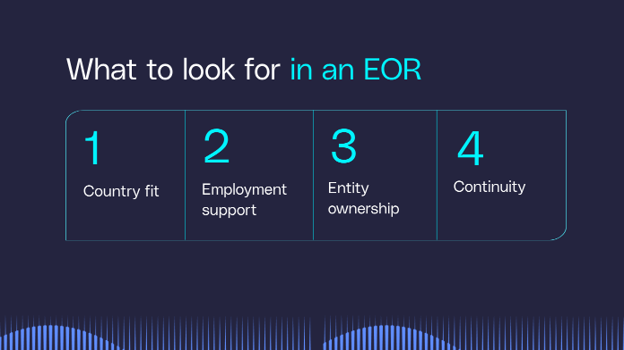
Four considerations help you compare providers meaningfully:
- Country-and-role fit: The arrangement must fit destination rules, including provider authorization where relevant. Suitability depends on the actual role and employment relationship, beyond the service label or country coverage.
- Coordinated employment support: A clear service scope connects onboarding with payroll and benefits administration. That coordination helps your team avoid gaps between contract preparation and ongoing employment.
- Responsive support and ownership: You need clarity about who handles employment questions and resolves administrative problems. Accessible support matters to both your HR team and the person joining.
- Continuity as needs change: Consider how support accommodates changes to the team member’s employment or a later move to direct employment. The arrangement should fit your immediate hire and longer-term plans.
Clear ownership matters most when onboarding begins: your team, the provider, and the candidate each supply information or approvals that affect the start date.
Build the start date around authorization and onboarding readiness
A useful start date reflects readiness to perform the intended work. Digital onboarding can move information quickly, but the underlying employment conditions still determine when the candidate can begin.
The readiness process brings together contributions from your business, the provider, and the candidate:
- Supply the country and role details: Your business provides the intended work location and job information so the provider can assess the proposed arrangement. Complete details at the outset reduce avoidable clarification before employment documentation begins.
- Verify work authorization: The candidate supplies information about permission to work, and the provider assesses that status for the intended employment. If additional immigration permission is needed, it becomes a separate timing dependency.
- Agree on local employment terms: Your business provides compensation details and approvals, while the provider prepares local employment documentation. Prompt review helps keep unresolved terms from delaying completion.
- Complete payroll and benefits setup: The candidate provides personal information, makes applicable benefits selections, and completes assigned onboarding tasks. The provider uses those inputs to prepare employment administration, with your business supplying the necessary approvals and funding information.
A credible start date reflects the work still open, whether that is authorization, agreed terms, or employment setup. Knowing who owns each item helps you avoid delays and prepare the first payroll.
Route salary payments through the actual employer
With an EOR, your business funds employment through the provider, and the legal employer administers local salary payments. The EOR also handles applicable withholding and benefits administration within the agreed service scope.
Under direct employment, your finance team arranges local payroll funding and payment processing, either internally or through a payroll service.
For a U.S. business employing someone directly, U.S. federal income tax withholding depends on factors such as the worker’s tax status and where the services are performed. Your payroll team needs those details alongside the destination’s rules to set up payments correctly.
Payroll funding covers more than the salary transfer. Employer contributions, benefits, and administration also belong in the budget for that hire.
Compare the full employment cost, not the service fee
A useful comparison holds the destination, compensation, and service scope consistent. Otherwise, a lower headline fee can obscure differences in what your business still needs to fund or administer.
Your employment budget has several components:
- Compensation: Include the agreed salary and other compensation attached to the role.
- Statutory employer costs: Account for employer taxes and contributions applicable in the destination.
- Benefits costs: Include the cost of the benefits themselves, separately from any fee for administering them.
- Service and administration fees: Identify what the recurring fee covers and which administrative activities sit outside it.
- Selected add-ons: Include optional services relevant to the candidate, such as visa support, in the quoted scope.
Payment currencies and any applicable conversion charges belong in the candidate-specific quote, so your finance team can understand the funding commitment. Direct employment also brings your own setup costs and continuing administration into the comparison.
A complete quote shows which employment work the provider takes on and which costs your business will fund. That gives you a useful basis for discussing the candidate’s start date and ongoing employment with an EOR.
Move your international candidate toward a compliant start with G-P
G-P EOR provides legal employment in 180+ countries without your business establishing its own local entity. G-P combines a platform with HR and legal expertise to help you move your selected candidate into employment and support the team member afterward.
For the U.S. market, G-P EOR pricing starts at USD 599 per team member per month. The service brings the hiring and ongoing administration together:
- Hiring and onboarding: Locally compliant contracts, right-to-work verification, and included AI-guided onboarding help turn your job details into an organized employment process.
- Payroll and tax administration: Payroll processing and local tax filings are included, keeping employment payments coordinated.
- Benefits and ongoing support: The fee includes benefits administration and ongoing legal and HR support. G-P EOR offers locally competitive benefits, and team members can update their personal information and benefits through the Professional Portal.
- Additional employment costs: Compensation is additional to the platform fee, as are statutory taxes and country-specific employment costs.
- Optional visa support: You can add immigration help where relevant to the candidate’s employment needs.
Bring the candidate’s destination and role, the compensation you intend to offer, their work-authorization status, and your desired start date to a candidate-focused demo.
Together, we can discuss employment fit and remaining onboarding inputs, then review funding arrangements and a complete budget for your hire.
 FAQs
How does an employer of record work after onboarding?
As the legal employer, the EOR keeps running payroll, applicable withholding, and benefits administration. You continue to direct the team member’s daily work and performance. Ask how team members update their personal details and benefits, and where they go with employment questions.
What are the benefits of using an EOR beyond avoiding entity setup?
The administration continues after the start date. The provider keeps handling payroll, local tax filings, and benefits administration, so your team does not build local payroll. Ask which reports and integrations connect that administration to your existing HR and payroll systems.
How do U.S. companies pay international employees?
Through whichever organization employs the person locally: an EOR, or your own entity or non-resident employer registration . Before the first payroll, agree on the payment currency, any conversion charges, and when your business must fund each pay run.
How should an employer verify an international candidate’s right to work?
Verification follows the destination-country process and checks existing authorization. Visa support serves a separate purpose, addressing permission still needed.