




Key Takeaways
- Bridge local skill gaps globally: With 84% of executives struggling to find specialized talent locally, expanding your strategy to borderless hiring helps you fill key roles and lower employment costs.
- Reduce economic risk and ease burnout: Global workforces give greater business stability against local market shocks, while offering the stability and flexibility 65% of anxious employees seek.
- Scale fast without entity setup: AI-powered Employer of Record (EOR) solutions like G-P handle local payroll, benefits, and compliance across 180+ countries — cutting compliance time and costs by up to 95%.
HR leaders are facing pressure from all sides. To navigate HR trends, companies are using AI to restructure teams and automate daily work, driving a rush for faster results. But that speed brings real weight. Employees are taking on broader roles, burnout is rising, and local talent pools are shrinking fast.
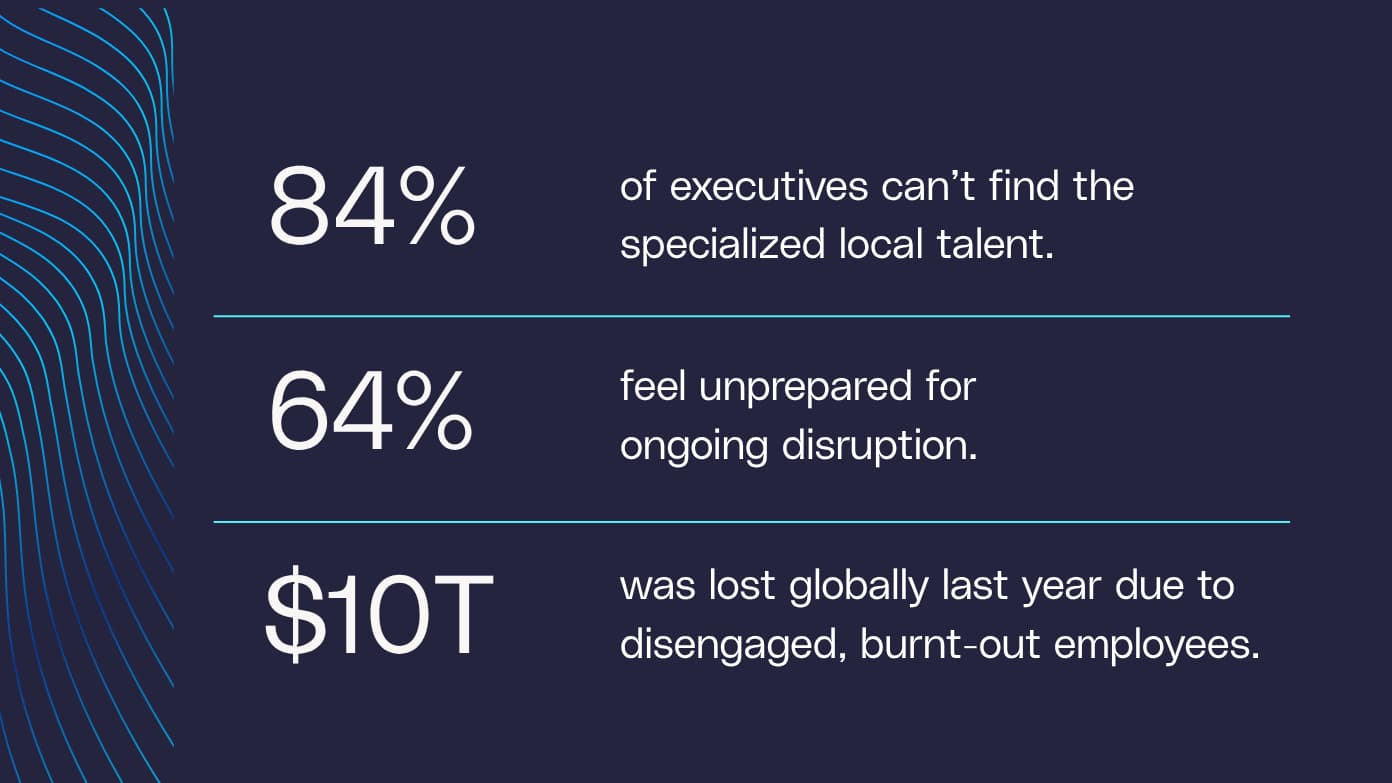
The numbers tell the story:
- 84% of executives can’t find the specialized local talent they need.
- 64% feel unprepared for ongoing disruption.
- USD 10T was lost globally last year due to disengaged, burnt-out employees.
When disruption hits, it’s easy to default to budget cuts. But this won't solve talent shortages. As AI handles routine tasks, your competitive edge depends on candidates with strong human-centered skills like critical thinking, leadership, emotional intelligence, and adaptability.
By 2030, technological advances will unlock 78 million net new jobs worldwide. Instead of reacting to local talent gaps with short-term fixes, forward-looking leaders are building resilient, borderless workforces
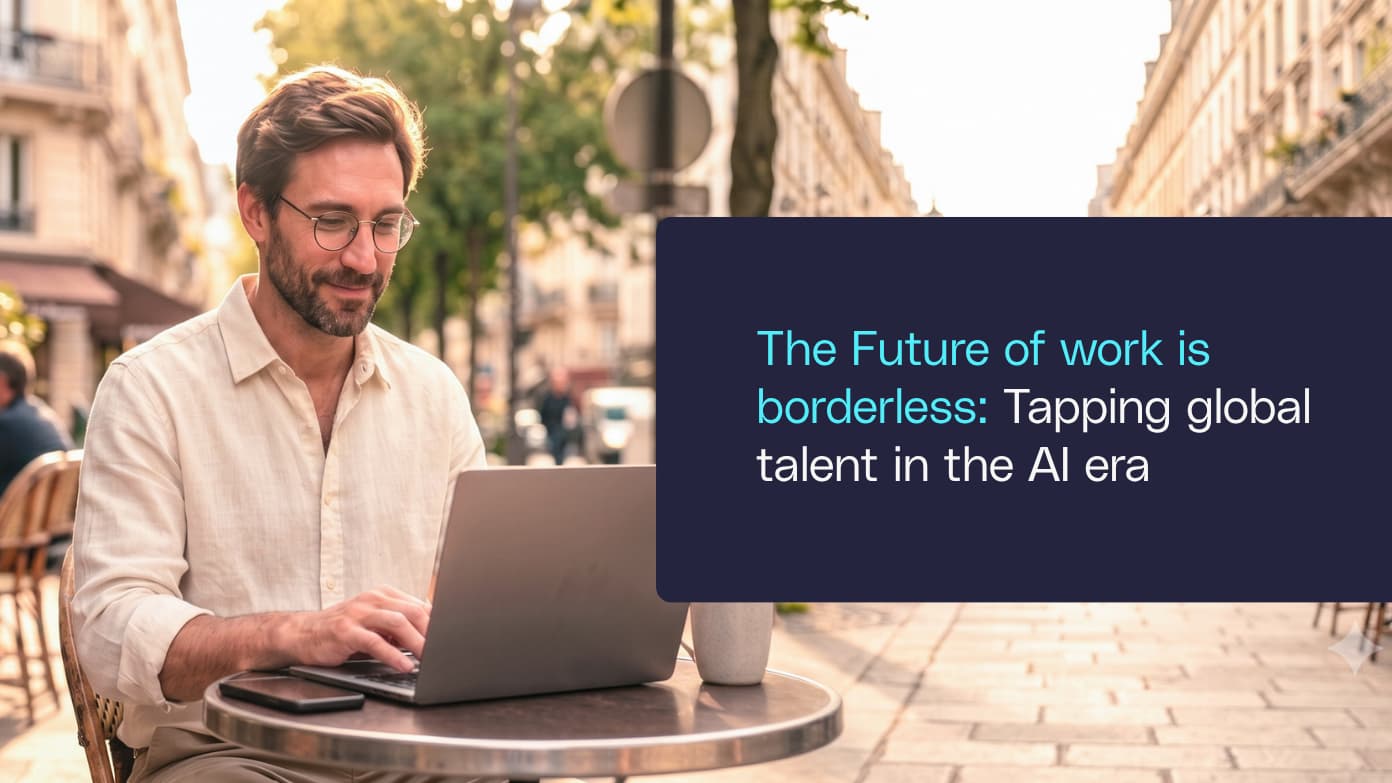
Looking beyond local borders gives you direct access to the specialized skills you need, relieves pressure on your team, and positions your business to lead through change.
 Future of work trends 2026: how does the global economy impact jobs?
The broader job market is feeling the strain of economic uncertainty, trade shifts, and rapid AI adoption. Recent International Labour Organization data shows global unemployment hovering at 4.9%. Yet businesses everywhere are still struggling to find the right talent.
Economies grow at different rates, even during downturns, and a global presence helps companies mitigate risks from regional economic changes. Whether the goal is talent acquisition, mergers and acquisitions, or expansion, global hiring can be a solution to help you grow.
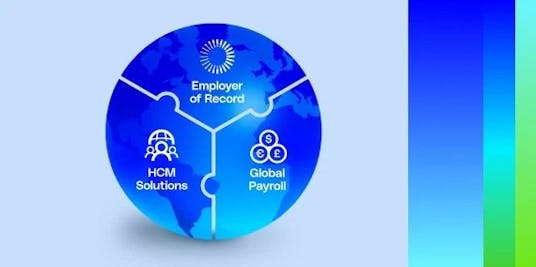
That's where an employer of record (EOR) like G-P EOR™ becomes invaluable. Companies of all sizes can expand into new markets and manage global teams with full compliance. Partnering with an EOR gives you the agility you need to navigate economic shifts and maintain momentum.
Learn more about the pathways to global hiring, the common pain points and how AI-powered EOR solutions can take your business to the next level.

Employment trends and job security trends 2026: Employees are concerned about losing their jobs
Economic anxiety affects employees’ job security too. G-P’s research on recent employment trends found that 65% of global employees have concerns about job loss in 2025. That number jumps to 70% in the U.S. and 85% in Singapore.
In the U.S., job insecurity may be magnified by at-will employment policies, which allows for termination without cause. In contrast, most European countries require just cause, advance notice and severance, giving workers more protections. Add in America's weaker social safety net and the fear of losing health insurance, and it’s no surprise U.S.-based employees are feeling the stress more acutely.
Escalating job uncertainty is changing employee expectations around work. In 2025, employees want stability, beyond just a paycheck. Nearly half of employees (46%) believe a global company offers greater security, seeing them as more resilient to local downturns. Other benefits of working for a global company include:
- Career growth
- Diversity of thought
- Cross-cultural teamwork
- Relocation opportunities
While a global presence is a draw for talent, HR leaders have to consider the entire employee lifecycle. Navigating offboarding for employees in different countries is complex because employment laws, termination procedures, and employee rights differ from one jurisdiction to another.
Properly handling offboarding reduces the risk of wrongful termination claims. G-P Gia™, our AI-powered global HR agent, can confirm the legal requirements for offboarding in different countries, outline best practices for exit interviews, and even generate compliant termination letters.
AI talent acquisition trends 2026: Specialized talent can be a differentiator
As modern AI talent acquisition tools handle more tasks, highly specialized skills can set you apart.
Boston Dynamics partnered with G-P to find specialized global talent. The company needed to hire a professional with rare expertise in robotics animation. They found one based in Denmark and G-P's existing entity infrastructure made it possible to move immediately. “Don't wait,” says Eduardo Ramos, Head of Total Rewards at Boston Dynamics. “The longer you wait, you're just losing out on the opportunity for you to drive your business goals forward.”
An EOR gives you the flexibility to expand or scale back as needed while handling all the tricky parts of global employment, like payroll, benefits, and legal paperwork. With G-P, location isn’t a barrier. You can hire talent you need, regardless of where candidates reside.
Global workforce trends 2026: Tap into global talent
Relying solely on local talent pools is a growing risk for modern companies. By adapting to borderless hiring trends, you can instantly access specialized skill hubs using AI-driven platforms and talent heatmaps.
With over 13 years of global data, we know top talent concentrates in specific, cost-effective regions. Diversifying across these emerging hubs helps you fill skill gaps, lower employment costs, and build a resilient workforce protected against local market shocks.
Some countries offer larger talent pools for specific roles. Let’s take a look:
|
Job roles |
Traditional hubs |
Cost-effective scale |
Emerging talent hubs |
|---|---|---|---|
|
Engineering and development |
EU, U.S., Canada, Australia |
India, Philippines, Vietnam, Ukraine |
Poland, Romania, Brazil, Mexico, Argentina, Colombia |
|
Customer success and support |
Philippines, Ireland, Portugal |
Mexico |
Colombia, South Africa |
|
Marketing creative (digital marketing) |
U.K., U.S., Canada, Australia |
Philippines, India, South Africa, Nigeria |
Germany, Brazil, Argentina, Mexico, Colombia, Poland, Romania, Ukraine, Spain, Portugal |
|
Sales |
Ireland, Portugal, Colombia, Philippines, South Africa |
South Africa, Argentina, India, Philippines, Colombia |
Mexico, Brazil, Poland, Romania, UAE and Czechia |
Every market comes with its own employment landscape. Use Globalpedia, G-P’s global hiring and compliance reference covering 180+ countries, to better understand local labor laws, norms, and employment considerations before expanding.
Challenges of global hiring and how an EOR helps
While a global presence can help you weather shifting macroeconomic dynamics, it’s not without complexities. Global employment is a moving target, where the laws and best practices change all the time and are unique to individual markets. HR teams can't be experts in every law in every country.
Here are some of the most common challenges you should consider:
- Navigating complex employment laws: Every country has its own labor laws, regulations, and statutory requirements like minimum wage, working hours, termination rules and benefits. Noncompliance can result in fines, legal disputes or reputational damage.
- Worker classification: Correctly classifying workers is tricky when criteria varies in each jurisdiction. Misclassification can lead to penalties and back payments.
- Payroll and tax compliance: Setting up compliant payroll systems for each country is difficult, involving local tax withholdings, social contributions and reporting. Currency fluctuations and local banking requirements add further challenges.
- Benefits and compensation: Mandatory and customary benefits like healthcare, pensions and paid leave vary widely. Competitive compensation packages must be tailored to local markets.
- Cultural and language differences: Communication styles, workplace expectations and business etiquette differ across cultures. Language barriers can impact onboarding, training and daily operations.
- Data privacy and security: Countries have strict data protection laws that affect how employee data is collected, stored and transferred.
How an EOR can speed up your global hiring
Growing a global team doesn't require local entities or legal headaches. With G-P, you can onboard, pay, and manage top talent in over 180 countries. We manage compliance, payroll, and benefits so you can expand with total confidence.
Our AI-powered platform streamlines your heavy admin work. Plus, our AI compliance agent, Gia, helps you draft and review employment contracts in minutes — cutting your compliance time and costs by up to 95%. You get instant, expert-backed guidance whenever you need it.
Get the full 2025 World at Work report
The future of work is a constant state of flux. To succeed in economic uncertainty and keep up with changing employee needs, you need to be quick and flexible. The 2025 World at Work report provides a roadmap for leaders to navigate these future of work trends. Download the full report to get all the insights you need to stay ahead of the curve.
What are the top future of work trends in 2026?
Key 2026 trends include intentional hiring, AI-assisted entry-level roles, tech-driven HR compliance, and expanded global talent acquisition.
How is AI changing HR operations in 2026?
AI tools like G-P Gia™ automate contract creation, answer complex labor law questions, and streamline workforce management.
Why are companies expanding global hiring in 2026?
Persistent local skill shortages force 84% of leaders to recruit internationally to find specialized talent quickly.
How does an Employer of Record (EOR) support 2026 growth?
An EOR lets you onboard and manage global team members legally across 180+ countries without setting up local entities.