



Key takeaways
- Learn about your options: You can hire talent by creating your own legal entity, working with an employer of record (EOR), or engaging independent contractors.
- Find the best choice: Each hiring method serves different purposes. An EOR can support faster hiring without entity setup, contractors can fill project-based needs, and a local entity provides direct control but requires more resources.
- Improve your hiring process with technology: When hiring globally, use tools like applicant tracking software and AI agents to optimize your strategy.
If you're interested in hiring globally, you have three main options: using an employer of record (EOR), creating a legal entity, or working with independent contractors. Each method for hiring global teams serves different business needs and impacts your timeline, budget, legal protections, and control over the hiring process. The good news is that your approach can evolve as your international footprint grows.
Let’s explore the basics of global hiring, so you can tailor your strategy to suit your needs.
3 ways to hire global teams
1. Use an employer of record (EOR)
An EOR allows you to hire employees globally without having to set up a new legal entity. EORs handle the legal complexities, manage payroll for your global teams, and complete all compliance paperwork. Your company maintains control over day-to-day work management, while the EOR handles employment logistics and ensures compliance.
Best for: Quick hiring decisions, testing new markets, small teams across multiple countries
2. Create a legal entity
Creating a legal entity means establishing your own company branch or subsidiary in-country to hire global employees directly. While this approach gives you complete control, it requires a lot of time and investment. You'll need to learn how to navigate and comply with all local employment laws and regulations for each location you hire in.
Best for: Long-term expansion plans, large teams in strategic markets, permanent market presence
See the differences between an EOR and a legal entity.
3. Work with independent contractors
Independent contractors provide specialized services for your company without the commitment of full-time employment. Many countries let you hire independent contractors without setting up a local entity
This global hiring option offers the fastest path to specialized talent for project-based work, but misclassification risks arise if you treat contractors like traditional employees.
Best for: Project-based work, specialized skills, non-core business functions
Hiring decision tree: comparing your options
| What to compare | EOR | Legal entity | Contractors |
|---|---|---|---|
| Speed to hire | Days to weeks | Months to years | Immediate |
| Starting cost for hiring global workers | Low | High | Low |
| Amount of work for your HR team | Low | High | High |
| Legal risk for your company | Low | Low (if done right) | High (worker misclassification) |
| Scalability for global teams | Very easy | Somewhat easy | Very easy |
| Intellectual property protection | Strong | Requires careful contracts | Requires careful contracts |
| Worker experience | Excellent (with right partner) | Excellent (with thoughtful approach) | Mixed |
The steps of hiring globally
Regardless of whether you choose to work with an EOR, create your own entity, or hire contractors, there are some hiring details you'll always need to consider. Here's what to think about when you're working on a global hiring project.
Managing global payroll and taxes
Global payroll depends on the worker’s country, employment model, and classification. Payroll may include income-tax withholding, social insurance, statutory contributions, paid leave, and other required benefits. An EOR or local payroll provider can calculate deductions, make required payments, and submit filings.
If you hire through your own entity, you’re responsible for accurate payroll records, deadlines, and local reporting. Contractor payments may follow different rules, but you should still confirm withholding, invoicing, and tax requirements before you hire international workers.
Preparing documents for global hiring
Document requirements vary by country, but a practical checklist includes:
- A signed employment or contractor agreement
- Proof of identity and local address
- Tax identification and bank details for payroll
- Right-to-work or work authorization documents, where required
- Emergency contact and required benefits information
- Any role-specific licenses, certifications, or background-check consent
Collect only information required by local law, store it securely, and confirm whether documents need translation, notarization, or local-language versions.
Setting compensation for international hires
A strong global compensation strategy balances company-wide consistency with local market standards. For best results set pay using local market data rather than converting a home-country salary directly into another currency.
Review the role, seniority, location, currency, statutory benefits, required allowances, and local pay-frequency rules. A competitive package may include private benefits or equity, but these can have different tax and reporting treatment in each country. Document how you review exchange-rate changes and compensation adjustments so international hires get a clear, consistent offer.
Onboarding and managing global employees remotely
Before a remote employee starts, finalize the compliant contract, payroll setup, required benefits, equipment, system access, and data-security training. Build onboarding around the employee’s time zone and include local policies, holidays, leave rules, and communication expectations.
Managers should set clear goals, schedule regular one-to-ones, document performance feedback, and create opportunities for collaboration across locations. This global onboarding approach helps dispersed employees contribute quickly while supporting consistent remote management.
Checking employment verification and work authorization
For international hires, confirm the equivalent right-to-work requirements, employment contracts, payroll registrations, and local employment-law obligations before the start date. Requirements differ by country, so obtain qualified local guidance when the hiring model or worker’s status is unclear.
Creating a global workforce with helpful tools
While global hiring has always existed, modern technology has made the process easier than ever. If you want to make hiring as stress-free as possible, consider some of these helpful options:
Integrated central HRIS
A centralized Human Resources Information System (HRIS) can help global HR teams manage employee records and workforce data in one place. Depending on its capabilities and integrations, an HRIS can connect payroll information, time-off requests, onboarding records, and reporting across locations. Make sure the system has appropriate privacy and security controls for handling sensitive employee data.
Localized ATS
An applicant tracking system (ATS) can help global HR teams organize candidate information and maintain a consistent hiring process across locations. When supported, connect your ATS with localized contract generation and onboarding workflows to speed up hiring and reduce repetitive administrative work.
Global HR agent
Double-check that your hiring is compliant with local laws through an AI-powered global HR agent like G-P Gia™. Gia draws from expert-vetted sources to provide global HR and compliance guidance across 50 countries and 50 U.S. states.
AI-assisted contract audits
AI tools can help review lengthy contracts, flag missing or inconsistent terms, and summarize complex localized language. These capabilities can save HR teams time and money.
"Knowing that Gia's guidance is based on expert-reviewed, legally vetted sources gives me peace of mind. It lets me spend less time on paperwork and more time on strategic initiatives."
Choosing the right global hiring option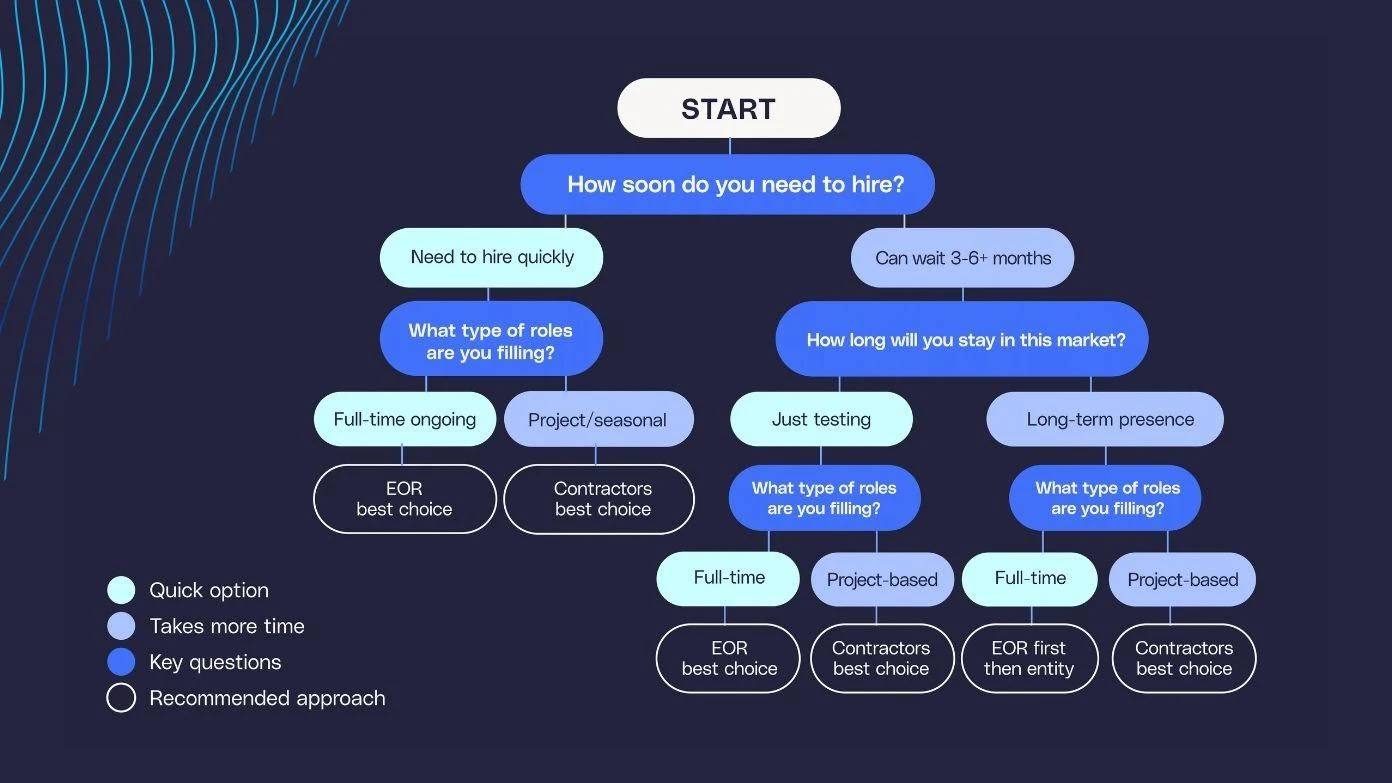
Learning how to hire globally involves choosing the best approach for your business. Many HR departments prefer EORs for quick market entry, legal entities for long-term commitment, and contractors for specialized projects. Ultimately, your hiring decision should balance urgency, budget, and strategic goals.
Hire globally with G-P
Our Global Employment Platform and its AI-powered products, EOR, Contractor, and Gia, enable companies of all sizes to build and manage global teams.
With more than a decade of experience, the largest team of HR, legal, and compliance experts, and a global proprietary knowledge base, G-P is the recognized leader in global employment.
Book a demo to see how G-P can support your global goals.

FAQs
What are the three main ways to hire globally?
The three main approaches to hiring globally are using an employer of record (EOR), creating a legal entity, and working with independent contractors. Each method serves different business needs and affects your timeline, budget, legal protections, and control over the hiring process. Your approach can evolve as your global footprint grows.
What is an employer of record (EOR)?
An EOR hires people for you in other countries without requiring you to set up a legal entity. They handle all legal complexities of international employment, manage payroll, and ensure compliance. Meanwhile, you maintain control over day-to-day work management.
When is setting up a legal entity the best global hiring option?
Setting up a legal entity is best for long-term expansion plans, large teams in strategic markets, and establishing a permanent market presence. This approach gives you complete control over hiring global employees directly, but it requires more time, investment, and oversight. It's ideal when you have many workers in one location and key strategic markets to develop.
What are the risks of hiring independent contractors internationally?
The main risk of hiring independent contractors internationally is misclassification. If local labor laws determine the working relationship between you and your contractor counts as traditional employment, it can lead to legal complications and regulatory penalties. Contractor arrangements also provide weaker intellectual property protection compared to direct employment if agreements aren't structured properly.
How quickly can I onboard talent using an EOR compared to a legal entity?
An EOR can onboard talent in days to weeks, while setting up a legal entity takes months to years. EORs provide immediate compliance and faster access to global talent without the administrative burden of entity establishment. Legal entities require navigating local regulations, paperwork, and approval processes that extend timelines.
How do I choose the right global hiring option for my business?
Choose based on three key factors: urgency vs. volume, market commitment, and role structure. For urgent needs with fewer positions, use an EOR. For larger teams with long-term plans, consider a legal entity. Many companies like to test new markets with a flexible EOR, while permanent presence may justify the extra work of setting up an entity.