


Key takeaways
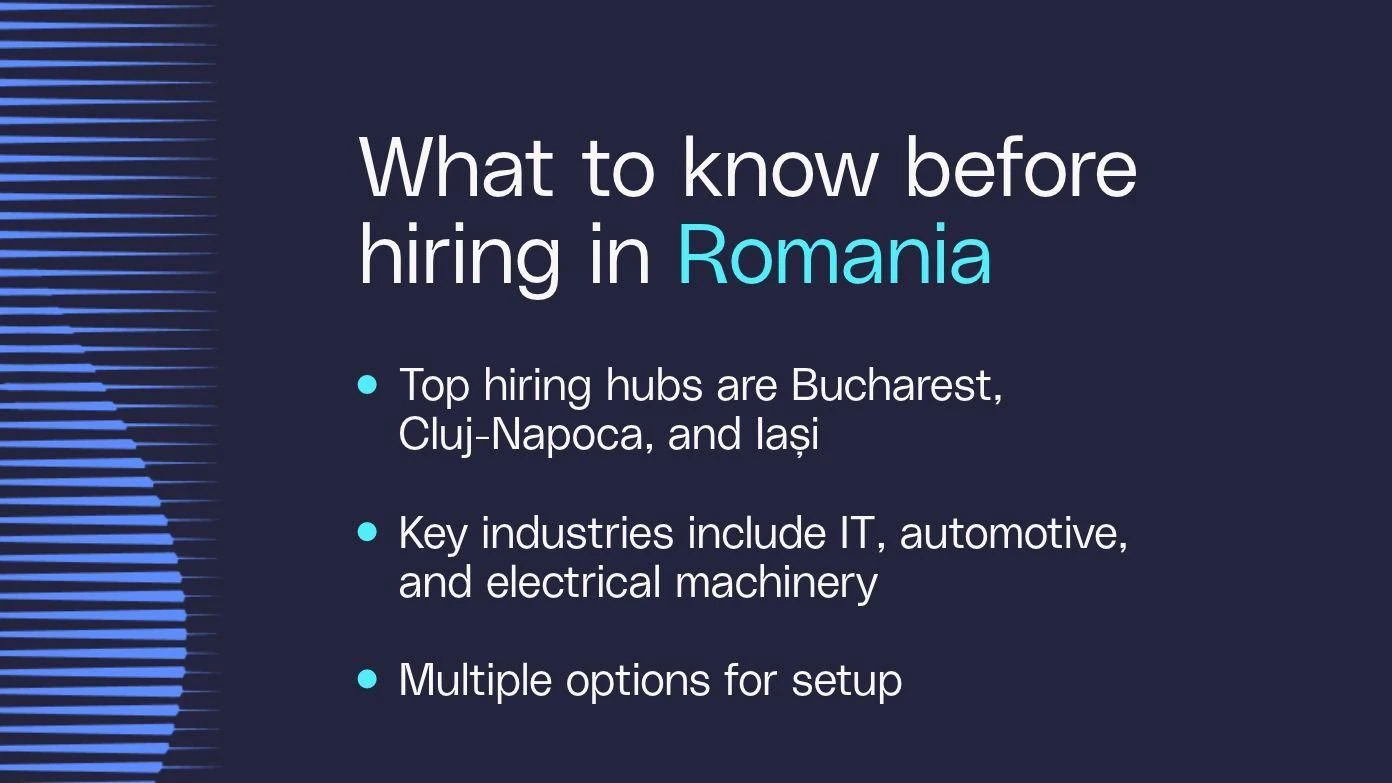
- Romania's skilled talent pool: Access a diverse pool of talent in Romania. Some of the top industries include IT, engineering, manufacturing, and business services, with major hiring hubs in Bucharest, Cluj-Napoca, Iași, and Timișoara.
- Employment laws: Global companies must follow multiple employment laws and regulations when expanding into Romania. Failure to comply with these requirements can lead to financial penalties and legal consequences.
- Multiple global hiring options: Choose from direct employer registration, an employer of record (EOR), and a subsidiary or branch. Each type offers unique benefits for managing employees and expanding business operations.
Romania has one of the fastest-growing economies in the EU and offers a skilled talent pool for global companies. IT and business services are major economic drivers, with a strong base in automotive and electronics. The country’s GDP is around USD 382–422B.
Before expanding into Romania, you’ll need to understand contracts, taxes, wages, benefits, and other employment laws. Our guide will tell you everything you need to know about hiring in Romania.
What to know before hiring in Romania
If you’re looking to hire in Romania for the first time, there are legal requirements to be aware of. These norms and laws influence hiring practices in Romania and many aspects of the employer-employee relationship, including compensation and benefits.
G-P Gia™, our AI-powered global HR agent, can answer your toughest compliance questions across 50 countries — including Romania — and all 50 U.S. states. Reduce your reliance on outside counsel and cut the time and cost of compliance by up to 95% with Gia.
Here are five things to know about hiring in Romania.
1. Termination regulations
Employers in Romania need legally recognized grounds to terminate an employee. A minimum notice period of 20 working days generally applies to dismissals for reasons such as professional incompetence. Exceptions include disciplinary dismissal and termination during the probationary period, when the applicable legal conditions are met.
Probation periods are limited to 90 days for executive roles and 120 days for managerial positions. Termination during probation requires only written notification without a notice period or cause. The terms for termination, including notice and probation, have to be clearly stated in the employment contract.
2. Contract structure
Written contracts in Romania are mandatory. All employment contracts have to be registered with the employees’ general register before the employee starts work.
Open-ended contracts are the default. A single fixed-term employment contract can generally last up to 36 months. Employers can enter into no more than three successive fixed-term contracts with the same employee, with additional duration limits applying to successive contracts.
Probation periods for fixed-term contracts are as follows:
- 5 working days for contracts under three months
- 15 working days for contracts between 3–6 months
- 30 working days for contracts over six months
- 45 working days for managerial positions with contracts over six months
You must give the employee a copy of the contract and keep the original on file.
3. Employment taxes
The main employer social security contribution is a unified work insurance contribution (CAM) of 2.25% of gross salary. Much higher rates for social security, health, unemployment, and medical leave are paid by employees (25% for pension and 10% for health insurance).
Romania, unlike many other European countries, has a disability compensatory fee. Companies with over 50 employees are required by law to ensure that at least 4% of their workforce consists of people with disabilities. If you don’t meet this quota, you have to pay a monthly compensatory fee.
4. Wages and work schedules
The general minimum wage in Romania is RON 4,325 gross per month as of July 2026. The workweek is eight hours per day and 40 hours per week. The legal maximum of 48 hours includes overtime. Employees get at least 20 working days of paid annual leave, plus extra leave for family events. Romania has at least 15 holidays.
5. Employee leave
Employees get up to 183 days of sick leave. Sick leave for common illnesses is generally compensated at 55%, 65%, or 75% of the calculation base, depending on the duration of the medical leave. There are higher rates, up to 100%, for specific conditions such as:
- Contagious diseases
- Surgical emergencies
- Quarantine
- Cancer
- Tuberculosis
The maximum sick leave can be extended to 18 months for serious illness. Under the temporary rules in effect from February 2026 through December 2027, the first day of sick leave is generally unpaid. Employers cover days two through six, and the national health insurance fund generally covers subsequent days, subject to applicable exceptions.
Maternity leave is 126 calendar days. It’s compensated at 85% of the average gross income and paid from the national health insurance fund. Paternity leave is 10 working days. It can be extended to 15 days if the father completes a certified childcare course. Paternity leave is paid at 100% of salary. Parental leave is available for up to two years (three for a child with disabilities). Parental leave is compensated at 85% of the average net income, subject to caps.
Hiring models for global companies in Romania
You have several ways to build a team in Romania that offer different advantages and levels of flexibility, but you must first consider your overall business goals and hiring needs to choose a method that aligns with your plans.
If you're planning to test the market, start by hiring a few workers to support your internal operations without setting up a local entity. But if you want to expand your operations long-term, establishing a permanent presence and using a subsidiary or branch may work better since you're making a larger investment in the country.
Keep in mind that the hiring model you use will have a direct impact on how much control you have over employment arrangements, the amount of administrative work that you must handle, and your ability to scale your workforce.
Direct employer registration
With direct employer registration, you can operate as a foreign company that employs workers in Romania under your own name, but you must meet all applicable legal and registration requirements. These may include registering with the Romanian tax authorities, fulfilling payroll reporting obligations, and making required social contributions, depending on your business structure. Companies that prefer to manage their own employment relationships often use this approach because of its flexibility.
One of the main advantages is that direct employer registration lets you maintain direct oversight over your employment arrangements and internal HR processes. Your business activities and corporate structure will both affect whether you can legally hire workers with this type of arrangement. And you must also consider whether your operations will create a permanent establishment for tax purposes. If they do, there may be additional obligations, like corporate income tax reporting and local tax filings, that you must comply with.
Employer of record
If you use an employer of record (EOR) to hire workers in Romania, you'll have a third-party organization take care of your employment contracts, payroll processing, and benefits administration. This approach is especially beneficial if you want to hire workers without establishing a local entity because you can still maintain control over the management of the workers' daily activities, including the performance expectations they must meet.
Many companies looking to test the Romanian market will use an EOR before making a large investment. It's also a preferred choice for companies that want their HR teams to have more time to focus on employee engagement and professional development instead of managing local employment administration.
If you choose to use an EOR to hire employees in Romania, choose one based on its local expertise, technology capabilities, service coverage, and pricing structure.
Subsidiary or branch
Taking the subsidiary or branch approach tends to make the most sense when you want to develop a substantial, long-term presence in Romania. Even though both of these give you an established local business presence, the structural differences between the two are worth noting:
- Subsidiary: A subsidiary is a separate legal entity, typically established as a Romanian limited liability company (SRL). It can enter into contracts, hold assets, and conduct business under its own legal identity. The parent company's liability is generally limited to its investment in the subsidiary.
- Branch: A branch operates as an extension of the foreign parent company rather than a separate legal entity. The parent company remains legally responsible for the branch's obligations and liabilities.
Independent contractor
It's common for global companies to hire independent contractors in Romania as they test new markets. For example, hiring a Romanian consultant to perform research on local consumer preferences and then a marketing specialist to develop a promotional strategy so you can evaluate market demand makes more sense than hiring them as permanent employees. Both of these professionals can provide valuable insights and help you decide whether you want to expand your operations. But you can’t treat independent contractors as employees when it comes to employment classification and tax purposes. And if you misclassify workers, there are severe penalties, like financial fines, unpaid tax liabilities, or legal action.
Top hiring hubs in Romania
Some cities in Romania are known for particular industries. Knowing what each region has to offer allows you to focus your hiring efforts in the right place and fill roles faster.
The top talent hubs in Romania are:
- Bucharest is the capital and largest city of the nation. It has the largest concentration of professionals in IT, software development, finance, marketing, and BPO/shared services. It also has the most tech companies and startups, including global companies such as Microsoft, IBM, Oracle, and UiPath.
- Cluj-Napoca, the unofficial capital of Transylvania, is Romania's fastest-growing technology hub. It’s called the Silicon Valley of Eastern Europe. The city’s tech professionals specialize in software engineering, AI, data science, and R&D.
- Iași is a historic cultural and academic city that has become an IT and BPO hub. The city offers many technical graduates in software development, web development, and IT support.
- Timișoara is located near the borders of Hungary and Serbia. It’s known for its industrial past and engineering sector. The city is a great place to find talent in engineering, manufacturing, automation, and hardware development.
Key industries in Romania
Understanding Romania’s top industries allows you to benchmark salaries and benefits. You can use this insight to make smart choices about where to invest and grow your talent pool.
The top industries in Romania include:
- IT: Romania has many highly skilled tech graduates. The country is a European leader in areas such as cybersecurity, fintech, and enterprise software. Major tech cities include Cluj-Napoca, Bucharest, and Timișoara.
- Automotive: The automotive export industry makes Romania a regional leader in car production. The country is home to major manufacturers like Dacia (Renault Group) and Ford, as well as many auto parts and components suppliers.
- Electrical machinery and equipment: Romania is a major exporter of electrical machinery and equipment. This includes insulated wire, electrical control boards, and various electrical and electronic components.
- Construction: The construction sector is focused on modernizing transport, expanding commercial real estate, and building new homes in urban areas.
- Agriculture: Romania has large areas of fertile land and is a major producer of cereals (like corn and wheat), oilseeds, and wine. The country is focused on modernizing agribusiness and increasing EU investment.
The cost of hiring an employee in Romania
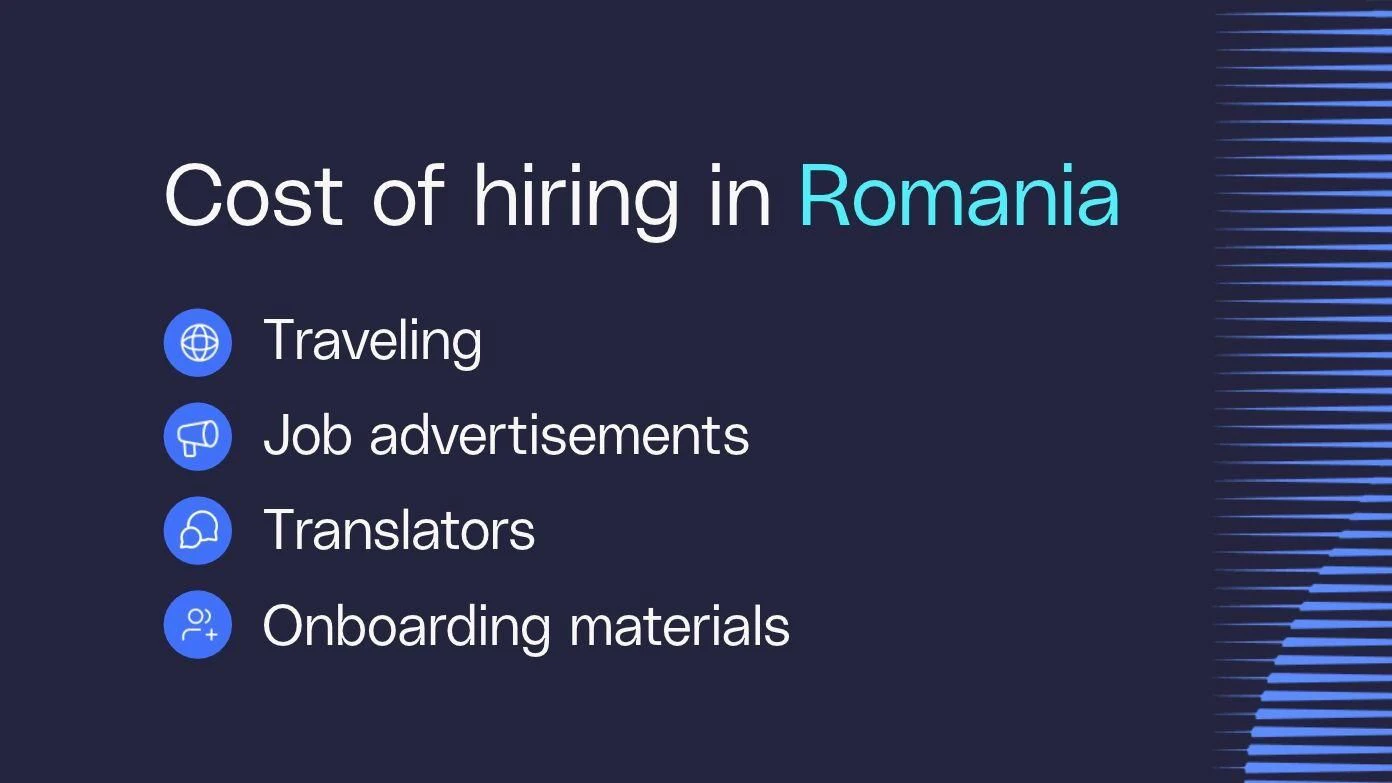
Whether you’re hiring one employee or an entire team in Romania, expenses are inevitable. Budget for the following:
- Setting up an entity (unless you partner with an employer of record)
- Advertising job positions
- Paying referral bonuses to employees with connections in Romania
- Paying an in-house hiring committee
- Traveling to and from Romania, including hotel stays, meals, and transportation
- Partnering with a translator to draft documents or facilitate conversations (if applicable)
- Using a background check service for screening candidates
- Drafting compliant employment contracts, legal review, and consultation with HR and legal experts
- Costs for providing computers, phones, and software licenses
- Onboarding materials and initial training
- Costs for maintaining required tax and payroll records and documentation
According to G-P Verified Sources from Gia, the employer burden rate in Romania, which includes costs triggered on top of salaries, is about 2.5%, excluding accident insurance that can vary.
What does a company need to hire employees in Romania?
Make sure you cover these essentials before expanding your team in Romania:
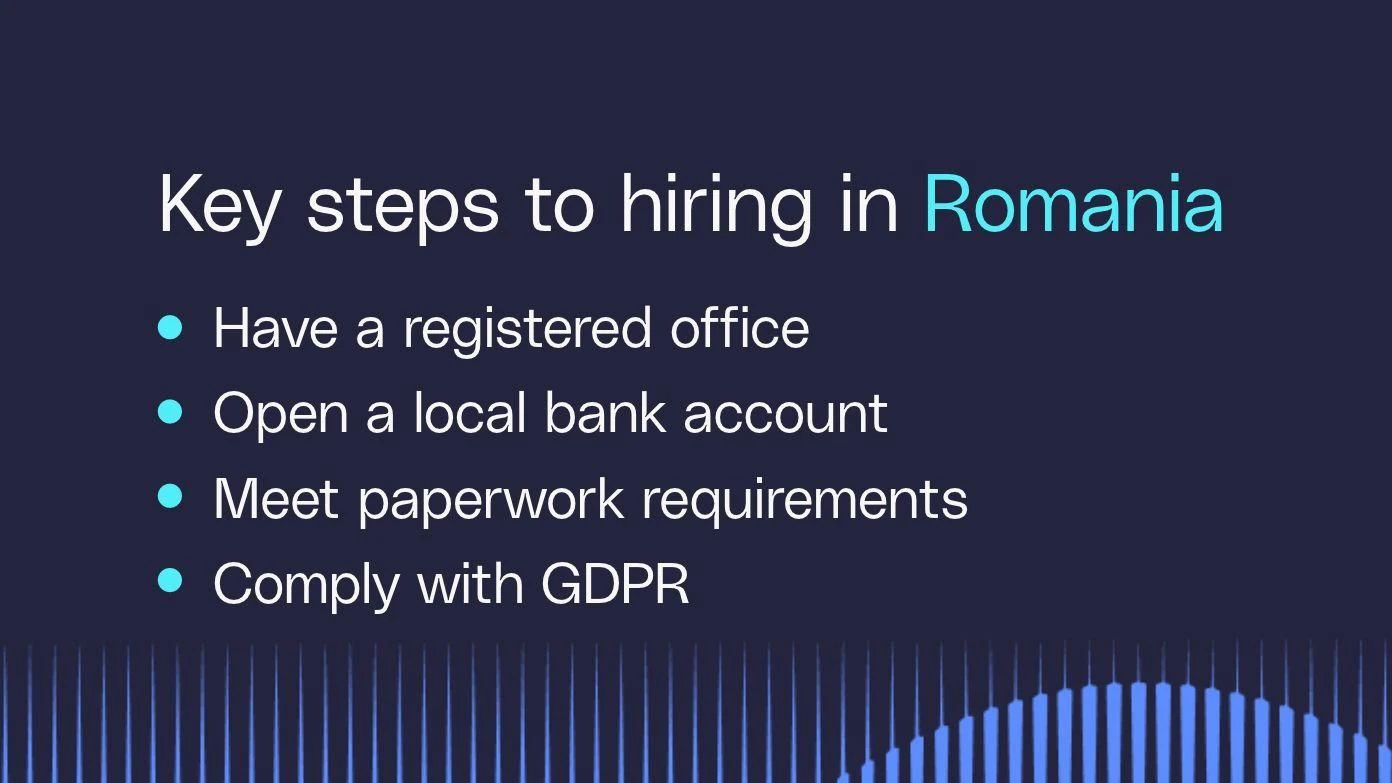
- Register a local company or branch with the Romanian trade register.
- Get a unique registration code (CUI).
- Get a trade license.
- Open a local bank account.
- Register with the National Agency for Fiscal Administration (ANAF) and the Territorial Labor Inspectorate (ITM).
- Enroll employees in the general register of employees before they start work.
- Make sure payroll systems are compliant and ready to process salaries and contributions.
- Arrange health and safety training and medical checks as required by law.
Setting up a subsidiary in Romania can take weeks or months. Use G-P EOR to hire full-time employees in Romania without setting up your own entity. Build your team at a lower cost and with peace of mind that you’re doing so compliantly.
The steps to hiring employees in Romania
The hiring process in Romania is similar to the one you’re likely familiar with in your own country. The hiring process follows five basic steps: advertising the job, evaluating applications, interviewing candidates, sending job offers, and onboarding new employees.
1. Advertise job vacancies
Publish the vacancy on job boards, company websites, or through recruitment agencies. Make sure the ad is nondiscriminatory and complies with local laws.
BestJobs, eJobs, Hipo, LinkedIn, and Jooble are popular job sites in Romania.
2. Evaluate job applications
Review submitted CVs and cover letters. Shortlist candidates based on qualifications and experience.
3. Interview candidates
Conduct interviews, either in-person or virtually, to assess skills, experience, and cultural fit. Gia can help you create questions that follow anti-discrimination laws in Romania, so you can find the best fit for the role while complying with local regulations.
4. Make job offers
Prepare a written employment contract in Romanian. Include all terms and have it signed by both parties.
5. Onboard new employees
Now, you can onboard new employees. Register the employment contract with the general register of employees before the employee’s first day of work. Arrange any required pre-employment medical checks. Provide health and safety training. Set up payroll and contributions.
If you’re working with an EOR like G-P, you won’t have to worry about the administrative burden of onboarding. We’ll streamline the process, so you can focus on training your new team members and integrating them into your company culture.
Hiring contractors in Romania
Working with independent contractors in Romania can be a cost-effective way to test the market and build a presence without the commitment of full-time employees.
Contractors based in Romania understand local consumer behavior, rules, and business practices. They’ll be ready to start working quickly with their own equipment and established work processes.
Hiring contractors allows you to easily adjust your talent pool based on your business needs, without the complexities and costs of employment.
Before you enter an agreement with an independent contractor in Romania, consider the following:
1. Employees vs. independent contractors
It’s important to understand the difference between employees and independent contractors. Romanian law uses a specific set of criteria (the seven criteria test in the fiscal code) to determine independent contractor status. To be classified as an independent contractor, at least four of the following must apply:
- Freedom to choose work location, manner, and schedule
- Ability to work for multiple clients
- Assumption of business risk
- Use of own equipment and resources
- Use of own skills and expertise
- Membership in a professional body, if applicable
- Freedom to subcontract or collaborate with others
The working relationship must reflect these criteria in practice, not just in the contract.
2. Penalties for misclassification
Classifying someone as a contractor when they’re not can lead to severe penalties. If misclassification occurs, you may have to face:
- Financial penalties that depend on the nature of the violation
- Liability for unpaid taxes and social security contributions
- Additional legal consequences, depending on the circumstances
3. How to pay contractors
G-P Contractor™ takes away the messy, time-consuming process of hiring and paying international contractors. You can create and issue contracts and pay contractors with just a few clicks, all while ensuring a compliant process.
Hire employees and contractors in Romania with G-P
Our Global Employment Platform and its AI-powered products, EOR, Contractor, and Gia, support companies as they build and manage global teams.
G-P is the recognized leader in global employment with more than a decade of experience; the largest team of HR, legal, and compliance experts; and a global proprietary knowledge base.
Make your expansion to Romania easier with G-P. Contact us or book a demo today.
 FAQs
Do I need a local entity to hire employees in Romania?
No. You can use an employer of record (EOR) like G-P EOR to hire employees compliantly without setting up new entities.
What are the employer contributions and taxes in Romania?
The main employer contribution is the work insurance contribution (CAM). This is 2.25% of gross salary. The employee pays the majority of social security and health contributions.
What are the requirements for employment contracts in Romania?
Before the employee starts work, employment contracts have to be in writing, in Romanian, and registered with the general register of employees.
What’s the minimum wage and working hours in Romania?
The minimum wage is RON 4,325 gross per month as of July 2026. The standard workday is eight hours, with a 40-hour workweek.
What types of leave are employees entitled to in Romania?
Employees get at least 20 working days of paid annual leave, sick leave, maternity/paternity leave, and parental leave, as well as holidays.