
Key takeaways
- Budget the total, not the fee: Add gross compensation, employer taxes, statutory benefits, the EOR service fee and any extras to get the monthly cost of each hire.
- Compare equivalent plans: Keep the hiring plan and service scope consistent when evaluating flat and percentage-based fees.
- Separate cash from expense: Build a cash forecast alongside your operating budget to account for funding timing.
- Localize optional benefits: Preserve entitlements and commitments while directing discretionary spending toward locally suitable coverage.
EOR pricing should be evaluated as a total monthly employment budget covering gross compensation, employer taxes and benefits, the service fee, and applicable extras.
An employer of record (EOR) is an organization that legally employs team members on another business’s behalf and administers their employment. For U.S.-based HR and finance leaders, the planning challenge is translating international hiring plans into a usable budget and cash forecast.
Build your EOR pricing budget from the full cost formula
Your hiring country and compensation package establish the employment-cost baseline. Applying U.S. payroll assumptions to international hires can leave local obligations out of your forecast.
Use this monthly planning formula:
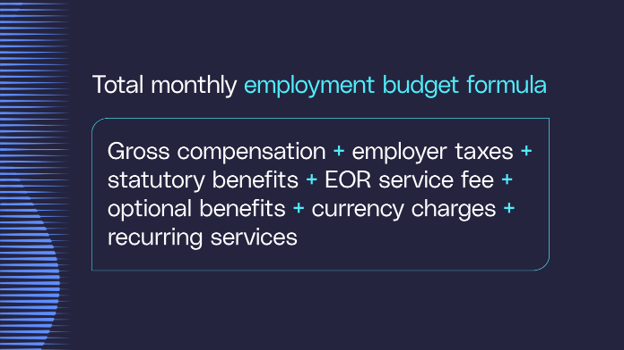
Total monthly employment budget = gross compensation + employer taxes + statutory benefits + EOR service fee + optional benefits + applicable currency and payment charges + separately priced recurring services.
Each component has a distinct purpose:
- Gross compensation: This is pay before team-member deductions. Those deductions remain within gross pay; they aren't another employer expense.
- Employer taxes and statutory benefits: Include the hiring country's applicable employer obligations. As the Social Security Administration's international framework explains, one social-security contribution can cover several benefit categories, so count that bundled contribution only once.
- EOR service fee: This funds the provider's stated employment-administration scope. The quote determines which services are included.
- Optional benefits: Include premiums and employer contributions for the supplementary coverage you select.
- Currency and payment charges: Include applicable transaction costs based on your payment arrangement, including conversion charges where relevant.
- Separately priced recurring services: Add ongoing services outside the quoted scope only when your hiring plan uses them.
Annual compensation or benefit obligations may need a monthly planning allowance even when payment falls in another month. That allowance helps you plan; it doesn't change the invoice date.
This breakdown establishes the employment funding you need. The next distinction is the scope of administration behind the service fee.
Distinguish EOR payroll from payroll processing alone
Service scope determines whether two payroll-related prices are comparable. EOR payroll is the administration of team-member pay, deductions, and related filings within an employer-of-record employment service.
- Payroll-only services: process payroll for an existing employment arrangement. A processing quote covers a narrower task than becoming the legal employer.
- Best fit: Your business already has an employment route and needs payroll-processing support.
- EOR services: combine payroll with the legal-employer role and broader employment administration. That scope extends to employment contracts and benefits support.
- Best fit: You want to hire internationally without establishing your own local entity.
When payroll processing is bundled into the EOR fee, a second processing allowance duplicates the same administration. The applicable quote determines whether any payroll-related service sits outside that bundle, so a standalone payroll price won't tell you the full cost of EOR employment.
Once the service boundary is clear, your cash forecast can show when those costs must be funded.
Separate recurring expenses from upfront funding and exit costs
Your monthly operating budget shows employment expenses. Your cash forecast shows when money leaves the business. Keeping both views helps you plan for upfront funding without overstating recurring costs.
Separate payments into three groups:
- Recurring expenses: These are the ongoing costs captured in your monthly formula, with payment timing tracked separately.
- One-time expenses: Setup or exit charges, where applicable, belong against the relevant event. Onboarding included in the service fee doesn't automatically create an additional setup charge.
- Refundable deposits and payroll prefunding: A refundable deposit is not a cost when you get it back under the stated conditions. Prefunding pays payroll costs that you already budgeted, so do not count it twice.
The applicable offer gives you the amounts and settlement timing needed to complete the cash forecast. With funding timing accounted for, you can focus cost-control efforts on spending choices, including optional benefits.
Control optional benefit spending around local needs
A locally suitable benefits package gives discretionary spending a clearer purpose than repeating one package everywhere. Your benefits budget funds coverage, while the administration fee pays for supporting that coverage.
Three budgeting choices help you direct optional funding:
- Set country-specific budgets: Establish statutory entitlements and existing commitments first, then allocate supplementary funding. A global benefits budget should reflect differences in local costs.
- Benchmark locally: Compare supplementary coverage with local expectations and team-member needs to assess whether the package suits the people receiving it.
- Review enrollment alongside spending: Participation can identify plans worth assessing more closely. Low enrollment is a signal to investigate suitability, with existing commitments guiding any decision about coverage.
This approach gives HR and finance a shared basis for deciding where optional funding belongs. It also makes the selected package part of your proposal baseline: a lower total could reflect different coverage rather than a better-priced service.
Compare proposals on the same hiring plan and service scope
Fee differences become meaningful when providers quote against an equivalent plan. Align the comparison inputs before assessing the fee mechanics:
- Hiring footprint: Use the same countries and headcount.
- Employment package: Match compensation assumptions and benefits coverage.
- Service scope: Compare equivalent administration and selected additional services.
The table separates underlying employment costs from fee mechanics:
|
Cost component or consideration |
Flat per-person model |
Salary-percentage model |
|---|---|---|
|
Gross compensation |
Agreed compensation baseline |
Same compensation baseline |
|
Employer contributions and statutory benefits |
Applicable country obligations |
Same country obligations |
|
Optional benefits |
Selected package and funding |
Equivalent package and funding |
|
Monthly service fee |
Headcount × quoted monthly rate |
Quoted percentage × defined monthly compensation base |
|
Applicable recurring extras |
Charges for selected scope and payment arrangement |
Charges for equivalent scope and payment arrangement |
|
Conditional best fit |
Salary-independent service-fee planning, at unchanged rates |
Plans accepting fees that move with the defined compensation base, at unchanged rates |
For percentage pricing, the proposal must define which compensation enters the calculation. Apply any quoted minimums or caps, then account for discounts. Neither model is inherently cheaper; the quoted terms and matched scope determine the result.
Service quality belongs alongside the cost breakdown because it affects your team's day-to-day work:
- Payroll reliability: Consistent processing supports dependable pay and reduces time spent resolving problems.
- Accessible local support: Relevant HR guidance helps you address country-specific employment questions.
- Clear issue ownership: Defined responsibility makes it easier to move a concern toward resolution.
- Predictable transition support: Planning equivalent benefits policies during a transition helps avoid coverage gaps.
A comparable proposal gives you a financial baseline and a clear understanding of the service behind it. You can then assess a provider's starting fee against your business needs.
Plan your international employment budget with G-P
G-P EOR helps you hire internationally without establishing local entities and gives you a defined service-budget baseline. G-P acts as the legal employer for your international team members.
For U.S. buyers, G-P EOR uses a flat platform-fee model, starting at USD 599 per team member per month. Volume discounts and custom pricing plans are available for scaling teams.
The scope breaks down into three budget categories:
- Included administration: The platform fee covers onboarding, payroll processing and tax filings, benefits administration, and ongoing legal and HR support.
- Additional employment funding: Compensation and statutory taxes are additional, alongside country-specific employment costs. Your planned hires determine this portion of the monthly employment budget.
- Optional add-ons: You can add background checks, visa support, equity payroll management, an employee assistance program, office space and IT equipment.
During a consultation, G-P provides a detailed employer-contribution breakdown using employer-burden data. That detail helps translate your country mix into a hiring budget before you commit, connecting the service price to the underlying employment obligations.
To ground the conversation in your plan, bring:
- Hiring locations: The countries where you intend to add team members.
- Compensation and scale: Planned pay and team size.
- Budget priorities: Your employment budget and the support your team needs.
The conversation can also clarify applicable currency and payment charges, plus any setup or exit expenses. Discuss any deposit or prefunding amounts and their treatment to complete your cash forecast alongside the employment budget.

FAQs
How much does an EOR cost as your team grows?
Employment costs grow with each hire's compensation and employer obligations. The service fee grows with headcount under a flat model, or with the compensation base under a percentage model. Ask about volume discounts: a starting rate multiplied by headcount may not reflect your final quote.
What is the basic formula for calculating employee cost?
Calculate each planned hire's cost using the hiring country's obligations and the agreed employment package, then add the per-hire amounts to build your team budget. This preserves local cost differences that a single blended allowance can obscure.
Which strategies can employers use to control employee benefit costs?
Besides planning packages locally, ask whether a provider pools demand across its customers to negotiate better benefit terms, such as shorter waiting periods. That can control cost without making coverage reductions the default.
How much does payroll cost per employee when payments involve multiple currencies?
The amount depends on the administration scope and on transaction costs such as currency conversion. Ask each provider to show the conversion rate and fees for each payment, so you can compare actual costs with the allowance in your budget.
What is an EOR payroll’s role alongside existing HR systems?
EOR payroll covers pay, deductions and filings for the people the EOR employs. Your own HR and payroll systems still hold data for the rest of your workforce, so check which integrations and reports connect the two for HR and finance.