



主要心得
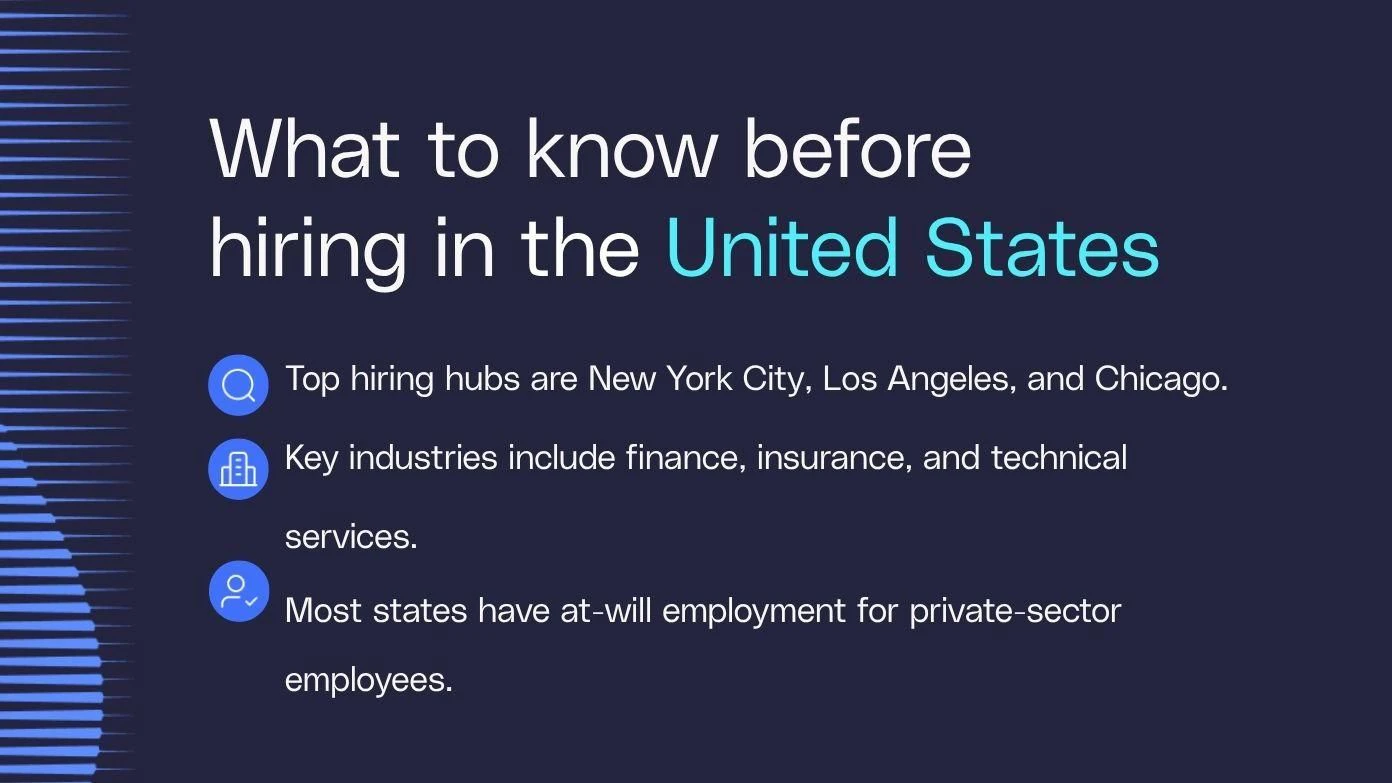
- The United States' top hiring hubs are New York City, Los Angeles, and Chicago.
- Top industries in the U.S. include finance, insurance, technical services, and healthcare.
- Companies hiring in the United States have various options for setup, including partnering with an employer of record (EOR), hiring contractors, establishing a subsidiary, or direct employer registration.
The U.S. is the world's largest economy by nominal GDP (approximately USD 32.6T) in 2026. The United States also represents the largest consumer market in the world. It continues to be a global leader in technology, finance, and innovation, from Silicon Valley and Wall Street, offering access to venture capital and a high-income customer base.
Before expanding into the U.S., you'll need to understand contracts, taxes, wages, benefits, and other employment laws. Our guide will tell you everything you need to know about hiring in the U.S.
在美國招募前需要了解哪些內容
If you're expanding your business into the U.S. for the first time, there are important legal requirements to be aware of. These norms and laws influence hiring practices in the U.S. and many aspects of the employer-employee relationship, including compensation and benefits.
G-P Gia™, our AI-powered global HR agent, can answer your toughest compliance questions across 50 countries — including the U.S. — and all 50 U.S. states. Reduce your reliance on outside counsel and cut the time and cost of compliance by up to 95% with Gia.
Here are five things to know about hiring in the U.S.:
1. At-will employment and termination
Most U.S. states have at-will employment for private sector, non-union employees. Employers can terminate employees at any time, for any legal reason, or no reason at all. Employees cannot be terminated as retaliation or for protected reasons. Contracts, collective bargaining agreements, workplace policies, and state regulations may have additional policies for compliant termination.
Notice and severance pay aren't legally required in most cases, though many employers provide them as a courtesy or for higher-level roles. Sometimes, federal WARN and mini-WARN laws require that employees be notified about upcoming major layoffs or job site closings. Other exceptions include employment contract terms, company policies, or collective bargaining agreements. There are also state-specific requirements in New Jersey and Maine.
At-will employees can leave their jobs at any time, for any reason, without legal penalty. However, in some cases, there may be a required notice period, repayments, confidentiality agreements, or other obligations.
Employment contracts aren't standard for most U.S. employees, except for executives or specialized positions. Most workers are hired without a formal contract. Public sector and unionized employees may have additional due process or just cause protections.
Montana is the only state that doesn't follow the at-will doctrine. After a 12-18 month probationary period, employees can only be terminated with good cause. Exceptions to at-will employment still apply, such as terminations that violate anti-discrimination laws, public policy, or an existing employment contract.
2.薪資發放和稅收
Employers have to add employees to payroll, withhold federal and usually state income taxes, and deposit these to the IRS and state or local tax agencies. Federal income tax withholding works on a bracketed system. For employees earning up to $184,500, both employers and employees contribute 6.2% of wages to social security for 2026. The maximum social security tax is $11,439 for each party.
Employees are subject to federal income tax withholding, which uses a bracketed system. Withholding is based on taxable wages, pay frequency, and W-4 forms. State income tax rates and brackets vary by state and are based on work location, residence, reciprocity agreements, and local rules. Some states have no income tax, while others have flat or progressive rates.
Employers and employees each contribute 1.45% to Medicare. For employees earning over USD 200,000, regardless of filing status, there is an additional 0.9% employee-only Medicare tax. There are additional thresholds based on income and filing status. There is no annual wage cap on Medicare contributions.
3. Standard working hours
The culturally standard workweek in the U.S. is 40 hours, spread across eight hours per day, five days per week. The Fair Labor Standards Act (FLSA) doesn't cap working hours or require an eight-hour workday. An FLSA workweek is defined by a 168-hour period, not seven consecutive 24-hour periods.
Alternative schedules in healthcare and other industries are common. Some companies offer shorter workweeks or part-time roles.
For overtime, the U.S. law distinguishes between exempt and nonexempt employees under the FLSA:
- Exempt employees, who meet certain duties tests, don't get overtime pay.
- Covered, nonexempt employees are entitled to overtime pay at 1.5 times their regular rate of pay after working 40 hours in a workweek. For example, an employee making USD 10 per hour would make USD 15 per hour in overtime.
State and local regulations can include additional overtime requirements, rules for meal and rest breaks, split-shift premiums, and more.
4. Employee benefits
There are no federal mandates for private-sector employers to provide paid vacation, paid sick leave, or paid parental leave. However, state and local laws may require employers to provide paid leave. There are also exceptions for federal contractors and under certain employment contracts and CBAs.
The Affordable Care Act (ACA) requires employers with 50 or more full-time employees or full-time equivalents in the prior calendar year to offer affordable, minimum essential health coverage. This coverage must be offered to at least 95% of eligible workers and their dependents. The ACA affordability threshold is 9.96%.
Smaller employers may be eligible for the Small Business Health Options Program (SHOP) and related tax credits. Employer-sponsored health insurance is a big part of compensation. Out-of-pocket annual healthcare costs for U.S. employees are currently among the highest in the world, averaging up to USD 14,885 per person.
The Family and Medical Leave Act (FMLA) provides up to 12 weeks of unpaid, job-protected leave for certain family and medical reasons, but only for employees at companies with 50 or more employees within 75 miles. Employees must also meet eligibility requirements, including 12 months of service and working 1,250 hours.
The U.S. has 11 federal holidays. Private employers aren't required by law to provide these days off or pay extra for work on holidays.
5. State and federal regulations
U.S. employment regulations are a blend of state and federal laws. For instance, federal law imposes a minimum wage, currently USD 7.25 per hour for covered, non-exempt employees. However, individual states can impose higher minimum wage laws if they choose, and rates may be different for tipped industries.
Federal law requires employees to prove they're eligible to work in the U.S. No matter what state they plan to work in, employees have to be prepared to show proof of identity and work verification documents.
2026 美國員工的期望
Stress levels are creeping up for employees in the U.S. Our research found that 70% of U.S. workers are concerned about job loss due to macroeconomic factors, and 64% are worried their skills won't cut it in an AI-powered workplace.
約有55% 的員工正積極尋找或可能在未來六個月內尋找新工作。對於在美國招募員工的企業而言,工作保障和專業發展是留住員工和招募員工的關鍵因素。強調公司的穩定性,並建立強大的人工智慧技能提升計畫,以解決技能過時的憂慮。
Hiring models for global companies in the U.S.
There are a few options for expanding your business into the U.S., each with their own pros and cons. These options include:
- Direct employer registration: forming a U.S. entity or registering a non-national entity. You will independently manage payroll, tax withholding, statutory insurance, and federal, state, and local employer obligations.
- 雇主記錄 (Employer of record): G-P EOR acts as the legal employer, handling administrative and payroll processes on behalf of your company, including contracts, withholding, contributions, and mandatory benefits. In the U.S., EOR rules and licensing vary by state. Clients can retain joint-employment, co-employment, or other obligations and liabilities.
- Subsidiary or branch: a subsidiary will function as a separate legal entity, while a branch will function as an extension of your parent company. Regulations for branch registration and subsidiary qualifications vary from state to state.
- Independent contractor: hiring independent contractors in the U.S. generally doesn't require establishing a local entity or branch. However, there are significant penalties for misclassified workers, so federal and state tests must be followed when hiring them. Hiring contractors may still trigger registration, nexus, reporting, or other liabilities.
美國主要招聘中心
美國的一些城市以特定產業而聞名。瞭解每個城市所能提供的職位,讓您能將招募工作的重點放在正確的地方,並更快地填補職位空缺。
美國最頂尖的人才樞紐是
- New York City: the largest U.S. city and a global center for finance, technology, healthcare, media, and professional services.
- Los Angeles: a hub for entertainment, technology, healthcare, and global trade.
- Chicago: known for its finance, manufacturing, logistics, and healthcare sectors.
- Houston: a leader in energy, healthcare, aerospace, and manufacturing.
- Dallas-Fort Worth: a fast-growing region in technology, finance, and logistics.
- San Francisco Bay Area: the center of the tech industry, including San Francisco, San Jose, and Oakland.
- Atlanta: a big center for logistics, media, technology, and corporate headquarters.
- Boston: known for healthcare, education, biotechnology, and finance.
- Seattle: home to major employers like Amazon, Microsoft, and Boeing.
- Washington DC Metro Area: includes DC, Northern Virginia, and Maryland, and has strong government, tech, and consulting sectors.
- Miami: a gateway for global business, tourism, and finance.
- Austin: a fast-growing tech and innovation center.
美國主要產業
瞭解美國的主要產業可讓您以薪資和福利為基準。您可以運用這些洞察力,明智地選擇在何處投資和發展您的勞動力。
美國的主要產業包括:
- Finance, insurance, and real estate: This industry is the largest GDP contributor in the U.S. This includes commercial banking (USD 1.42T), health insurance (USD 1.54T), property/casualty insurance, and commercial real estate market (USD 1.48T).
- Professional, scientific, and technical services: This industry includes legal, accounting, consulting, engineering, and architectural services.
- Healthcare and social assistance: The U.S. healthcare industry is one of the largest single industries by revenue globally. Hospitals and medical insurance generate trillions of dollars.
- Information Technology (IT): While only a portion of the overall service sector, the information sector (which includes software, data processing, and IT services) is important to every other industry.
- Energy and mining: The U.S. is the world's largest producer of petroleum and natural gas.
在美國聘請員工的成本
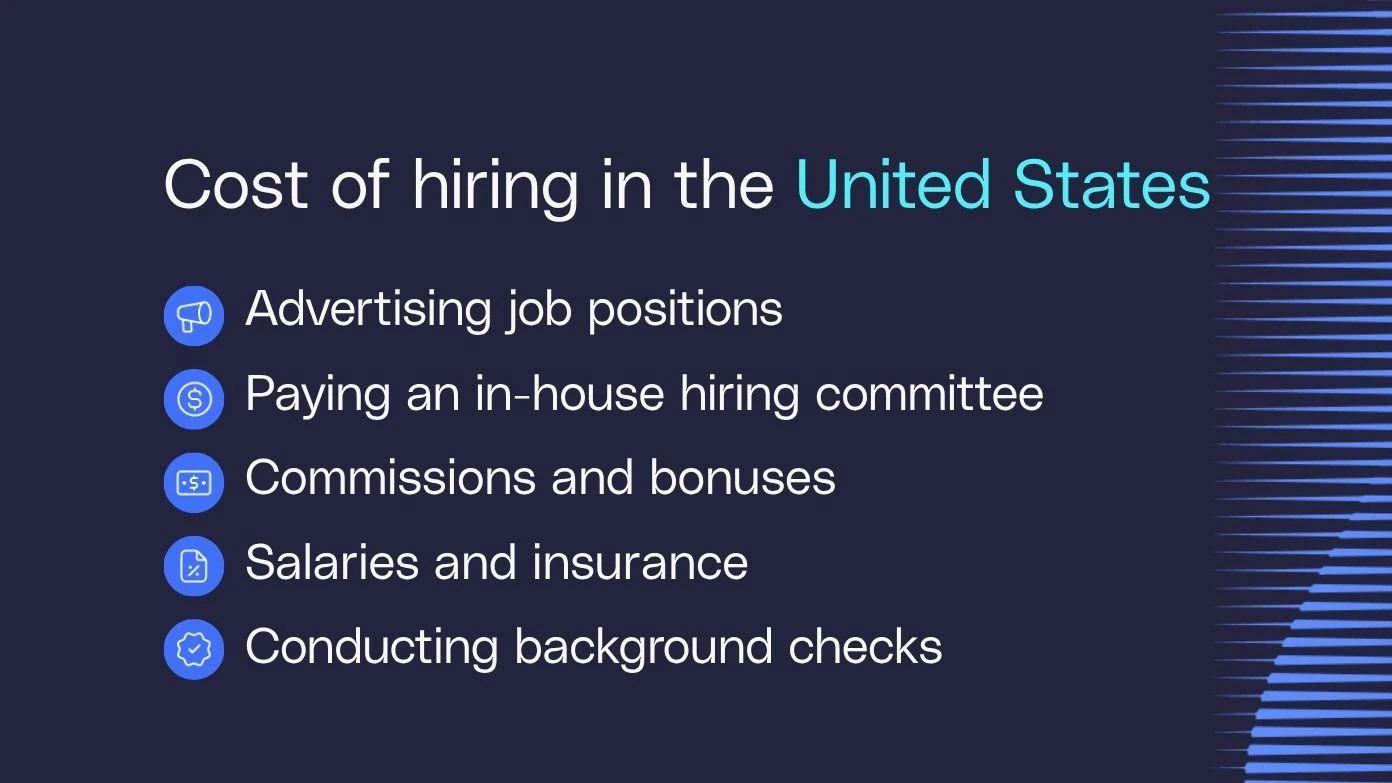
Whether you're hiring one employee or an entire team in the U.S., expenses are inevitable. Budget for the following:
- 實體設立(除非您與法定雇主合作)
- 招聘廣告
- 審核應徵者的勞動成本
- 薪資
- 稅務
- 薪水
- 優點
- 獎金
- 津貼
- 保險
- 旅遊
According to G-P Verified Sources from Gia, the employer burden rate in the U.S., which includes costs triggered on top of salaries, is approximately 7.65–10%.
公司在美國需要聘僱哪些員工?
在美國擴展您的團隊之前,請確保您涵蓋了這些基本要素:
- Choose a hiring model.
- File 編制文件。
- 取得僱主識別碼 (EIN)。
- 向州稅務機關登記。
- 登記繳納地方稅(部分城市/縣需要額外登記)。
- 建立計算、預扣及匯出聯邦和州所得稅、社會安全及 Medicare 的系統。
- 登記失業保險。
- Register for workers' compensation insurance.
- 草擬合規的聘書和僱傭協議。
- 制定員工手冊和政策。
- 為每個潛在新僱員填寫表格 I-9 並保留文件。
- 向國家報告新聘人員。大多數州需要在聘僱後20 天內提出報告。
Setting up a U.S. subsidiary can take weeks or months. Use G-P EOR to hire full-time employees in the U.S. without setting up your own entity. Build your team in the U.S. at a lower cost and with peace of mind that you're doing so compliantly.
美國招募步驟
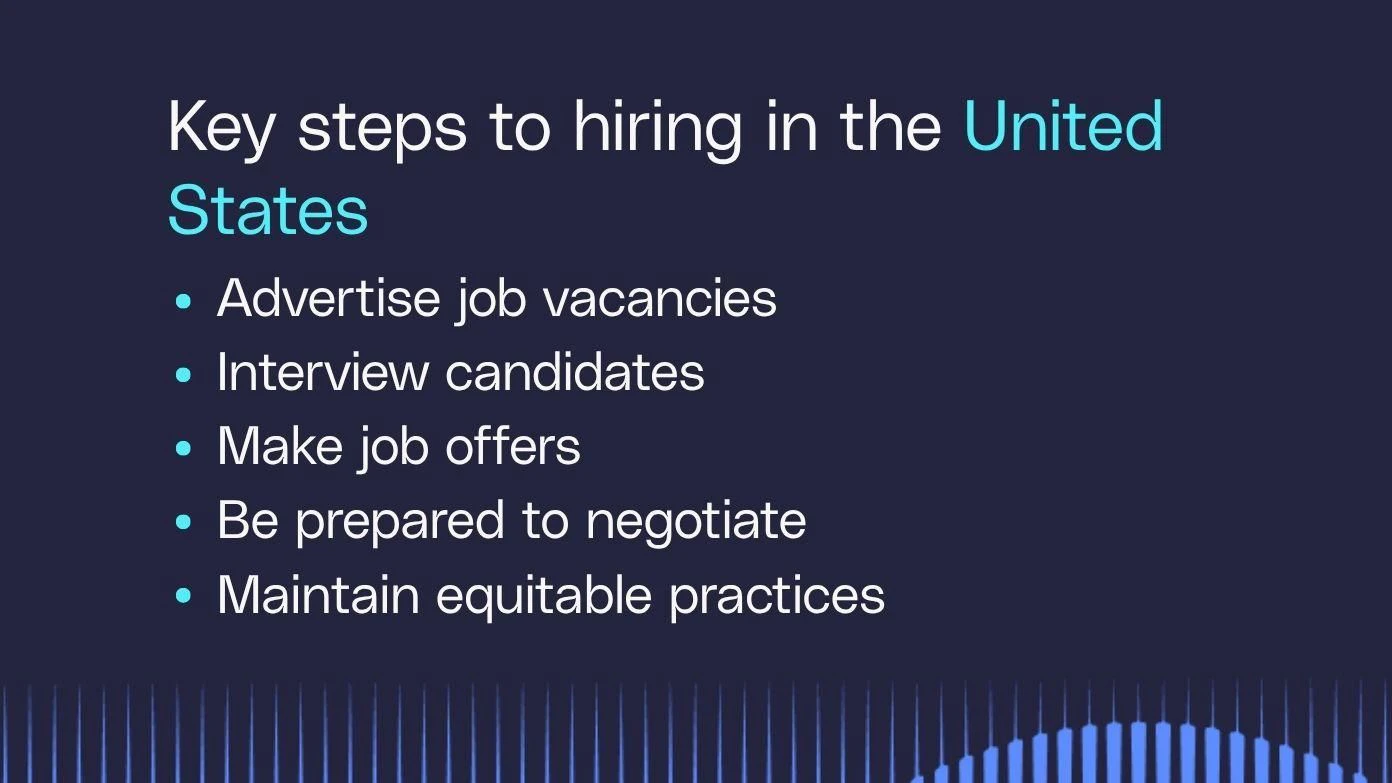
The hiring process in the U.S. is similar to the one you're likely familiar with in your own country. The hiring process follows five basic steps: advertising the job, evaluating applications, interviewing candidates, sending job offers, and onboarding new employees.
1.廣告職缺
Create a detailed job description and define the role based on responsibilities and qualifications. Write a clear job description outlining duties, qualifications, and skills needed. Determine compensation and benefits. It's best practice to include an Equal Opportunity Employer (EOE) statement to signal your commitment to fair hiring.
州和當地法律可能會要求在職缺公告中揭露薪水範圍 (例如,加州、科羅拉多州、紐約州、新澤西州自六月起2025)。 Indeed 和 LinkedIn 是美國很受歡迎的求職網站。
2.評估應用程式
Collect applications and review resumes. Screen candidates based on their qualifications, experience, and fit for the role. Employers with 15+ employees must provide reasonable accommodations to applicants with disabilities, such as accessible application formats or interpreters for interviews.
3.面試候選者
Interview candidates who made it onto your shortlist. You can do these interviews in-person or virtually. Use structured, nondiscriminatory interview questions. Gia can help you create questions that follow anti-discrimination laws in the U.S., so you can find the best fit for the role while complying with local regulations.
4。發出工作邀請
Contact your chosen candidate to offer them a position with your company. Have the employee complete Form I-9 (work eligibility verification) and Form W-4 (tax withholding). Provide any state-required forms and notices. Report the new hire to the state's new hire registry (needed in all states, usually within 20 days).
5.讓新員工入職
Now you can onboard new employees. Set up payroll and benefits. Provide orientation, your employee handbook, and required labor law posters.
If you're working with an EOR like G-P™, you won't have to worry about the administrative burden of onboarding. We'll streamline the process, so you can focus on training your new hire and integrating them into your company culture.
在美國僱用承包商
Working with independent contractors in the U.S. can be a cost-effective way to test the market and build a presence, without the commitment of full-time employees. Contractors based in the U.S. understand local consumer behavior, rules, and business practices. They'll be ready to start working quickly with their own equipment and established work processes.
招聘約聘人員可讓您根據業務需求輕鬆調整勞動力,而不會造成就業的複雜性和成本。
在您與美國的獨立約聘人員簽訂協議之前,請考慮以下事項:
1.員工與獨立約聘人員
It's important to classify workers correctly when hiring employees and independent contracts. A worker is classified as an employee when your company controls how, when, and where they work, assigns them ongoing duties, or supplies the tools they need. An independent contractor operates an independent business, controls their own work, uses their own equipment, and completes a defined project or service.
State and federal tests can differ when determining if a worker is a contractor or an employee. For legal classification, contract terms are not as important as the worker's level of control over their work and whether their services form a core part of your business.
Use G-P Contractor™ to hire and pay contractors in 190+ countries compliantly. Get peace of mind that your contractors are correctly classified with AI contract checks that deliver guidance on what to change.
2.錯誤分類的罰款
當某人不是約聘人員時將其歸類為約聘人員可能會導致嚴重的罰款。 如果出現分類錯誤,您需要:
- 向被錯誤歸類的工人支付拖欠的工資、加班費和福利。
- Pay unpaid payroll taxes, such as social security, Medicare, and unemployment insurance, plus interest and penalties.
- 面對額外的國家級罰款。
3。如何支付約聘人員
G-P Contractor簡化了僱用和支付國際化承包商的繁瑣、耗時的過程。 只需點擊幾下滑鼠,即可建立和發布合約並向承包商付款,同時確保流程合規。
使用 G-P 在美國僱用員工和承包商
我們的全球就業平台™ (全球僱傭平台)及其人工智慧產品、雇主、承包商和Gia為企業建立和管理全球團隊提供支援。
G-P是全球就業領域公認的領導者,擁有十多年的經驗;最大的人力資源、法律和合規專家團隊;以及全球專有知識庫。
Make your expansion to the US easier with G-P. Contact us or book a demo today.
常見問題
在美國僱用新員工需要哪些文件?
New hires have to complete Form I-9 for employment eligibility verification and Form W-4 for federal tax withholding. State-specific forms may also be required.
在美國是否需要提供勞動契約?
Most U.S. employees are hired "at-will" and do not need a formal contract, except for executives or specialized roles. Offer letters are standard practice.
美國的最低工資是多少?
The federal minimum wage is USD 7.25 per hour, though many states and cities enforce higher local minimums.
在美國,雇主要繳納哪些薪資稅和供款?
Employers must withhold and pay social security, Medicare, federal and state income taxes, and unemployment insurance. Specific rates vary by state.
在美國,雇主有義務提供福利嗎?
Federal law does not mandate paid vacation, sick leave, or health insurance for small employers. However, the Affordable Care Act requires companies with 50 or more full-time employees to offer health insurance coverage.