



Key takeaways
- Understand Europe's diverse business markets: Europe offers professionals with specialized skills in technology, healthcare, automotive, and other industries. Each country has unique regulations and business practices.
- Choose the right market strategy: You can work with contractors, establish a local entity, or use G-P EOR to hire employees in Europe.
- Navigate European employment requirements: European labor laws have strong worker protections and employment laws like the EU Pay Transparency Directive.
- Build your global team with G-P EOR: Hire, onboard, and manage employees in 180+ countries without establishing local entities, reducing administrative work and compliance risk.
You’ve been experiencing steady success in your home country for some time now, and you’re looking for opportunities to grow your company. Expanding into the highly competitive European market is an excellent step for companies in many different industries.
This post will explain important differences in European business practices, profitable industries in Europe, and tips for expanding into the European market.
Understanding European business culture
European business etiquette differs significantly between regions, and it’s important to consider these differences as you expand.
Europe includes countries that are not members of the European Union (EU). The EU’s Single Market supports the free movement of goods, services, capital, and people among its member states. The European Economic Area (EEA) extends much of that market to Iceland, Liechtenstein, and Norway, though it doesn’t include every EU policy. The United Kingdom (U.K.) is outside both the EU and EEA, so it has separate rules for trade and market entry.
The United Nations divides Europe into four regions:
1. Western Europe
Western Europe includes Austria, Belgium, Germany, France, Luxembourg, and the Netherlands. All countries in this region use the euro and share the same time zone. The region benefits from sophisticated, well-maintained public transportation infrastructure and service.
English is the most common language for business in this region, but many people speak German as well. Speaking French is especially important if you plan to do business in France.
2. Northern Europe
Northern Europe includes Denmark, Sweden, Norway, Finland, Iceland, and the Republic of Ireland. The region has one of the highest rates of internet usage on the continent, with approximately 94% of the population having reliable access to the internet in 2025.
English is commonly spoken in business proceedings in Northern Europe, as is Swedish.
3. Eastern Europe
Eastern Europe is a large region including several countries. Within this area are three subregions:
- Baltic: Latvia, Lithuania, and Estonia
- Balkans: Romania and Bulgaria
- East Central Europe: Poland, Czech Republic, Hungary, and Slovakia
One of the most striking differences between countries in Eastern Europe is the linguistic divide. Most countries speak a Slavic language, but there are a few exceptions:
- Finno-Ugric: Estonia and Hungary
- Baltic: Latvia and Lithuania
- Latin-based: Romania
4. Southern Europe
Southern Europe includes Italy, Greece, Croatia, Cyprus, Macedonia, Malta, Portugal, Spain, Slovenia, and Turkey. Employment compliance in Southern Europe is procedure-heavy and shaped by collective bargaining. Collective bargaining may set practical rules on classification, pay floors, probation, working hours, leave, notice, and dismissal processes. EU-wide frameworks sit beneath these local systems, including GDPR, anti-discrimination protections, working-time minimums, etc.
How competitive is the European business market?
Europe is highly competitive in the global market due to transparent business practices, sophisticated infrastructure, and high productivity levels. The following reports demonstrate Europe’s economic strengths.
Ease of doing business
European countries rank at the top in the World Bank’s B-Ready 2025 report. European countries like Denmark, Sweden, and Germany consistently rank at the top in the 10 assessment areas.
High-ranking countries often share several similarities, including:
- Widespread integration of electronic systems
- High transparency of regulations
- Reliability of supply
- Expedited company setup
World competitiveness
The World Competitiveness Index, published by the Switzerland-based International Institute for Management Development (IMD), ranks world economies based on how they perform through a variety of different metrics. The four categories measured include:
- Economic performance
- Government efficiency
- Business efficiency
- Infrastructure
In 2026, European countries took many of the top 10 spots, including Switzerland in third, Denmark in sixth, Ireland in seventh, the Netherlands in eighth, Finland in 8th, and Sweden in ninth.
Economic freedom
According to the 2026 Index of Economic Freedom report, European economies are some of the freest in the world, with Switzerland taking second place, followed by the Republic of Ireland. Luxembourg ranked sixth, Denmark seventh, and Norway eighth.
Countries are graded on a scale of 0 to 100 based on the following criteria:
- Rule of law: Property rights, judicial effectiveness, and government efficiency
- Government size: Tax burden, fiscal health, and government spending
- Regulatory efficiency: Business freedom, monetary freedom, and labor freedom
- Open markets: Investment freedom, trade freedom, and financial freedom
The better a country performs in these areas, the freer its economy — which lends to better performance in the global market.
What is the most profitable business in Europe?
The most profitable industries in Europe include the following.
1. Technology
Europe is experiencing a technology boom. Quarterly funding is up 77% from last year. In fact, Europe has posted its strongest quarter in four years, with AI driving 75% of that funding.
Procuring investments from venture capital (VC) firms can help Europe-based tech startups more easily navigate the challenges of scaling beyond national borders by opening access to international networks, potential fundraising partners, or even mergers and acquisitions (M&A) opportunities.
Especially promising countries for tech companies include the United Kingdom, France, and Germany. Global increases in remote employment and networking expand the sector’s ability to grow throughout the continent.
2. Automotive
The European Union (EU) is one of the largest motor vehicle producers in the world, designing and manufacturing many iconic car brands such as Audi, Volkswagen, Volvo, Ferrari, Jaguar, and more.
The automotive industry, which provides jobs to 13.8 million people — accounting for 6.1% of total employment in the EU — is critical to Europe’s economic prosperity. Specific roles in the automotive industry and how many individuals they employ include:
- Manufacturing: 3.5 million jobs
- Sales and maintenance: 4.5 million jobs
- Transport: 5.1 million jobs
Vehicle exports are another important aspect of the European auto industry. According to the European Automobile Manufacturers’ Association (ACEA), the EU exported 4.9 million cars in 2025, primarily to Central and South America.
3. Healthcare
Medicine — and especially medical technology (medtech) — is expected to remain in high demand.
According to Medtech Europe’s 2025 report, Europe-based medtech companies filed more than 15,700 new patents in 2024. As a strong contributor to the European economy, the medtech sector has a promising future ahead.
Which European countries are good for business?
Generally, these European countries may be good locations to grow your company:
1. Denmark
Denmark is a small country in the European market.
Many professionals within the country speak English, simplifying communication for international companies. While Denmark is an EU member state, they do not use the euro — instead, the national currency is the Danish krone.
According to the 2026 World Competitiveness Index, Denmark’s high economic performance is due to improvements in the following areas:
- Reduced public debt
- Reduced government deficit
- Excellent institutional framework
- Exceptional business legislation
- High business efficiency
- Excellent management practices
- Increased investment flows
- Limited rise in prices compared to similar economies
- Robust public finances
The country’s high emphasis on sustainability is also important to mention, as it has helped Denmark-based companies become leaders in energy efficiency. For example, Denmark aims to cut total emissions by 70% over the next decade.
2. Sweden
Similar to its southern neighbor Denmark, Sweden has an open, competitive mixed economy supported by a strong, sophisticated welfare system. With its highly advanced business infrastructure, Sweden presents a unique opportunity for companies looking to gain a foothold in Northern Europe.
Also like Denmark, Sweden is one of the EU member states with a currency other than the euro — their national currency is the Swedish krona.
Sweden’s top industries include advanced manufacturing and the information and communications technology (ICT) sector, which is steadily growing.
3. The Republic of Ireland
The Republic of Ireland’s economy is growing — and expected to continue growing throughout the next two years. Its per capita GDP is 60% higher than the Organisation for Economic Co-operation and Development’s (OECD) best performers, leading to high living standards and a stable economy.
One advantage of doing business in the Republic of Ireland is the ease of paying taxes. This country has numerous advantageous corporate tax incentives, including:
- Corporation tax: The Irish corporate tax rate is only 12.5%, which is the 3rd-lowest in the EU. It’s also the 4th-lowest tax rate out of the OECD group of developed economies behind Switzerland, Hungary, and Chile.
- R&D tax credit: To encourage investment in research and development, the Irish state offers a 35% R&D tax credit for companies from around the world.
- Knowledge Development Box: Tech companies in the Republic of Ireland can benefit from the Knowledge Development Box (KDB), which offers companies up to 20% tax deductions on profits from qualifying technological innovations. This deduction can reduce the tax rate to as low as 10%.
Tips for growing in European markets
Before making any decisions, you need to determine if European business development is right for your company.
If you’ve decided that your company will benefit from a European growth strategy, make sure you can meet the requirements for establishing a company in Europe:
Residency and work authorization: Forming or owning a company isn’t the same as having the right to live in a country or actively work in, manage, or operate a business. Requirements depend on the country, planned activities, and length of stay. EU/EEA/Swiss nationals may benefit from free movement rights, but longer stays can still trigger local residence, address, tax, or municipal registration. Other nationals may need a business visa, residence permit, work authorization, or a combined residence-and-work permit. 2. Business plan: Some entrepreneur, startup, self-employment, or investor pathways may require a business plan. Authorities typically assess viability, innovation, funding, market potential, and the proposed economic contribution before granting or renewing status under that route.
- Creating jobs: Some programs require local job creation or hiring, but this isn’t universal. Obligations depend on the specific country, immigration route, business model, investment level, and proposed local operations plans.
Unless you work with an employer of record (EOR), you’ll also need to register your company with the appropriate jurisdictions and agencies in your target country. In addition to being approved for a European business registry, you’ll also need to obtain a business tax identification number and enroll in your target country’s social security program to ensure legal compliance.
Simplify your global expansion with G-P EOR. We’ll manage tasks such as legal compliance and human resource management for you so you can apply your full attention to operating your company.
Managing European employment law and pay transparency
Understanding European labor laws is crucial if you plan on expanding your business in Europe.
Employment regulations prioritize statutory benefits, worker protections, and fair compensation. Requirements vary from country to country, so review local laws before hiring.
When you do business in Europe, you’ll need to comply with their working-hour limits, paid leave, minimum wage requirements, and termination procedures. Many European markets also use collective bargaining agreements (CBAs) to establish employment conditions.
You must also consider worker classification. Incorrectly classifying your workers as independent contractors can expose you to tax liabilities and penalties. Before hiring in Europe, review the local classification rules.
The EU Pay Transparency Directive
The EU Pay Transparency Directive (Directive EU 2023/970) prioritizes equal pay protections and introduces requirements for gender pay gap reporting, compensation, and recruitment. Under the directive, you must follow these guidelines:
- Disclose salary information: Provide candidates with their starting salary or salary range before the interview process.
- Avoid salary history questions: You’re not allowed to ask candidates about their salary history from current or previous employment.
- Use gender-neutral job titles: Ensure job postings and recruitment processes use gender-neutral titles.
- Disclose applicable agreements: Inform candidates about any collective bargaining agreement provisions that will affect their compensation.
The directive also gives workers the right to ask about average compensation and individual pay levels, broken down by sex.
EU pay transparency milestones
The directive uses phased implementation and reporting deadlines:
|
Date |
Requirement |
|---|---|
|
June 7, 2026 |
Deadline for EU member states to adopt the directive into their national laws. |
|
June 7, 2027 |
First gender pay gap reports due for employers with 250 or more workers; then, annual reporting thereafter. |
|
June 7, 2027 |
First reports due for employers with 150–249 workers; then reporting every three years thereafter. |
|
June 7, 2031 |
First reports due for employers with 100–149 workers; then reporting every three years thereafter. |
Companies must also carry out a pay assessment if there’s no justification for a gender pay gap of at least 5%. This applies to certain categories of workers.
Ensure compliant contracts and compensation for your global teams with G-P EOR.G-P EOR lets you hire. onboard, and manage employees in Europe without establishing a local entity.
The Global Compliance Engine (GCE) powers our platform and digitizes local laws across 180+ countries in real time, automatically updating workflows as local laws evolve. You can also use our salary benchmarking to create a competitive compensation package.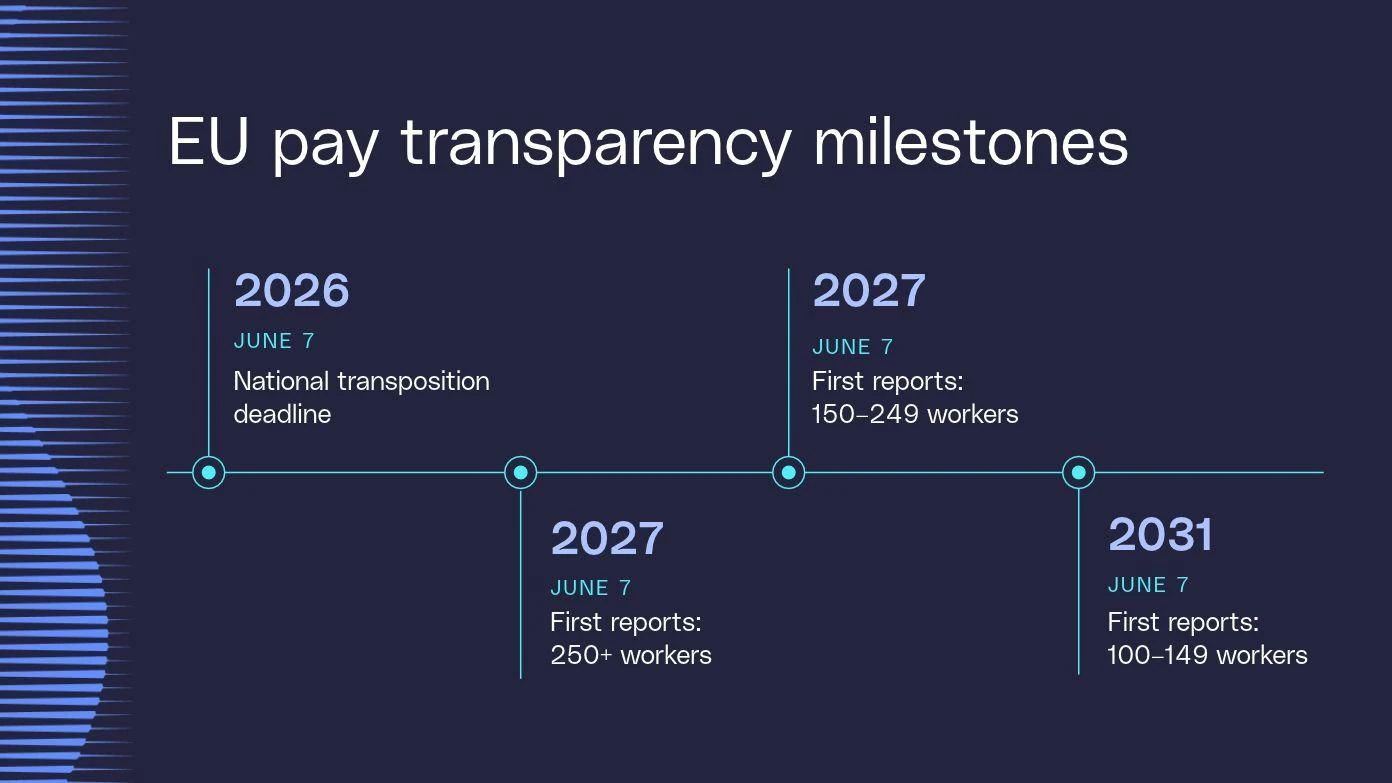
Expand your business in Europe with G-P
G-P can help you act on promising business opportunities in Europe without needing to establish a new local entity or subsidiary.
G-P EOR combines built-in compliance with deep local expertise to help you build teams with confidence. Our platform embeds vetted labor law intelligence directly into your existing tech stack, allowing you to hire and scale compliantly in 180+ countries in minutes.
Book a demo today, or contact us for more information on scaling your workforce in Europe.
FAQs
Which go-to-market model fits a European expansion?
The right model for a European expansion depends on your hiring plans, budget, and business goals. If you establish a subsidiary, you’ll have direct control over hiring and employment responsibilities. If your priority is hiring local professionals without the time and cost of entity setup, an employer of record is a more practical route. G-P EOR lets you hire, onboard and manage professionals without establishing a local entity. Review how to choose an employer of record for more information.
What operational challenges do businesses need to plan for in Europe?
When doing business in Europe, plan for language differences as well as payroll requirements, employment laws, and data protection obligations. Collective bargaining agreements and statutory benefits will also impact your operating costs.
Take into account permanent establishment risk, too. Certain business activities can create a taxable presence without a local entity. Review these requirements before expanding into Europe to help control business costs and reduce compliance risks.
When do General Data Protection Regulation (GDPR) obligations apply to businesses entering Europe?
The GDPR obligations apply to businesses in the EU that process a worker’s personal data in connection with their business activities. The obligations also apply if your business is outside the EU and you process personal data when offering goods or services to individuals in the EU. Keep in mind that GDPR obligations can apply before you establish a physical presence in Europe.
What does doing business in Europe involve?
Doing business in Europe involves selecting your target markets, understanding their local laws, establishing business relationships, and managing employment obligations. Your requirements depend on the country you choose, your industry, and business activities. You also need to consider operating costs, local competition, and cultural differences. G-P EOR simplifies the employment side by letting you hire professionals without establishing local entities.
How can businesses choose their first European market?
Start by reviewing market demand, operating costs, available talent, and employment regulatory laws. Consider language differences, taxation requirements, infrastructure, and worker classification rules. G-P EOR lets you build teams in 180+ countries without establishing local entities, making it easier to hire professionals quickly.