


Key takeaways:
- AI transforms global employment: It's now easier than ever to expand globally thanks to advancements in artificial intelligence (AI) and automation that enhance decision-making and reduce manual work.
- Fintech modernizes global payroll: Cross-border payroll is now faster and more flexible thanks to digital wallets, real-time payment rails, and automated tax withholding.
- Global EOR tech enables growth: When your goal is to enter new markets without establishing local entities, you can use an EOR to grow your global workforce, speed up hiring, and manage compliance requirements.
Global employer of record (EOR) technology has advanced significantly from its foundational roots. Originally centered on hyper-localized compliance and payroll, early systems focused on aggregating local data, supporting workers, and billing clients. At the time, reliable cloud-based customer portals effectively met those core operational needs.
In recent years, however, global EOR providers have leaned into building out their software-as-a-service (SaaS) solutions and enabling global employment platforms. Some are racing toward full global human capital management (HCM) suites and becoming broader and less focused on EOR alone, while others have stayed true to their core EOR specialization and are doubling down by developing highly intelligent global employment orchestration platforms.
Global EOR providers are increasingly integrating their solutions with HCM platforms and leveraging artificial intelligence to automate, augment, guide, and orchestrate global employment research, decisions, and execution. This can lead to greater speed, agility, and ROI.
True to its payroll roots, global EOR is underpinned by fintech and cross-border money movement. Both are progressing rapidly, making global payroll faster and giving workers greater access to wages as they earn them.
Further, global employment and compliance data are becoming more readily available on demand, while AI is making it possible to use these insights to predict and derisk talent opportunities and global expansion decisions.
AI, automation, and insights
AI and automation are game-changing innovations for HR, compliance, and workforce management. Processes that have long been manual and labor-intensive are now being digitized and automated. Administrative tasks such as onboarding, benefits enrollment, and payroll are increasingly being streamlined by automation. AI is enabling a much more guided, insightful, personalized, and contextual experience for both employees and employers.
With global EOR now integrated with most major human capital management (HCM) platforms, the model is closer than ever to HR actions and strategy, with its compliance insights available in the flow of business. Years of expertise, insights, and capabilities are now being incorporated into automated solutions with the help of AI.
G-P Gia™ is a great example of using insights and automation to bring greater speed and agility to business and talent decisions and orchestration to help execute them. Gia is an agentic AI agent that automates tasks throughout the global employment lifecycle, reducing the time, effort, and cost required to act on business and talent decisions.
A typical use case
A business leader researching new locations of operation for strategic expansion asks Gia for help exploring each target country and provides an analysis comparing the costs and risks of operation based on employment needs in each country. Gia could help determine the employment type required, draft localized job descriptions, and provide guidance on local compensation norms and requirements. From there, it can research compliant employment contracts, provide relevant insights, and generate a contract for review.
This is a basic example, but you can see how, in minutes, not weeks or months, a business leader could address and confidently act on strategic plans and talent opportunities. It’s much like having an attorney and HR business partner provide legal and compliance guidance on demand, giving the business greater speed and agility while reducing risk.
As AI becomes more intelligent, agentic, and interoperable, you can see how the global EOR service could very likely take on a Services-as-a-Software future (credit HFS Research). Behind the scenes, autonomous agents could conduct work, handle tasks, make decisions, and orchestrate global employment compliance with less human input while still benefiting from human expertise and oversight. The value and ROI would then be less about the actual software and more about the outcomes it and its insights produce.
In the longer term, global EOR with AI could enable hyper-connected, AI-orchestrated talent management that anticipates needs, mitigates compliance exposure, and uncovers insights previously hidden between disparate systems. Its data and guidance will empower organizations to predict and derisk talent strategies, ensuring the right skills are deployed at the right time, regardless of location or sourcing model.
In this way, global EOR capabilities help companies evaluate new markets and plan mergers, acquisitions, and divestitures. AI-driven modeling helps businesses compare potential costs and risks before making decisions, while global EOR technology makes it easier to put those plans into action.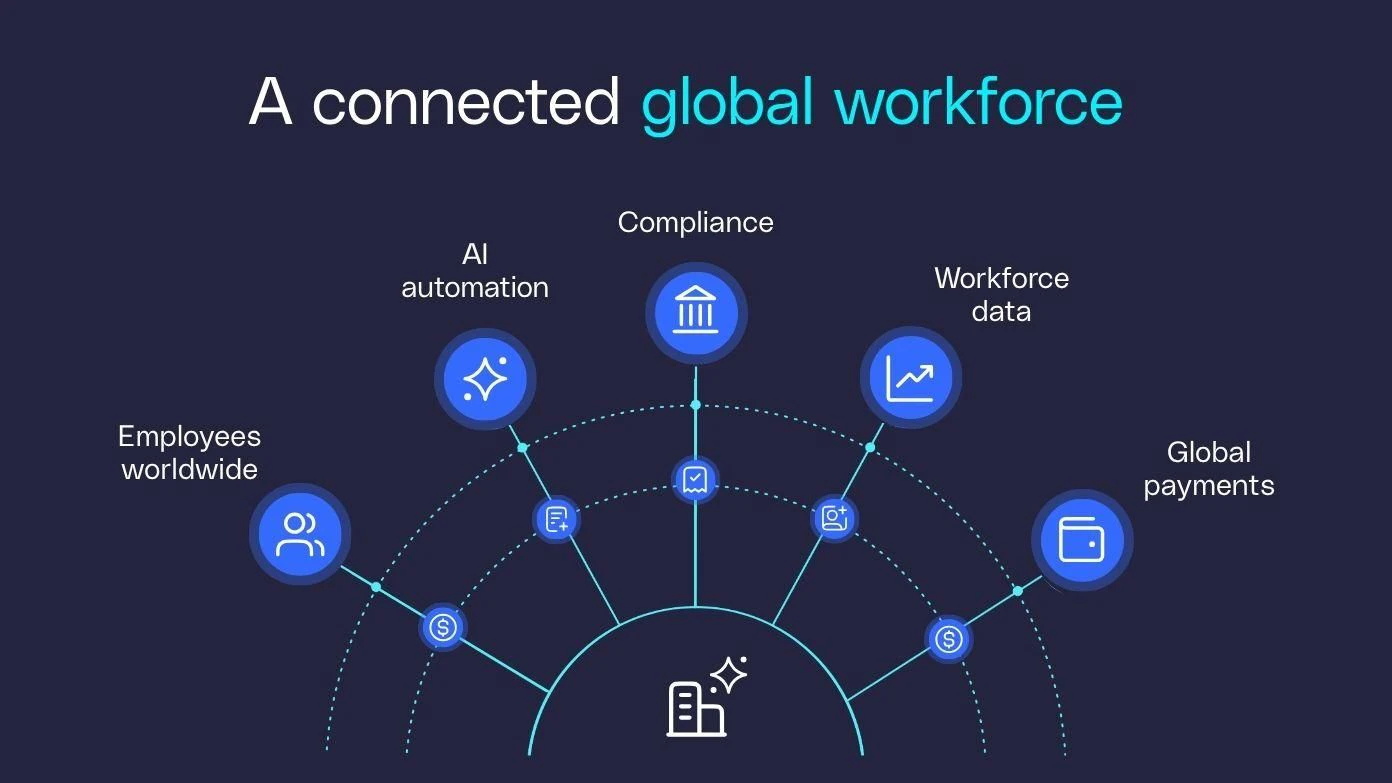
Fintech
Fintech is changing how global EOR providers move money to workers around the world, making payments faster, less expensive, and easier to manage. Digital wallets, blockchain, instant payment rails, and settlement technology are also helping reduce delays, administrative work, and the challenges that come with cross-border transactions.
Fintech and AI-powered global EOR technology are moving payroll toward continuous access to earnings. Pay can be calculated based on hours worked and wages earned, with automated tax withholding and faster payouts in local currencies through digital banking rails.
A strategic use case might include managing a cross-border acquisition. Longer-term global EOR platforms could help manage settlements for severance, bonuses, and equity conversions. AI could also help predict currency fluctuations and determine the best timing for payments, potentially reducing costs while accounting for local tax requirements and financial reporting needs.
The intelligent, adaptive Global Employment Platform
The global EOR model is heading toward intelligent, adaptive Global Employment Platforms that leverage AI to anticipate talent and compliance needs rather than reacting to them. These platforms will orchestrate the global employment process, support personalized talent experiences, embed insights, and help maintain compliance. They will also bring together HR, compliance, payroll, and performance data from global sources into a cohesive, actionable resource that helps businesses make informed decisions and derisk their global employment strategies.
Building an agile, borderless workforce
With so many advancements and innovations in global EOR technology, it's no wonder that workforce management has become more of an elastic, software-orchestrated process that allows companies to quickly adapt to changing talent needs in addition to expanding into new markets. For your global hiring and workforce operations, this means you can scale your team up or down as business needs change rather than having to build the infrastructure to support every new market on your own.
G-P is the #1 EOR according to all industry analyst reports. For example, in the 2026 Global EOR Services NEAT Evaluation, G-P was recognized as an EOR industry leader for the sixth consecutive year. This serves as a valuable resource for companies wanting to compare global EOR providers. The report goes into detail about G-P's capabilities, including our Global Employment Platform, proprietary compliance data, and partner ecosystem.
In the Everest Group EOR Solutions PEAK Matrix® Assessment, G-P has secured the highest EOR Leader position for four consecutive years. Recognized as both a Leader and Star Performer in the 2025 assessment, G-P was cited for its ability to combine innovation with scale. The assessment looks at factors such as operational scale, technological innovation, and customer satisfaction, giving companies another resource for evaluating global EORs.
The IEC Group's 2026 Global EOR Study also ranked G-P as the #1 EOR for the fourth consecutive year. In the report, you will see highlights of G-P's Global Employment Platform and global hiring infrastructure, including a close look at AI tools like G-P Assist and G-P Gia™ and how they optimize and guide users through the employment lifecycle. It also highlights G-P's in-house expertise for supporting compliance and reducing risk.
When used strategically, these resources provide companies with the technology, guidance, and infrastructure they need to enter new markets and expand their global workforce without having to establish their own infrastructure in every country.
Further recognition for G-P can be found in the QKS Group's 2026 SPARK Matrix™, which named G-P the overall leader in the EOR market based on technology innovation and customer impact. All in all, these recognitions give you multiple independent resources for evaluating G-P's capabilities and determining whether its technology and global employment products align with your company's expansion goals.
Book a demo to learn more aboutG-P’s agentic Global Employment Platform.
About the author
Pete A. Tiliakos
Principal Analyst, Strategic Advisor, & Chief Payroll Champion at Payroll Influences LLC
Pete leverages unique market expertise from over 30 years in HR and payroll technology, services, and transformation. Pete is globally recognized for his extensive knowledge, coverage, research, and strategic advisory of leading and emerging solution providers across the payroll, employer of record services, payments, and HCM technology marketplaces. Both practitioners and providers widely leverage his research and perspectives as he is a regular contributor to industry associations, podcasts, publications, and events and the co-host of the HR and Payroll 2.0 podcast, and host of The Source podcast by DailyPay.
LinkedIn: https://www.linkedin.com/in/petetiliakos/
FAQs
What is the difference between an EOR and a PEO?
An EOR acts as the legal employer for your global team members and handles payroll, benefits, taxes, and compliance with local labor laws. This allows you to hire workers in new markets without having to establish your own legal entity. If you use a professional employer organization (PEO), the arrangement is a co-employment model and is mainly for U.S.-based hiring needs.
What is a global employer of record?
A global EOR is a third-party service provider that can legally employ workers on behalf of your company in countries outside of your home market. This is different from a domestic EOR that only supports hiring within a single country.
What does global EOR technology include?
There are many different forms of global EOR technology. Some of the more advanced platforms include automated payroll, compliance monitoring, and benefits administration. You may also want to use technology that offers API access and HR system integrations to speed up workflows and reduce the risk of errors within your employment processes.
Which EOR platform features support international hiring?
If you need an EOR platform that supports international hiring, look for these features: automated onboarding, right-to-work verification, employment contracts, local payroll, tax filings, benefits administration, and compliance support. Depending on your hiring needs, you may also want a platform that offers API access, HCM integrations, workforce analytics, and automated compliance updates, since these features help streamline global workforce management and lower the risk of compliance errors.
How can an EOR support hiring without a global subsidiary?
When your global expansion plans include hiring talent in new countries but you don't want to establish your own legal entities, you can work with a global EOR that already has the necessary infrastructure in place. The EOR will take care of employment contracts, payroll, taxes, benefits, and local compliance requirements so you can focus on managing your team and growing your business.