
Key takeaways
- Review working practices: Reassess status when control, business integration, financial independence, or continuity changes during an engagement.
- Apply the relevant law: Seek a local assessment for the countries and working arrangements involved.
- Match the response to reality: Preserve genuine independence where supported, or move the work to employment when that’s the appropriate relationship.
- Separate analysis from administration: Confirm country coverage for classification support and payments separately, since each serves a different purpose.
Contractor misclassification occurs when someone engaged as an independent contractor is an employee under applicable law, despite the contractor label. For U.S.-based organizations engaging professionals internationally, the difficulty is often visibility: HR holds the agreement, finance sees the invoices, and the business team knows how the work gets done.
Those separate perspectives can leave an important gap in your understanding of an engagement. Closing that gap helps your team recognize potential problems and choose a working arrangement that fits the business’s needs.
Assess contractor misclassification against the actual working relationship
The original agreement records the scope and rights the parties intended. Your classification review also needs to capture the relationship operating today, including how work is performed and how the professional is paid. For U.S. federal employment-tax purposes, the IRS expressly states that the substance of the relationship governs status.
Substantive operational changes are therefore a practical reason to revisit an earlier decision. The review should identify what changed and when, rather than relying exclusively on the description recorded at the start. Your business team’s account of the engagement helps HR and legal understand that history.
A mismatch is a reason to investigate, rather than a conclusion on its own. A clear description of the relationship gives local advisers a stronger basis for evaluating its legal significance.
Interpret control, integration, independence, and continuity in context
Your review becomes more useful when it describes observable practices rather than relying on broad statements that someone “works independently.” The International Labour Organization’s Employment Relationship Recommendation, 2006 (No. 198) is nonbinding guidance for national approaches to identifying employment relationships. Applicable law determines status in a particular engagement.
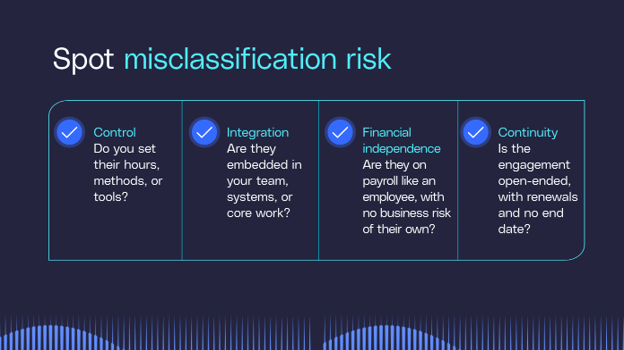
Control, integration, financial independence, and continuity provide useful areas to document for a local assessment. Their significance depends on the legal framework and the relationship as a whole; counting warning signs won’t produce a reliable classification decision.
Your account of the work should make these areas concrete:
- Instructions and control: Describe who directs how the work is carried out and how much discretion the professional retains. This makes the allocation of decision-making visible to the person assessing the relationship.
- Organizational integration: Explain how the services fit into your operations and how the professional works with the organization. The connection between the work and the business deserves more detail than a role title alone.
- Financial independence: Record the economic arrangement, including the professional’s opportunity for profit or loss. Payment against an invoice captures only one part of that picture.
- Duration and continuity: Describe the engagement’s history and whether the parties expect a defined project or an ongoing relationship. That gives the assessment context beyond the latest contract’s dates.
With the working picture established, your team can assess which obligations may follow from the relationship.
Account for payroll, benefits, and employment exposure
Paying agreed invoices fulfills the commercial payment process. If the relationship is employment under applicable law, your organization may also have employment, payroll, statutory-benefit, and dispute exposure linked to unmet obligations.
For U.S. federal employment taxes, classifying an employee as a contractor without a reasonable basis may create tax liability, subject to applicable relief provisions.
For your international engagements, HR, legal, and payroll need a shared understanding of what applies to the actual arrangement. Worker location, engagement history, and current practices help inform that assessment. Each function can then connect the findings to its responsibilities, rather than treating classification as a contract issue owned by one department.
A documented U.S. case shows how working facts can outweigh the commercial arrangement. In 2023, a jury found that Travelon’s medical-transport drivers, treated as contractors with van-leasing, insurance, maintenance and equipment costs deducted from their wages, were employees: according to the U.S. Department of Labor, they were integral to the business, subject to company control, and had no opportunity for profit or loss.
Charging costs to contractors did not make them independent. Once you identify a mismatch, the response needs to address how the work is organized.
Align the engagement or move the work to employment
A useful response starts with what your business needs from the relationship. The goal is an arrangement your team can sustain in practice, with the appropriate documentation and administration supporting it.
Your business team establishes the scope of the work it needs to continue. HR and legal coordinate the relevant local assessment and translate its findings into a decision the business can implement. Involving the people responsible for the work makes it easier to determine whether genuine independence fits the operating model.
The assessment informs two practical paths:
- Continue a genuinely independent engagement: Where the facts and applicable law support contractor status, agreements and working practices should reflect that independence. The arrangement should also suit the professional’s preference for independent engagement.
- Move the work to employment: Where the relationship calls for employment, an employment arrangement provides the appropriate structure for ongoing work. Your team can then plan the transition around the role and the countries involved.
For an international contractor engagement, defining the work and assessing status come before preparing the appropriate agreement, arranging invoices, and making payments. Each administrative stage supports the chosen relationship, with clear responsibilities for documentation and payment processing. Keeping that order gives your team a sound basis for setting up the engagement.
The operational need now becomes more specific. Independent engagements need contract and invoice administration; an employment transition needs employment contracts, onboarding, payroll, and benefits support. Check coverage for the task you need: contract analysis and payments can cover different countries.
Support the right working arrangement with G-P
For independent engagements, G-P Contractor analyzes contractor contracts against local rules and suggests specific amendments in 40+ countries.
You can upload an existing agreement or use a platform-generated contract, individually or in bulk. Invoices, approval, payment and reconciliation run in one workflow, with local-currency payouts and live payment tracking in 190+ countries.
Move to employment with G-P EOR
An employer of record (EOR) is an organization that legally employs team members on another business’s behalf. Where the work calls for employment, G-P EOR supports contractor-to-employment transitions in 180+ countries. We become the legal employer and handle employment contracts, onboarding, payroll, local tax filings and benefits, so you can hire without your own local entity.
Bring your countries, existing agreements, engagement history and actual working arrangements to a G-P demo and explore the support that fits your chosen path.

FAQs
What guidance do ILO standards provide for determining who is an employee?
Recommendation No. 198 addresses national governments, proposing ways to define worker–employer relationships and protect workers. For an HR or legal team, its intended audience explains its role: it informs the development of national policy rather than serving as a company’s engagement-approval procedure.
How does hiring global contractors work?
After classification assessment and agreement preparation, the operational handoff establishes who prepares and approves invoices, the payout currency, and responsibility for tracking and reconciliation. Invoice approval authorizes the payment process; payment tracking shows its progress toward settlement. Clear ownership of these activities helps your finance team follow payments through to completion.
How is hiring global contractors different with G-P?
G-P Contractor helps HR and finance coordinate around shared contractor details as responsibility moves between documentation and payment administration. That continuity is useful when the people preparing agreements differ from those approving invoices and reconciling payments.
How does the IRS determine whether someone is an independent contractor?
For U.S. federal employment taxes, the IRS assesses behavioral control, financial control, and the type of relationship together . No single factor or factor count decides status. A retained right to control how work is performed can matter even without active instructions, so limited day-to-day supervision alone doesn’t settle the analysis.