



Key takeaways
- Manage the contractor lifecycle: Contractor management software automates processes across domestic and international jurisdictions to simplify compliance and reduce risk.
- Improve efficiency: Contractor management software can simplify payments, support compliance with local requirements, increase productivity, unify data and workflows, and reduce misclassification risk.
- Look for essential features: Prioritize multiple-jurisdiction support, scalability, customizability, data security, native reporting and analytics, and versatility.
Working with independent contractors gives you access to specialized skills and lets you scale your workforce quickly. But managing these working relationships while ensuring compliance is trickier when your operations span across borders.
Effective contractor management processes centralize these workflows and reduce manual work. This guide covers the benefits of these platforms, their must-have features, and top providers so that you can find the right technology for your company's needs.
What is contractor management software?
Contractor management software is an integrated platform that automates, governs, and executes the full lifecycle of contractor talent across both domestic and international jurisdictions. This software simplifies compliance and reduces multijurisdictional risks.
Key administrative functions:
- Digital identity and tax verification.
- Localized contract generation with strong intellectual property (IP) assignment.
- Automated worker classification vetting.
- Consolidated cross-border invoicing and multicurrency payments.
Contractor management technology differs from adjacent enterprise workforce systems in the following ways:
- Contractor management software: Direct B2B commercial engagements with individual independent talent.
- Vendor management systems (VMS): Procurement platforms for staffing agencies, master service providers (MSPs), and contingent supplier rate cards.
- Employer of record (EOR): Legal entity infrastructure where the provider acts as the statutory employer for global employees.
- Human resources information systems (HRIS): Internal systems of record for permanent employees and internal organization charts.
|
Feature |
Contractor management software |
Vendor management systems (VMS) |
Employer of record (EOR) |
Human resources information systems (HRIS) |
|---|---|---|---|---|
|
Target audience |
Legal, finance, and procurement teams that track individual legal commitments |
Staffing agencies, master service providers (MSPs), and contingent suppliers |
Companies hiring globally without local entities |
Companies with permanent employees |
|
Legal status |
Focuses on contract language and compliance to identify areas of legal exposure |
Worker tax status and transactional tax compliance |
Serves as the legal employer of distributed workers for global companies operating across jurisdictions |
Companies retain legal responsibility internally and manage their own risk |
|
Tax governance |
Strategic and proactive tax governance to identify and prevent risk |
Operational and reactive tax governance during and after transactions to focus on transactional risks |
Handles employment-related payroll taxes and withholding for the workers it legally employs. |
Companies are responsible for their own tax compliance |
Why global enterprises need contractor management solutions
Global companies need dedicated contractor management solutions to:
- Move beyond manual accounts payable cycles and fragmented communication channels
- Reduce setup time to start projects without delay
- Reduce bank wire fees, retail FX markups, and multiple invoice reconciliations
- Eliminate misclassification uncertainty
- Provide CFOs and HR leaders with a single source of truth for global contingent workforce spend
Benefits of an independent contractor management platform
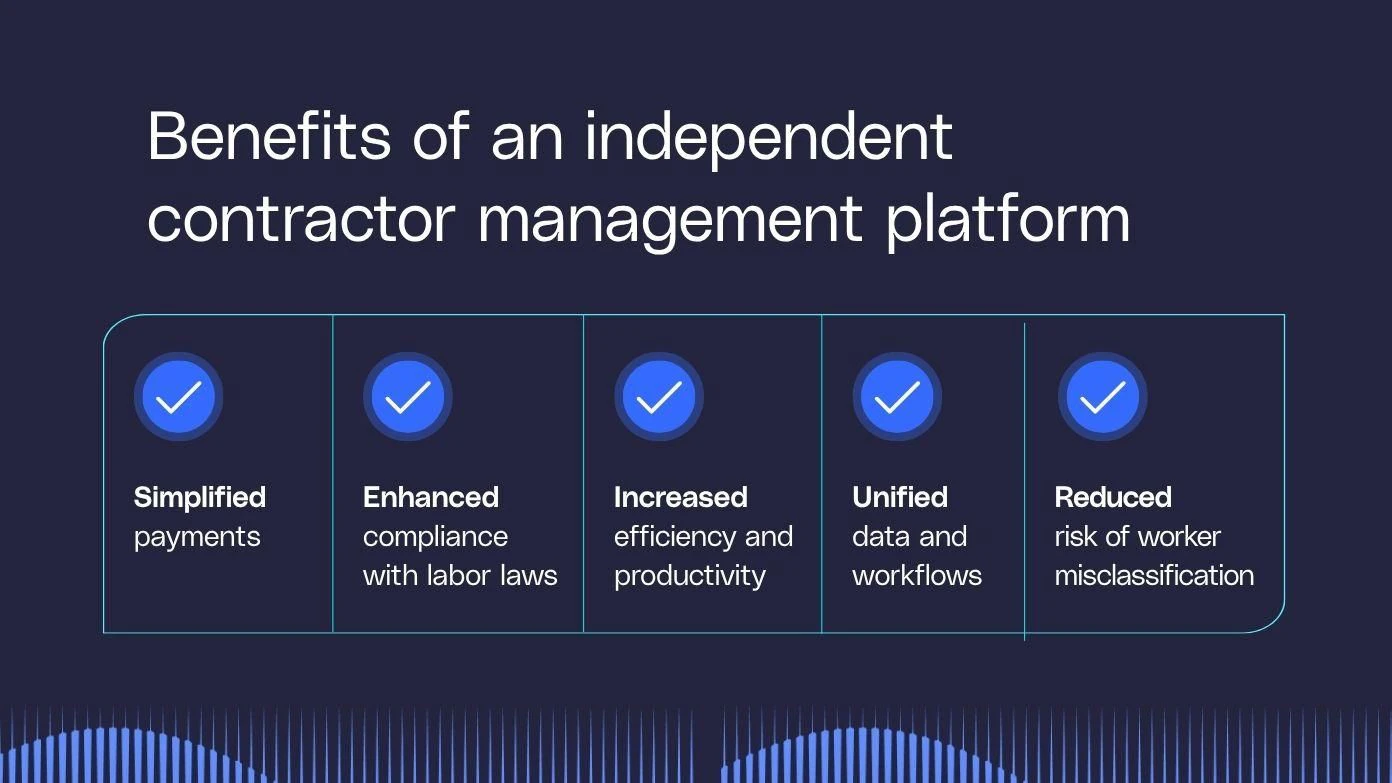
Independent contractor management technology drives organizational value in the following ways.
Simplified payments
As your company grows, paying independent contractors can be challenging. A well-designed platform simplifies the process.
For example, technology can transform payment runs from hours to minutes. You can quickly invoice for your contractors, creating faster payment cycles and a simpler experience. Global contractors receive their earnings on time, and your in-house team enjoys less administrative burden.
A global independent contractor management platform improves payment capabilities with multiple frequencies, options, and currencies. This lets you better meet your contractors' payment expectations and preferences.
Many platforms use automation features to deliver extra value to payment processes. The technology automates payment scheduling and currency conversions, eliminating the complex logistics of global payments.
Enhanced compliance with labor laws
Following local labor laws is nonnegotiable. The ideal independent contractor management platform makes compliance easier in many ways:
- Better organization: Platforms centralize documentation and create an audit-ready trail. Better organization makes it easier to track requirements and deadlines, such as license renewals.
- More accuracy: Technology reduces errors by eliminating manual updates and workflows. Greater accuracy mitigates legal risk and payment disagreements.
- Simplified compliance: Many platforms automatically generate tax forms and verify independent contractor data, such as tax identification numbers, to support compliance.
Increased efficiency and productivity
Independent contractor management software increases efficiency and productivity. For example, these platforms help you improve resource allocation with real-time data. Use information about skill sets and talent availability to align project assignments with the right expertise.
Independent contractor management tools also help reduce administrative expenses. Streamlined workflows, integrations, and automation reduce the need for manual processes, so your teams can focus on work that generates revenue and boosts customer satisfaction.
These platforms also facilitate organization and communication. Your teams will find it easier to retrieve relevant information and collaborate.
Unified data and workflows
When your company invests in contractor management technology, you can unify your contractor data and workflows in one place. This enhances visibility and organization across projects, documentation, and the contractor lifecycle.
A comprehensive platform ensures quick access to the information you need, from previous projects to payment histories. You can also pull important metrics and performance data with a few clicks, which helps with growth strategies and informed project planning.
Reduced risk of worker misclassification
Worker misclassification is one of the top risks of hiring independent contractors. Classification rules are different across borders, so you need to understand the distinction between contractors and employees before hiring.
Noncompliance can lead to penalties, reputation damage, or even criminal charges. Management technology offers protection against these risks. Some platforms use AI to review independent contractor agreements and flag potential worker misclassification. These insights can help you proactively address problematic contract language to avoid misclassification.
7 features to look for in independent contractor management software
You can make an informed decision for your company when you understand the key features of contractor management technology:
Jurisdictional expertise
Violating local labor laws and practices is a serious and expensive issue. Legal authorities may impose fines and penalties or even force you to suspend operations within the jurisdiction. Look for a contractor management platform that offers localized expertise to help you adhere to the rules.
Customizability
You need more than a generic independent contractor management platform. Organizational roles and goals differ, change, and grow. For example, one team member's focus may alternate between hiring contractors, tracking projects, and generating invoices. The ability to create personalized dashboards for each of these workflows helps streamline the process.
Look for a platform that allows you to customize specific workflows, reminders, forms, fields, and scheduling options to reduce friction and ensure alignment across your contractors.
Scalability
Global expansion requires a careful balance between efficiency and strategy. The right technology partner is critical to achieving that alignment, making scalability a primary factor to evaluate. Verify that the partner you choose can keep pace with changes as your company grows.
Data security
Your company gathers a lot of sensitive data when building global teams, including personal information and payment details. This data is a valuable target for cybercriminals.
Choose technology with security controls, such as role-based access, to protect sensitive data. These tools allow you to configure access permissions based on a user's organizational role, department, and location, protecting against unauthorized use or disclosure. The provider you choose should also be ISO 27001 certified.
Versatility
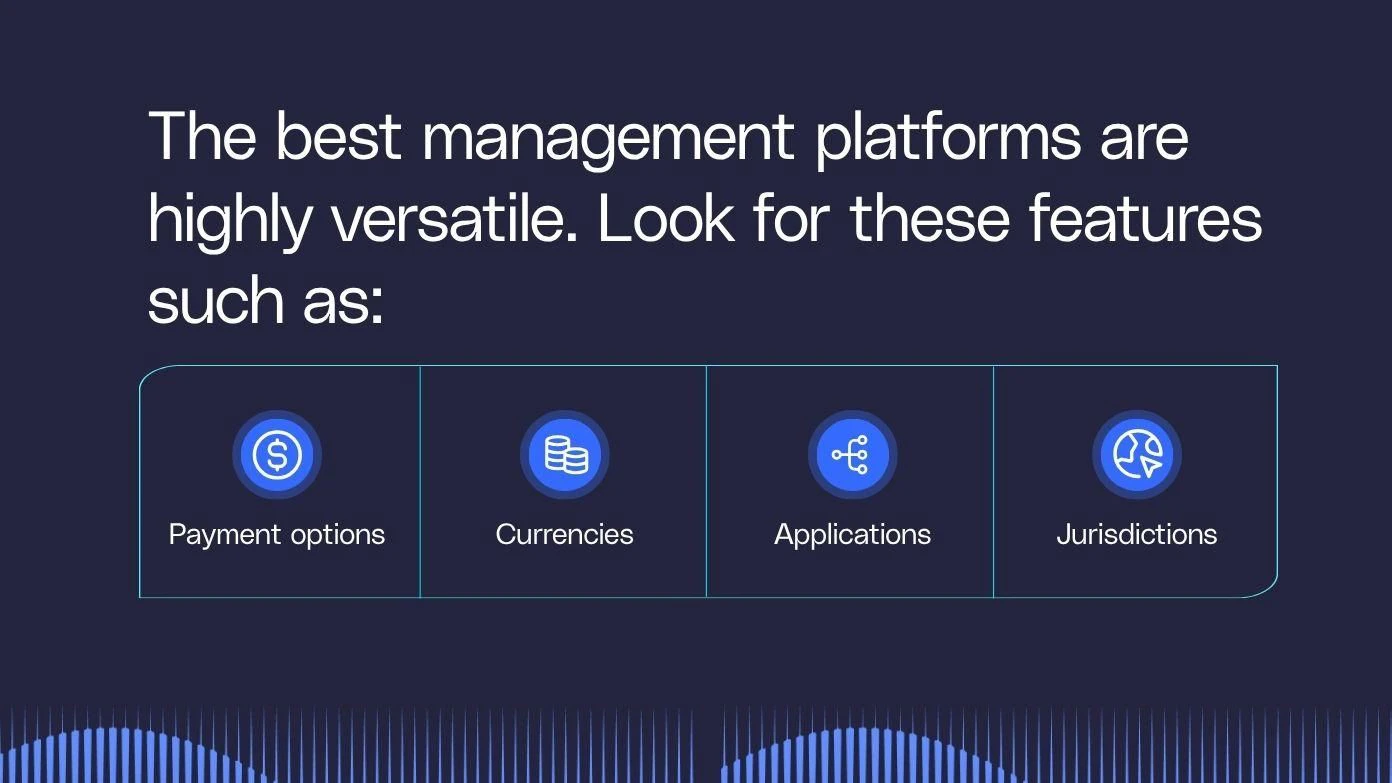
The best management platforms are versatile. Look for features such as:
- Payment options: See how the software processes payments for your organization and your independent contractors. Verify that you can choose flexible payment frequencies and methods.
- Currencies: Confirm that the platform allows payments in your contractors' local currencies. Many providers automatically convert the amounts for you, reducing potential accuracy errors.
- Applications: Evaluate the technology's ability to support your independent contractor workflows. Some specialize in specific workflows, such as payments, while others are more inclusive. One unified or easily integrated platform typically provides the most organizational efficiency and streamlines operations.
- Jurisdictions: Look for technology capable of supporting multiple jurisdictions if your company has long-term growth goals.
Native analytics and reporting
In-depth data about your independent contractors supports effective project planning, budgeting, and contract management. Choose a platform with built-in analytics and reporting to simplify data collection and evaluation.
Real-time visibility and regularly tracking key metrics help your company:
- Detect and identify anomalies, patterns, and opportunities to improve your processes.
- Set goals and develop strategies for sustainable growth.
- Prioritize specific initiatives, projects, or tasks more effectively.
- Measure performance and progress to optimize your independent contractor relationships.
- Learn from previous missteps, such as worker misclassification, and refine your approaches to prevent future oversights and errors.
- Track projects and contracts throughout the independent contractor lifecycle to eliminate missed deadlines and budget overruns.
- Determine which contracts to end or renew.
Company reputation and history of innovation
Look into the technology provider's reputation. See what customers are saying, and how they rate their experience with the platform. Explore resources such as customer success stories, ratings, and testimonials.
A technology partner with a track record of innovation is also crucial to achieving your goals. Providers with an ongoing commitment to new features and functionality can make your business more resilient and agile.
Which technology capabilities should you look for in a contractor management platform?
Look for the following capabilities when evaluating a contractor management platform:
- AI-powered compliance and classification engines:
- The platform should perform instant classification analysis to evaluate role descriptions and contracts against country labor codes.
- Look for real-time compliance guidance to troubleshoot issues before they become a liability.
- Enterprise fintech infrastructure:
- The system should directly integrate with the local clearing systems to help reduce SWIFT intermediary fees.
- Look for a system that offers real-time mid-market currency conversion rates.
- Confirm flexible payout options for contractors, including local bank deposits and digital wallets.
- Ecosystem interoperability and integrations:
- The platform should sync with leading HCM systems (Workday, ADP Workforce Now, SAP).
- The technology should offer general ledger mapping to enterprise ERP platforms (NetSuite, QuickBooks, SAP).
- Look for APIs and integrations that connect contractor data with your existing systems and workflows.
- Enterprise-grade security and privacy governance:
- The technology should meet certified data protection standards: ISO/IEC 27001, ISO/IEC 27017, ISO/IEC 27018, and ISO/IEC 42001 (AI Management).
- The platform should offer SOC 2 Type II compliance and other relevant security certifications.
- The technology should strictly comply with GDPR and international data privacy frameworks.
5 best independent contractor management software providers
The following five companies provide the top global contractor management software.
G-P Contractor™
G-P Contractor is one of the best platforms for independent contractors. It simplifies contractor hiring and payment across 190+ countries.
G-P Contractor key features:
- Flexible payment options in 190+ markets and over 130 currencies
- Invoicing on behalf of contractors
- Powerful reporting tools to help manage budgets
- AI classification engine that analyzes service agreements and offers precise, actionable recommendations for compliance
- Built-in tools to help protect against worker misclassification at no additional charge
- Streamlined invoicing for quicker payment runs
- Clear pricing and cost-effective transaction expenses
- Self-service tools to reduce administrative burdens
- Integrations with third-party HR solutions to eliminate information gaps and redundancy
Payoneer Workforce Management (formerly Skuad)
Skuad started in 2019 as a user-friendly platform that helps streamline hiring, payment, and compliance for global teams. Payoneer acquired Skuad in August 2024 and rebranded it as Payoneer Workforce Management.
Skuad key features:
- Localized knowledge in 160 countries
- An affordable choice for independent contractor management
- Unified dashboards, real-time visibility, and native reporting
- Self-service tools for contractors
- Around-the-clock customer support, five days per week
- Mobile-friendly
- Visa support
Remote
Remote is designed for global companies that want more self-service-style experiences for their independent contractors.
Remote key features:
- Add-on protection against worker misclassification
- Automated payment on several convenient schedules
- Over 200 jurisdiction-specific contractor agreements
- Transparent, cost-effective pricing with customizable service plans
- Over 120 payment currencies
- Strong customer support
- Real-time reporting and visibility across global operations
Deel
Deel is an award-winning platform with comprehensive functionality for managing global independent contractors. The technology is user-friendly and compatible with companies of all sizes.
Deel key features:
- Built-in contractor templates customized to the operational jurisdiction
- Multiple payout methods in over 120 currencies, with bulk payment options
- Classification tools to help support compliance
- Available upgrade to protect against worker misclassification
- Flexible, subscription-based pricing
- Native reporting with customizability
- Mobile app to manage on the go
Rippling
Rippling is a leader in contractor compliance management software. Its robust, all-in-one platform unifies IT, HR, and payroll.
Rippling key features:
- One intuitive platform to serve both independent contractors and employees
- Integration with hundreds of partner technologies
- Customizable automation tools to simplify workflows
- Suite of self-service tools
- Over 50 payroll currencies and payment options spanning over 185 countries
- Centralized, real-time reporting, holistically or granularly
- Robust mobile app
- Project- and task-tracking capability
- Flexible, subscription-based pricing with add-ons available
Hire and pay contractors with G-P Contractor
G-P Contractor is a centralized platform that simplifies contract creation, ensures compliance, and allows you to hire and pay contractors in minutes instead of hours, no matter where they are in the world.
Our AI-powered tools protect your company against worker misclassification risks, so you get global agility without global headaches.
Book a personalized demo to learn more about our contractor product.
FAQs
What are the stages of contractor management?
The stages of contractor management processes include searching for and selecting talent, generating contracts, managing ongoing compliance during the project, and offboarding at the conclusion of the contract.
How does software track contractor compliance and data safety?
Software centralizes contractor compliance during the contract lifecycle by vetting talent, tracking training completion and pass/fail rates, monitoring progress, sending real-time alerts, and logging safety incidents for audit preparation and compliance.
What does contractor management software do?
Contractor management software automates an independent contractor's entire lifecycle, including vetting, contract storage and document management, compliance management and monitoring, payment and invoicing, and risk management.
What risks can contractor management software reduce?
Contractor management software mitigates legal, financial, and safety risks through compliance automation and data centralization.
What features does contractor management software include?
Key features of contractor management software include:
Identification of talent and vetting Onboarding and documentation Extensive APIs Compliance tracking and management with real-time alerts Real-time monitoring and access control Payment and invoice automation Data analytics and reports Offboarding upon contract completion