





Key takeaways
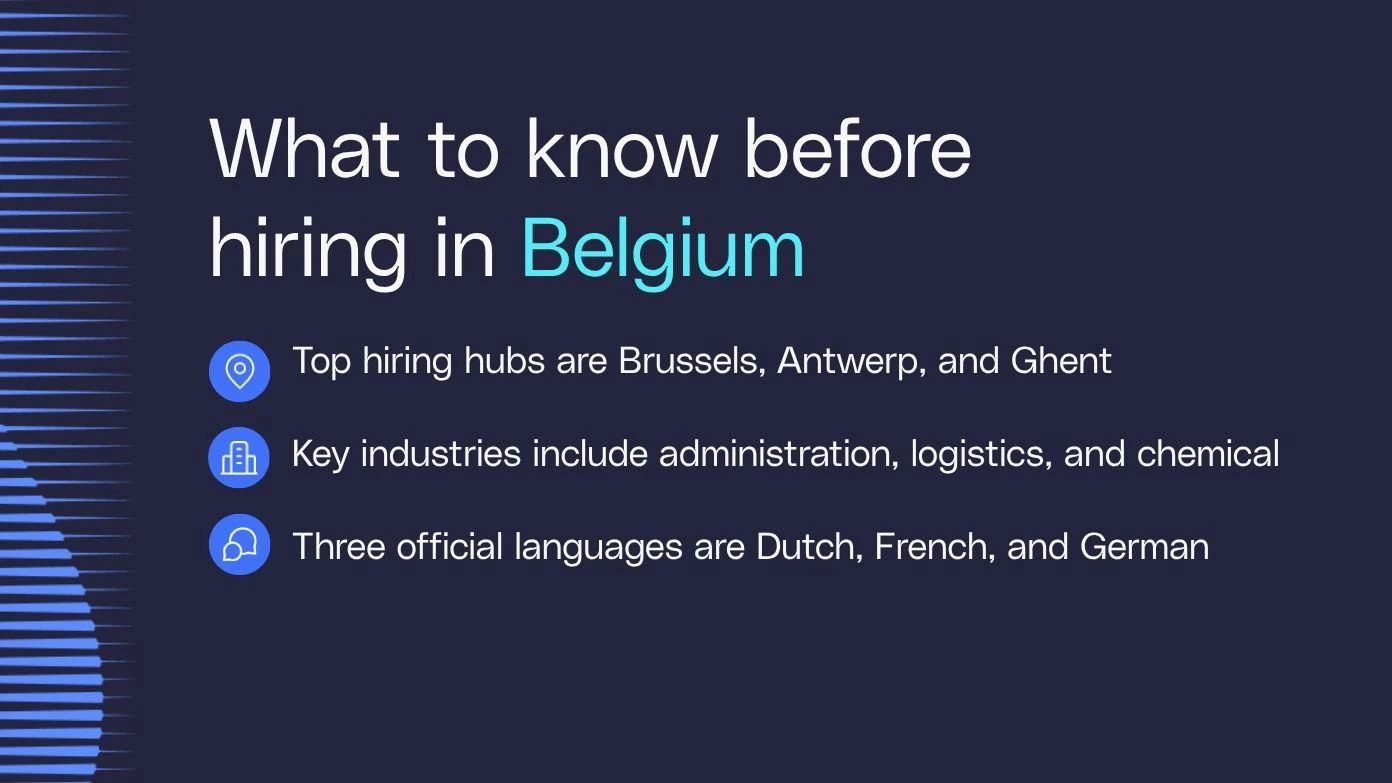
- Belgium’s top hiring hubs are Brussels, Antwerp, and Ghent.
- Top industries in Belgium include services and administration, logistics and transportation, and chemicals and petrochemicals.
- Companies hiring in Belgium have various options for setup, including partnering with an employer of record (EOR), hiring contractors, establishing a subsidiary, or direct employer registration.
Belgium is a member of the Schengen Area and is the tenth largest exporting country in the world. It has a workforce of over five million people. Its central location in Europe enables supply chain efficiency and fast distribution to neighboring markets. The European Union’s headquarters are in the country’s capital city of Brussels.
Before hiring employees in Belgium, you’ll need to understand contracts, taxes, wages, benefits, and other employment laws. Our guide will tell you everything you need to know about hiring in Belgium, from top hiring hubs, to key industries, to country-wide regulations.
What to know before hiring employees in Belgium
If you’re expanding your business into Belgium for the first time, there are important legal requirements to be aware of. These norms and laws influence hiring practices in Belgium and many aspects of the employer-employee relationship, including compensation and benefits.
G-P Gia™, our AI-powered global HR agent, can answer your toughest compliance questions across 50 countries — including Belgium — and all 50 U.S. states. Reduce your reliance on outside counsel and cut the time and cost of compliance by up to 95% with Gia.
Here are five things to know about hiring in Belgium:
1. Languages and regions
Belgium has three official languages: Dutch, French, and German.
There are three territorial regions in Belgium, which are separated by language, governmental structure, and wage requirements:
- Flemish Region: Located in the north, Flanders is the Dutch-speaking region. It’s governed by one Flemish Parliament and Flemish Government.
- Brussels-Capital Region: Brussels is officially a bilingual area. French and Dutch are the spoken languages. The region is under the legislative power of the Parliament of the Brussels-Capital Region and the governing power of the Government of the Brussels-Capital Region.
- Walloon Region: French is the primary language of the southern region of Wallonia. German is spoken by a small community in the province of Liege, within Wallonia. The region is under the power of the Walloon Parliament.
2. Standard workweek and holidays
The standard workweek is 38 hours, although CBAs or individual companies may have slightly different schedules. Employees working six hours per day get a break of 15 minutes or longer. Breaks don’t count toward working hours. Some sectoral Collective Bargaining Agreements (CBAs) have different arrangements.
Belgium has 10 public holidays each year, which are:
- New Year's Day
- Easter Monday
- Labor Day
- Ascension Day
- Whit Monday
- Belgian National Day
- Assumption Day
- All Saints' Day
- Armistice Day
- Christmas Day
Each region has its own holidays in addition to these 10. Overtime pay is 150%, but on Sundays and public holidays, it increases to 200%. CBAs may provide higher rates. Full-time workers in Belgium get at least four weeks of paid annual leave.
3. Leave for new parents
Mothers get 15 weeks of maternity leave for a single birth. This is divided into a prenatal period and a postnatal period. Prenatal is up to six weeks, with at least one mandatory week before the due date. Postnatal is at least nine weeks after childbirth. Multiple births or newborn hospitalization can extend this time. Maternity leave is generally paid by the public health insurance fund, rather than the employer.
Fathers or co-parents get 20 days of birth leave. This can be taken within four months of the child’s birth. The employer pays for the first three days, and the public health insurance fund pays for the other 17.
4. Belgium’s tax system
Belgium taxes residents on their worldwide income. Non-residents are taxed on income sourced in Belgium. The personal income tax is progressive. Rates range between 25–50%. For residents, there are also municipal surcharges that vary by locality and are added as a percentage of the federal tax. Non-residents may owe federal surcharges.
Both employees and employers pay social security contributions. These benefits include healthcare, pensions, unemployment, and family allowances. The rates are set by law and deducted from salaries. Companies pay corporate income tax on their worldwide profits. The standard rate for employees is 13.07%, and 25% for employers, although actual rates may vary. There’s a reduced rate of 20% on the first EUR 100,000 for small and medium-sized enterprises (SMEs).
Regions such as Flanders, Wallonia, Brussels may charge extra taxes, such as property tax, inheritance tax, and registration duties.
5. Employment contracts in Belgium
It’s best practice to use the regional language in contracts. For example, if you hire an employee in Wallonia, draft their contract in French.
Belgian employment law allows several contract types:
- Open-ended (indefinite) contract: The default form, with no fixed end date
- Fixed-term contract: Specifies the duration of employment and is subject to strict rules regarding renewal and succession
- Part-time contract: Clearly states the work schedule and hours
- Student contract: Fixed-term for students to work outside of school hours
- Temporary contract: Fixed-term for seasonal work or staff absences
- Specific project contract: Automatically ends once a project is complete
Many sectors are covered by CBAs. These can impose extra benefits. Always check the applicable CBA for your sector.
G-P EOR has an Employment Contact Generator to help you draft compliant employment contracts that meet all legal needs and best practices in Belgium.
Hiring models for global companies in Belgium
There are a few options for expanding your business into Belgium, each with their own pros and cons. These options include:
- Direct employer registration: establishing a legally registered entity in Belgium to employ workers directly. You will independently manage payroll, tax withholding, statutory insurance, and other employer obligations.
- Employer of record (EOR): G-P EOR acts as the legal employer, handling administrative and payroll processes on behalf of your company, including contracts, withholding, contributions, and statutory benefits.
- Subsidiary or branch: a subsidiary will function as a separate legal entity, while a branch will function as an extension of your parent company and must be registered locally.
- Independent contractor: hiring independent contractors in Belgium generally doesn’t require establishing a local entity or branch. However, there are significant penalties for misclassified workers, so legal tests must be followed when hiring them. Registration, tax, immigration, LIMOSA, or other requirements may also apply.
Top hiring hubs in Belgium
Some cities in Belgium are known for particular industries. Knowing what each city has to offer allows you to focus your hiring efforts in the right place and fill roles faster.
The top talent hubs in Belgium are:
- Brussels is Belgium’s largest employment hub. It hosts multinational corporations and government institutions. There are many administration, finance, technology, and services jobs in the city.
- Antwerp is known for its port, the second largest in Europe. It’s a major center for logistics, shipping, petrochemicals, and the diamond trade. The city has a strong presence in fashion and creative industries.
- Ghent is a hub for technology, education, and manufacturing. Ghent’s universities and research centers contribute to a vibrant job market, especially in biotech, IT, and engineering.
- Leuven is home to one of Europe’s oldest universities. Leuven is a center for research, innovation, and high-tech industries, particularly pharmaceuticals and life sciences.
- Liège is located in the French-speaking Wallonia region. Liège is an important industrial and logistics center, with strengths in aerospace, steel, and transport.
Key industries in Belgium
Understanding Belgium’s main industries allows you to benchmark salaries and benefits. You can use this insight to make smart choices about where to invest and grow your workforce.
The main industries in Belgium include:
- Services and administration: Brussels, as the EU’s administrative capital, is a major center for public administration, international organizations, and business services. Specialist talent includes project and office managers, logistics and supply chain administrators, and events coordinators.
- Logistics and transportation: Belgium is a European logistics hub with major ports in Antwerp and Zeebrugge. The sector supports jobs in shipping, warehousing, and supply chain management. Specialist talent includes supply chain managers, customs specialists, and demand forecasters.
- Chemicals and petrochemicals: The Antwerp region is home to one of the world’s largest chemical clusters. Several multinational companies operate in chemicals, plastics, and related industries. Specialist talent includes various engineering roles, health and safety professionals, and supply chain and logistics workers.
- Pharmaceuticals and life sciences: Belgium is a leader in pharmaceuticals, biotechnology, and medical research. There are clusters in Leuven and Ghent. Specialist talent includes R&D professionals, clinical research project managers, and regulatory affairs professionals.
- Manufacturing and engineering: The country has a strong manufacturing base for automotive, machinery, electronics, and aerospace. Flanders and Wallonia are leading locations. Specialist talent includes various engineering roles.
Costs of hiring employees in Belgium
Whether you’re hiring one employee or an entire team in Belgium, expenses are inevitable. Budget for the following:
- Setting up an entity (unless you partner with an employer of record)
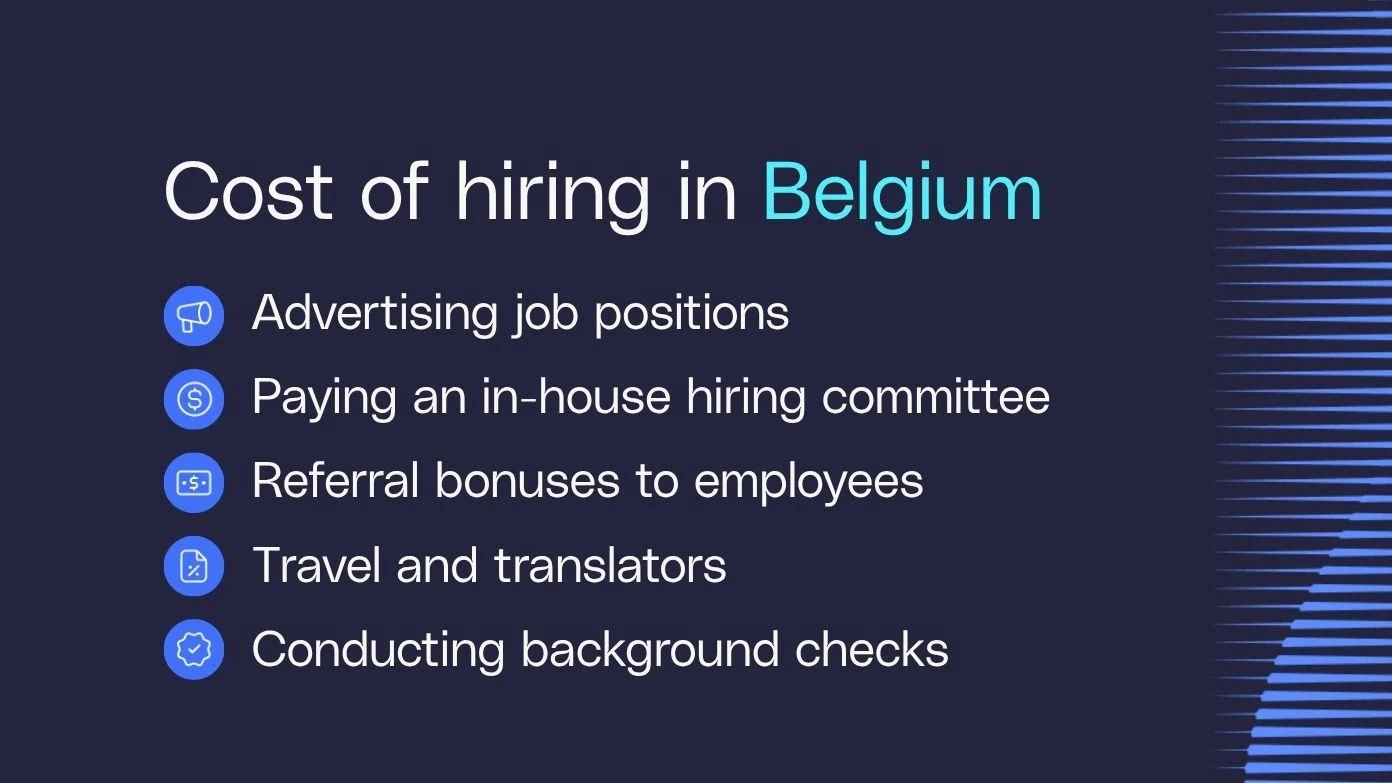
- Advertising open roles
- Paying referral bonuses to employees with connections in Belgium
- Paying an in-house hiring committee
- Traveling to and from Belgium, including hotel stays, meals, and transportation
- Partnering with a translator to draft documents or facilitate conversations, if applicable
- Using a background check service for screening candidates
According to G-P Verified sources from Gia, the employer burden rate in Belgium, which includes costs triggered on top of salaries, can range from 27–35%.
What does a company need to do to hire employees in Belgium?
Make sure you cover these essentials before expanding your team in Belgium:
- Choosing your hiring model, such as a Belgium EOR
- Registering your company with the National Social Security Office (NSSO), the tax collector’s office, and the Crossroads Bank for Enterprises, if needed
- Appointing an authorized person to manage documentation and correspondence with national officials
- Applying for a company number at the Central Register of Companies
- Registering with customs for an Economic Operators Registration and Identification (EORI) number, so you can trade with non-EU members
- Designating a business counter to be your main point of contact for administrative formalities
- Completing right-to-work checks and any required permits
- Setting up payroll administration
- Obtaining mandatory occupational accident insurance for covered employees
- Confirming work rules, wage scales, benefits obligations, classification, and working time rules
- Preparing employee contracts and documentation in the correct languages
- Assessing Limosa, A1/social-security coordination, and Belgian mandatory working conditions
- Consulting with a Belgium law firm to stay compliant throughout the hiring process
Setting up a subsidiary in Belgium can take weeks or months. Use G-P EOR to hire full-time employees in Belgium without setting up your own entity. Build your team in Belgium at a lower cost and with peace of mind that you’re doing so compliantly.
The steps to hiring in Belgium
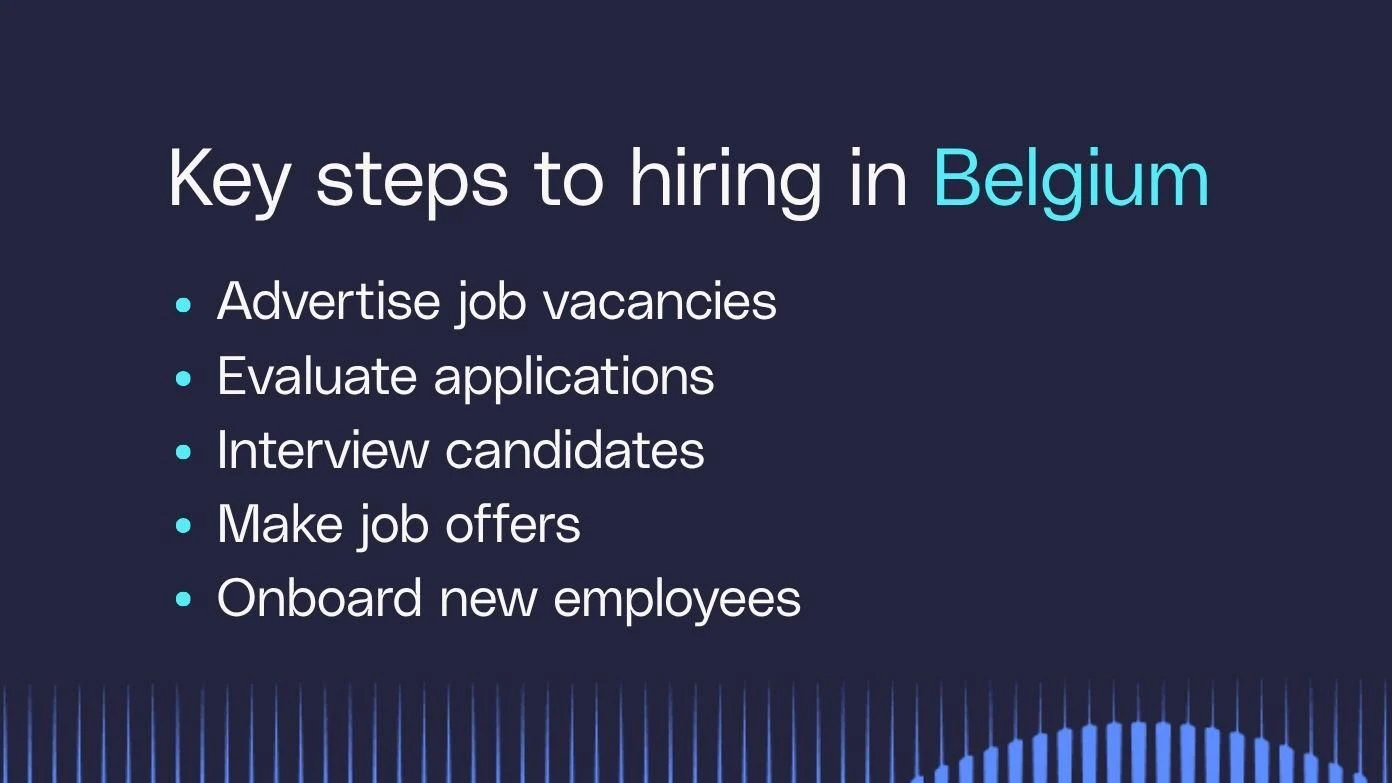
The hiring process in Belgium is similar to the one you’re likely familiar with in your own country. The hiring process follows five basic steps: advertising the job, evaluating applications, interviewing candidates, sending job offers, and onboarding new employees.
1. Advertise job vacancies
Clearly outline the job description, responsibilities, and qualifications. Starting June 2026, Belgian law (implementing the EU Pay Transparency Directive) will require you to disclose the minimum and maximum salary range for the position. Wallonia has already passed this directive, so only public sector employers in this region are impacted until it becomes a national law.
Make sure job advertisements comply with antidiscrimination laws. Avoid mentioning protected characteristics, such as gender, age, or ethnicity, unless legally justified. The language of the job advertisement and all employment-related communications should match the official language of the region you’re hiring in. For example, if you’re hiring in Wallonia, draft job ads in French.
Jobat, Stepstone, Indeed, and Monster are all popular job sites in Belgium.
2. Evaluate applications
Gather CVs and application forms. Screen candidates based on qualifications and experience, ensuring compliance with privacy and antidiscrimination regulations. Inform candidates about how their data will be used, and respect their rights to access, rectify, or request deletion of their data.
3. Interview candidates
Interview candidates who made it onto your shortlist. Use structured, nondiscriminatory interview questions. Gia can help you create questions that follow antidiscrimination laws in Belgium, so you can find the best fit for the role while complying with local regulations.
Reference checks and background verifications are allowed but have to comply with data protection regulations. Criminal record checks are only allowed if the nature of the job justifies it (e.g., working with children or financial positions).
4. Make job offers
Contact your chosen candidate to offer them a position with your company. Prepare a written employment contract in the right language, depending on the region. The contract has to include all mandatory clauses — such as job description, payment frequency, notice period, and termination procedures — and comply with Belgian labor law.
5. Onboard new employees
Now you can onboard new employees. You’ll have to submit a Dimona declaration to the NSSO and register the employee with a health insurance fund (mutualité/ziekenfonds). Familiarize new employees with your company’s work regulations and give them a copy of these documents.
If you’re working with an EOR like G-P, you won’t have to worry about the administrative burden of onboarding. We’ll streamline the process, so you can focus on training your new hires and integrating them into your company culture.
Hiring contractors in Belgium
Working with independent contractors in Belgium can be a cost-effective way to test the market and build a presence without the commitment of full-time employees.
Contractors based in Belgium understand local consumer behavior, rules, and business practices. They’ll be ready to start working quickly with their own equipment and established work processes.
Hiring contractors allows you to easily adjust your workforce based on your business needs, without the complexities and costs of employment.
Before you enter an agreement with an independent contractor in Belgium, consider the following:
1. Employees vs. independent contractors
It’s important to understand the difference between employees and independent contractors. In Belgium, employers hire employees to do work and, in return, pay them a regular salary and benefits. Independent contractors provide services. Unlike employees, contractors set their schedules, use their own equipment, and work on specific projects, rather than having an ongoing role.
2. Penalties for misclassification
Classifying someone as a contractor when they’re not can lead to severe penalties. Classification is determined by details of the working relationship, not simply the label on the contract itself. If misclassification occurs, you may have to:
- Pay retroactive social security contributions, payroll-tax corrections, and employee claims for wages, holiday pay, benefits, and severance, with interest.
- Pay administrative and criminal fines to the Belgian Social Criminal Code, depending on the violation.
- Face prison in cases of severe or intentional misclassification or social fraud.
3. How to pay contractors in Belgium
G-P Contractor™ takes away the messy, time-consuming process of hiring and paying international contractors. You can create and issue contracts and pay contractors with just a few clicks, all while ensuring a compliant process.
Hire employees and contractors in Belgium with G-P
Our Global Employment Platform and its AI-powered products, EOR, Contractor, and Gia, support companies as they build and manage global teams.
G-P is the recognized leader in global employment with more than a decade of experience; the largest team of HR, legal, and compliance experts; and a global proprietary knowledge base.
Make your expansion to Belgium easier with G-P. Contact us or book a demo today.

FAQs
What employment contracts are recognized in Belgium?
Belgium recognizes indefinite (open-ended), fixed-term, specific-assignment, replacement, full-time, and part-time contracts. Specialized contracts also exist for sales representatives, teleworkers, and student employees. Fixed-term and part-time contracts must be in writing, and strict limits apply to the renewal and duration of fixed-term contracts.
What language should employment contracts in Belgium be in?
Contracts must be drafted in the official language of the region where the employee works: Flemish in Flanders, French in Wallonia, German in the German-speaking community, and Flemish or French in Brussels, depending on the employee's language preference.
Is there a minimum wage in Belgium?
Yes. Belgium has a national minimum wage of approximately EUR 2,111.89 per month (2025). Sectoral Collective Bargaining Agreements (CBAs) can set higher minimum rates.
What benefits are commonly provided to employees in Belgium?
Common benefits include meal vouchers (up to EUR 10 per day as of January 2025), telework allowances (up to EUR 157.83 per month), vacation pay, year-end premiums, and sector-specific benefits negotiated through CBAs. Statutory annual leave is at least 24 days per year.
What are Collective Bargaining Agreements (CBAs)?
CBAs set sector-specific minimum wages, working conditions, and other employment terms. They are legally binding and supplement statutory law.