




Key takeaways
- How Hong Kong works: Hong Kong is a special administrative region (SAR) of China under the "one country, two systems" framework. It has its own currency, judicial system (common law), and police force.
- Benefits of hiring in Hong Kong: Hong Kong is a fantastic place for global companies to do business. Its economy is characterized by free trade, low taxation, and minimal government intervention.
- Paths to hiring in Hong Kong: Companies have various options for setup, including partnering with an employer of record (EOR), hiring contractors, establishing a subsidiary, or direct employer registration.
What to know before hiring in Hong Kong
If you’re expanding your business into Hong Kong for the first time, there are important legal requirements you'll need to know. They influence hiring practices in Hong Kong and many aspects of the employer-employee relationship, including compensation and benefits.
G-P Gia™, our AI-powered global HR agent, can answer your toughest compliance questions about Hong Kong. Reduce your reliance on outside counsel and cut the time and cost of compliance by up to 95% with Gia.
Here are five things to know about hiring in Hong Kong.
1. Languages in Hong Kong
Chinese and English are the official languages of Hong Kong, with the latter being especially common in business settings. Cantonese, which differs from Mandarin Chinese, is the most commonly spoken language in Hong Kong.
Because of the Western influence in Hong Kong and the wide use of English, you can find that some job applicants have both a Chinese name and a Western name that is designed to be easier for global employers to pronounce and remember. Make sure you know which name a person prefers.
2. Payroll considerations in Hong Kong
The minimum wage in Hong Kong is reviewed every year. In 2026, it’s HKD 43.10 per hour.
Payroll in Hong Kong is fairly straightforward. Employers aren’t required to withhold income tax from employees’ salaries. Employees are responsible for filing and paying their own taxes to the Inland Revenue Department (IRD). However, employers have to prepare and provide annual tax forms (such as the IR56B) to both the IRD and the employee.
Both employers and employees contribute to the Mandatory Provident Fund (MPF) that stores retirement savings for employees. The standard contribution rate is 5%.
There’s no statutory requirement for employers to withhold funds for healthcare. Hong Kong’s public healthcare system is funded through general taxation, not payroll deductions.
3. The Hong Kong workweek
Hong Kong doesn’t have any regulations on the maximum number of hours that employees can work. The average employee works about 42 hours per week. While the government leaves working hours up to employers and employees, one rest day out of every seven is mandated. This rest day tends to fall on Sundays, but employers can choose a rest day that makes sense for their company. Pay close attention to this requirement because ignoring it can lead to heavy fines.
4. Holidays and vacation leave in Hong Kong
There are 15 national holidays in Hong Kong. Employees on a continuous contract (at least 17 hours per week for four consecutive weeks) get holiday pay after three months. If a statutory holiday falls on an employee’s rest day, the employer must provide a replacement holiday in accordance with the Employment Ordinance.
Employees get the following paid annual leave after completing 12 months of continuous service:
- Seven days per year for the first two years of service
- From the third year onward, annual leave increases by one day per year of service, up to a maximum of 14 days after nine years.
Unused annual leave can be carried over, but the Employment Ordinance requires that annual leave be taken within the following 12 months after it's earned, unless otherwise agreed between employer and employee.
5. Sick leave in Hong Kong
Employees get two paid sick days per month during their first 12 months of employment, and four paid sick days per month after. Employees get paid sick leave if they take at least four consecutive days off (unless the leave is for pregnancy-related care) and provide a medical certificate from a registered doctor or dentist.
The statutory rate for paid sick leave is 80% of the employee’s average daily wage. Paid sick leave is protected under the Employment Ordinance. Unused sick days can be carried forward up to the 120-day cap.
Hiring models for global companies in Hong Kong
Depending on your business, there are a few different ways you can go about hiring employees in Hong Kong:
- Direct employer registration: Register as a local Hong Kong business and employ people directly.
- Employer of record: Work with a Hong Kong EOR who employs people for you and handles contracts, withholding, contributions, and statutory benefits.
- Subsidiary or branch: Maintain your central business elsewhere but open a subsidiary in Hong Kong for hiring purposes.
- Independent contractor: Hire contractors to test the market and handle specialized projects, but keep in mind that you’ll face significant financial penalties if the government determines you've misclassified actual employees as contractors.
Top hiring hubs in Hong Kong
Some districts in Hong Kong are known for particular industries. Knowing what each region has to offer allows you to focus your hiring efforts in the right place and fill roles faster.
Here are the top talent hubs in Hong Kong:
- Central is the primary business and financial district. It’s home to multinational corporations, banks, law firms, and professional services.
- Admiralty and Wan Chai are important commercial and government centers. Many regional headquarters, consulting firms, and technology companies are located here.
- Tsim Sha Tsui (Kowloon) is a major retail, hospitality, and commercial area.
- Quarry Bay and Taikoo Place (Eastern District) are growing hubs for technology, media, and creative industries, with many modern office complexes.
- Causeway Bay is known for retail, marketing, and creative roles, as well as regional offices for global brands.
Key industries in Hong Kong
Understanding Hong Kong’s top industries allows you to benchmark salaries and benefits. You can use this insight to decide where to invest and grow your talent pool.
The top industries in Hong Kong include:
- Financial services: This is Hong Kong's most important sector, contributing the largest share to its GDP. Its advantages include a lack of capital controls, a strong common law legal system, and its status as a big global financial center.
- Trading and logistics: Hong Kong is one of the world's busiest logistics hubs, using its position as a free port and a strategic gateway to mainland China.
- Professional services: This sector provides the high-value expertise necessary for Hong Kong's role as a regional corporate headquarters.
- Innovation and technology: This is a central focus of government policy, aiming to foster R&D, commercialize patents, and attract talent.
- Life and health sciences: This industry has a large talent pool in research, medical services, and biotechnology.
The cost of hiring an employee in Hong Kong
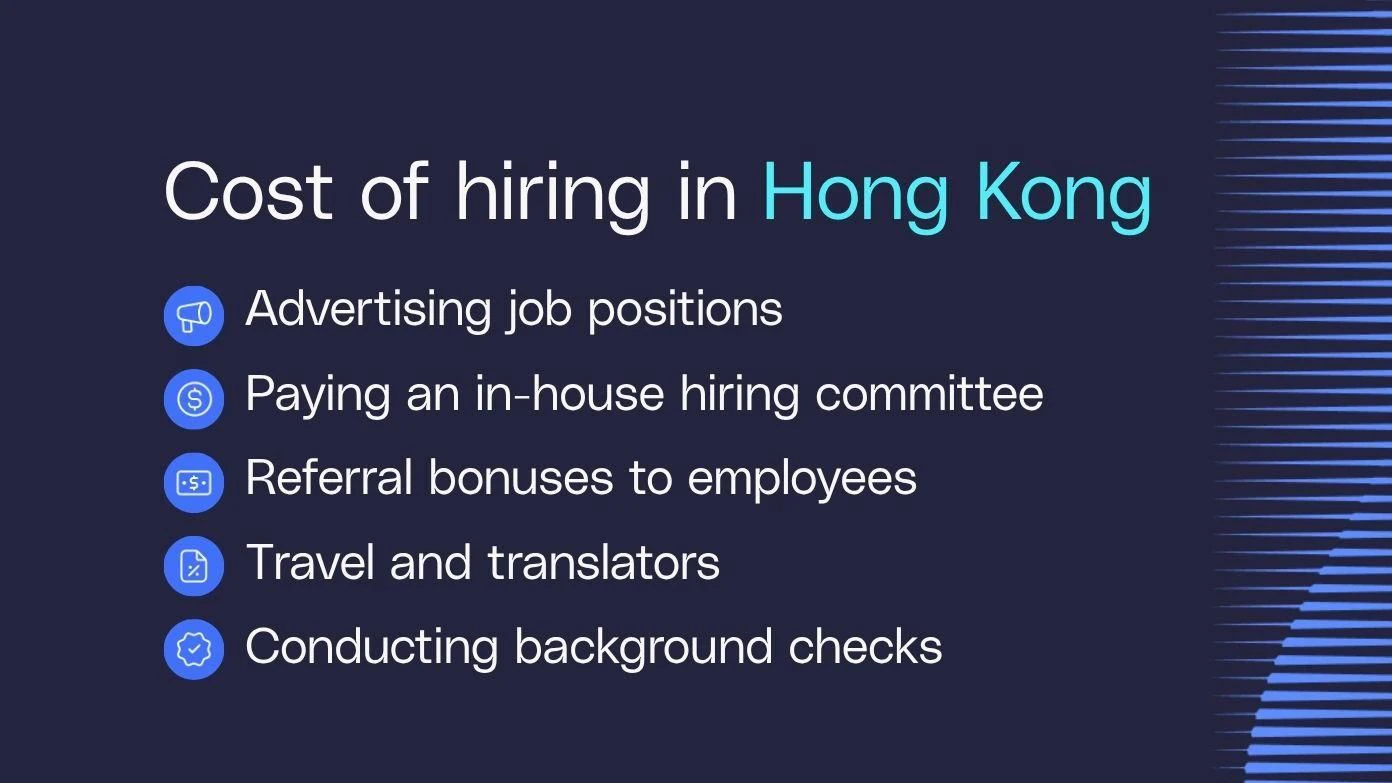
Whether you’re hiring one employee or an entire team in Hong Kong, expenses are inevitable. We find it useful to budget for the following:
- Setting up an entity (unless you partner with an employer of record).
- Advertising job positions.
- Paying referral bonuses to employees with connections in Hong Kong.
- Paying an in-house hiring committee.
- Traveling to and from Hong Kong, including hotel stays, meals, and transportation.
- Using a background check service for screening candidates.
- Drafting compliant employment contracts, legal review, and consultation with HR and legal experts.
- Costs of computers, phones, and software licenses.
- Expenses for onboarding materials and initial training.
- Mandatory employer contributions.
- Costs of maintaining required tax and payroll records and documentation.
According to G-P Verified Sources from Gia, the employer burden rate in Hong Kong, which includes costs triggered on top of salaries, is about 5%, excluding accident insurance, which can vary.
What does a company need to hire employees in Hong Kong?
Make sure you cover these basic essentials before expanding your team in Hong Kong:
- Register with the Inland Revenue Department to get a business registration certificate.
- Open a local bank account.
- Enroll in an MPF scheme with a private provider.
- Draft written employment contracts in English or Chinese.
- Notify the Inland Revenue Department of your status as an employer.
- Get the right work visas or permits for any non-Hong Kong resident employees.
- Set up a payroll system to calculate wages, MPF contributions, and statutory entitlements.
- Keep accurate record-keeping for payroll, leave, and employee data.
Setting up a subsidiary in Hong Kong can take weeks or months. Use G-P EOR to hire full-time employees in Hong Kong without setting up your own entity. Build your team at a lower cost and with peace of mind that you’re doing so compliantly.
If you plan on hiring employees directly in Hong Kong, here are some more details on the legal and operational steps that we recommend following:
- Stay updated on legal requirements: Make sure you keep your Business Registration Certificate from expiring. You'll also need to fulfill all your employer obligations, including tax, payroll, MPF payouts, insurance, and compliance with local employment laws.
- Follow banking best practices: Though a Hong Kong bank account isn't always a requirement, we find it very helpful for details like payroll, vendor payments, and MPF remittances. If you don't want a local account, make sure to follow lawful wage-payment alternatives like postal orders or checks.
- Get employees’ compensation insurance: Employers are required to have employees’ compensation insurance before new hires begin work.
- Draft contracts: Employment contracts in Hong Kong may be written or verbal, but as a best practice, have employees sign a written contract. Lay out the terms of employment, including wages, payment periods, reasons for termination, and notice periods. The contract can be in English or Chinese as long as both parties understand it.
- Complete right-to-work checks: For each hire, run a check to make sure they have the correct visas from Hong Kong immigration.
- Enroll employees in an MPF scheme: Most employees need to be enrolled in an MPF scheme within 60 days of you employing them, but casual employees (workers hired for less than 60 days) in the construction and catering fields need to get contributions within 10 days.
- Make your IRD filings: For each new employee, you'll need to file an IR56E form. You'll also need to file annual BIR56A/IR56B forms and file IR56F or IR56G forms for employees who leave.
- Run payroll carefully: Hong Kong payrolls need to calculate wages based on employee work and then keep records of taxes, MPF contributions, and leave. You're required to keep records for the past 12 months and keep them for six months after an employee leaves.
- Comply with the PDPO: Hong Kong's Personal Data Privacy Ordinance (PDPO) requires you to alert employees about data collection and store data securely.
- Handle sector-specific obligations: In certain industries, you might need to follow additional rules about licenses and workplace safety.
The steps to hiring in Hong Kong
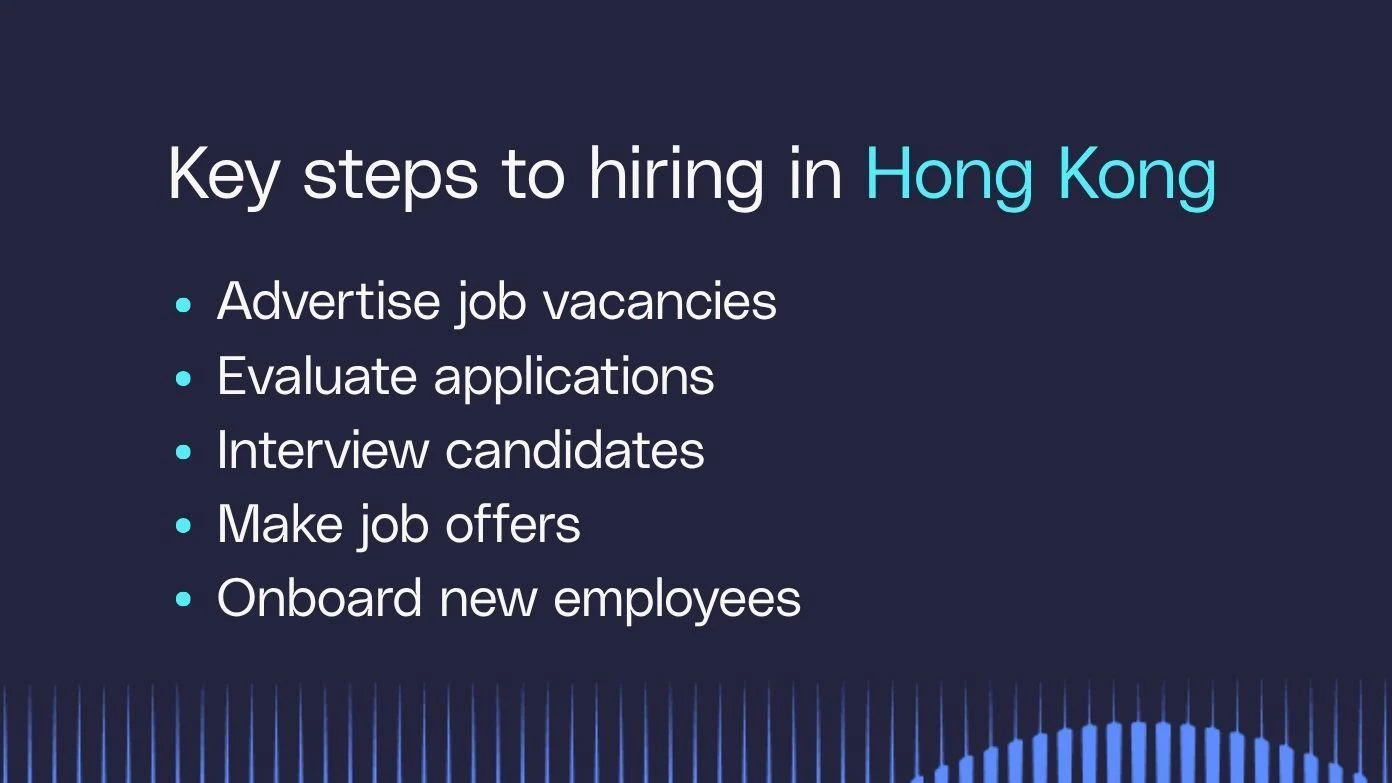
The hiring process in Hong Kong is similar to the one you’re likely familiar with in your own country. It follows five basic steps: advertising the job, evaluating applications, interviewing candidates, sending job offers, and onboarding new employees.
1. Advertising job vacancies in Hong Kong
Create a detailed job description, including responsibilities, qualifications, and compensation. Job advertisements can’t contain any discriminatory language or criteria based on gender, marital status, pregnancy, family status, disability, or race, unless a Genuine Occupational Qualification (GOQ) applies.
All job advertisements must be truthful. Misrepresentation of job duties, salary, or benefits can result in severe penalties.
2. Evaluating job applications in Hong Kong
Review applications and CVs to shortlist candidates who meet the job requirements. Employers must comply with the Personal Data (Privacy) Ordinance (PDPO) when collecting personal data through job advertisements.
3. Interviewing candidates in Hong Kong
Interview candidates who made it onto your shortlist. You can do these interviews in person or virtually. Verify references and, if relevant, conduct background checks in compliance with the PDPO.
Gia can help you create questions that follow antidiscrimination laws in Hong Kong, so you can find the best fit for the role while complying with local regulations.
4. Making job offers in Hong Kong
Make the job offer in writing and include the salary, benefits, and other key employment terms. Although employment contracts can be oral or written, using a written contract in English or Chinese helps ensure both parties understand the terms.
5. Onboarding new employees in Hong Kong
Now you can onboard new employees. Enroll your new hire in an MPF scheme and make sure both employer and employee contributions are set up. Provide orientation on company policies, workplace safety, and job duties. Set up payroll, benefits, and time-tracking systems.
With G-P EOR™, you won’t have to worry about the administrative burden of onboarding. We’ll streamline the process, so you can focus on training your new team members and integrating them into your company culture.
Hiring contractors in Hong Kong
Working with independent contractors in Hong Kong can be a cost-effective way to test the market and build a presence without the commitment of full-time employees. Contractors based in Hong Kong understand local consumer behavior, rules, and business practices. They’ll be ready to start working quickly with their own equipment and established work processes.
Hiring contractors allows you to easily adjust your talent pool based on your business needs, without the complexities and costs of employment.
Before you enter an agreement with an independent contractor in Hong Kong, consider the following:
1. Employees vs. independent contractors in Hong Kong
In Hong Kong, employers hire employees to do work and, in return, pay them a regular salary and benefits. Meanwhile, people hire contractors in Hong Kong for specific services. Unlike employees, contractors set their schedules, use their own equipment, and work on specific projects, rather than having an ongoing role.
2. Penalties for misclassification in Hong Kong
Classifying someone as a contractor when they’re not can lead to severe penalties. If misclassification occurs, you’ll have to:
- Retroactively provide all statutory employment rights and benefits.
- Face fines from the Labor Department, up to HKD 350,000.
- Face claims from misclassified workers through the Labor Tribunal.
3. How to pay contractors in Hong Kong
G-P Contractor™ takes away the messy, time-consuming process of hiring and paying international contractors. You can create and issue contracts and pay contractors with just a few clicks, all while ensuring a compliant process.
"Conducting business on an international scale is complex, but with G-P, I feel confident knowing they stay on top of the ever-changing laws in each country. The country insights provided by G-P are invaluable."
Teresa Cheek
Director of HR, IT and Administration at AmbioPharm
Hire employees and contractors in Hong Kong with G-P
Our Global Employment Platform and its AI-powered products, EOR, Contractor, and Gia, enable companies of all sizes to build and manage global teams.
G-P is the recognized leader in global employment with more than a decade of experience, the largest team of HR, legal, and compliance experts, and a global proprietary knowledge base.
Make your expansion to Hong Kong easier with G-P. Contact us or book a demo today.
FAQs
What are the main legal requirements for hiring employees in Hong Kong?
Companies must be incorporated in Hong Kong (unless partnering with an employer of record), hold a valid business registration certificate, and enroll employees in a Mandatory Provident Fund (MPF).
What are the mandatory employee benefits in Hong Kong?
The mandatory benefits for any worker hired under a continuous employment contract include paid annual leave, paid leave on statutory holidays, paid sick leave, mandatory rest days, and contributions to an MPF.
How much does it cost to hire an employee in Hong Kong?
In addition to your agreed-upon salary, you're required to pay a mandatory 5% MPF contribution, capped at HKD 1,500 per month. There are no mandatory employer contributions for social security, unemployment, or public healthcare.
Can Hong Kong employment contracts be in English?
Yes, you can draft employment contracts in English, Chinese, or another language both parties understand, and bilingual contracts are acceptable. English and Chinese are standard options in Hong Kong business settings.
What's the standard workweek and overtime policy in Hong Kong?
There's no statutory limit on weekly working hours, and overtime pay isn't required by law unless explicitly outlined in the employment contract. Keep in mind that Hong Kong does require employers to offer one mandatory rest day every seven days.