



Key takeaways
- Understand local employment requirements: Before hiring in Indonesia, review the rules for contracts, payroll taxes, wages, working hours, leave, terminations, and ongoing labor reforms.
- Choose the right hiring model: Depending on your entity status and expansion plans, you can establish a local entity, use G-P EOR, or engage genuine independent contractors while carefully managing classification risk.
- Budget beyond base salary: Account for BPJS contributions, statutory benefits, payroll administration, equipment, onboarding, and other employment-related costs.
- Target the right talent hubs: Jakarta, Surabaya, Bandung, Medan, and Bekasi offer different concentrations of talent across technology, finance, manufacturing, logistics, and other industries.
Indonesia is Southeast Asia's largest economy and a key market for global businesses that want access to a skilled talent pool. The country’s GDP is over USD 1.45T. Indonesia’s major economic pillars include the domestic consumer market and manufacturing sector, including exports like automotive parts, electronics, and textiles.
The government processes mineral resources like nickel and copper to target the global electric vehicle battery supply chain.
Before expanding into Indonesia, you’ll need to understand contracts, taxes, wages, benefits, and other employment laws. Our guide will tell you everything you need to know about hiring in Indonesia.
What to know before hiring in Indonesia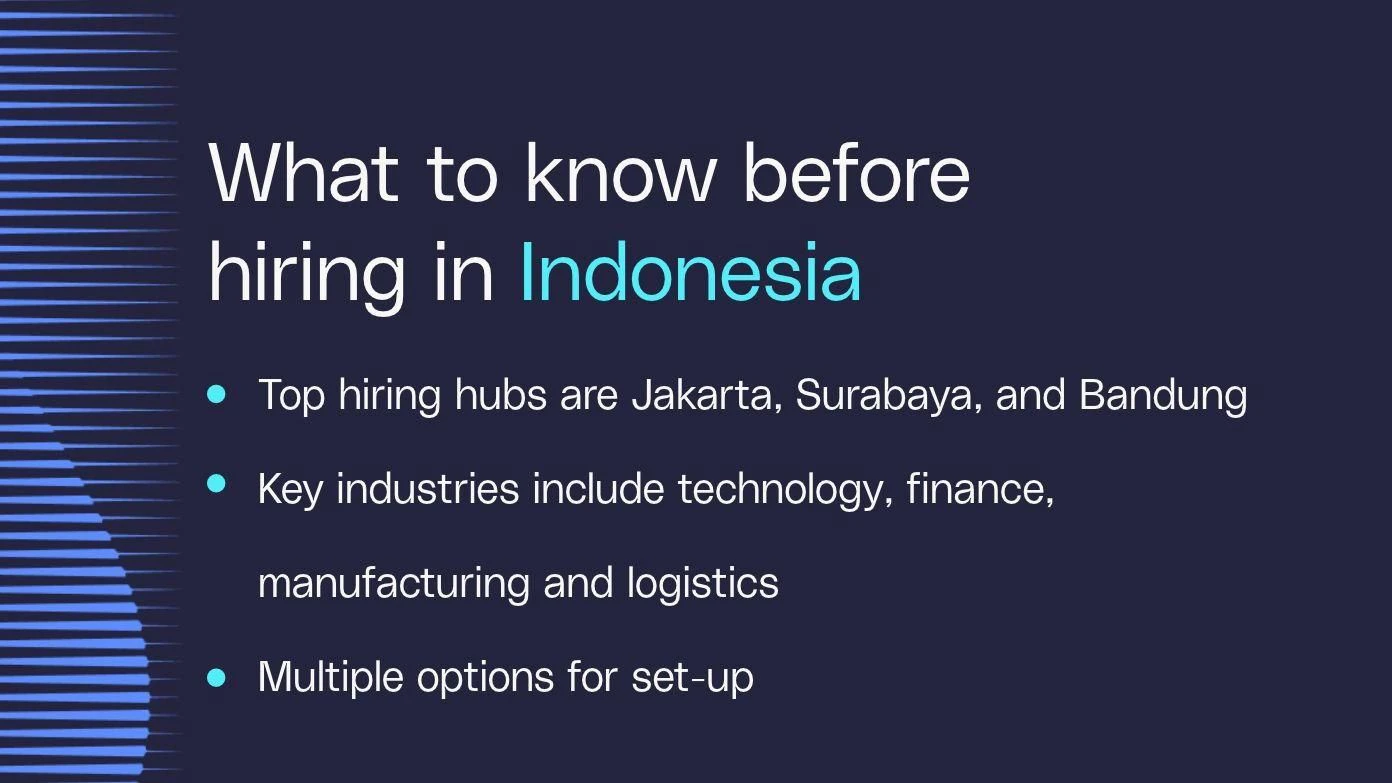
If you’re expanding your business into Indonesia for the first time, you must understand the local legal requirements. These norms and laws influence hiring practices in Indonesia as well as many aspects of the employer-employee relationship, including compensation and benefits.
G-P Gia™, our AI-powered global HR agent, can answer your toughest compliance questions across more than 50 countries — including Indonesia — and all 50 U.S. states. Gia can help reduce reliance on outside counsel and cut the administrative time and cost of compliance by up to 95%.
Here are five things to know about hiring in Indonesia:
1. Contracts and terminations
All employment relationships require an indefinite contract (PKWTT) or a fixed-term contract (PKWT). Fixed-term contracts can run for a maximum of five years, including extensions. Indefinite-term contracts have no set end date. You must prepare all of your fixed-term contracts in Indonesian. While bilingual contracts are allowed, any
inconsistency will mean that the Indonesian version prevails. The contracts must define job duties, compensation, benefits, and termination requirements.
Probation is only allowed for indefinite-term contracts. The maximum probation period is three months.
2. Payroll and taxes
As an employer, you must register employees and remit contributions to Indonesia’s social security systems: BPJS Kesehatan (health insurance) and BPJS Ketenagakerjaan (occupational injury, old-age/retirement savings, pension, and death benefits). The contribution rates are:
- Health insurance: 1% from the employee and 4% from the employer (on salary up to IDR 12M per month)
- Occupational injuries: 0.2–1.74% from the employer, depending on risk classification
- Retirement savings (JHT): 2% from the employee and 3.7% from the employer
- Pension benefits (JP): 1% from the employee and 2% from the employer (on salary up to IDR 10.5M+ per month)
- Death benefits: 0.3% from the employer
Employees are subject to annual income tax on a progressive scale. For payroll, the average effective tax rate is used for monthly withholdings from January to November. A final annual calculation uses progressive rates for December. The progressive rates in place for 2026 are:
- 5% for annual income up to IDR 60M
- 15% for IDR 60–250M
- 25% for IDR 250–500M
- 30% for IDR 500M–5B
- 35% for income above IDR 5B
3. Wages and working hours
The Indonesian workweek is 40 hours. Overtime is allowed up to four hours per day and 18 hours per week. Overtime pay is 150% of the regular hourly wage for the first hour and 200% for subsequent hours. You must obtain your employees’ written consent before you have them work overtime.
Employees get a minimum of 12 paid annual leave days after 12 months of service. The Indonesian government sets holidays each year. In 2026, there are 17 national public holidays and seven collective leave days.
There is no cap on sick days. Employees get:
- 100% of their salary for the first four months of illness
- 75% for the next four months
- 50% for the following four months
- 25% after that until employment is terminated
You must provide three months of fully paid maternity leave, with the possibility of an extension of up to six months if medically required. The first three months are at 100% pay and any subsequent months are at 75% pay. Fathers get two days of paid paternity leave, with up to three extra days by agreement with the employer.
Employees are entitled to paid leave for certain family events, including marriage, childbirth, bereavement, and a child’s circumcision or baptism. The applicable number of days depends on the event.
4. Job market and workforce
Indonesia’s labor force is one of the largest in the world. As of May 2026, its size was approximately 155.41 million people out of a total population of over 288 million. This trails only China, India, and the U.S.
Indonesia is an active member of the Group of 20 (G20), participating in international economic discussions and initiatives.
About 18% of young adults in Indonesia have a postsecondary degree.
5. Ongoing labor law reforms
The Indonesian government passed the Omnibus Law on Job Creation in 2020 and amended it in 2023. The law introduced labor reforms to make Indonesia more attractive for investment. It streamlined hiring, increased overtime flexibility, and eased restrictions on outsourcing and expatriate hiring.
Changes have continued to occur. In 2024, the Indonesian Constitutional Court issued Case Decision 168/PUU-XXI/2023, which placed a maximum total duration of five years for fixed-term contracts, including extensions. It also held that fixed-term contracts must be written in the Indonesian language.
On Oct. 6, 2026, the House of Representatives passed the Employment Protection Law. This law introduces changes to fixed-term contracts, outsourcing, and protections for digital and gig workers. The final legal text and regulations will determine the scope of these provisions.
Hiring models for global companies in Indonesia
There are a few options for expanding your business into Indonesia, each with their own pros and cons. These options include:
- Direct employer registration: You can form a foreign-owned local LLC directly in Indonesia. This provides you with direct control over your operations and employees, but it can take several months to establish and requires a substantial capital outlay.
- Employer of record: When you partner with an employer of record (EOR), it will act as the legal employer for your workforce in Indonesia and manage payroll, tax compliance, benefits, and compensation for you. This is much faster and allows you to set up within two to three weeks and test the market without having to form and register a local entity or open a subsidiary or branch.
- Subsidiary or branch: You can open an Indonesian subsidiary or branch of your company, which will allow you to control your operations and employees. However, you will need to be aware of and comply with all local laws and regulations.
- Independent contractor and misclassification risk: You can hire independent contractors in Indonesia on project-based contracts. However, you must be aware of the serious misclassification risks and penalties under Indonesian labor law.
Top hiring hubs in Indonesia
Some cities in Indonesia are known for particular industries. Knowing what each region has to offer allows you to focus your hiring efforts in the right place and fill roles faster.
- Jakarta is the capital and largest city. It is the country’s main business, financial, and technology center, hosting the headquarters of many multinational and local companies.
- Surabaya is home to the Port of Tanjung Perak. The city is Indonesia's second busiest seaport and handles over 3 million TEUs (the standardized unit of measurement in global shipping and logistics, based on the volume of a standard 20-foot shipping container) annually. It’s the main gateway for Eastern Java and the wider Eastern Indonesia region.
- Bandung is known for its universities and creative industries. It’s been called the Paris of Java. More than half of Bandung’s economic activity is design-related.
- Medan is the largest city in Sumatra. It’s a key gateway to the Malacca Strait. Medan is a center for agribusiness, trade, and manufacturing. It’s an export hub for Indonesia's palm oil and rubber.
- Bekasi is a large industrial and manufacturing area with many factories and logistics companies.
Key industries in Indonesia
When you understand Indonesia’s key industries, you are better able to benchmark salaries and locations. You can use this insight to make smart choices about where to invest and grow your talent pool.
The top industries in Indonesia include:
- Manufacturing: Indonesia has a strong manufacturing sector, particularly in automotive, electronics, textiles, footwear, and consumer goods. Many multinational companies have set up factories and supply chains here. In 2025, manufacturing constituted 19% of Indonesia’s GDP. This is the highest share among Association of Southeast Asian Nations (ASEAN) nations.
- IT and digital services: The country’s tech sector is growing, with a booming startup ecosystem in Jakarta and Bandung. The digital economy is driven by e-commerce and fintech.
- Banking and financial services: Indonesia’s financial sector is expanding, with opportunities in banking, insurance, fintech, and investment services. Digital payments are the main source of fintech revenue in the country, consisting of nearly 75% of the sector’s total revenue.
- Agriculture and agribusiness: Indonesia is the world’s largest producer of palm oil, and it accounts for a significant share of rubber, coffee, and cocoa as well. The country’s agriculture sector offers expertise in production, processing, and export.
- Energy and mining: Indonesia is rich in natural resources, including oil, gas, coal, and minerals. The country holds the world's largest nickel reserves and is a top global producer of tin, bauxite, and cobalt. There are opportunities in extraction, processing, and supporting services.
The cost of hiring an employee in Indonesia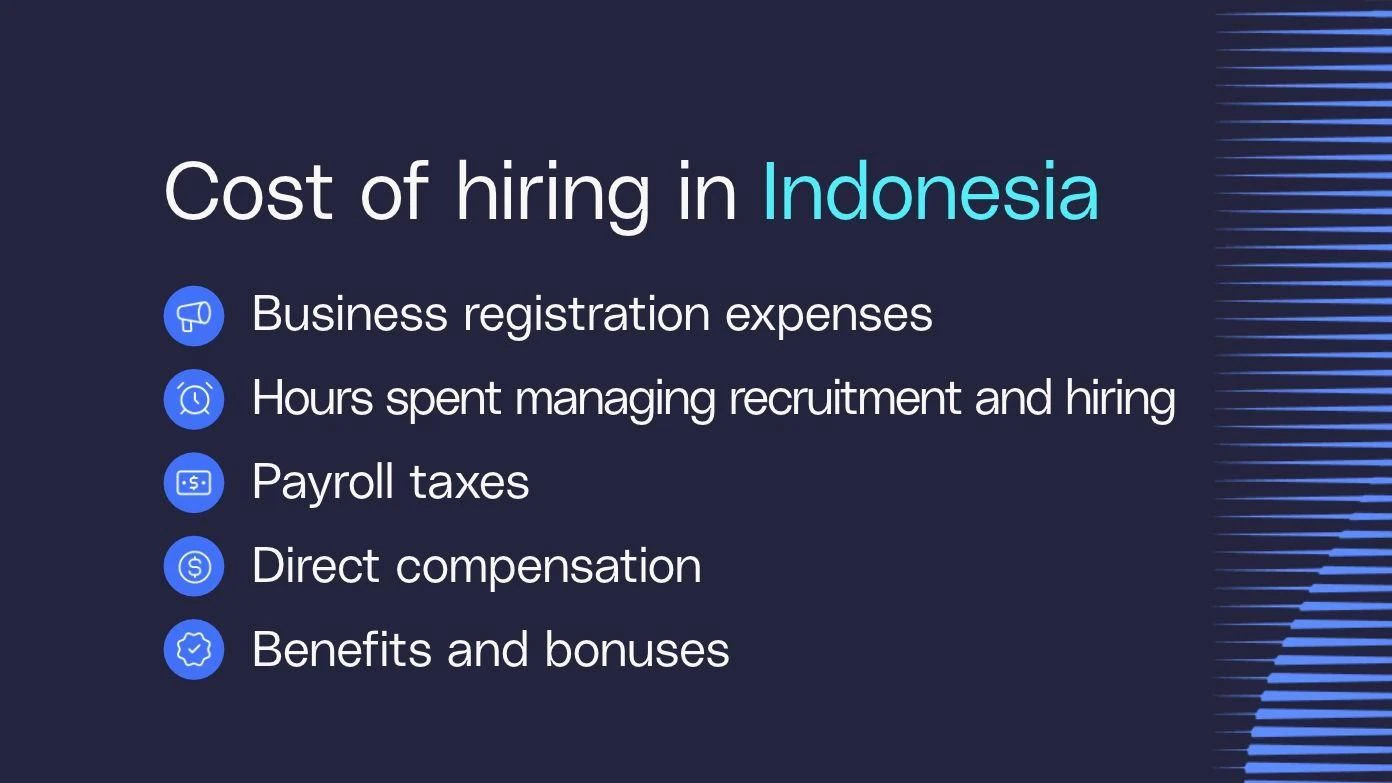
Whether you’re hiring one employee or an entire team in Indonesia, expenses are inevitable. Budget for the following:
- Setting up an entity (unless you partner with an employer of record)
- Advertising job positions
- Traveling to and from Indonesia, including hotel stays, meals, and transportation
- Partnering with a translator to draft documents or facilitate conversations (if applicable)
- Using a background check service for screening candidates
- Drafting employment contracts, legal review, and consultation with HR and legal experts
- Costs of computers, phones, and software licenses
- Onboarding materials and initial training
- Costs of maintaining required tax and payroll records and documentation
According to G-P Verified Sources from Gia, the employer burden rate in Indonesia, which includes costs triggered on top of salaries, is about 10–12%, excluding accident insurance that can vary.
What does a company need to hire employees in Indonesia?
Make sure you cover these essentials before expanding your team in Indonesia:
- Get a deed of establishment, approval from the Ministry of Law and Human Rights, and a company registration certificate.
- Register for a corporate tax ID with the Indonesian tax office.
- Get a NIB through the OSS, which serves as a unique business registration code.
- Open a local bank account in your company’s name for payroll and statutory payments.
- Enroll your company and employees with BPJS Kesehatan and BPJS Ketenagakerjaan.
- Prepare employment contracts in Indonesian.
- Ensure compliance with minimum wage, working hours, and benefits.
- Depending on the business sector, extra licenses or permits can be required.
Setting up a subsidiary in Indonesia can take weeks or months. Use G-P EOR to hire full-time employees in Indonesia without setting up your own entity. Build your team at a lower cost and with peace of mind that you’re doing so compliantly.
The steps to hiring employees in Indonesia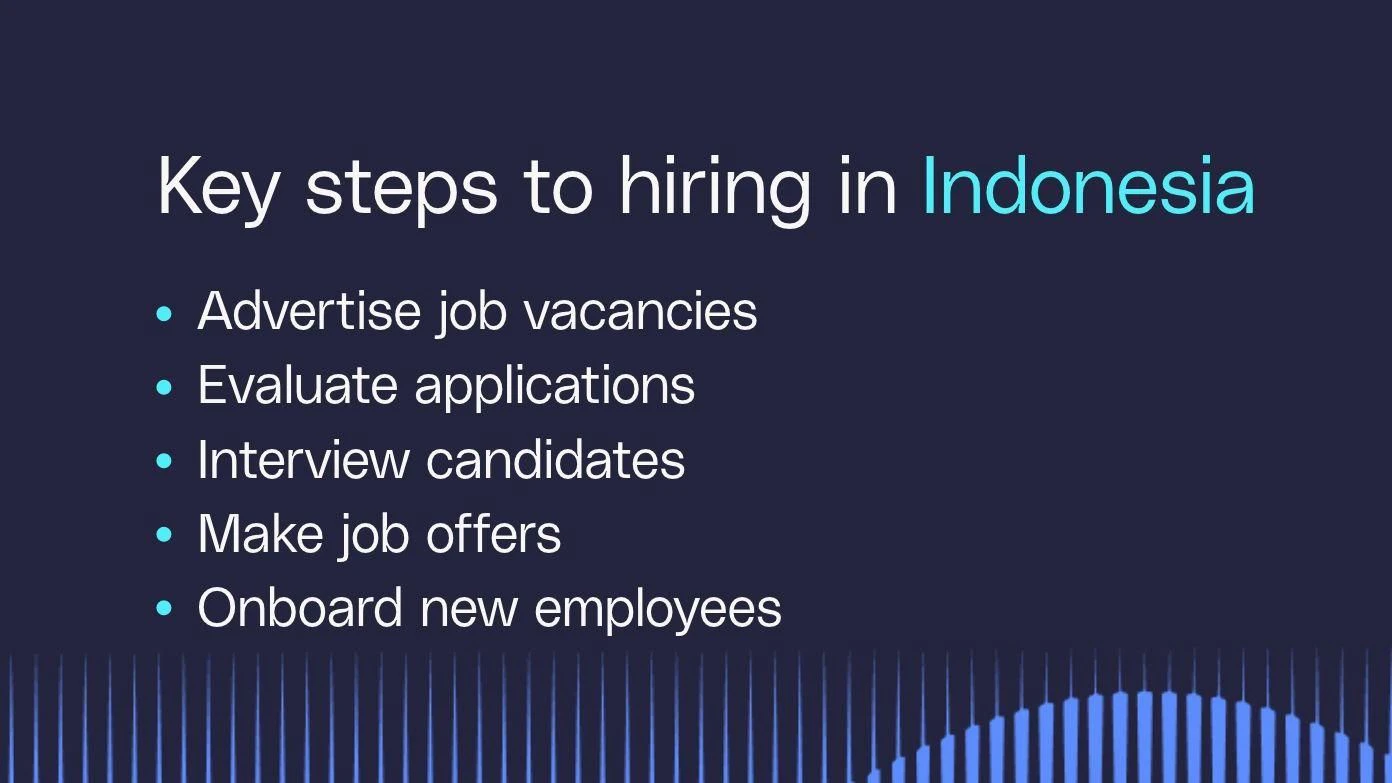
The hiring process in Indonesia is similar to the one you’re likely familiar with in your own country. It follows five basic steps: advertising the job, evaluating applications, interviewing candidates, sending job offers, and onboarding new employees.
1. Advertising job vacancies
Prepare a clear job description outlining responsibilities, qualifications, and compensation. Post the job on local and international job boards.
JobStreet, Indeed Indonesia, Glints, KitaLulus, and Karir are popular job boards in Indonesia.
2. Evaluating job applications
Review the resumes and cover letters and then shortlist candidates who meet the requirements.
3. Interviewing candidates
Conduct initial interviews via phone, video, or in-person. Gia can help you create questions that follow anti-discrimination laws in Indonesia, so you can find the best fit for the role while complying with local regulations.
Arrange further interviews or assessments as needed. Verify employment history, education, and conduct background checks if required.
4. Making job offers
Prepare a compliant employment contract in Indonesian (bilingual if needed). Clearly state salary, benefits, job duties, and termination terms.
5. Onboarding new employees
Now, you can onboard new employees. Register your new hire with BPJS Kesehatan and BPJS Ketenagakerjaan. Set up payroll, provide orientation, and make sure the employee understands your company policies. Keep accurate employment records and stay compliant with Indonesian employment laws.
If you’re working with an Indonesia EOR, you won’t have to worry about the administrative burden of onboarding. We’ll streamline the process, so you can focus on training your new hire and integrating them into your company culture.
Hiring contractors in Indonesia
Working with independent contractors in Indonesia can be a cost-effective way to test the market and build a presence without the commitment of full-time employees. Contractors based in Indonesia understand local consumer behavior, rules, and business practices. They’ll be ready to start working quickly with their own equipment and established work processes.
Hiring contractors allows you to easily adjust your talent pool based on your business needs, without the complexities and costs of employment.
Before you enter an agreement with an independent contractor in Indonesia, consider the following:
1. Employees vs. independent contractors
Employees work under the employer’s supervision and control, follow set schedules, are integrated into the organization, and get a regular salary and benefits, such as BPJS social security, paid leave, and minimum wage protections.
Contractors provide services independently, set their own schedules, use their own equipment, and are engaged for specific projects or periods. They don’t get employee benefits and serve multiple clients. Indonesian law uses a qualitative assessment based on factors such as degree of control, economic dependency, provision of resources, and the nature of the engagement. The working relationship, not just the contract, determines classification.
2. Penalties for misclassification
Classifying someone as a contractor when they’re not can lead to severe penalties. If misclassification occurs, you’ll have to:
- Pay back wages, overtime, social security contributions, paid leave, and other benefits that the worker should have received as an employee.
- Face administrative fines for noncompliance with labor, tax, and social security laws.
- Pay unpaid income tax withholdings and related penalties.
3. How to pay contractors
G-P Contractor™ takes away the messy, time-consuming process of hiring and paying international contractors. You can create and issue contracts and pay contractors with just a few clicks, all while ensuring a compliant process.
Hire employees and contractors in Indonesia with G-P
Our Global Employment Platform and its AI-powered products, EOR, Contractor, and Gia, support companies as they build and manage global teams.
G-P is the recognized leader in global employment with more than a decade of experience; the largest team of HR, legal, and compliance experts; and a global proprietary knowledge base.
Make your expansion to Indonesia easier with G-P. Contact us or book a demo today.
FAQs
What are the main types of employment contracts in Indonesia?
The main types of employment contracts in Indonesia are indefinite-term contracts and fixed-term contracts. Indefinite-term contracts have no set end date, while fixed-term contracts are for a period or project and are subject to strict legal requirements.
What’s the minimum wage in Indonesia?
The minimum wage in Indonesia varies by province and is set annually by local governments. Jakarta usually has the highest rate. You have to comply with the regional minimum wage law where the employee works.
What are the overtime rules in Indonesia?
Overtime is allowed up to four hours per day and 18 hours per week. Employees get 150% of their regular pay for the first hour and 200% for each subsequent hour. Overtime has to be agreed upon in writing.
How much annual leave are employees entitled to in Indonesia?
Employees in Indonesia get a minimum of 12 days of paid annual leave after completing 12 months of continuous service. This is in addition to holidays, which are set by the government each year.
What are the procedures for terminating an employee in Indonesia?
To offboard an employee in Indonesia, you have to follow strict legal procedures. This includes providing a written notice, documenting the reason for termination, and, in most cases, getting approval from the industrial relations court or reaching a mutual agreement.