





Key takeaways
- Flexible market expansion options: You can hire talent in Saudi Arabia through direct registration, setting up a local entity, engaging independent contractors, or using an employer of record (EOR) to hire quickly and legally without setting up a physical subsidiary.
- Strict contract and platform rules: Employment contracts need to be written in Arabic (or bilingual with Arabic taking precedence) and registered on the Qiwa platform. Saudi nationals can have fixed-term or indefinite contracts. Global employees have to be hired on fixed-term contracts.
- Complex social insurance rates: Employers have to contribute to GOSI for Saudi staff. Rates depend on registration date: 11.75% for existing workers, and 12.75% (phasing up to 13.75% by 2028) for workers registered on or after 3 July 2024.
- Strict worker classification and WPS: Employment status depends on actual direction and supervision. Misclassifying employees or failing to process pay through the Wage Protection System (WPS) can trigger fines, retroactive benefit pay, and government service restrictions.
As the Middle East's largest economy with a GDP of around USD 1.1T, Saudi Arabia is a key destination for global companies expanding their regional presence. Aside from oil and gas, the country is undergoing a transformation under Vision 2030 to diversify into digital technology, financial services, and advanced manufacturing. The government is focused on developing a skilled talent pool in these new technology and service-based industries to drive long-term sustainable growth.
Before expanding into Saudi Arabia, you’ll need to understand contracts, taxes, wages, benefits, and other employment laws. Our guide will tell you everything you need to know about hiring in Saudi Arabia.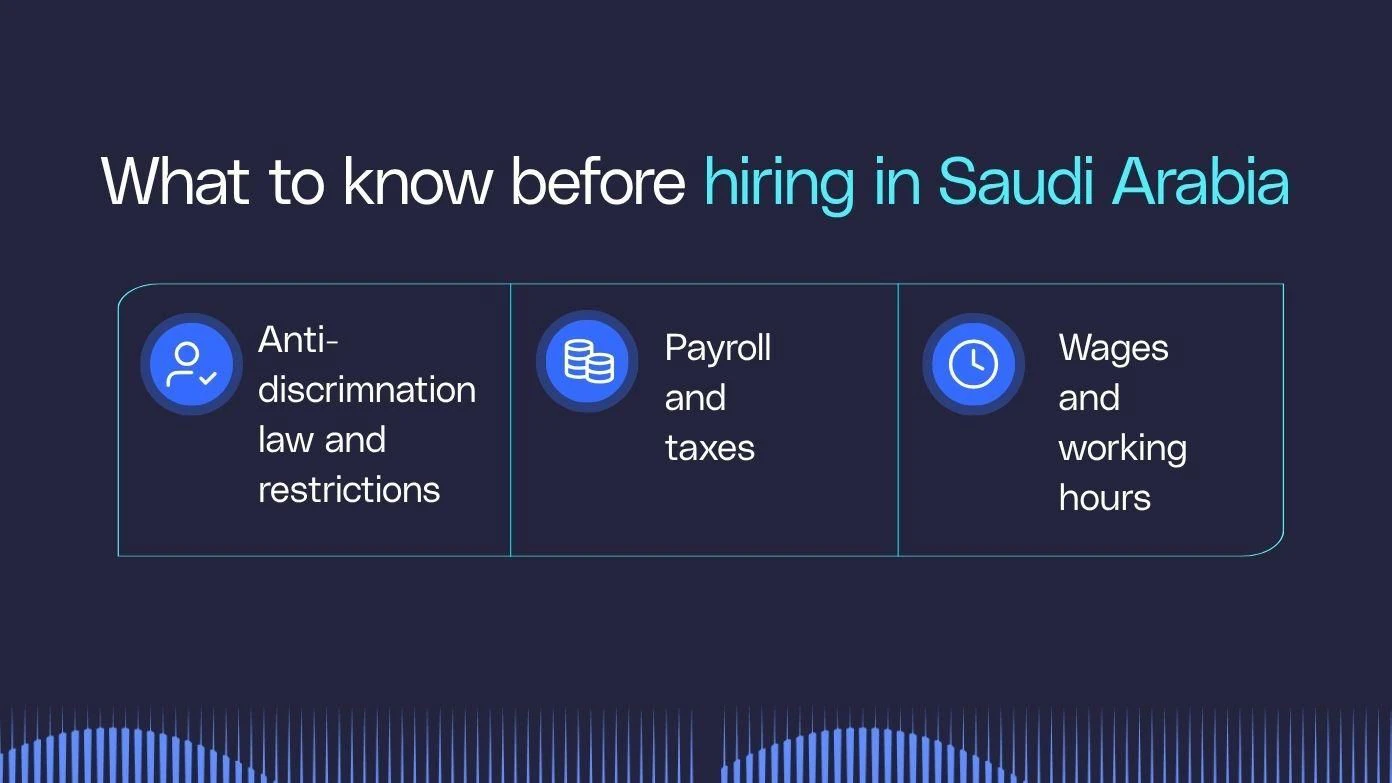
What to know before hiring in Saudi Arabia
If you’re looking to hire employees in Saudi Arabia for the first time, there are legal requirements to be aware of. These norms and laws influence hiring in Saudi Arabia and many aspects of the employer-employee relationship, including compensation and benefits.
G-P Gia™ is an intelligent HR compliance platform that serves as the complete action layer, automating the mundane tasks of HR execution — from drafting localized documents to navigating complex cross-border compliance scenarios.
Here are five things to know about hiring employees in Saudi Arabia.
1. Contract employment in Saudi Arabia
To employ someone in Saudi Arabia, your contract has to be written in Arabic and authenticated on the Qiwa platform. You can include a second language, but the Arabic text takes precedence in legal disputes. If a written contract isn't in place, employees can still prove their work relationship through other means.
Your hiring options depend on your candidate's nationality:
- Saudi nationals: You can hire them on fixed-term or indefinite contracts.
- Non-Saudi nationals: You need to hire them on fixed-term contracts.
Required contract details
Your contract includes:
- Employer name and business address
- Employee name, nationality, ID details, and home address
- Agreed wage, benefits, and allowances
- Job role and work location
- Start date (and contract length for fixed-term agreements)
Probation period: You can set a probation period of up to 180 days if both parties agree in writing. Official holidays (like Eid al-Fitr and Eid al-Adha) and sick leave do not count toward this limit.
Notice periods
For indefinite contracts, notice periods depend on who terminates the agreement and how you pay the employee:
- Monthly-paid employees: 60 days’ notice if you terminate the contract. 30 days’ notice if the employee resigns.
- Non-monthly-paid employees: 30 days’ notice, regardless of who ends the relationship.
End-of-service benefits
Calculate the end-of-service payout using the employee's last actual wage, prorating for partial years:
- First five years: Half a month's wage per year
- After five years: One month's wage per year
If an employee resigns, their entitlement follows these service tiers:
- Under two years: No payout
- 2–5 years: One-third of the benefit
- 5–10 years: Two-thirds of the benefit
- 10+ years: Full benefit
2. Payroll and taxes in Saudi Arabia
When hiring employees in Saudi Arabia, you have to make contributions to the General Organization for Social Insurance (GOSI). Your contribution rate depends on when your employee first registered with GOSI.
GOSI contribution rates
- Existing employees (registered before 3 July 2024): Pay 11.75% of their contributory wage. This covers 9% for pension, 0.75% for SANED unemployment insurance, and 2% for occupational hazards.
- New employees (first registered on or after 3 July 2024): Pension rates phase upward over time. Currently (1 July 2026 – 30 June 2027), the employer share is 12.75% total (10% pension, 0.75% SANED, and 2% occupational hazards). Scheduled rate increases bring this total to 13.25% in July 2027 and 13.75% in July 2028.
Calculating the contributory wage The contributory wage usually includes the basic salary plus any housing allowance, excluding commissions and other extra perks. Key limits to keep in mind:
- Rates are capped at a maximum wage of SAR 45,000 per month.
- Statutory minimum wage thresholds apply.
- Special valuation rules apply if you offer housing in kind rather than a cash allowance.
3. Wages and working hours in Saudi Arabia
The workweek is up to 48 hours (eight hours per day, six days per week). For Muslim employees during Ramadan, it’s reduced to six hours per day and 36 hours per week.
Overtime is paid at 150% of the regular wage for hours worked beyond the daily or weekly limits. This includes on Fridays or holidays. Overtime is triggered after 48 hours per week unless a lower threshold is specified in the employment contract.
Compensation for employees has to include a base salary and allowances for housing and transportation.
To be fully counted for Saudization quotas, Saudi employees have to get SAR 4,000 per month. Those getting between SAR 3,000–4,000 count as half a Saudi national for quota purposes.
4. Time off in Saudi Arabia
To keep your business compliant when you hire in Saudi Arabia, make sure you meet guidelines for working hours, overtime, and leave entitlements.
Working hours and rest days
- Standard hours: Cap working hours at eight hours per day or 48 hours per week.
- Ramadan hours: Reduce working hours for Muslim employees to six hours per day or 36 hours per week.
- Weekly rest: Provide at least one 24-hour weekly rest day (usually Friday, though you can designate another day).
Overtime pay Hours worked beyond standard daily or weekly limits — or on designated rest days and official holidays — count as overtime. Calculate overtime pay by taking the regular hourly wage and adding 50% of the basic hourly wage.
Annual leave Give a minimum of 21 days of paid annual leave. This increases to 30 days after five years of continuous service. You can offer 30 days from the start to stay competitive.
Sick leave Employees can take up to 120 days of sick leave per year, paid out in tiers:
- First 30 days: 100% pay
- Next 60 days: 75% pay
- Final 30 days: Unpaid
Parental leave
- Maternity leave: 12 weeks of fully paid leave, regardless of length of service.
- Paternity leave: Three days of fully paid leave.
Hajj leave Muslim employees with two years of continuous service can take 10 to 15 days of paid Hajj leave (including Eid al-Adha). You only need to grant this leave once per employee.
Public holidays Provide paid time off for official public holidays:
- Eid al-Fitr: Four days
- Eid al-Adha: Four days
- Saudi National Day: September 23
- Founding Day: February 22
5. Anti-discrimination law in Saudi Arabia
Saudi Labor Law prohibits workplace and hiring discrimination based on:
- Age
- Sex (gender)
- Disability
- Race
- Color
- Social status
Recent legal reforms have strengthened protections for women and persons with disabilities. The country has made progress in increasing women’s workforce participation. This is supported by both legislative changes (such as the right to drive and travel independently) and government programs aimed at promoting workplace inclusion.
Hiring models for global companies in Saudi Arabia
Choosing the right hiring model to hire employees in Saudi Arabia depends on your business goals, budget, and expansion timeline. Here’s how the four main options compare:
|
Hiring model |
Known for |
Best for |
Main risks |
|---|---|---|---|
|
Direct employer registration |
Registering your company with Saudi tax authorities without a full local incorporation. |
Global companies entering the market directly while managing payroll in-house. |
Complex setup for non-resident entities. Managing direct Saudization quota compliance. |
|
Employer of record (EOR) |
Hiring local staff legally through an established third-party partner. |
Testing the market quickly or hiring small teams without establishing a legal entity. |
Higher ongoing monthly fees per employee. Reliance on a third party for HR operations. |
|
Subsidiary or branch |
Setting up a permanent foreign investment license (MISA) and legal entity. |
Long-term growth, hiring large teams, and securing government contracts. |
High upfront capital requirements. Registration and licensing can take several months. |
|
Independent contractor |
Fast, project-based engagement for specialized or short-term work. |
Scaling work on demand without making long-term employment commitments. |
Worker misclassification risks. Fines, back pay liabilities, and immigration issues for non-Saudis. |
Top hiring hubs in Saudi Arabia
Some cities in Saudi Arabia are known for particular industries. Knowing what each region has to offer allows you to focus your hiring in Saudi Arabia in the right place and fill roles faster.
The top talent hubs in Saudi Arabia are:
- Riyadh is the capital and largest city in Saudi Arabia. Riyadh is the center for the country's banking, insurance, and investment sectors. The city hosts the Tadawul All Share Index (TASI) and the headquarters of the country’s main financial institutions.
- Jeddah is a commercial and logistics center. The Jeddah Islamic Port is the busiest container port in the country. The port drives demand for professionals in shipping, supply chain management, warehousing, and customs clearance.
- Dammam, Khobar, and Dhahran is a tri-city area in the heart of Saudi Arabia’s oil and gas industry. It has many multinational energy companies and a growing presence in manufacturing, logistics, and technology. Dhahran has one of the highest GDP per capita figures in the Middle East. This reflects the concentration of high-level management and engineering roles within the oil and gas sector.
Key industries in Saudi Arabia
Understanding Saudi Arabia’s top industries allows you to benchmark salaries and benefits. You can use this insight to make smart choices about where to invest and grow your talent pool.
The top industries in Saudi Arabia include:
- Oil and gas: This is the largest sector and the foundation of the economy. Oil and gas generate the majority of government revenue and export earnings.
- Petrochemicals and refining: Closely related to the oil sector, Saudi Arabia is a global leader in the production and export of petrochemicals, plastics, and fertilizers, primarily through companies like SABIC.
- Construction and real estate: This sector is driven by unprecedented spending on giga-projects such as NEOM, the Red Sea project, and Qiddiya.
- Renewable energy: There is a long-term commitment in Saudi Arabia to transition a large portion of the country's power generation to solar and wind energy by 2030.
- Logistics and transportation: The country is focused on using their strategic geographical location to become a major regional logistics hub through investments in ports, airports, and railway networks.
The cost of hiring an employee in Saudi Arabia
When expanding your team in Saudi Arabia, plan for a mix of statutory obligations, setup fees, and role-specific operational costs. Your overall expenses for hiring employees in Saudi Arabia depends on whether you hire a local national or an expatriate, and whether you operate through a local entity or an employer of record (EOR).
Core employment costs
- Base salary and allowances: Agreed compensation, including customary housing and transportation allowances.
- Statutory payroll and administration: GOSI social insurance contributions, Qiwa contract registration, Wage Protection System (WPS) processing, and recordkeeping.
- Accruals and compliance: Paid statutory leave, overtime, end-of-service benefit accruals, and Saudization quota requirements.
Additional costs for expatriate hires
- Recruitment and international onboarding
- Work visa processing and Iqama (residency) issuance
- Mandatory health insurance for employees and eligible dependents
- Medical examinations and professional accreditation
- Exit and repatriation expenses
Entity vs. EOR expenses
- Local entity: Budget for company incorporation, legal setup, and ongoing local tax compliance.
- EOR: Expect to pay monthly service provider fees if you hire in Saudi Arabia without a local legal entity.
Operating and role-specific costs Laptops, mobile devices, role-specific software licenses, and specialized training are general operating expenses rather than statutory hiring costs — unless required for the role, remote-work compliance, or agreed in the employment contract.
According to G-P Verified Sources from Gia, the employer burden rate in Saudi Arabia, which includes costs triggered on top of salaries, is about 13–18%, excluding accident insurance that can vary.
What does a company need to hire employees in Saudi Arabia?
Make sure you cover these essentials before expanding your team in Saudi Arabia:
- Set up a legal entity in Saudi Arabia.
- Global companies have to get a foreign investment license from the ministry of investment (formerly SAGIA).
- Register your business with the ministry of commerce to get a commercial registration certificate.
- Register with the Zakat, tax and customs authority to get a tax identification number for corporate tax and VAT purposes.
- Open a local bank account.
- Enroll with the GOSI to manage mandatory social insurance contributions for Saudi and expatriate employees.
- Set up an account on the Qiwa platform to manage employment contracts, Saudization compliance, and labor relations.
- Make sure payroll is processed through the government-mandated WPS to comply with wage payment regulations.
- Meet minimum quotas for hiring Saudi nationals, which vary by sector and company size.
Setting up a subsidiary in Saudi Arabia can take weeks or months. G-P EOR is a Global Employment Platform that enables companies to hire, manage, and pay professionals in 180+ countries without setting up local entities.
The steps to hiring employees in Saudi Arabia
The process for hiring employees in Saudi Arabia is similar to the one you’re likely familiar with in your own country. The hiring process follows five basic steps: advertising the job, evaluating applications, interviewing candidates, sending job offers, and onboarding new employees.
1. Advertising job vacancies in Saudi Arabia
Clearly outline the job description, qualifications, and Saudization requirements for the position. Post the vacancy on approved job boards, recruitment platforms, or through recruitment agencies. Job advertisements have to comply with Saudi labor law, including using approved job titles and avoiding discriminatory language.
Bayt, GulfTalent, and Mihnati are popular job sites when hiring in Saudi Arabia.
2. Evaluating job applications in Saudi Arabia
Review applications and shortlist candidates. Consider both nationals and global candidates, keeping in mind Saudization quotas.
3. Interviewing candidates in Saudi Arabia
Conduct background checks as appropriate for the role. This isn’t mandatory for all positions but is common for sensitive roles.
4. Making job offers in Saudi Arabia
Issue a formal offer letter and prepare a compliant employment contract in Arabic (and optionally in English). All contracts have to be registered and approved on the Qiwa platform.
5. Onboarding new employees in Saudi Arabia
Now you can onboard new employees. Enroll your new employee with the GOSI for social security coverage. Give mandatory health insurance for your employee (and their eligible dependents) through a licensed provider. Set up payroll through the WPS.
If you’re working with an EOR like G-P, you won’t have to worry about the administrative burden of onboarding. Our AI-first experience and Global Compliance Engine automatically applies real-time local labor laws and compliance requirements to every step — so your team can move fast without putting your business at risk.
Hiring contractors in Saudi Arabia
Working with independent contractors in Saudi Arabia can be a cost-effective way to test the market and build a presence without the commitment of full-time employees. Contractors based in Saudi Arabia understand local consumer behavior, rules, and business practices. They’ll be ready to start working quickly with their own equipment and established work processes.
Choosing to hire contractors in Saudi Arabia allows you to easily adjust your talent pool based on your business needs, without the complexities and costs of employment.
Before you enter an agreement with an independent contractor in Saudi Arabia, consider the following:
1. Employees vs. independent contractors in Saudi Arabia
It’s important to understand the difference between employees and independent contractors. The legal distinction between employees and contractors under Saudi law is whether the worker performs services under the employer’s management or supervision for a wage. If so, the individual is an employee, regardless of the contract’s title.
While there’s no official list of criteria for classification, control over work, provision of equipment, financial risk, and integration into the business are considered. The actual working relationship, not just the contract wording, determines status.
2. Penalties for misclassification in Saudi Arabia
If authorities reclassify an independent contractor as an employee, you face retroactive liabilities for unpaid benefits and statutory entitlements, including:
- Back wages and mandatory overtime pay
- Accrued annual, sick, and public holiday leave
- End-of-service benefits
- Retroactive GOSI social insurance registrations and unpaid contributions
- Mandatory health insurance coverage
Saudi law doesn’t enforce a single, flat misclassification fine. Penalties vary based on the specific statutory breaches:
- GOSI non-registration: Failure to register workers carries fines of up to SAR 10,000 per affected worker, plus monthly late-payment penalties on back-contributions.
- Labor and Wage Protection System (WPS) breaches: Fines apply separately for failing to register employment contracts or process wages through WPS.
- Service restrictions: Severe or repeat violations can lead to government service suspensions, restricting your ability to issue work permits or renew business licenses.
Engaging non-Saudi nationals as independent contractors carries elevated legal risk. Global workers have to hold proper employment sponsorship and work authorization. Freelancing without valid work permits exposes your business to immigration fines and blacklisting.
3. How to pay contractors in Saudi Arabia
G-P Contractor™ is a centralized platform for contractor engagement that simplifies contract creation, ensures compliance, and allows you to pay contractors in minutes instead of hours, no matter where they are in the world.
Hire employees and contractors in Saudi Arabia with G-P
G-P is the world’s first agentic Global Employment Platform built to turn global HR and compliance into a revenue engine. We’ve embedded cross-border legal and HR intelligence into a secure tech stack that supports compliant employment across 180+ countries. Designed to integrate seamlessly with your existing tools, G-P allows you to scale your global workforce in minutes, eliminate liability, and compete locally anywhere on Earth.
Make hiring in Saudi Arabia easier with G-P. Contact us or book a demo today.

Frequently asked questions (FAQs)
What are the legal requirements for hiring employees in Saudi Arabia?
A company has to:
Set up a legal entity or partner with an EOR Get a commercial registration and tax ID Enroll with the GOSI Register on the Qiwa platform Provide mandatory health insurance Comply with Saudization quotas
What types of employment contracts are recognized in Saudi Arabia?
Both fixed-term and indefinite employment contracts are recognized. All contracts must be in writing, drafted in Arabic, and registered on the Qiwa platform. Fixed-term contracts automatically become indefinite if renewed three times or if the total duration exceeds four years.
What is the minimum wage in Saudi Arabia?
The minimum wage for Saudi nationals working in the private sector is SAR 4,000 per month. There is no minimum wage for expatriate employees.
What are the mandatory benefits in Saudi Arabia?
Mandatory benefits include social insurance contributions for Saudi employees, employer-provided health insurance for all employees and their eligible dependents, paid annual leave, paid holidays, sick leave, maternity and paternity leave, and end-of-service gratuity upon termination.
What are the steps for terminating employment in Saudi Arabia?
To terminate employment, you must give written notice (60 days for monthly-paid employees and 30 days for others), pay any owed end-of-service benefits, and complete all final payments and documentation per Saudi labor law. For non-nationals, you must process the cancellation of the work permit and residency. Termination must be for a lawful reason and comply with notice periods to avoid legal disputes.