







Key takeaways
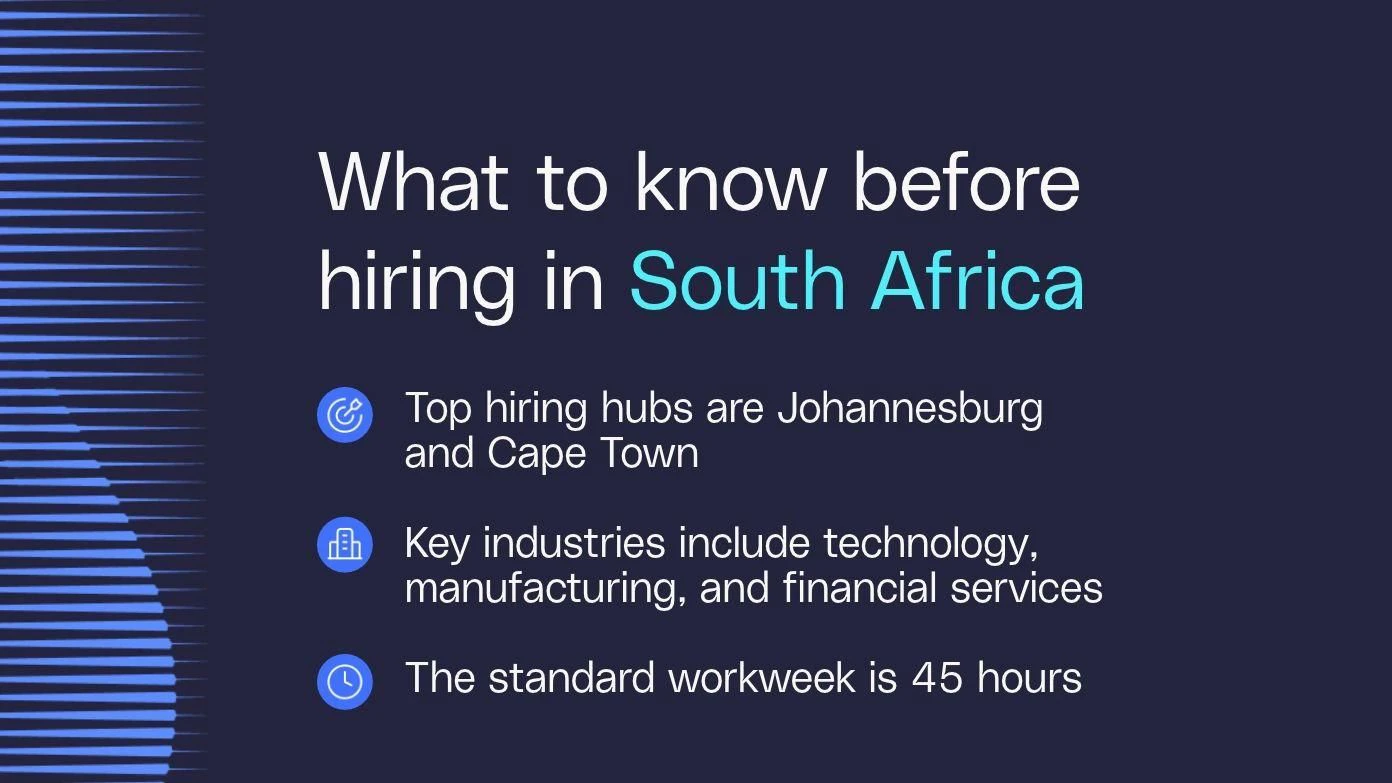
- South Africa’s top hiring hubs are Johannesburg and Cape Town.
- The country’s key industries include technology, manufacturing, and financial services.
- An employer of record (EOR) simplifies expansion: You can hire and pay professionals in South Africa without setting up a local entity, reducing compliance risk and accelerating market entry.
Hiring in South Africa gives you access to a highly skilled workforce in one of Africa’s most established business environments.
But recent employment changes, like updated minimum wage and parental leave entitlements, are impacting the 2026 hiring landscape. Before you enter this market, you’ll need to understand payroll taxes, employee benefits, labor laws, and other employment requirements.
Our guide will tell you everything you need to know about hiring in South Africa.
What to know before hiring in South Africa
South African labor law strongly protects employees. The Basic Conditions of Employment Act (BCEA) sets minimum employment standards across the country.
Here are four key regulations you should know:
1. Wage and working time regulations
Effective March 1, 2026, the national minimum wage is ZAR 30.23 per ordinary hour. Employees who work fewer than four hours must still be paid for four hours. The minimum daily pay is ZAR 120.92 for any day worked.
South Africa's standard workweek is 45 hours. Employees are entitled to 21 days of paid annual leave, 12 paid public holidays, and up to six weeks of paid sick leave.
South Africa doesn't legally require a 13th-month salary. However, many employers provide an end-of-year bonus equal to one month's wages as a common market practice.
2. BCEA earnings threshold
Effective May 1, 2026, the BCEA earnings threshold increased to ZAR 269,600.90 per year. Employees earning above this amount are excluded from automatic overtime protections.
3. Unified parental leave
On Oct. 3, 2025, the Constitutional Court handed down a unanimous ruling allowing both parents to share South Africa's statutory parental leave. This means:
- Employed parents collectively share 4 months and 10 days of unpaid, protected leave.
- A single employed parent gets 4 consecutive months of leave.
Employers need to monitor legislative developments because the ruling granted Parliament 36 months to enact permanent legislation.
4. Language and culture
South Africa recognizes 12 official languages, including South African sign language. While Zulu is the most widely spoken first language, English is the standard language for business communication and employment contracts.
Hiring models for global companies in South Africa
If you’re hiring employees in South Africa, you have several options. The right model depends on your budget, hiring needs, expansion goals, and your company’s ability to manage the local employment requirements.
Here are four hiring models to consider:
- Direct employer registration: Direct employment gives you control over the entire employment process, including recruitment, benefits, taxes, payroll, and other requirements. To hire directly, you will need a local entity to operate as an employer in South Africa. You will also need to complete the required registrations with the local authorities. These include registering with the South African Revenue Service (SARS) for pay-as-you-earn (PAYE) tax and other statutory obligations. Your HR team will also need to manage payroll, benefits, and employment contracts. Direct employment is a good idea if you plan to maintain a long-term business in the country.
- Employer of record: An employer of record lets you hire employees in South Africa without establishing a local entity. With G-P EOR™, you can recruit, hire, onboard, and manage team members quickly. We manage the employment infrastructure so you can focus on your company’s daily work and priorities. G-P EOR supports hiring in 180+ countries and can generate compliant employment contracts in minutes.
- Subsidiary or branch: A subsidiary or branch gives you a formal business presence in South Africa. A subsidiary is a separate entity, while a branch is an extension of your company. Both structures must handle tax obligations and employment requirements. These hiring models are ideal if you plan to have a substantial, long-term presence in South Africa. However, establishing a subsidiary or branch adds time and ongoing costs before and after hiring.
- Independent contractor and misclassification risk: Hiring contractors in South Africa gives you flexibility if you need professionals for project-based work or special assignments. You can hire professionals without setting up a traditional employment relationship. But South African authorities assess the actual working relationship and determine the right classification.
Misclassifying an employee as a contractor exposes your business to penalties. You will also have to pay unpaid taxes, statutory contributions, and employment claims. G-P Contractor™ simplifies this process with classification checks, contractor onboarding, and invoicing. You can manage contractors and pay them in more than 130 countries through one platform.
Top hiring hubs in South Africa
South Africa's mature business environment has attracted major global companies, including BMW, Vodafone, Volkswagen, and General Electric.
The country's hiring activity is concentrated in two major business hubs:
- Johannesburg is South Africa's economic capital. The city is a major center for manufacturing, retail, and business operations. Many multinational companies use Johannesburg as their regional headquarters.
- Cape Town is Africa's leading technology hub. Known as “Silicon Cape,” the city has a thriving startup ecosystem and strong talent pools in software development, IT, financial services, and creative industries. Cape Town also has a well-established financial and insurance services sector.
Key industries in South Africa
Here are some of South Africa's strongest industries for hiring:
- Technology: The technology sector is growing quickly in Johannesburg and Cape Town. Demand is strong for software developers, IT specialists, cybersecurity professionals, and data experts.
- Manufacturing: Manufacturing is a major contributor to South Africa's economy. Global companies including BMW, Volkswagen, and General Electric have a significant presence in the country.
- Financial services: South Africa has one of the most developed financial services sectors in Africa. Major institutions, including Barclays Africa and Standard Bank Group, operate across the country.
- Logistics and mining: Logistics, supply chain, and mining continue to create strong demand for skilled professionals. These industries play an important role in both domestic and international trade.
Paying employees in South Africa
Calculating payroll goes beyond the base salary. Mandatory contributions add to your total employment costs. Make sure to factor in the following obligations:
Unemployment Insurance Fund (UIF)
Employers and employees each pay 1% of the employee's salary to this fund.
For the 2026 cycle, this contribution is capped at a monthly wage of ZAR 17,712.
Skills Development Levy (SDL)
Employers with an annual payroll above ZAR 500,000 must pay a 1% SDL.
Compensation Fund (COIDA)
Employers pay annual assessments based on industry risk and payroll amounts. Rates vary according to industry classification and payroll size.
Effective March 1, 2026, the annual earnings cap is ZAR 668,000 per employee.
The 2026 COIDA Amendment Act replaced criminal prosecution with immediate administrative fines. Report injuries immediately, as late reports may trigger a massive financial penalty. Review the act thoroughly to learn of other changes that might affect you.
Personal income tax
South Africa uses a progressive personal income tax system ranging from 18% to 45%. Employers are responsible for withholding the appropriate amount through payroll.
Key steps to hiring in South Africa
Navigating the hiring process in South Africa is simple when you understand the local requirements.
Here’s what to expect:
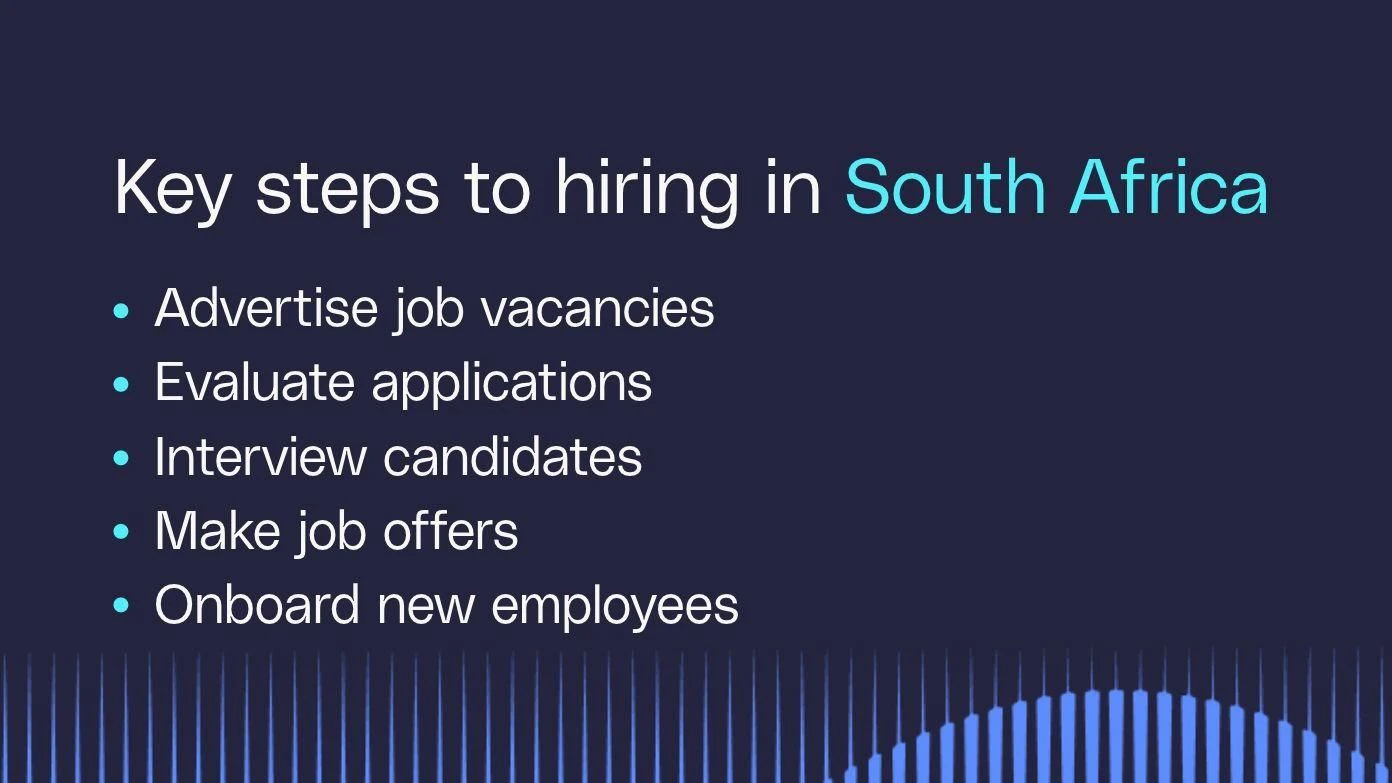
1. Publish job ads
Post job openings in English on popular platforms such as Careerjet and LinkedIn. LinkedIn is widely used by South Africa professionals and remains one of the most effective channels for reaching qualified candidates.
2. Review applications
Evaluate CVs and shortlist candidates. South African CVs often include personal information that may not appear on applications in other countries.
3. Conduct interviews
Virtual interviews are common. Schedule interviews with local time zones in mind to create a smooth candidate experience.
4. Run pre-employment checks
If you have the candidate’s explicit consent, conduct background or reference checks.
5. Make a written offer
Issue a written offer letter, stating all compensation amounts in South African rand (ZAR).
6. Onboard new hires
Provide a written employment contract on or before the employee's first day of work. With G-P EOR, you don’t need to worry about the administrative burden of onboarding. Our platform streamlines the process so you can focus on training and growing your team.
Hiring contractors in South Africa
Hiring independent contractors gives you greater flexibility when entering the market or scaling your team. However, it's important to understand the local worker classification rules first.
Employee vs. contractor classification
South African authorities closely examine working relationships to determine whether a worker is truly independent. The method of examination differs based on your contractor’s salary bracket:
|
Low earners (< ZAR 269,600.90 annually) |
High earners (> ZAR 269,600.90 annually) |
|---|---|
|
Section 200A of the Labour Relations Act (LRA) presumes an employment relationship for professionals if any of seven statutory criteria are present: 1. Their work is controlled or directed. 2. Their working hours are controlled or directed. 3. They form part of your organization. 4. They have worked an average of at least 40 hours per month during the previous three months. 5. They are economically dependent on your business. 6. You provide their tools, equipment, or resources. 7. They work exclusively or primarily for one client. |
For higher earners, courts apply the common law dominant impression test. This test examines the overall working relationship to determine whether someone is truly an independent contractor. No single factor determines the outcome. Courts may consider whether the individual delivers a specific result, works under supervision, or can delegate work to others. |
Penalties for contractor misclassification
Worker misclassification may result in significant financial and legal consequences.
If SARS determines that your contractor should have been classified as an employee, you may be required to:
- Pay outstanding PAYE taxes
- Pay unpaid SDL contributions
- Pay unpaid UIF contributions
- Cover additional penalties and interest
Managing contractors compliantly
Clear contracts and accurate worker classification reduce compliance risk from the start.
G-P Contractor lets you hire and pay contractors with ease. AI-backed classification checks support compliant hiring, while built-in payment capabilities let you pay contractors in more than 130 currencies from a single platform.
Hire employees and contractors in South Africa with G-P
Our Global Employment Platform and its AI-powered products, EOR, Contractor, and Gia, support companies as they build and manage global teams.
G-P is the recognized leader in global employment with more than a decade of experience; the largest team of HR, legal, and compliance experts; and a global proprietary knowledge base.
Make your expansion to South Africa easier with G-P. Contact us or book a demo today.
FAQs
What’s the national minimum wage in South Africa for 2026?
Effective March 1, 2026, the national minimum wage is ZAR 30.23 per ordinary hour. Employees who work fewer than four hours in a day must still be paid for four hours, making the minimum daily pay ZAR 120.92.
What’s the BCEA earnings threshold for 2026?
Effective May 1, 2026, the Basic Conditions of Employment Act (BCEA) earnings threshold is ZAR 269,600.90 per year. Employees earning above this amount are excluded from automatic overtime protections.
How is parental leave structured in South Africa?
South Africa currently follows a unified parental leave framework. Employed parents share four months and 10 days of unpaid, protected leave. A single employed parent receives four consecutive months of leave.
Parliament has not yet made these provisions permanent, so monitor legislative developments.
What are the risks of contractor misclassification?
Misclassifying a contractor can result in significant financial penalties. You may need to pay:
- Outstanding pay-as-you-earn (PAYE) taxes - Outstanding Skills Development Levy (SDL) contributions - Outstanding Unemployment Insurance Fund (UIF) contributions - Additional penalties and interest charged by the South African Revenue Service (SARS)
Do I need a local entity to hire in South Africa?
No. Partnering with G-P lets you hire and pay talent legally without setting up a subsidiary.