





Key takeaways
- Thailand offers talent across several growing industries: Key sectors include manufacturing, automotive, electronics, digital infrastructure, AI, food processing, and petrochemicals.
- Local rules shape every stage of hiring: Thailand has regulations governing contracts, wages, working hours, leave, payroll taxes, social security, and anti-discrimination protections.
- Choose a hiring model that fits your plans: You can hire employees directly through a local entity, work with an EOR, open a subsidiary or branch, or hire independent contractors.
- Contractor classification depends on the working relationship: Structure independent contractor arrangements carefully to reduce the risk of misclassification.
Thailand is one of Southeast Asia’s largest economies, with a GDP of over USD 570 billion in 2025. The country has a long history as a manufacturing and export hub, with strengths in key industries such as automotive, electronics, food processing, petrochemicals, and more. Thailand is also attracting growing investment in digital infrastructure, AI, and advanced manufacturing.
Hiring in Thailand can give your company access to talent across several growing industries. Before you expand your team, you need to understand the complexities of Thai labor law and employment requirements. This guide covers what you need to know about hiring employees and contractors in Thailand.
What to know before hiring in Thailand
Before hiring in Thailand, you need to understand the country's distinct employment laws, payroll rules, benefits requirements, and other applicable regulations. These rules govern everything from employment contracts and working hours to leave and termination.
G-P Gia™ can answer compliance questions for hiring in 50+ countries, including Thailand, and all 50 U.S. states. Gia helps companies like yours save time, reduce administrative overhead, and lower compliance costs by up to 95%.
Here are five things to know about hiring employees in Thailand.
1. Employment contracts in Thailand
Thailand recognizes both written and verbal contracts. When you hire employees in Thailand, use written contracts to clearly document compensation, benefits, responsibilities, and termination terms.
Employment can be indefinite or fixed-term. Fixed-term contracts are suitable for seasonal, temporary, or project-based roles, but strict conditions still apply. These contracts don't automatically exempt your company from severance obligations.
If you choose to offer a probationary period, Thailand doesn't set a maximum period. However, the country does have rules surrounding severance pay. Statutory severance generally applies after 120 days of service.
2. Payroll and taxes in Thailand
Employers in Thailand must withhold personal income tax from employee wages and make statutory social security contributions.
Both the employer and the employee typically contribute 5% of wages to Thailand's Social Security Fund (SSF). As of 2026, contributions apply to monthly wages up to THB 17,500, with a maximum monthly contribution of THB 875 for both parties.
Thailand has progressive personal income tax rates. The highest rate is 35%.
Corporate income tax in Thailand is typically 20% of net profits. Qualifying small and medium-sized enterprises (SMEs) can get lower rates on the first THB 3 million of net profit.
Thailand's Employee Welfare Fund requires covered employers and employees to each contribute 0.25% of wages, starting October 1, 2026. Employees who participate in a qualifying provident fund are excluded.
3. Wages and working hours in Thailand
Thailand's minimum wage varies by location. In some cases, it can also vary based on industry. Current daily rates range from THB 337 to THB 400, depending on the location and, in some cases, the industry. The THB 400 rate applies in Bangkok, several other areas, and certain sectors.
For most roles, Thailand caps working hours at 8 hours per day and 48 hours per week. Thailand typically limits hazardous work to 7 hours per day, 42 hours per week.
Overtime and holiday work are subject to additional limits and premium pay rates. Your company needs to account for these rules when setting schedules and calculating payroll.
4. Time off in Thailand
Workers in Thailand are entitled to at least six working days of paid annual leave after one year of continuous service. Employers need to provide at least 13 paid traditional holidays each year.
The workers you hire in Thailand can take sick leave when needed. Your company needs to pay wages for up to 30 working days per year. Thailand also requires that employees receive at least three paid working days of personal business leave.
Thailand's employment law also provides pregnant employees with up to 120 days of maternity leave, with employers paying wages for up to 60 days. Certain eligible employees can also receive 15 days of paid leave to support a spouse after childbirth.
5. Anti-discrimination law in Thailand
Thailand's workplace protections come from several laws, including the country's Constitution, the Labour Protection Act, the Gender Equality Act, and disability legislation.
The Constitution prohibits discrimination based on factors including:
- Origin
- Race
- Language
- Sex
- Age
- Disability
- Physical or health condition
- Personal status
- Economic or social standing
- Religious belief
- Education
- Political opinion
Thailand's Labour Protection Act also requires equal treatment and equal pay for work of equal value. The Gender Equality Act prohibits unfair gender-based discrimination, while disability legislation protects workers with disabilities. Thai law also protects certain union activities.
When you hire in Thailand, review your hiring, compensation, promotion, and termination practices for compliance with applicable anti-discrimination law.
Hiring models for global companies in Thailand
You have several options for hiring in Thailand. The right model for your company will depend on your overall staffing plans, timeline, and whether you want to establish a local presence.
- Direct employer registration: If your company has a legal entity in Thailand, you can hire employees directly. You'll handle payroll, tax withholding, social security registration, and other employer obligations.
- Employer of record (EOR): G-P EOR lets you hire professionals in Thailand without establishing your own local entity. G-P EOR handles employment administration, including payroll and benefits, so that you can focus on managing your team.
- Subsidiary or branch: You can establish a local subsidiary or branch if you plan to maintain a long-term presence in Thailand. Depending on your company's ownership structure and business activities, you may need approvals under Thailand's foreign business rules.
- Independent contractors: Contractors can support project-based or specialized work. However, the actual working relationship determines worker classification. You need to avoid treating contractors as employees to reduce compliance risks.
Top hiring hubs in Thailand
Various regions in Thailand offer access to different industries and talent pools. Knowing where key sectors cluster can guide your hiring efforts and help you find the right professionals.
The top talent hubs in Thailand are:
- Bangkok is the capital and largest city in Thailand. It's the country's main hub for business, finance, and professional services. Bangkok also generates the country's largest provincial economic output.
- Chiang Mai is a popular destination for digital nomads. It has a growing digital and creative sector, along with tourism, hospitality, education, and service industries.
- Chonburi is a major industrial and logistics hub within Thailand's Eastern Economic Corridor (EEC). Key sectors include automotive manufacturing, electronics, logistics, and technology.
- Phuket is traditionally known for tourism and hospitality, but it also supports a growing digital, creative, and service-sector talent pool.
- Rayong is another major EEC hub. Key industries include automotive, electronics, petrochemicals, clean energy, and advanced manufacturing.
Key industries in Thailand
Thailand has a diverse economy with strong manufacturing and export sectors. Recent investments also show a growing demand for talent in digital infrastructure, advanced electronics, automotive and EV manufacturing, automation, clean energy, and other high-value industries.
The top industries in Thailand include:
- Manufacturing: A major part of Thailand's economy, the manufacturing industry includes sectors like automotive, electronics, machinery, and food processing. Manufacturing employs about 16% of the national labor force.
- Digital and data infrastructure: Thailand is attracting major investment in cloud infrastructure, data centers, AI and other digital services.
- Agriculture and food processing: Thailand is a major food producer and exporter. The country is known for rice, seafood, rubber, sugar, and processed foods.
- Automotive: The country has a long-established automotive manufacturing sector. It's a major hub in Southeast Asia, producing cars and auto parts for export and domestic use. The sector is expanding with electric vehicles and related supply chains.
- Electronics and electrical appliances: Thailand is a large producer of hard drives, semiconductors, and consumer electronics. The country is a major global producer and exporter of air conditioning units and a main exporter of refrigerators, washing machines, and compressors.
- Petrochemicals and chemicals: Thailand has a large petrochemical and chemical industry, with significant activity concentrated in the EEC.
The cost of hiring an employee in Thailand
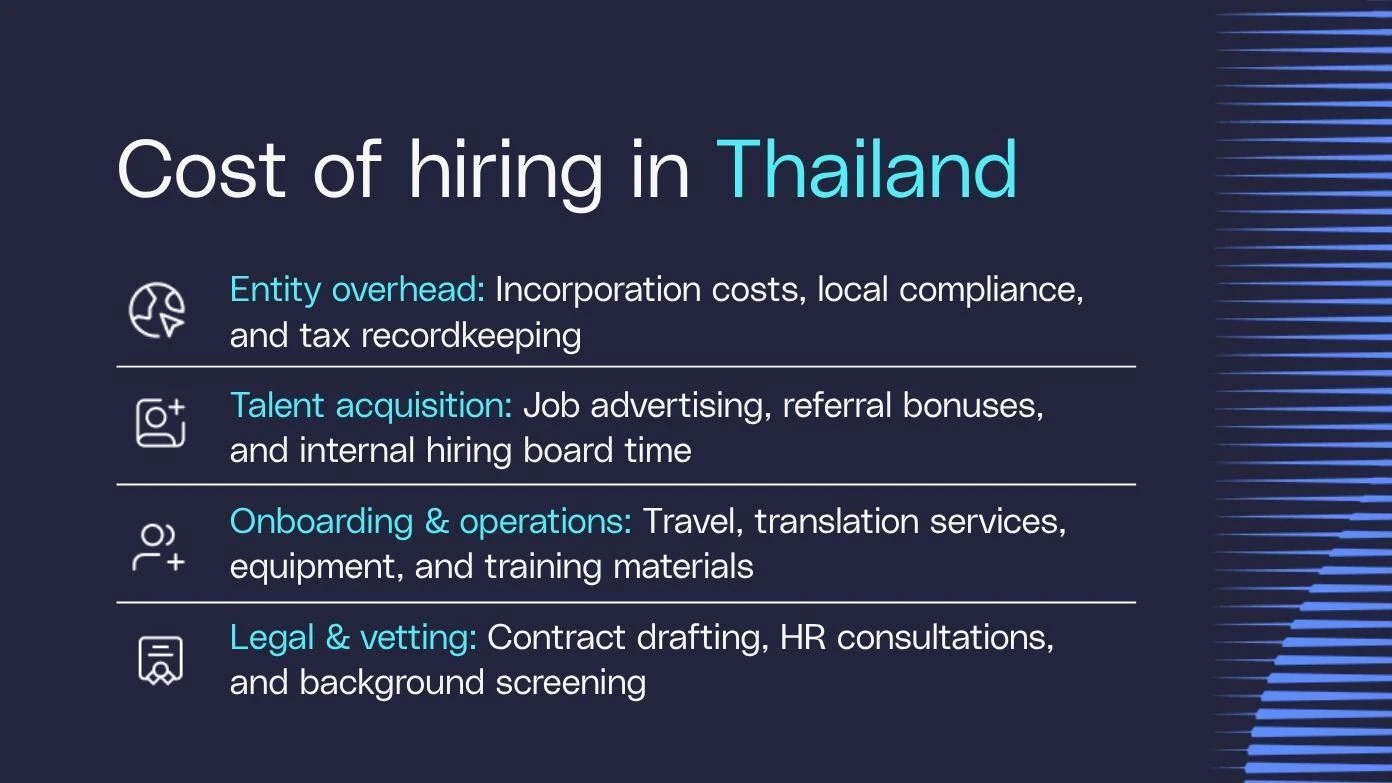
Hiring costs in Thailand depend on your hiring model, team size, and role requirements. Beyond salary, budget for:
- Entity setup (unless you partner with an EOR)
- Job advertising and recruitment
- Referral bonuses
- Interviewing and hiring costs
- Travel and relocation expenses, if applicable
- Translation or legal review
- Background screening
- Employment contracts and HR support
- Equipment and software
- Onboarding and training
- Payroll, tax, and recordkeeping
G-P Verified Sources reports an employer burden rate of about 5.2%–6% on top of salary, excluding accident insurance.
What does a company need to hire employees in Thailand?
If you plan to hire employees in Thailand directly through your own Thai entity, you'll need to complete several compliance and registration steps.
Make sure you:
- Register your company with Thailand's Department of Business Development (DBD).
- Get a tax ID and register for VAT when applicable.
- Open a local bank account.
- Register as an employer with the Social Security Office (SSO) and enroll eligible employees.
- Set up payroll and tax withholding.
- Prepare written work rules if you have 10 or more employees.
- Secure the appropriate work visas and permits for professionals who require authorization to work in Thailand.
Setting up and maintaining a local entity can take time and add considerable administrative overhead. G-P EOR reduces that burden, letting you hire eligible professionals in Thailand without establishing a local presence.
The steps to hiring employees in Thailand
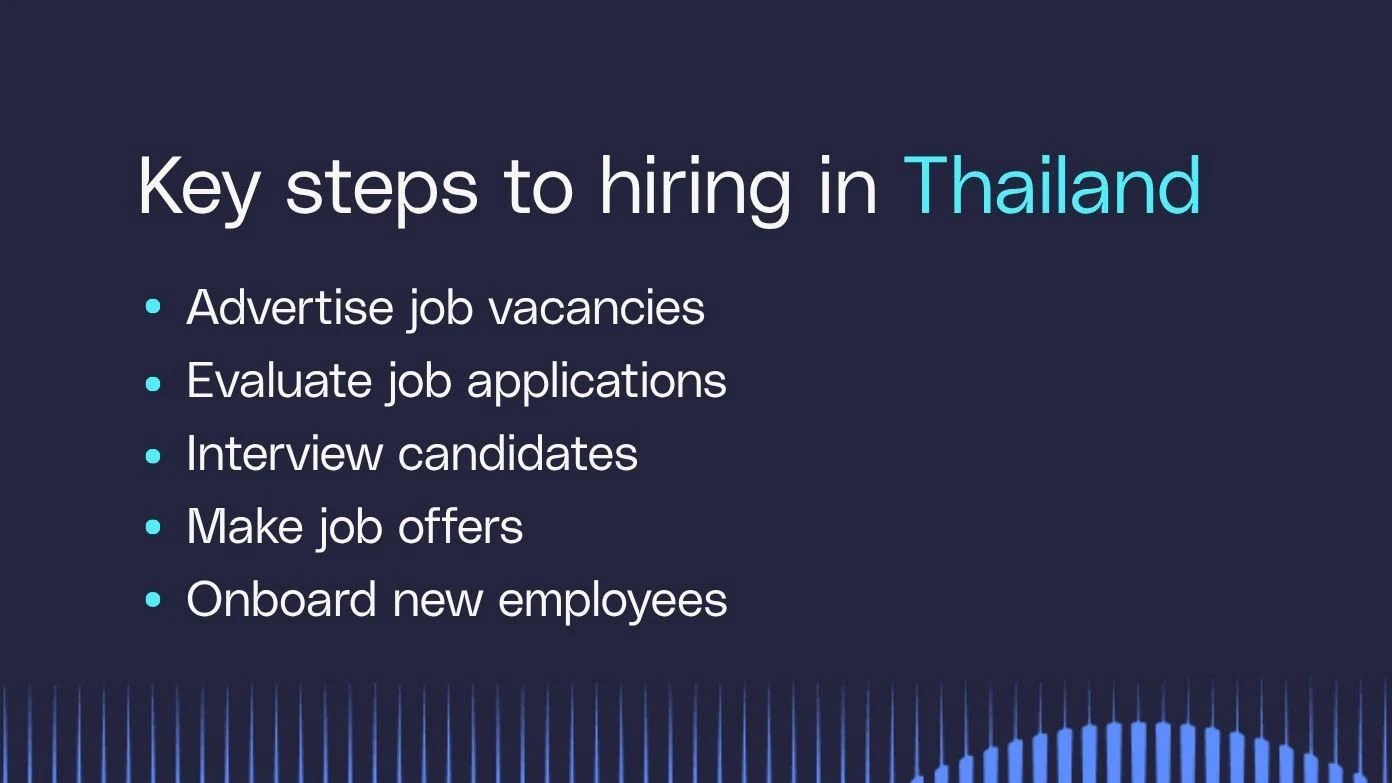
The hiring process in Thailand usually follows five basic steps. They are:
1. Advertise job vacancies in Thailand
Clearly define the role, responsibilities, qualifications, and compensation. Make sure the job description and requirements comply with Thai anti-discrimination laws.
Popular job boards in Thailand include JobThai, JobsDB Thailand, and JobBKK.
2. Evaluate job applications in Thailand
Review CVs and applications to identify candidates who meet the role requirements.
3. Interview candidates in Thailand
Use consistent interview questions to evaluate candidates against the same role-specific criteria. Gia can help you create questions that align with applicable anti-discrimination requirements in Thailand. You can also use skills assessments or practical tests where appropriate.
4. Make job offers in Thailand
Verify a candidate's credentials, employment history, and references as appropriate. If you choose to conduct background checks, ensure the process complies with Thailand's privacy and data protection requirements.
Then issue a formal offer letter that clearly outlines compensation, benefits, working hours, leave, and the intended start date.
5. Onboard new employees in Thailand
When it's time to onboard new employees, register eligible employees with the SSO within the required timeframe. Add them to payroll, set up tax withholding, and complete any other administrative tasks.
If you're using G-P EOR, G-P handles much of the employment administration while you focus on integrating your new team members.
Hiring contractors in Thailand
Independent contractors in Thailand can provide specialized skills for project-based work. They offer specialized skills and can support project-specific work without becoming full-time employees. You can also hire them to adjust your talent strategy based on business needs. However, contractor relationships must reflect the actual working relationship.
1. Employees vs. independent contractors in Thailand
Thai authorities may consider the real working relationship rather than relying only on what's in the contract. Key factors include the degree of control the company has over the worker, integration into the organization, provision of equipment, method of payment, and financial risk.
True independent contractors typically have more autonomy than employees and work toward a defined result. If you treat a contractor more like an employee in practice, authorities can reclassify the relationship.
2. Penalties for misclassification in Thailand
Misclassification creates real risk. If authorities reclassify the relationship, you can face backdated employment liabilities. These can include unpaid social security contributions and related surcharges, tax corrections, and employment benefits or entitlements.
For overdue social security contributions, Thailand can impose an additional charge of 2% per month on the unpaid amount.
3. How to pay contractors in Thailand
G-P Contractor™ helps you create contracts, onboard contractors, and manage cross-border payments on one platform. It takes away the messy, time-consuming process of hiring and paying international contractors while helping you manage contractor compliance.
Hire employees and contractors in Thailand with G-P
Our Global Employment Platform and its AI-powered products, EOR, Contractor, and Gia, enable companies of all sizes to build and manage global teams.
With more than a decade of experience, the largest team of HR, legal, and compliance experts, and a global proprietary knowledge base, G-P is the recognized leader in global employment.
Make your expansion to Thailand easier with G-P. Contact us or book a demo today.
 FAQs
FAQs
What's the minimum wage in Thailand?
Thailand's minimum wage depends on location and industry. It's currently THB 337 to THB 400, with the higher rate applying to areas such as Bangkok and certain sectors.
What are the working hours in Thailand?
For most roles, Thailand caps working hours at 8 hours per day and 48 hours per week. The country sets caps for hazardous work at 7 hours per day and 42 hours per week. Overtime and holiday pay are subject to additional limits and premium pay rates.
How are annual leave and sick leave structured in Thailand?
Professionals in Thailand receive at least six working days of paid annual leave after one year of continuous service. They can also take sick leave whenever needed, with employers covering up to 30 working days per year. Employers can request a medical certificate for absences of three or more consecutive working days.
What do I need to do to offboard an employee in Thailand?
Termination rules depend on the employment arrangement and the reason for termination. If the professional is on an indefinite contract, notice typically follows their wage-payment cycle. Eligible employees can also receive statutory severance based on length of service. Payment for accrued entitlements, such as unused annual leave, may also apply.
What types of employment contracts are recognized in Thailand?
Thailand recognizes indefinite and fixed-term employment contracts. Verbal agreements can be valid, but written contracts clearly document key employment terms. Fixed-term contracts can apply to certain temporary, seasonal, or project-based work, but they don't automatically remove severance obligations.