








Key takeaways
- Access India's pool of skilled talent: The country has a large workforce with skills that are relevant to many sectors, including technology, finance, manufacturing, AI, machine learning, and cloud computing.
- Navigate central and state requirements: There are both central and state-specific rules that affect compensation, benefits, and leave.
- Prepare for India’s labor codes: India has modernized and consolidated 29 existing Central Labor Acts into four labour codes to create a more unified framework for employment requirements.
- Paths to hiring in India: Companies have various options for setup, including partnering with an employer of record (EOR), hiring contractors, establishing a subsidiary, or direct employer registration.
India is one of the most sought-after countries for global companies looking to expand and hire. It boasts a massive workforce across tech, finance, manufacturing, and several other in-demand sectors.
If you're looking to hire in India, there are plenty of opportunities. However, you need to know how to navigate the country's unique laws and guidelines, including local rules for employment contracts, compensation, taxes, benefits, and statutory contributions.
This guide covers everything you need to know about hiring in India, from choosing hiring models to building and managing your team.
What to know before hiring in India
There are several legal requirements you must follow when hiring employees in India. The country's employment framework includes both central and state-level laws that influence the employer-employee relationship. That includes compensation and benefits.
If you’re unsure where to begin, G-P Gia™, our AI-powered global HR agent, can answer your toughest compliance questions across 50 countries — including India — and all 50 U.S. states. Reduce your reliance on outside counsel and cut the time and cost of compliance by up to 95% with Gia.
Let’s take a look at six things to know about hiring in India:
India’s labor codes and 2026 regulatory updates
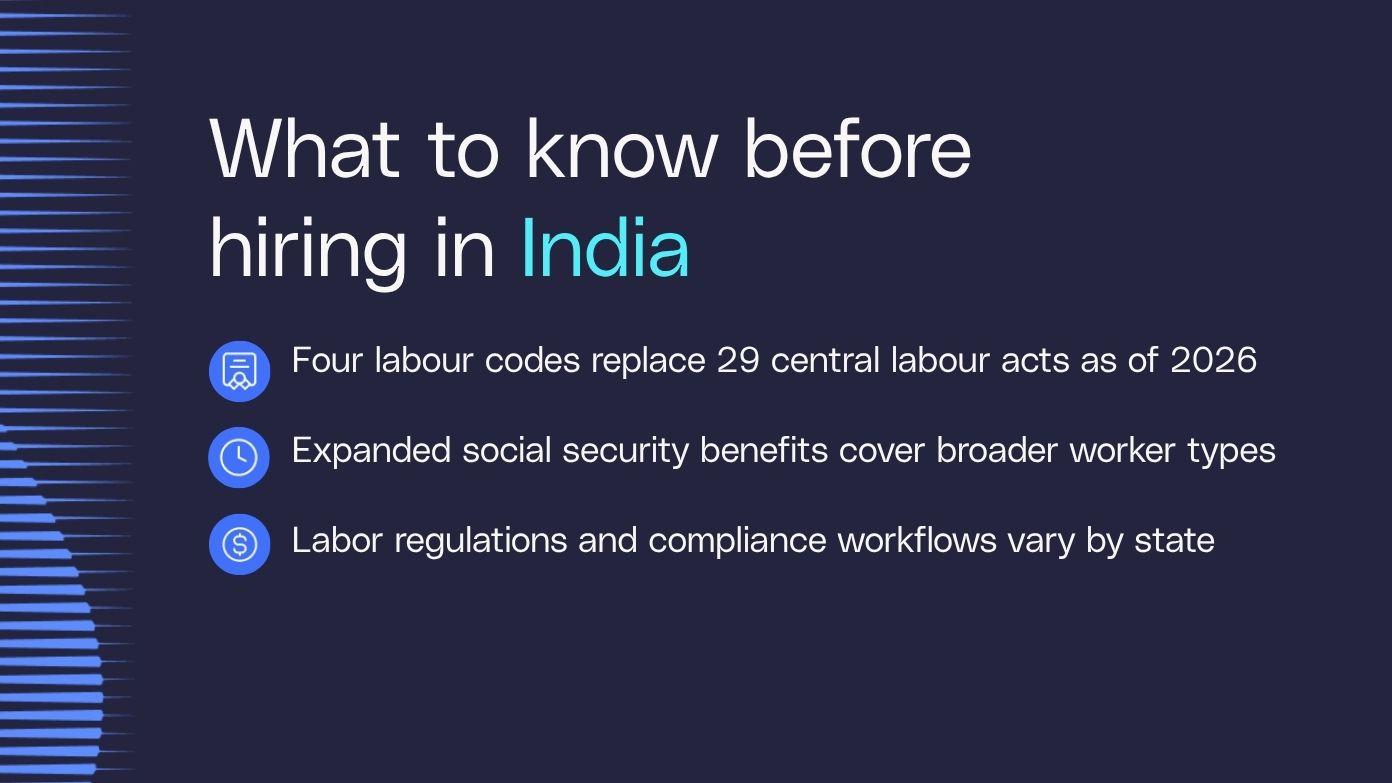
India has undergone a major labor law overhaul. The new labour codes are four comprehensive laws that modernize and consolidate 29 existing Central Labor Acts. Many of the changes make it easier for both local and global businesses to hire in India while extending benefits to new types of workers.
As of 2026, these labor codes are now in force:
- Wages and wage-related compliance: Changes affect how employers define, calculate, and document wages. One of the codes sets rules for minimum wages, timely salary payments, and more, while standardizing the overall definition of wages across India.
- Social security and statutory contributions: Companies that want to hire employees in India must understand the applicable statutory schemes, reporting, and record-keeping requirements. Changes expand social security benefits and cover more types of workers.
- Industrial relations and dispute processes: The code covering industrial relations consolidates rules governing trade unions, staff layoffs, and more. There are new procedures for notices, standing orders, and certain compliance workflows used for employee relations.
- Occupational health and safety: New rules for health checkups and overall safety standards can affect workplace policies, training, and incident reporting.
Applicable rules can vary by state. Consider where your new team will work after you hire in India, and align your work contracts, HR policies, and payroll processes accordingly.
2. India’s tech- and human-focused workforce
India's workforce is large and continuing to grow, and the country is a global powerhouse in technology. Many of the country’s workers have skills in AI, machine learning, cybersecurity, cloud computing, and data analytics. Hiring in India lets you tap into an enormous talent pool of people with specialized, relevant skills.
3. Employee mobility and retention in India
When you hire in India, recruitment is just half the battle. According to an ACCA study from February 2026, roughly half of India-based workers want to move into a new role within the next year. Another study from AON found attrition rates declined to around 16.2%.
Career progression and upskilling are still important to the country's workforce. Job mobility is an opportunity to broaden skills and gain cross-functional exposure. However, for those hiring in India, these studies show that retention should be a top priority when building teams. Competitive compensation, career development, and chances for career advancement can help you attract and retain skilled professionals.
4. Salary packages in India
Negotiating compensation packages is a complex process in India due to the many allowances employees get on top of basic pay. Salary packages can include basic pay, performance-based bonuses, benefits, childcare allowances, and other forms of compensation. Allowances can make up a significant portion of an employee's total compensation package.
The compensation structure you use matters because India's labor codes changed how the country defines wages for statutory calculations. Under the new definition, basic pay, dearness allowance (which is a type of COLA), and retaining allowance form the core wage components. If other allowances exceed 50% of the total remuneration, the excess is added back to wages for new statutory calculations. However, some performance-based incentives, employee stock option benefits, and reimbursement-based payments aren't considered wages.
Make sure to account for these rules when you calculate statutory contributions and benefits. It's also important to consider how taxable allowances and benefits affect an employee’s take-home pay.
5. Taxes and social security contributions in India
India uses two progressive tax systems, meaning tax rates rise as income increases. Employers deduct tax directly from paychecks based on the system each team member selects.For the assessment year 2026-2027, the new system waives tax on income up to INR 4,00,000. The old system maintains a tax-free threshold of INR 2,50,000 for taxpayers under age 60.
The old system keeps the INR 2,50,000 threshold for individuals under the age of 60. While the new regime is the default, eligible workers can choose the old one.
When you hire employees in India, your payroll processes need to account for tax withholding and any applicable statutory contributions. Generally, employers deduct tax at source from taxable salary and remit it to the government.
Another thing to consider is India's social security system. Both the employer and the employee contribute to a retirement savings scheme called the Employees Provident Fund (EPF). The standard contribution rate is 12% of applicable EPF wages. However, that rate is subject to wage ceilings and other rules. The Employees Deposit Linked Insurance scheme also provides life insurance benefits to eligible EPFO members.
When you hire in India, your payroll setup should account for these requirements from the start. Exact rules will vary based on the employee's compensation package. State and central requirements also come into play.
6. Guaranteed employee benefits in India
India doesn’t have a universal list of statutory benefits that applies to all workers. Instead, benefits are determined by federal laws and state-specific legislation. The rules depend on the industry sector and the state where the employee works.
The new labor codes changed how employers approach several areas of employee benefits and social security. Take, for example, annual leave. Under the new labor codes, individuals who worked at least 180 days in a calendar year typically earn one day of leave for every 20 days worked. Eligible workers can carry over up to 30 days of leave, and any leave that has been requested but denied can carry over without that limit. State rules may also provide more favorable benefits.
When you hire employees in India, you also need to consider the country's three national holidays, which are Republic Day, Independence Day, and Mahatma Gandhi's birthday. Bear in mind that state-specific holidays may also apply.
Maternity benefits also deserve extra consideration when you hire in India. C Eligible employees are entitled to 26 weeks of maternity leave for their first two children, and 12 weeks when they have 2+children.
Other statutory benefits can include social security coverage and workplace health and safety protections. However, requirements can vary based on employee wages, the type of establishment they work at, and applicable state-specific rules. Eligible employees may also receive health coverage through India's Employees' State Insurance (ESI) scheme. Many employers also offer private group health insurance to supplement any statutory benefits.
Before hiring and building your team in India, make sure your compensation, benefits, leave, and workplace policies account for all applicable requirements.
Hiring models for global companies in India
Your global company has several ways to onboard workers in India. The right approach will depend on your hiring goals, desired workforce size, business activities, and whether or not you already have an established presence in the country. Here are some of the most common hiring models.
- Direct employer registration: Registering your company with India employment authorities gives you greater control over your local operations. The downside is that you need to handle entity setup and ongoing employment requirements like payroll, benefits, and compliance.
- Employer of record: An employer of record (EOR) lets you hire in India without setting up a local entity. This path offers a simpler market entry, and you can build a team without the costs and time required to establish an entity. G-P EOR supports hiring in India through a global entity infrastructure.
- Subsidiary or branch: Establishing a new subsidiary or branch in India lets you establish a presence in the country to support more long-term operations. It operates as an Indian company, and it is like an extension of your company back home.
Entity requirements, registration, and permitted activities vary based on your business structure and operations.
- Independent contractors: When you need more hiring flexibility, independent contractors are an option worth considering. That said, misclassifying someone as a contractor when they’re actually an employee can create significant financial and compliance problems.
Before choosing this model, review the new hire's role, level of control, and working arrangement. India's legal framework doesn't rely on a universal test to distinguish an independent contractor from an employee, so carefully evaluate the working relationship.
Top hiring hubs in India
India has several major cities where global companies like yours can find specialized talent across many different sectors. Some cities are well-known for specific industries. Knowing what each city has to offer allows you to focus your hiring efforts in the right place.
The top talent hubs in India are:
- Bengaluru (Bangalore) is one of the country’s top hiring hub for technology, IT services, startups, and R&D centers. It has a strong presence in biotechnology, aerospace, and fintech.
- Hyderabad is a major IT and business process outsourcing (BPO) center. Hyderabad is home to many global tech companies, pharmaceutical firms, and a growing startup ecosystem.
- Delhi NCR (National Capital Region) includes Delhi, Gurgaon (Gurugram), and Noida. The NCR is a hiring hub for IT, finance, consulting, e-commerce, manufacturing, and media. It’s also home to many multinational companies.
- Mumbai is the financial capital of India. Mumbai is a center for banking, finance, insurance, media, entertainment, and multinational corporate headquarters.
- Pune has a strong talent base for IT, automotive manufacturing, engineering and research. There are several universities and educational institutions that help contribute to the city’s skilled workforce.
Key industries in India
India has a diverse economy with several established industries and newer fast-growing sectors. When hiring employees in India, understanding the country's top industries allows you to benchmark salaries and benefits. You can use this insight to make smart choices about where to invest and grow your talent pool.
The main industries in India include:
- IT and IT-enabled services: India is a global leader in software development, IT services, business process outsourcing (BPO), and digital transformation.
- Manufacturing: This sector includes automotive, electronics, textiles, chemicals, machinery, and consumer goods. The "Make in India" initiative has boosted this sector in recent years.
- Pharmaceuticals and biotechnology: India is one of the world’s largest producers of generic medicines and has a strong biotechnology and life sciences sector.
- Financial services: This sector includes banking, insurance, fintech, and capital markets, with Mumbai as the financial capital.
- Telecommunications: India has one of the largest telecom markets globally, especially with the fast mobile and internet penetration.
Cost of hiring an employee in India
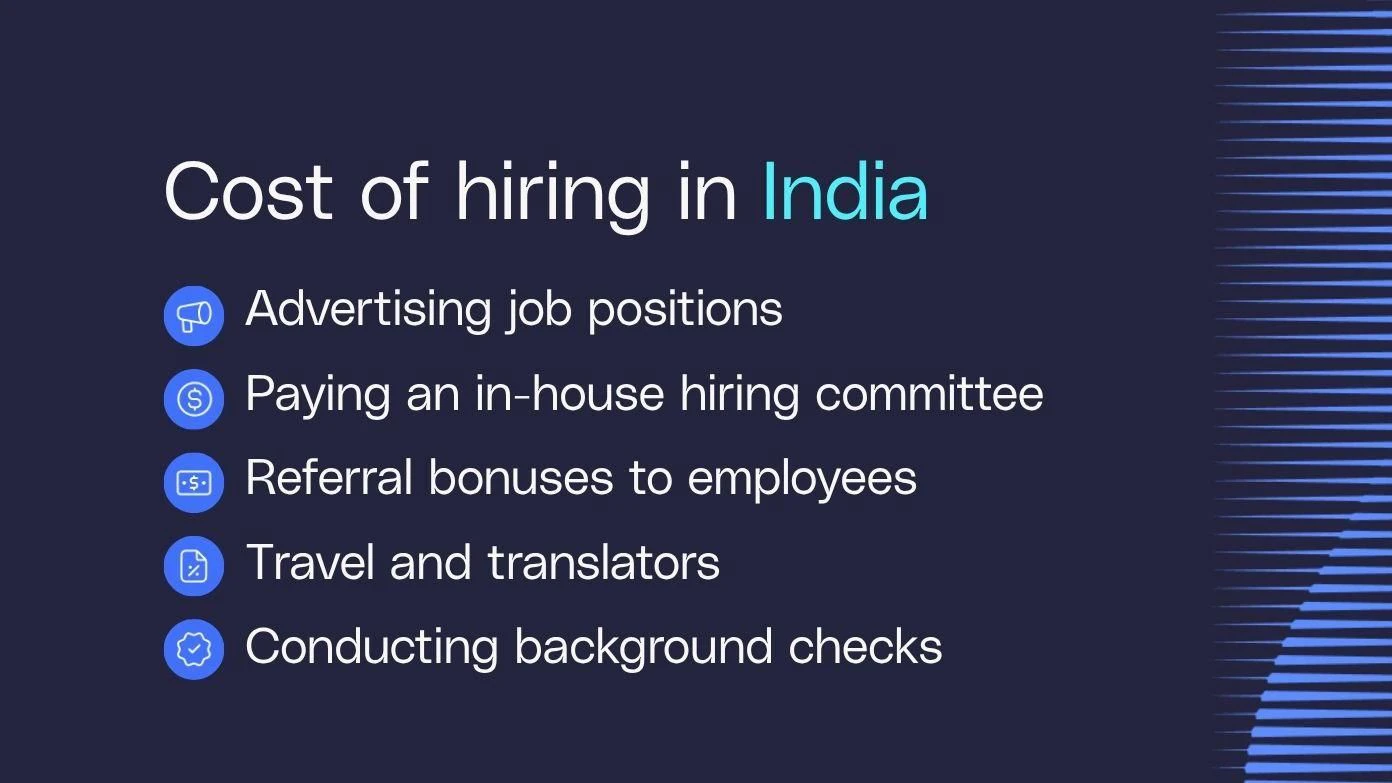
Whether you’re hiring one employee or an entire team, you’ll need to cover several costs. Budget for the following:
- Entity setup (unless you partner with an employer of record)
- Job advertisements
- Recruitment and applicant-review costs
- Payroll
- Taxes
- Salaries
- Benefits
- Bonuses
- Allowances
- Insurance
- Travel
- Translator (if applicable)
You should also account for applicable employer contributions and statutory benefits. These can include contributions to social security programs, provident funds, and more.
According to G-P Verified Sources from Gia, a reasonable statutory burden estimate in India is approximately 7–12% of gross salary, but the actual percentage depends on salary structure, eligibility, and work state.
What does a company need to hire employees in India?
If you plan to establish your own entity to hire employees in India directly, you’ll need to cover several essentials.
- Establish a legal entity.
- Register your company with the Ministry of Corporate Affairs (MCA) through the SPICe+ (Simplified Proforma for Incorporating Company Electronically Plus) portal.
- Get a certificate of incorporation.
- Get a permanent account number (PAN).
- Get a Tax Deduction and Collection Account Number (TAN) to deduct and remit applicable taxes.
- Register for statutory social security schemes, such as those administered by the Employees’ Provident Fund Organisation (EPFO) and Employees’ State Insurance Corporation (ESIC).
- Prepare compliant employment contracts, offer letters, and HR policies in line with India’s labor laws and state-specific requirements.
- Set up a payroll system to calculate salaries, deduct taxes, and remit statutory contributions (EPF, ESI, professional tax, TDS).
Establishing an India subsidiary can take several weeks. With G-P EOR, you can hire full-time employees in India without setting up your own entity. G-P manages employment, payroll, benefits, and local compliance while you manage your team’s day-to-day work.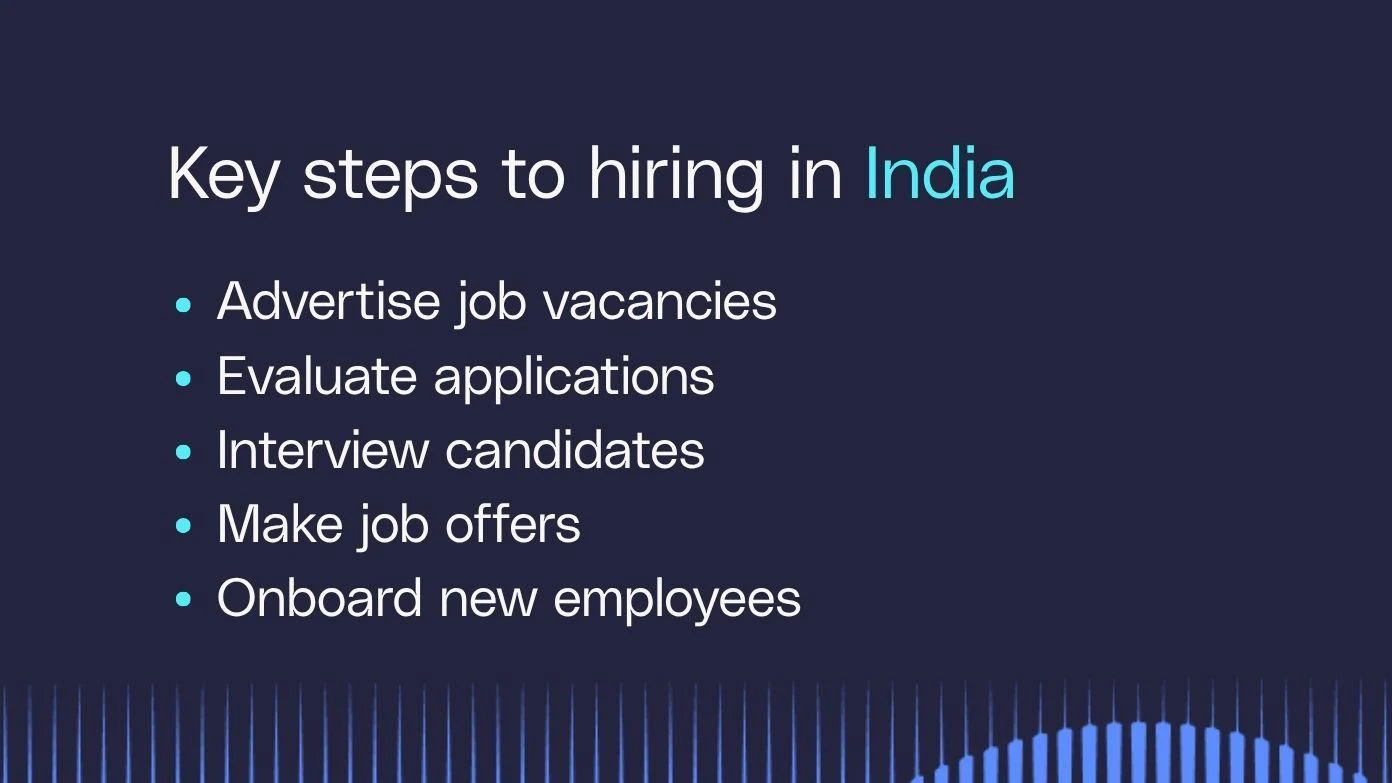
Steps to hiring in India
When you’re ready to hire in India, you can expect a process that’s similar to the one you’re likely familiar with in your own country. There are five basic steps: advertising the job, evaluating applications, interviewing candidates, sending job offers, and onboarding new employees.
1. Advertise job vacancies in India
Create a detailed job description and define the role based on responsibilities and qualifications. Some private-sector establishments with 25 or more employees need to report job vacancies to relevant employment exchanges before filling them. Those requirements form part of India's current social security framework.
Failing to follow notification requirements could lead to penalties and compliance issues. Check any requirements that apply to your company before you post a listing and cover a position.
When it comes to connecting with potential hires, Naukri, LinkedIn, Indeed, and Monster are all popular job sites in India.
2. Evaluating job applications in India
Collect applications and review resumes. Screen candidates based on their qualifications, experience, and fit for the role. Keep screening questions focused on the job at hand and the position's requirements. Avoid potentially discriminatory questions or selection practices.
3. Interviewing candidates in India
Next, interview candidates who make it onto your shortlist. You can conduct interviews in person or virtually from anywhere in the world. Use structured questions that focus on the candidate's qualifications and overall ability to fill the role.
G-P Gia™ can also help you during this process. Use it to create interview questions that align with all applicable employment regulations in India.
4. Making job offers in India
Once you’ve selected a candidate, you can make a formal offer and prepare the appropriate employee documents. You’ll need to reach out, draft an employment agreement, and collect several core documents to officially begin the working relationship.
Documents you’ll need to hire an employee in India
The next step is to collect the right paperwork to set up payroll and statutory enrollment. The types of documents you’ll need, and what you should request from potential hires, can vary based on the role, your company, and applicable regulations.
- Signed offer letter/employment agreement: This document outlines the specific terms of employment. A signed contract should reflect the agreed compensation, benefits, notice period, and other relevant terms.
- Identity and address proof: You’ll need to gather a government-issued ID and proof of current address for several employment and payroll processes. Specific requirements can vary by state and employer.
- PAN and bank details: PAN information is required for taxes and payroll purposes. Bank account information enables salary payments.
- Payroll and statutory enrollment information: These details are necessary for registering the new employee for required schemes, such as EPF and ESI, and to support payroll administration.
- Role-dependent qualifications and work records: If necessary, you can request documents that validate the candidate’s education, professional experience, and any role-specific certifications.
5. Onboarding new employees in India
Now you can onboard new employees. Complete any necessary statutory registrations (EPF, ESI, professional tax, as applicable) and provide induction, company policies, and initial training.
If you’re using G-P EOR, you won’t have to worry about the administrative burden of onboarding. We streamline the process, so you can focus on training the new hire and integrating them into your company culture.
Hiring contractors in India
Working with independent contractors in India can give you greater flexibility when entering the market or hiring talent for project-based work. You can create a presence in India, work with professionals who have specialized skills, and grow your business without the commitment of full-time employees. Contractors based in India may also bring knowledge of local consumer behavior, rules, and business practices.
Hiring contractors gives you the flexibility to easily adjust your workforce based on your business needs. However, contractors aren’t a substitute for employees in every situation. The working relationship must reflect a true independent contractor arrangement under Indian law.
Before you enter an agreement with an independent contractor in India, consider the following:
1. Employees vs. independent contractors in India
It’s important to understand the difference between employees and independent contractors. Employees typically work under an employment relationship. They receive compensation and applicable benefits in exchange for their work. Meanwhile, independent contractors provide services under separate contractual arrangements. They often have greater independence in how they perform their work.
The distinction matters. Misclassifying a contractor like an employee can create significant compliance and financial risks for your business.
2. How to pay contractors in India
G-P Contractor™ takes away the messy, time-consuming process of hiring and paying international contractors. You can create and issue contracts and pay contractors with just a few clicks, all while supporting a compliant contractor management process.
Hire employees and contractors in India with G-P
Hiring employees in India doesn't have to be difficult. While there are unique rules and legal requirements to navigate, we can help you tap into a massive pool of talented professionals with confidence.
Our Global Employment Platform and its AI-powered products, EOR, Contractor, and Gia, enable companies of all sizes to build and manage global teams.
G-P is the recognized leader in global employment with more than a decade of experience, the largest team of HR, legal, and compliance experts, and a global proprietary knowledge base.
Make your expansion to India easier with G-P. Contact us or book a demo today.
Frequently asked questions (FAQs)
What are the main employer obligations in India?
As a new employer hiring in India, you have to meet applicable requirements for employment contracts, wages, taxes, social security, benefits, and workplace conditions. You may also need to register for and comply with requirements such as the Employees' Provident Fund (EPF), Employees' State Insurance (ESI), Professional Tax (in applicable states), and the Shops and Establishments Act (or the Factories Act for manufacturing).
What are the standard working hours and overtime rules in India?
The standard under India's Occupational Safety, Health, and Working Conditions Code is eight hours per day and 48 hours per week. Some arrangements can permit longer daily hours, but employment needs to meet certain conditions. Generally, overtime is twice the normal wage rate.
What documents do you need to hire an employee in India?
Common documentation includes an employment agreement, identity and address information, PAN and bank details, statutory enrollment information, and role-specific qualifications or work records. Exact document requirements vary based on the employee, establishment, role, and applicable regulations.
Is health insurance mandatory for employees in India?
Employees can become eligible for medical coverage and other social insurance benefits through India's Employees' State Insurance (ESI) scheme. However, many companies also offer private group health insurance as a supplemental benefit.
What's the notice period for terminations in India?
Notice periods in India depend on the employment contract, the employee's role, applicable labor laws, and state-specific requirements. They are generally 30 days, but you need to review the employment terms and regulations that apply to your company before terminating an employee.
What are the rules for probation periods in India?
There's no universal probation period length in India. The employment contract usually sets the terms.