
Key takeaways
- Traditional entity setup can take 3–6 months, especially if you’re forming a subsidiary in every country.
- Using an EOR can help you scale quickly and compliantly, without the hassle of entity setup.
- G-P EOR allows you to bypass entity setup and offload payroll, benefits, and other HR administrative duties.
There are infinite opportunities for growth when expanding your business internationally. However, setting up entities in every country can take months, requiring extensive upfront funding and delaying your time to market.
An employer of record (EOR) can help you expand into new markets quickly and compliantly, with the flexibility to exit easily if needed. Read more to understand exactly how an EOR can support your global expansion.
How long does traditional entity setup take?
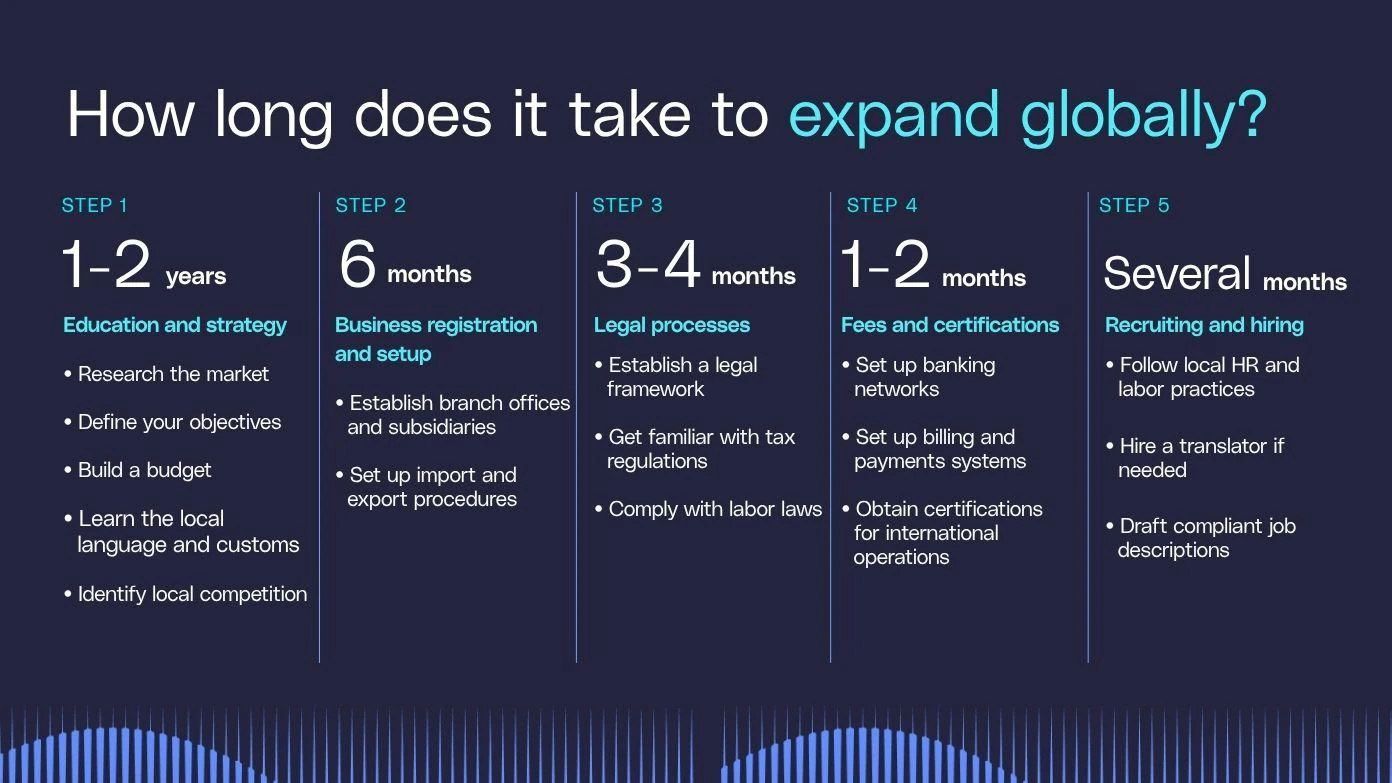
Once market research is complete, traditional entity setup can take 3–6 months. You’ll be responsible for entity registration, tax filings, banking setup, and hiring new talent. Various legal approvals are also required throughout the process, which can cause additional delays.
This chart breaks down the major phases of establishing an owned entity:
|
Phase |
Length |
Tasks |
Common blockers |
|---|---|---|---|
|
Market research and strategy validation |
12-24 months |
Researching product-market fit, competitors, local consumer behavior, and projected earnings |
Unclear business models or unresolved |
|
Legal entity registration and setup |
3-6 months |
Drafting corporate charters, notarizing company bylaws, securing name approvals, and hiring local agents |
Missing data and legal processing delays |
|
Statutory tax and labor law compliance |
2-4 months |
Registering for national revenue codes, direct corporate tax, indirect levies (VAT/GST), and drafting compliant employment contracts |
Agency rules, portal access, and requirements for representatives |
|
Banking infrastructure and local licensing |
1-3 months |
Navigating Know-Your- Customer (KYC) protocols, depositing funds, and securing permits |
Insurance underwriting, payroll setup, and consultations |
|
Recruitment and onboarding |
2-6 months |
Managing recruitment channels, benefits providers, statutory notice periods, and local payroll enrollments |
Background check rules and delays with candidate documents |
Comparing global market-entry timelines
Expanding your business internationally can look very different from one country to the next. Standard time to market can vary greatly due to each country’s setup regulations and approval processes.
For example, Anti-Money Laundering (AML) and Ultimate Beneficial Owner (UBO) reviews can create 4–12 week delays in the U.S., Canada, and the EU. In other locations, strict banking regulations are the most significant blocker. It’s also important to be careful with certain workarounds, as they may trigger permanent establishment (PE), which can require back taxes and penalties.
Keep in mind that incorporating a legal entity, which can take under 48 hours in some countries, doesn’t mean that your business is ready to operate. Depending on where you’re expanding, local payroll setup, clearing bank compliance, and tax registrations can add months to your go-to-market readiness.
Country breakdown
This chart breaks down how long it takes to scale to these major markets:
|
Country |
Nominal filing time |
Operational readiness time |
Potential blocker |
|---|---|---|---|
|
United Kingdom |
24–48 hours |
8–10 weeks |
Bank-related Know Your Customer (KYC) protocols |
|
Singapore |
1–2 days |
6–9 weeks |
Local resident director requirement |
|
United States |
3–7 business days |
8–16 weeks |
IRS EIN delays for non-US owners |
|
Germany |
1–2 weeks |
12–14 weeks |
Notary backlogs and paid-in share capital (EUR 25,000) |
|
India |
2–3 weeks |
16–24 weeks |
RBI foreign exchange clearances and multi-state tax setups |
|
Brazil |
3–5 weeks |
36–48 weeks |
Layered legal registrations and resident representative mandates |
How an EOR can help you expand internationally quickly
An agentic Global Employment Platform with built-in EOR can help your business get up and running in a new market in minutes, not months. An EOR removes the administrative guesswork, and minimizes legal liability and compliance risk. Most EORs work on a per-employee fee structure, which reduces the initial startup cost when expanding globally.
An EOR, such as G-P EOR, manages contracts, payroll, benefits, and labor compliance, while you direct day-to-day operations. With this option, there’s no need to open an international subsidiary or worry about municipal tax filings.
Our platform is powered by a Global Compliance Engine that digitizes and applies local labor laws across 180+ countries in real time. It acts as a compliance shield and validates every employment action — from contracts and onboarding to payroll and benefits — against the most current local requirements.
Ecolex Group, a global life sciences company, used G-P EOR to support their global expansion. This partnership gave them the flexibility to scale on their terms, all while maintaining international compliance.
Going to an EOR is definitely the best choice at a company’s early growth stage. As your business scales, hiring via an EOR means you can continue to grow seamlessly until reaching the critical mass that justifies setting up a legal entity.”
Read the full case study here.
When to choose an EOR vs. an owned entity
Choosing between an EOR and an owned subsidiary depends on headcount, urgency, and upfront costs. Delayed market entry can result in revenue loss, and your HR and finance teams may not have the knowledge or capacity to manage cross-border compliance as seamlessly as an EOR. This table can help you decide which option is better for you:
|
Direct subsidiary |
Employer of record |
|
|---|---|---|
|
Time to market |
3-6 months* |
48-72 hours |
|
Funds needed upfront |
Set-up fees are higher, as your business is responsible for everything from incorporation expenses to benefits setup. |
Set-up fees are lower, but you may need to provide advanced funding for payroll, taxes, benefits, insurance, etc. |
|
Bank account needed? |
Yes |
No |
|
Exit flexibility |
Slower and more expensive |
Quick and easy |
|
Compliance responsibility |
You’re legally responsible for any issues with payroll, taxes, benefits, etc. |
The EOR is the legal employer while you’re responsible for day-to-day management of your team. |
* Estimates can vary by country and specific circumstances.
Team size is another important consideration when deciding between EOR and direct entity setup. An EOR is often the quickest and most cost-effective solution when employing up to 25 people. Establishing an owned entity may make more financial sense when employing over 25 people.
Another powerful strategy for expanding internationally is to use a three-phase, hybrid approach. That way, you can get started with an EOR while working to establish an owned entity at the same time. The phases are as follows:
- Phase 1 (Months 1–6): Test market fit with contractors.
- Phase 2 (Months 6–18): Evaluate revenue opportunities without financial commitment. An EOR also gives you the option to hire in days and quickly exit a market if the results aren’t as expected.
- Phase 3 (Months 18–24): If your scale has increased, you may want to transition to an owned subsidiary. If not, you can continue to work with your EOR.
Scale globally with G-P
Our Global Employment Platform and its AI-powered products, EOR, Contractor, and Gia, support companies as they build and manage global teams in 180+ countries.
G-P is the recognized leader in global employment with more than a decade of experience; the largest team of HR, legal, and compliance experts; and a global proprietary knowledge base.
Make your global expansion easier with G-P. Contact us or book a demo today.
How long does international expansion take when forming a subsidiary?
Establishing an international subsidiary usually takes 3-6 months, depending on the country. The process includes market research, legal entity incorporation, tax registrations, banking setup, and onboarding new talent.
What’s the fastest way to expand a business globally?
Using an employer of record (EOR) is the fastest path to global expansion. An EOR acts as the legal employer, so you can hire quickly and compliantly without an entity.
What are common delays when setting up a subsidiary?
Corporate banking approvals, anti-money laundering (AML), and Know-Your-Customer (KYC) clearances can all take 4–12 weeks. Commercial registries and administrative issues with taxes can also cause delays.
Can I hire international contractors while waiting for subsidiary incorporation?
Hiring contractors before a subsidiary has been fully incorporated can help you stay agile, but it also has risks. There can be issues with worker misclassification or permanent establishment (PE) if the worker performs core company duties, such as negotiating business contracts.
When should I transition from an EOR to a subsidiary?
Consider setting up an entity if you have 25 or more full-time workers in a specific country.