
Key takeaways
- In-kind benefits are non-cash perks. Examples include employer-provided healthcare, transportation, housing, meals, and professional development.
- Benefits requirements and tax treatment vary across countries. Perks that are optional in one market may be mandatory in another, while tax exemptions and payroll obligations depend on local regulations.
- In-kind benefits strengthen your global hiring strategy. Qualifying benefits may offer tax advantages, address local workforce needs, and help you attract and retain talent across international markets.
- A localized approach simplifies global benefits administration. Use G-P EOR to manage benefits and payroll requirements for team members in 180+ countries without establishing local entities.
In-kind benefits are another way for you to strengthen your global compensation strategy. From health insurance and transportation to housing and meal vouchers, these non-cash perks can provide tax advantages, help meet local benefits requirements, and solidify your reputation as an employer.
However, benefits in kind aren't treated equally across borders. With the right knowledge of local regulations and tax rules, you can build competitive, compliant benefits packages that meet the needs of your global team.
Benefits in kind explained: How non-cash compensation works
In-kind benefits, also known as benefits in kind (BIK) or fringe benefits, are non-cash goods, services, or perks that employers provide in addition to regular salaries. Although employees don't receive direct cash payments, these benefits still have economic value. Tax authorities may use fair market value or prescribed formulas to determine their taxable value.
Cash bonuses and allowances generally count as taxable income and may trigger payroll contributions. By contrast, certain BIK qualify for tax exemptions or preferential treatment under local laws.
Some of the most common types of in-kind benefits include:
- Transportation: Company vehicles, public transit passes, and bicycles
- Healthcare: Private medical insurance, supplemental dental coverage, and wellness programs
- Professional development: Training courses, certifications, and educational assistance
- Housing: Employer-provided accommodations and relocation support
- Meals: Subsidized meals, grocery vouchers, and prepaid meal cards
An employer-paid transit pass, for example, may qualify for more favorable tax treatment in one market but be treated as taxable income in another.
Mandatory baselines versus supplemental perks across borders
Benefits that help attract top talent in one country may be a statutory requirement in another. This is why it's important to understand employment rules in every market you enter. Doing so helps your company meet country-specific obligations and identify opportunities to offer competitive supplemental benefits that meet local expectations.
Here's a quick look at how requirements vary across international markets:
|
Benefit category |
Country comparisons |
|---|---|
|
Healthcare |
Private medical insurance is generally supplemental in the U.K. and Canada. Meanwhile, employers in Dubai and Abu Dhabi must provide qualifying health insurance coverage. |
|
Parental and family leave |
The U.S. has no universal federal paid parental leave requirement. However, countries like Bulgaria, Japan, and Slovenia provide extensive statutory family leave requirements. |
|
Professional development |
Tuition assistance is generally discretionary in the U.S. In contrast, France requires employers to contribute toward vocational training through a statutory payroll contribution. |
|
Transportation |
Employer-funded parking is typically optional in North American countries. In France, employers need to reimburse at least 50% of qualifying public transit subscriptions. |
|
Meals and nutrition |
Office meals are often discretionary in many countries. Mexico regulates qualifying grocery voucher programs, while Brazil’s PAT establishes rules for participating employers. |
Not all statutory employment benefits qualify as benefits in kind. However, distinguishing between mandatory obligations and optional perks is vital to building locally appropriate compensation packages that meet compliance requirements.
Benefit-in-kind advantages for international hiring
In-kind benefits strengthen your compensation strategy while addressing the needs of a diverse global workforce. Three key benefit-in-kind advantages stand out for international employers.
Tax-efficient compensation
Cash salary increases generally affect taxable compensation and associated payroll contributions. However, certain non-cash benefits qualify for exemptions or preferential treatment under local laws.
For example, qualifying meal vouchers or transportation benefits may deliver greater post-tax value than an equivalent cash allowance. The result can be more valuable rewards for your team without a comparable increase in compensation costs.
Protection against local cost pressures
Inflation and currency fluctuations affect living expenses differently across markets. Employer-sponsored healthcare, housing, and transportation programs can give your team members more predictable access to essential services.
Negotiating group rates can also help reduce individual expenses, although actual savings depend on local pricing and program arrangements.
Attracting talent across career stages
Professionals at different stages of their careers have different priorities. Tailoring your benefits packages helps you appeal to a broader talent pool.
- Early-career professionals: Remote work equipment, professional development programs, and commuter subsidies
- Mid-career professionals: Childcare support, dependent healthcare coverage, and meal vouchers
- Senior executives: Supplemental retirement benefits, company vehicles, and corporate housing
Offering locally relevant benefits shows you understand your team's needs, strengthens your employer reputation, and supports retention across international markets.
Cross-border tax valuation and payroll compliance
The country and type of benefit determine how your company values and reports in-kind benefits. Accurate tax calculations and payroll reporting depend on applying the right rules in each country.
How employers calculate taxable benefit values
Common valuation approaches include:
- Fair market value (FMV): The market price or actual cost of a benefit, adjusted for any employee contributions under applicable rules
- Statutory formulas: Prescribed valuation methods for benefits such as company vehicles, housing, and fuel, which may differ from the benefit's actual cost.
The resulting taxable value determines how the benefit enters payroll calculations and reporting.
How tax gross-ups work
A tax gross-up increases gross compensation to offset taxes, preserving an agreed net benefit for the employee.
For instance, if you want a team member to receive GBP 500 after a hypothetical 20% income tax deduction, you'd pay GBP 625 before tax. Actual calculations also need to account for applicable payroll contributions and other deductions.
How benefits in kind are taxed in different countries
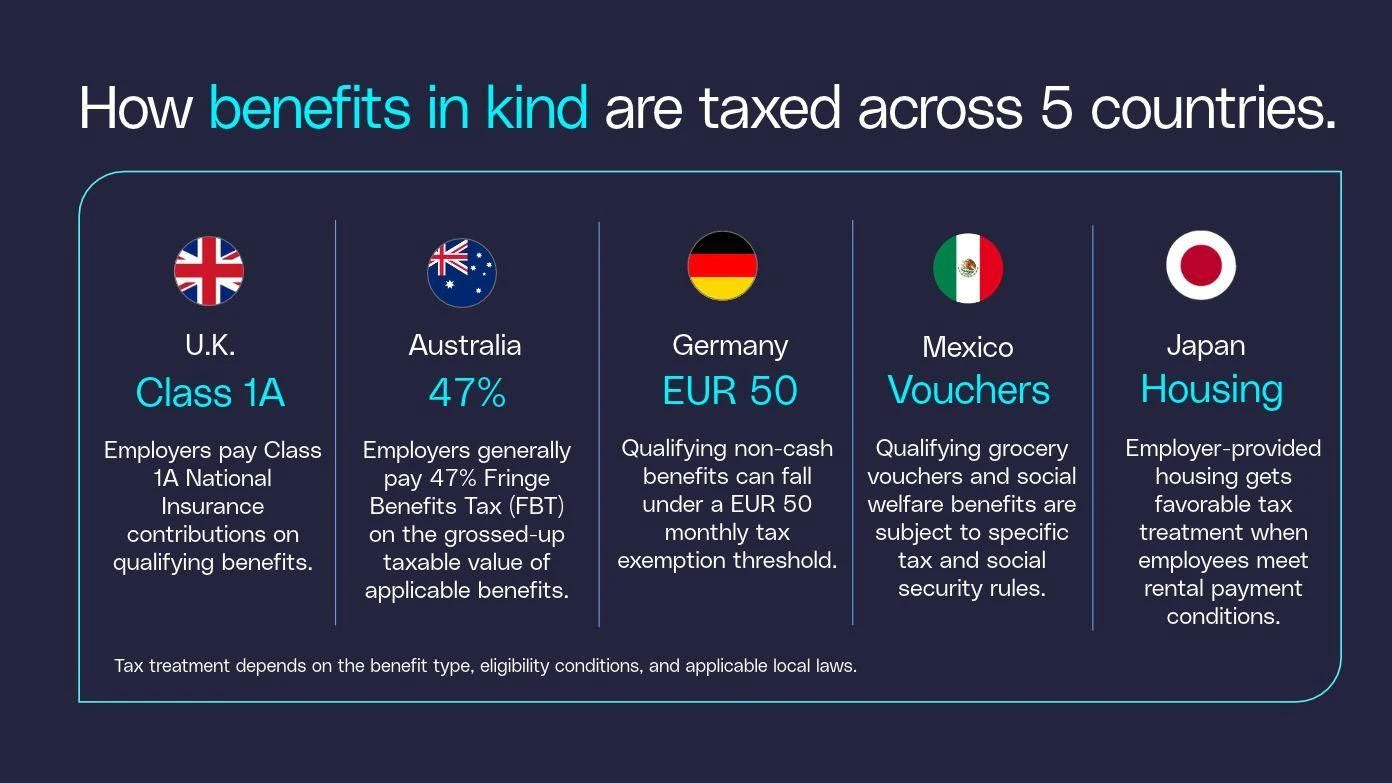
Tax obligations vary widely across international markets. Here’s how five countries approach the taxation of benefits in kind:
- United Kingdom: Employees typically pay income tax on taxable benefits, collected through PAYE or tax-code adjustments. Meanwhile, employers pay Class 1A National Insurance contributions on qualifying benefits. HMRC will introduce mandatory real-time payrolling for company vehicles, associated fuel, and medical benefits in April 2027, extending it to most remaining benefits in April 2028.
- Australia: Employers usually pay Fringe Benefits Tax (FBT) at 47% on the grossed-up taxable value of applicable benefits. The Australian Taxation Office uses two statutory gross-up factors: 2.0802 for Type 1 benefits and 1.8868 for Type 2 benefits, depending on eligibility for GST credits. These factors calculate the employer’s FBT liability, rather than increasing an employee’s take-home pay.
- Germany: Qualifying non-cash benefits can fall under a EUR 50 monthly exemption threshold (Sachbezugsfreigrenze) under Section 8(2) of the Income Tax Act. Exceeding this threshold generally makes the full qualifying benefit amount taxable.
- Mexico: Certain social welfare benefits (previsión social), including qualifying grocery vouchers (vales de despensa), receive specific tax treatment. Employers need to comply with SAT requirements for authorized electronic vouchers and assess applicable Mexican Social Security Institute (IMSS) contribution rules.
- Japan: Under the shataku company housing system, employer-provided accommodation can receive favorable income tax treatment. Employees typically avoid taxation on the housing benefit when they pay at least 50% of the officially calculated rental equivalent. However, the applicable calculation and conditions depend on the housing arrangement, and special rules apply to certain categories of workers.
How to deliver in-kind benefits to global teams
Offering in-kind benefits across multiple countries isn't as easy as adding perks to your compensation package. You also need a reliable way to deliver them while meeting local tax and employment requirements.
Cash stipends may seem convenient, but unrestricted allowances can trigger income taxes and additional social security contributions. They may also fail to satisfy the requirements for benefits that must be provided through approved programs or specific arrangements.
Establishing local entities gives you direct control over the administration of in-kind benefits. However, entity setup can take months and cost approximately USD 75,000 up-front plus ongoing legal and administrative expenses.
An employer of record (EOR) is an alternative worth exploring. With G-P EOR, you can hire, onboard, and manage team members in 180+ countries without establishing local entities.
As the legal employer, G-P administers locally appropriate benefits, manages payroll withholdings, and addresses applicable tax and employment requirements, so you don’t have to.
An EOR can also support compliant employment arrangements, although permanent establishment (PE) exposure depends on your company's activities and local tax laws.
How to build a compliant global in-kind benefits policy
A consistent global benefits policy helps you manage costs, meet varying local requirements, and deliver a competitive compensation package across markets. Follow these four steps to build an effective approach.
1. Audit local benefit requirements
Review statutory benefits, employment regulations, and applicable collective bargaining agreements in every country where you hire. Separate mandatory entitlements from optional perks that can differentiate your compensation packages. Consider local workforce expectations when choosing in-kind or supplemental benefits.
2. Establish tax and gross-up policies
Determine how each benefit is valued, taxed, and reported through payroll. Identify which benefits qualify for tax exemptions and when your company will provide gross-up payments to preserve employees' agreed-upon take-home pay. Document these decisions to promote consistency across all jurisdictions.
3. Choose compliant benefits delivery methods
Review existing cash allowances and determine whether vouchers, corporate accounts, or directly provided benefits offer better tax treatment. Some jurisdictions impose specific conditions on qualifying non-cash benefits, while others permit tax-advantaged reimbursements. Choose delivery methods that meet local requirements.
4. Centralize multi-country administration
Use a Global Employment Platform to coordinate benefits, payroll reporting, and country-specific requirements. G-P's Global Employment Platform supports centralized workforce management, so you can scale your global team anywhere with ease.
Regularly review your policies as local regulations and workforce needs change.
Build a competitive total rewards package
As your company expands internationally, the in-kind benefits you offer are just as important as the salaries you pay. When tailored to local requirements and workforce expectations, these benefits can help you attract talent, manage compensation costs, and create a more rewarding employee experience.
G-P EOR brings localized benefits, payroll, and employment support together to simplify global employment.
Give your global team benefits that reflect where they live and work. Book a demo to see how G-P EOR can help.

Frequently asked questions (FAQs)
What are in-kind benefits?
In-kind benefits are non-cash goods, services, or perks employers provide in addition to regular salaries. Common examples include private health insurance, company vehicles, subsidized housing, meal vouchers, and professional development programs.
Are benefits in kind taxable?
Many benefits in kind are taxable, but treatment varies by country and benefit type. Some qualify for exemptions, reduced valuations, or preferential tax treatment under local regulations.
What is the difference between a cash stipend and an in-kind benefit?
A cash stipend is a monetary allowance paid directly to a worker. An in-kind benefit provides goods, services, or access to specific programs instead. Depending on local laws, qualifying non-cash benefits may receive more favorable tax treatment than equivalent cash allowances.
Who pays the tax on benefits in kind?
Tax responsibilities depend on local regulations. In countries such as the U.K. and Germany, workers may owe income tax, while employers pay applicable social contributions. Australia generally imposes a separate Fringe Benefits Tax (FBT) on employers.
How does an employer of record manage global in-kind benefits?
An employer of record (EOR), such as G-P EOR, acts as the legal employer for international team members. It helps administer locally appropriate benefits, calculate taxable values, manage payroll deductions, and support compliance with applicable employment requirements.