



Key takeaways
- Identify issues early: The best way to strengthen your global HR risk management is to identify potential problems as early as possible using regular audits, compliance reviews, and workforce assessments.
- Choose a scalable infrastructure: Evaluate the differences between an employer of record and a foreign direct entity setup to see which structure best fits your expansion strategy.
- Use AI strategically: Use G-P Gia™ for guidance on global employment and compliance. Gia can also assist with HR document creation, contract reviews, and compliance modifications.
A global presence gives you more business opportunities and access to a broad talent pool. But it also brings more HR risks.
A global HR risk management plan is your company's blueprint for smooth global operations. It ensures the right people, processes, and policies are in place to address risks before they escalate.
What is risk management in global HR?
Risk management in HR involves identifying, assessing, and mitigating risks related to employees and the workplace. For global companies, risk management starts with evaluating each country's labor market, employee expectations, and compliance laws. Company-wide and location-specific risk management plans help you stay compliant across all areas.
Why global HR risk management matters
HR risk management strategies allow you to identify the warning signs and act on them to protect your reputation and finances. Read the expert advice from a G-P employment lawyer.
Types of risks in global HR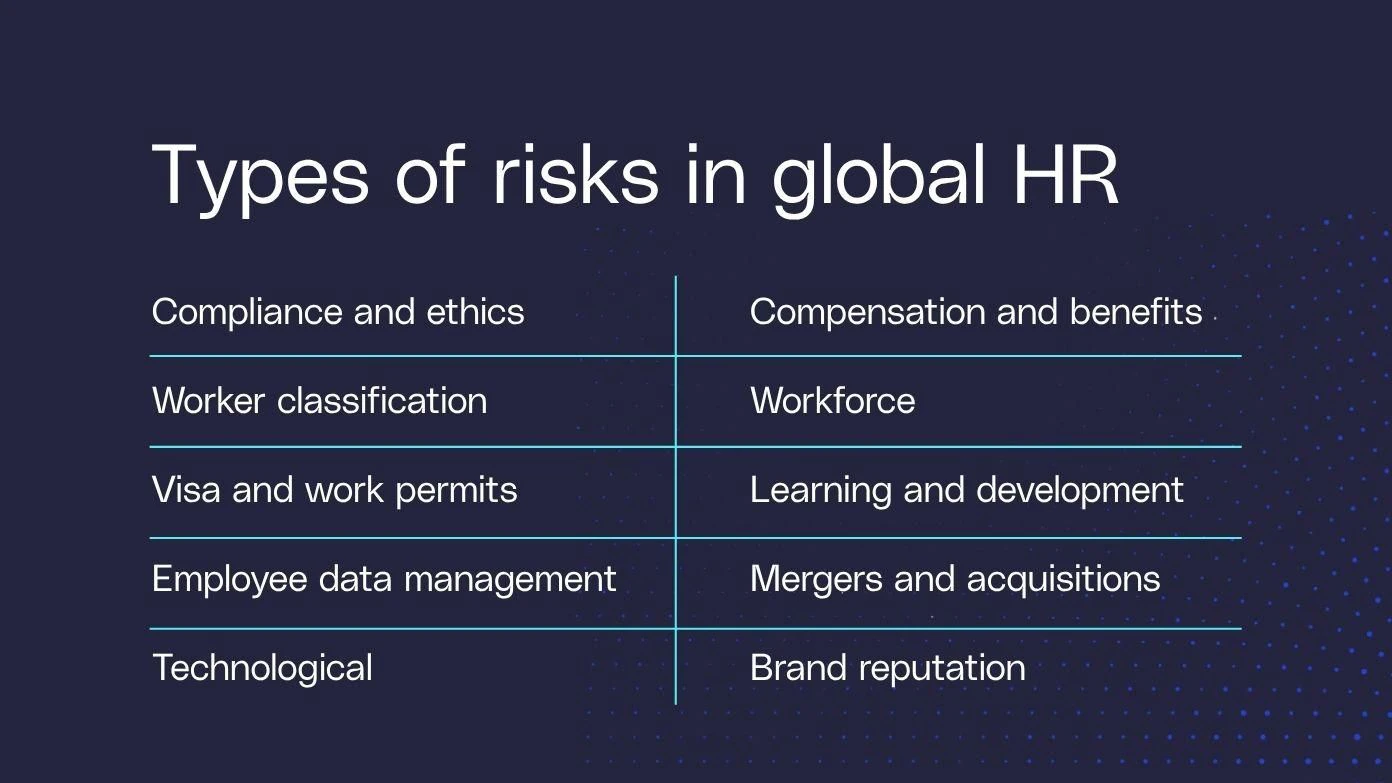
Most global HR risks fall under one of the following categories:
| Compliance and ethics | These refer to employment law violations, regulatory breaches, or ethical standards. For example, exceeding the maximum weekly work hours can trigger fines, penalties, and even employee lawsuits, depending on the location. Partner with in-country legal experts and schedule regular internal audits. |
| Worker classification | Accurate classification of employees and contractors is crucial for tax and benefits compliance. Partner with an employer of record (EOR), or conduct thorough legal research and classification audits to mitigate misclassification risks. Learn how to avoid independent contractor misclassification. |
| Visa and work permits | Ensure every employee has the right to work in your country of operation. This involves keeping up with changing immigration laws and navigating visa processes. Partner with experienced professionals who understand immigration regulations. |
| Employee data management | Global companies have to comply with both local and international data security standards. Risk mitigation includes establishing cybersecurity protocols, conducting data security audits, and keeping up with evolving data privacy regulations. |
| Technological | Establish effective cybersecurity protections and follow AI best practices. Integrate best-in-class solutions across every area of operations, including compliance and payroll. |
| Compensation and benefits | Mitigation requires balancing local regulations with employee expectations. Keep track of minimum wage requirements and paid leave entitlements to ensure compliance. |
| Workforce | These are the risks involved in managing employee relations and work environments. Implement policies to ensure fair treatment of all employees and conduct surveys to gauge satisfaction. |
| Learning and development | Inadequate learning and development can lead to challenges in retention, productivity, and competition. Develop comprehensive training programs tailored to locations and roles, and use online platforms to scale training. |
| Mergers and acquisitions | If you’re going through a merger or acquisition, risks of disruption, loss of talent, and operational inefficiencies arise. A detailed integration plan is crucial to retain talent. |
| Brand reputation | In the age of viral social media posts, negative publicity spreads fast. Mitigate this risk with a strong code of conduct and standards for managing public criticism. |
How to create a global HR risk management plan
Apply this four-step formula to your company-wide risk management framework.
1. Anticipate risks
Conduct a comprehensive HR audit to highlight general company risks like compliance gaps, cash flow bottlenecks, and industry-specific concerns. Work through all 10 risk areas above to ensure a thorough audit.
Prioritize these risks based on probability, preventability, and severity. The most important risks to plan for are those that are most likely to happen and could seriously impact your company but can be avoided by acting early.
Invite collaboration between departments and engage in-country experts to minimize the risk of blind spots. AI-powered risk intelligence can also help predict and rank risks based on data from your industry and location.
2. Prepare solutions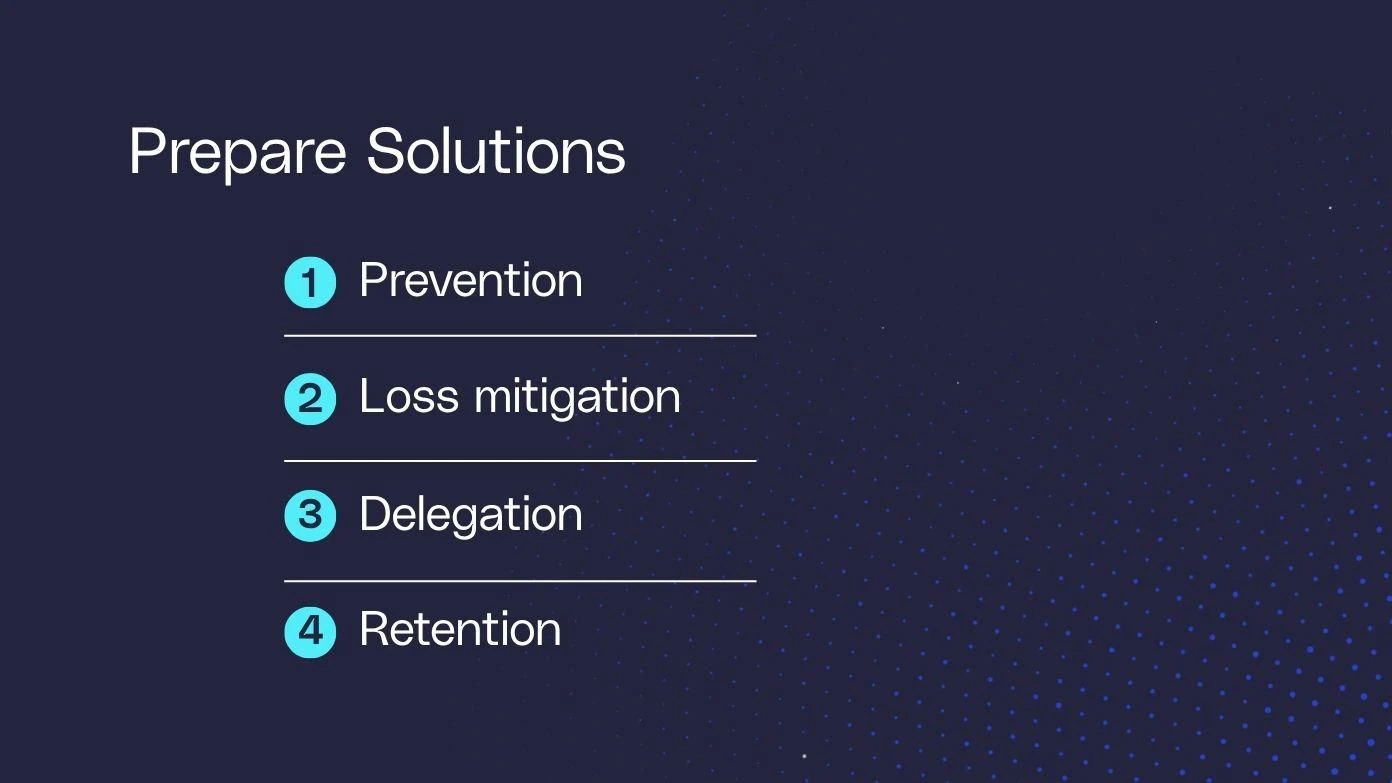
Design proactive solutions to tackle the root causes of potential risks. HR risk management techniques include:
- Prevention: Stop a risk from happening by addressing its causes. For example, avoid litigation by developing clear antidiscrimination training and policies.
- Loss mitigation: Reduce how often a risk is likely to happen or how severe its impact will be. While employee turnover is unavoidable, you can reduce the impact of resignations and retirements through succession planning and cross-training.
- Delegation: Use an employer of record to manage core employment administration and local compliance responsibilities. This can help reduce administrative problems in countries where you don’t have a legal entity.
- Retention: Decrease employee turnover with a positive, engaging work environment. Retention strategies include competitive salaries and benefits, professional development opportunities, and celebrating employee contributions.
3. Take action
Take proactive measures to respond to risks that have occurred. Timing is crucial in every risk management technique. HR technologies maximize efficiency and minimize human error. A global HR AI agent like G-P Gia™ can help you mitigate risks by generating compliant interview questions, contracts, policies, and other HR documents. Use Gia to draft or review existing documents for compliance across 50+ countries and all 50 U.S. states.
4. Adapt processes
Monitor the results of your risk-management strategies against key performance indicators (KPIs) and refine your processes.
For example, a KPI could be the number of annual compliance errors across all your locations. If you discover compliance gaps or violations, look for the root causes and adapt your strategies to address them. An EOR with in-country legal expertise and a spotless compliance record can help you avoid repeat incidents.
Mitigating cross-border risk with modern infrastructure and AI
When expanding globally, HR teams must account for a whole new set of responsibilities as they make structural and operational decisions that rarely come up when managing a workforce in one country. When your workforce expands across multiple jurisdictions, you need to track different leave entitlements, termination rules, payroll requirements, benefits, and contract standards for every location. A lack of reliable global HR practices for tracking requirements adds to your administrative workload and leads to compliance gaps.
You must also think about what happens when you close an entity in a particular location. As with setting up an entity, winding down operations differs from country to country. An improperly managed exit could interfere with your expansion strategy or result in unexpected legal, tax, or employment liabilities.
Fortunately, a scalable global HR management structure combined with modern AI and automation makes it easier to navigate international workforce management with fewer compliance gaps and administrative bottlenecks.
Employer of record vs. foreign direct entity setup
- What is an EOR? When you hire an EOR, you're hiring a third-party organization to legally employ team members on your behalf. They follow your day-to-day direction and expectations, but the EOR is their legal employer and handles payroll, benefits, and employment compliance responsibilities. This structure lets you focus on managing your workforce and growing your business while the EOR handles local employment requirements. It provides a great way to expand internationally and test new markets because you don't have to establish your own legal entity in each new country.
- What is a foreign direct entity setup? With this structure, you set up and maintain a legal entity in the new country. This often requires going through lengthy registration processes, complex legal requirements, and ongoing administrative obligations. You’ll have more control over the workers because you're employing them directly rather than relying on an EOR, but it also means you take on more employment, compliance, and administrative responsibilities.
| Consideration | Employer of record | Foreign direct entity setup |
|---|---|---|
| Speed-to-market | Use existing local employment infrastructure to begin hiring without establishing an entity first. | Entity registration and operational setup must occur before the company can employ workers directly. |
| Initial capitalization | Avoid many of the upfront costs associated with establishing your own local entity. | May require registration expenses, professional fees, capitalization, and other setup costs. |
| Administrative overhead | EOR manages core employment administration, including compliant payroll and employment processes. | Your company manages local payroll, HR administration, filings, benefits, and employment obligations. |
| Employment responsibilities | EOR serves as the legal employer and manages employment compliance responsibilities. | Your company directly employs workers and assumes the associated employment responsibilities and risks. |
| Exit agility | Provides greater flexibility when workforce needs or market strategies change. | Exiting may require entity closure, employee transitions, final filings, and other local procedures. |
- If you decide to use an EOR to hire workers for your global operations, ask how the provider manages its own infrastructure. A direct-model EOR operates through its own entities rather than routing employment through a network of third-party providers. This framework lowers the risk of communication gaps, inconsistent payroll processes, and fragmented data management. And since the EOR has direct legal oversight in relation to the workers it employs, it becomes easier to address compliance concerns when they arise. Your HR team won't have to coordinate with multiple providers because the EOR will do all coordination through its own infrastructure. For global operations, this speeds up communication, reduces administrative complexity, and leads to simpler invoicing since you're working with one EOR rather than multiple third-party providers.
Agentic AI and automated compliance intelligence
No matter the size of your HR team, global compliance is complex, especially when you enter multiple new countries or markets at the same time. A good portion of the team's time will likely go toward seeking answers relating to employment laws, worker classification, and compliance requirements. With G-P Gia™, you get a live global HR agent to answer all of your employment and compliance questions across 50 countries and 50 U.S. states. Gia provides guidance backed by G-P Verified Sources, including 100,000+ vetted articles and 1,500+ government sources.
Here are some of the many questions that Gia frequently helps global HR teams answer:
- Can I legally hire an employee in [country] without setting up an entity there?
- What benefits am I required to provide to employees in [country]?
- How much paid leave are employees entitled to in [country]?
- What rules do I need to follow when terminating an employee in [country]?
- What should I consider when classifying a worker in [country]?
- What needs to be included in an employment contract in [country]?
- What working-hour and overtime rules apply in [country]?
- What payroll requirements should I know about when hiring in [country]?
- What employment laws should I consider when hiring and onboarding workers in [country]?
- What maternity and parental leave requirements apply in [country]?
Gia also has the capability to review employment contracts and draft modifications to ensure legal compliance with country-specific employment laws and mandatory contract requirements. For example, you may have a standard employment contract that includes termination provisions or paid leave language that is not legally compliant for a different country or jurisdiction. Gia can also review employment contracts and provide you with recommended changes based on the applicable local employment laws and mandatory requirements.
Another part of global HR risk management that Gia can help with is enterprise AI safety and data security. If you're uploading contracts or HR documents into an AI platform, those files could contain sensitive company or employee information. You don't want those details exposed to unauthorized parties. Gia encrypts the information at rest and in transit, protecting it throughout the process. Furthermore, the platform never uses your data to train large language models. These protections are supported by G-P's broader security framework, including SOC 2 and ISO/IEC 27001 standards.
8 tips for successful HR risk mitigation
These tips will help you implement your risk mitigation strategies across global locations.
1. Integrate risk management with daily processes
Integrating risk management into daily HR operations rather than treating it as a siloed function is vital. For example, when creating a new compensation plan, consider risks related to compliance with local wage laws and market rates. Factoring risk management into every HR process supports proactive risk mitigation.
2. Centralize and localize documentation
Centralizing HR policy documents through a cloud-based platform promotes accountability and consistency across all your locations. It's also crucial to adapt documents to local laws and languages. Gia can create, translate, and adapt HR documents to local regulations in seconds.
3. Conduct scenario planning
Scenario planning means asking “what if?” and preparing contingency plans. This includes considering mild, moderate, and severe scenarios specific to each location. Scenarios range from economic fluctuations and political administration changes to natural disasters, pandemics, and armed conflicts.
The scenarios you plan for depend on the location. For example, planning HR actions for dealing with earthquakes is a higher priority in Japan than in Finland.
4. Form strategic partnerships
Partnerships help you identify, mitigate, and manage HR risks. For global compliance, an industry-leading EOR is your ideal partner. An EOR with an established entity in your target location can provide insights about local requirements and expectations. As the legal employer, the EOR manages core employment compliance responsibilities so that you don’t have to.
5. Seek buy-in at every level
Cultivate a company-wide commitment to risk mitigation. Loop in other departments to help with risk identification and solution planning. With buy-in at every level, you gain more insights and reduce the chances of negligence.
6. Make continuous improvements
Risk management in HR is an ongoing process that requires continuous improvement, especially when expanding globally. Monitor KPIs like reported incidents, training completion rates, and employee turnover rates. Gather feedback from employees and other stakeholders to identify improvement opportunities. Update your risk management plan as regulations evolve in each of your locations.
7. Upgrade your toolkit
Use innovative HR technologies to reduce human error, enhance efficiency, and support comprehensive risk analysis. An AI-powered global HR agent like Gia can generate contracts, review policies, and draft employee communications, helping you address compliance requirements in seconds. Cut compliance time and costs by up to 95% with Gia.
8. Prioritize compliance
A clean compliance record protects your finances and reputation. However, aligning HR policies to the latest labor laws in each location is the most challenging area of risk mitigation.
There are two main approaches to compliance. One is to rely on internal teams to conduct extensive research and regular audits for each location and accept liability for any errors. The other alternative is to partner with an EOR to streamline your HR functions and support compliance throughout the entire employment lifecycle.
Streamline global HR and risk management with G-P™
Partner with G-P to simplify global HR risk management. As the EOR industry leader, we help companies of all sizes hire in 180+ countries without setting up new entities. Our AI-powered global employment products and EOR solutions are backed by the largest team of in-country HR, legal, and compliance experts, so you can hire anywhere quickly and compliantly.
Complement your HR risk management strategy with our global HR agent, Gia. Gia brings G-P worldwide compliance expertise to your fingertips. Automate HR document creation and review, and cut compliance costs by up to 95% with Gia.Book a demo today.
Frequently Asked Questions
What does HR risk management mean?
HR risk management means identifying, assessing, and mitigating risks related to employees and HR practices. For global companies, this involves evaluating each location's labor market, employee expectations, and compliance landscape to address risks before they escalate.
What is the ROI of risk management in HR?
Effective HR risk management can deliver a significant return on investment through:
Cost savings: Avoid legal liabilities, penalties, and fines.
Increased productivity: Enhance employee engagement and reduce turnover.
Brand value: Improve reputation, brand image, and corporate culture.
How can AI improve global HR risk management?
AI can improve global risk management by automating compliance monitoring and accelerating HR tasks, such as contract creation. AI-powered global HR agents like Gia reduce manual errors that lead to noncompliance and other risks.
How does Gia protect user data from cybersecurity risks?
Gia protects user data by:
Encrypting information at rest and in transit.
Isolating user queries and documents from other users' information.
Never incorporating user data into a large language model (LLM) or using it to train a model.