



Key takeaways
- Top industries in Japan include automotive, finance, and technology
- Japan’s top hiring hubs are Tokyo, Osaka, and Nagoya
- Companies hiring in Japan have different options, including partnering with an employer of record (EOR), hiring contractors, setting up a subsidiary, or direct employer registration
- Overtime pay typically ranges from 25–50% premium on normal wages
The island nation of Japan is smaller than the U.S. state of California. However, Japan is the world’s fifth-largest economy, after the U.S., China, Germany, and India. If you’re looking to expand your business into Japan, our guide will tell you everything you need to know.
What do I need to know before hiring in Japan?
If you’re unsure where to begin, G-P Gia™, our AI-powered global HR agent, can answer your toughest compliance questions across 50 countries — including Japan — and all 50 U.S. states. Reduce your reliance on outside counsel and cut the time and cost of compliance by up to 95% with Gia.
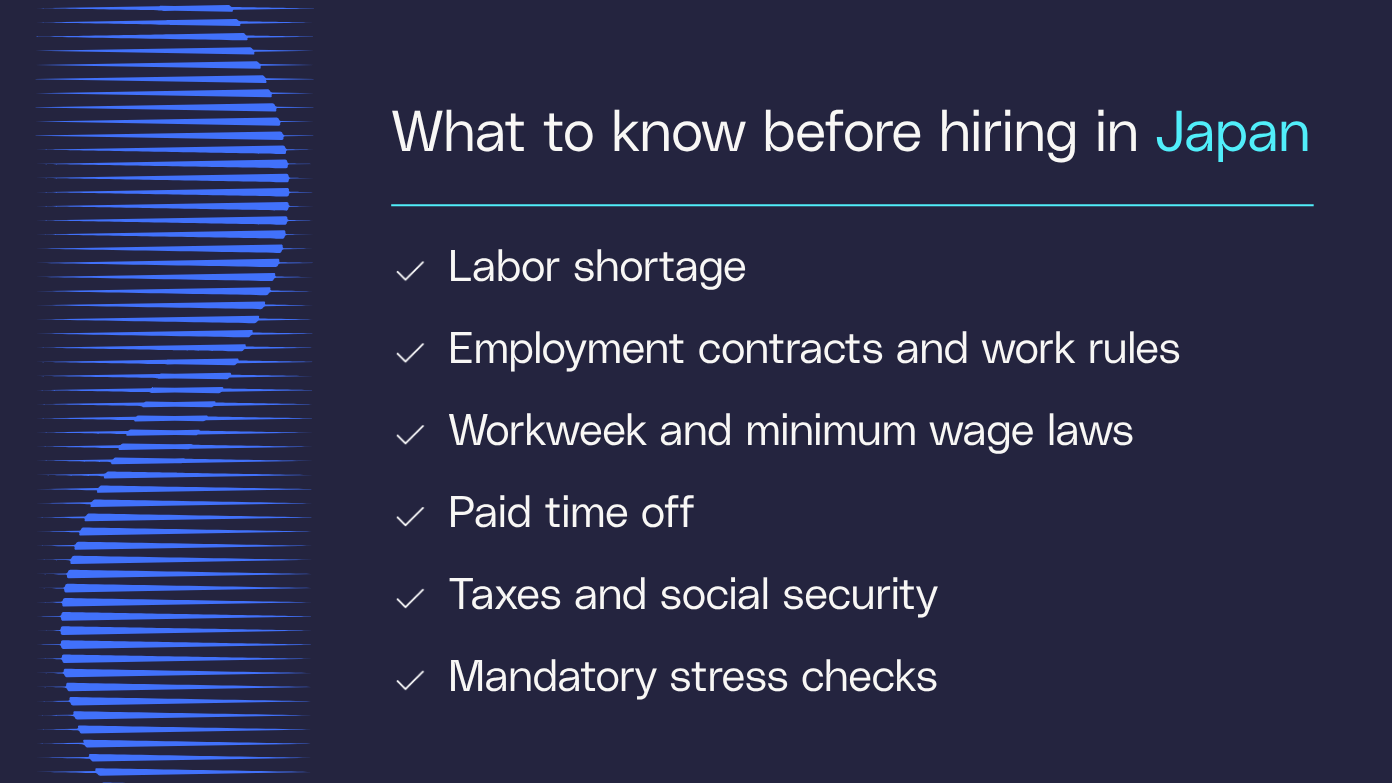
Let’s take a look at five things to know about hiring in Japan.
1. Labor shortage
An aging population and declining birthrates have led to a labor shortage in the country. This means employees are used to excellent job security. Candidates typically get offers from multiple companies. In interviews, selling your employer brand is just as important as assessing candidates' skills.
2. Employment contracts and work rules
Japan’s Labor Standards Act requires that key working conditions be provided in writing. This includes details such as working hours, wages, responsibilities, and the possibility of changes to workplace location and job duties.
According to Japanese law, companies with 10+ employees must create work rules and submit them to the local Labor Standards Inspection office. Work rules detail the working conditions you provide employees, including wages, working hours, holidays, company rules, and violation procedures. The Labor Standards Inspection office can give you guidance on whether your work rules cover all the necessary information.
G-P EOR has an Employment Contract Generator to help you draft compliant employment contracts that meet all legal requirements and best practices in Japan.
3. Workweek and minimum wage laws
The standard workweek in Japan is 40 hours, with a maximum of 8 hours per day. The Labor Standards Act regulates work hours to ensure fair conditions and protect employees’ well-being. Before employees are cleared to work overtime, employers are required to have a labor management agreement, known as a saburoku kyōtei, which must be approved by a labor union or employee representative and filed with the local labor board.
Employees who work extra hours or work during the night or on public holidays are entitled to overtime pay. This typically ranges from 25–50% premium on normal wages. Overtime is capped at 45 hours per month and 360 hours per year in most standard cases.
In Japan, the minimum wage isn’t the same across the country. The Japanese government provides a national average based on the cost of living, so local rates vary. Each of the 47 prefectures sets its own minimum wage.
As of 2025, the average minimum wage in Japan is JPY 1,121 per hour. Due to the candidate-driven labor market, you’ll need to offer competitive pay and benefits to attract top talent.
4. Paid time off
Japan-based employees are entitled to paid time off once they’ve worked for a company for six months and attended at least 80% of their scheduled working days. At that point, employees get 10 days of annual paid leave. After the first six months, employees get one more day after each additional year. So after 18 months, employees get 11 days off. Vacation time is capped at 20 days. An employee will reach this limit after 6.5 years of employment.
You can offer your team in Japan more paid time off than the statutory requirements if you wish. Many employers also offer paid public holidays even though it isn’t legally required. Japan has 16 national holidays. Providing these days as paid holidays can enhance your employer appeal. Paid sick leave isn’t a requirement in Japan.
You can easily administer benefits plans with G-P EOR. Our in-house experts continuously monitor Japanese labor laws to meet country-specific regulations and norms. Build and manage benefits plans through our platform to provide a smooth employee experience.
5. Taxes and social security
Japan has a progressive income tax system. Higher incomes are taxed at higher rates. Employers must deduct income tax from employees’ paychecks and send it to the tax authorities.
Both employers and employees contribute to Japan's social security system. This includes health insurance, pension insurance, and workers' accident compensation insurance. Employers and employees share the costs of health and pension insurance equally.
Employers pay 0.85% of wages for employment insurance, while employees pay 0.50%. Employers in Japan fully cover the cost of workers' accident compensation insurance.
Since social security includes public health insurance, you don’t need to offer private insurance plans. However, you must provide employees with annual physicals and checkups.
6. Mandatory stress checks
Annual wellbeing or stress checkups are required for all companies with 50+ employees, regardless of industry. On April 1, 2028, the requirements for these check-ins will expand to include all workplaces.
These stress checks were established to combat karoshi, or extreme burnout that translates to “death by overwork.” Not only does this legislation help create healthier workplaces, it also represents a cultural movement toward better work-life balance.
What are the hiring models for global companies in Japan?
There are different hiring models to consider when expanding your business into Japan. Options include:
-
Direct employer registration: registering your company with Japan’s government, while handling payroll and other services independently.
-
Employer of record (EOR): G-P EOR handles all administrative and payroll processes on behalf of your company.
-
Subsidiary or branch: establishing an entity in Japan, which will function as a separate entity under Japanese law.
-
Independent contractor: hiring independent contractors in Japan doesn’t require establishing a local entity or branch. There are significant penalties for misclassified workers, so strict guidelines must be followed when hiring them.
What are the top hiring hubs in Japan?
Some Japanese cities are known for particular industries. Knowing what each city has to offer can help you channel your hiring efforts to the right place and fill roles faster.
The top talent hubs in Japan are:
- Tokyo: Japan's capital and largest city. It’s the country's main center for business, finance, and technology. Tokyo has a diverse talent pool and hosts many major Japanese and international banks and fintech companies.
- Osaka: known for its strong manufacturing and service industries. It has a long history in manufacturing electronics, machinery, robotics, chemicals, and food. Companies like Panasonic and Sharp are based here.
- Nagoya: a major player in the automotive, aerospace, and manufacturing sectors. Many companies, including Toyota, Mitsubishi, and Boeing are located in the region.
- Fukuoka: often called Japan's Silicon Valley. The city is known for its startups and for having the highest business opening rate in Japan. It’s also known for blockchain and smart city initiatives.
- Yokohama: part of the Greater Tokyo Area. It’s a major port city known for logistics, technology, and international business.
What are the key industries in Japan?
Understanding Japan’s main industries helps you benchmark salaries and benefits. You can use this insight to make smart choices about where to invest and grow your workforce.
The main industries in Japan include:
- Automotive manufacturing: Japan is well-known for its car companies, like Toyota, Honda, Nissan, Mazda, and Suzuki. The industry covers everything from building vehicles to creating car parts. Specialist talent includes mechanical engineers, industrial automation experts, and quality control engineers.
- Electronics and electrical equipment: Japan is famous for its advanced electronics, including gadgets, semiconductors, and industrial machines. Companies like Sony and Panasonic play a big role in this field. This industry requires various engineering specialists.
- Robotics: Japan is a leader in robotics. Companies like Fanuc are among the best in the world. The need for industrial robots is growing due to the country's labor shortages. Specialist talent includes developers, machine learning engineers, and cybersecurity experts.
- Information technology and software: Japan has a strong IT sector. Key companies include Fujitsu, NEC, Hitachi, and Sony. Major global tech companies like Microsoft, Google, and Amazon also have operations in the country. Specialist talent includes developers, cloud architects, and data engineers.
- Finance and insurance: Tokyo is a major global financial hub with a
well-developed banking and asset management market. The country also has one of the largest insurance markets in the world, particularly its life and non-life insurance premiums. Specialist talent includes investment banking professionals, quantitative analysts, and financial risk managers.
What is the cost of hiring an employee in Japan?
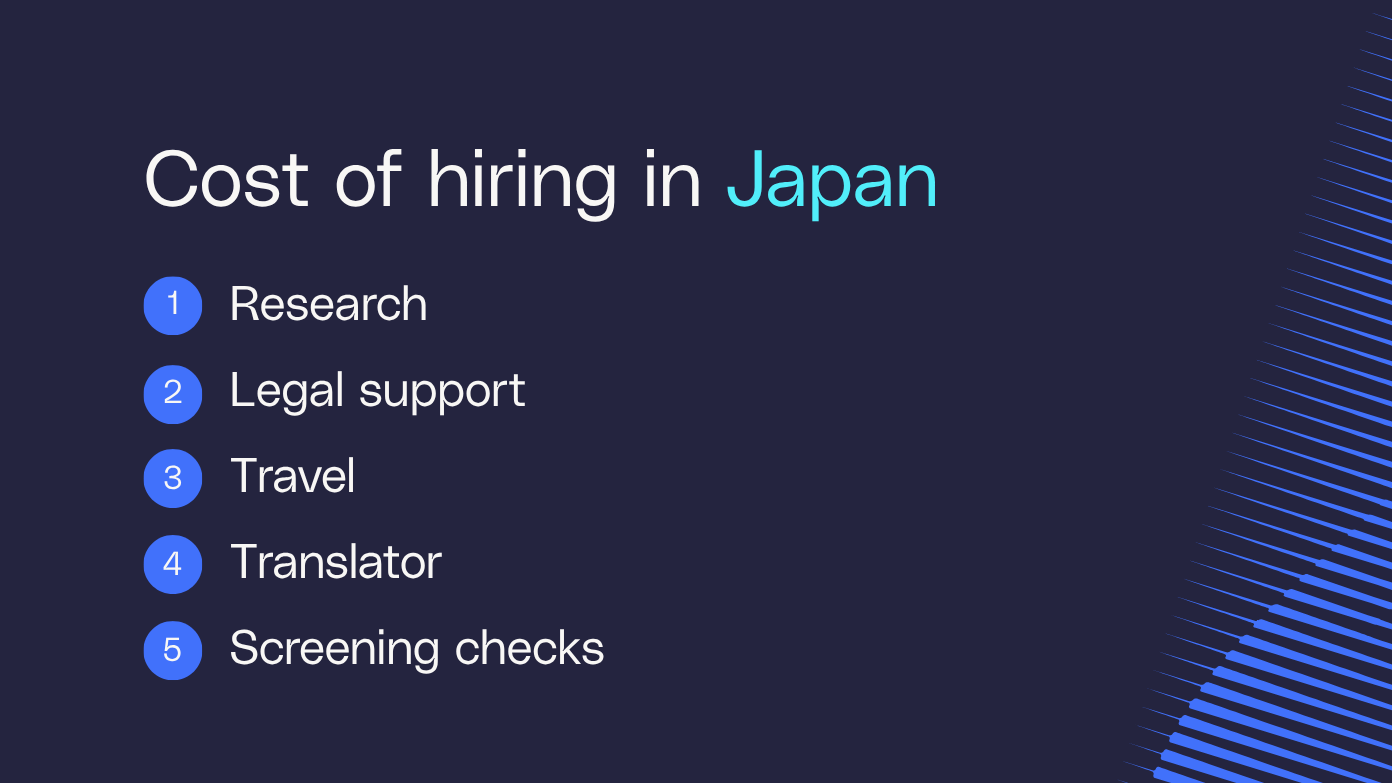
- Research: Determine where in Japan you want to establish your business, and research the employment practices there, as well as any requirements for your industry.
- Legal support: Unless you work with an employer of record (EOR), you’ll need a lawyer to help you with compliance and ensure you’re following local employment laws.
- Travel (: If you have to travel to Japan for recruiting or setting up your new office, you should factor in these costs.
- Job advertisements: Advertising your job online or in print can add to your recruitment costs.
- Translator: You may need to hire a translator to help you communicate with job applicants, both in writing and in interviews.
- Screening checks: Screening checks can add to your costs. Background checks and criminal record checks are regulated by strict privacy laws in Japan.
According to G-P Verified Sources from Gia, the total annual employer burden rate in Japan is between 15–17% of gross salary. This rate can increase in high-risk sectors due to the variable WCI premium.
What does a company need to hire employees in Japan?
Make sure you cover these essentials before expanding your team in Japan:
- Entity setup or EOR partnership
- Japanese bank account
- Tax registration
- Japan Pension Service registration
- Public Employment Security Office registration for unemployment insurance
- Workers’ accident insurance through the Labor Standards Office
Hire full-time employees in Japan without setting up your own entity with G-P EOR. Build your team in Japan at a lower cost and with peace of mind that you’re doing so compliantly.
What are the steps to hiring in Japan?
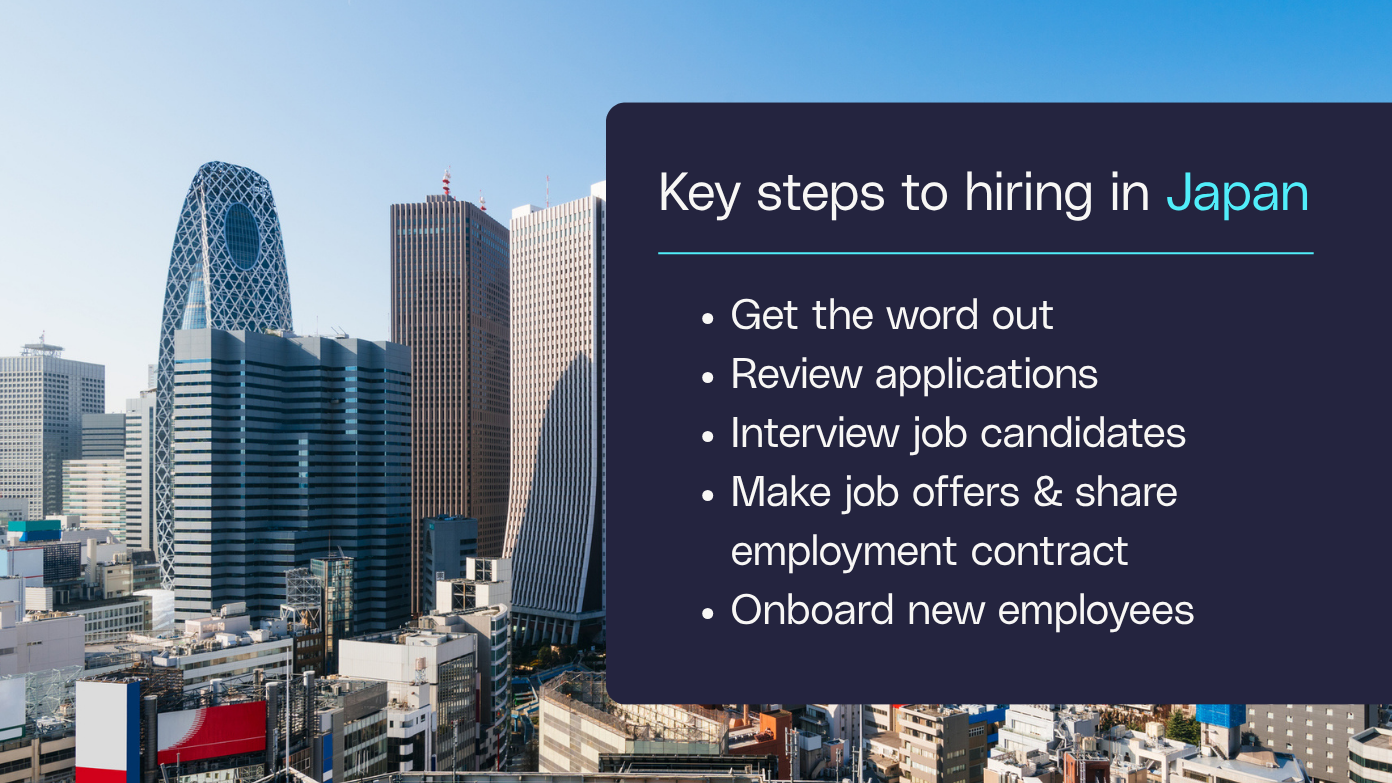
Before you start recruiting, let’s go over the basics of how to hire in Japan. Some aspects of the process will likely look different than what you’re used to in your home country.
1. Get the word out
The first step is to let local job seekers know about your vacant positions. Write job ads in Japanese and post them online where they’ll gain exposure. Post your role on popular Japanese job boards like Denko-Mirai, GaijinPot Jobs, CareerCross, Daijob, Rikunabi, En Japan, and MyNavi.
If you have connections in Japan, network to identify workers who’d want to join your team. Job candidates in Japan tend to pay more attention to personal recommendations than cold calls from recruiters or postings online.
Another option is to engage in a process called shinsotsu. This involves recruiting groups of university graduates as they enter the job market. While they may not have prior professional experience, graduates can offer fresh perspectives, strong ambition, and a solid educational background.
2. Review applications
With 1.26 jobs available per job applicant, local job seekers have plenty of opportunities to choose from.
As you evaluate applications, remember that you can always offer training to help a new employee succeed as a member of your team. Hire someone willing to grow with your company in the long term.
3. Interview job candidates
Next, interview candidates who made it onto your shortlist. Phone or video interviews are especially helpful if you’re hiring remote employees or want to avoid traveling.
Be sure to factor in the time difference based on your location. For instance, New York City is 13 or 14 hours behind Tokyo, depending on whether daylight savings time in the U.S. is in effect. Digital scheduling tools can be extremely helpful so that you can navigate this time difference with ease and accuracy.
4. Make job offers and share the employment contract
Once you’ve identified the right candidate for the role, you can formally offer them the job.
Share your work rules and create an individualized contract for your new hires. Outline their job duties, benefits, remote work expectations, compensation, and any other important details.
5. Onboard new employees
Finalize the hiring process by onboarding your new employee. Submit pension and health insurance forms within five days of the employee’s start date. Inform new employees of their itinerary for their first week and set up any training they need to get started.
If you hire any non-nationals in Japan, you’ll also need to submit paperwork to the Public Employment Service Center.
Employers must also enroll eligible employees in the Shakai Hoken social insurance system within five days of employment, covering health insurance, pension schemes, and nursing care insurance.
Onboard your team members in Japan in minutes with G-P EOR. We’ll handle the legal and administrative tasks, so you can start working faster. Simple, self-guided workflows ensure a smooth process for you and your new hires.
How do I hire contractors in Japan?
Working with independent contractors in Japan can be a cost-effective way to test the market and build a presence without the commitment of full-time employees.
Contractors based in Japan understand local consumer behavior, rules, and business practices. They’ll be ready to start working quickly with their own equipment and established work processes.
Hiring independent contractors allows you to easily adjust your workforce based on your business needs, without the complexities and costs of employment.
Before you enter an agreement with an independent contractor in Japan, consider the following:
1. Employees vs. independent contractors
In Japan, employees usually have indefinite contracts, implying ongoing employment. Contractors are hired for specific projects or fixed periods under services agreements, which clearly define start and end dates.
Employees get regular monthly salaries, and employers withhold income tax and social insurance premiums from their wages. Contractors are paid based on project scopes, hourly work, or milestones. They manage their own income tax filings and social insurance contributions.
2. Penalties for misclassification
Classifying someone as a contractor when they’re not can lead to serious penalties. If misclassification occurs, you may end up:
- Paying for withheld income taxes and social insurance contributions for the period of misclassification.
- Facing disruptions due to contract amendments, payroll system changes, and management training during reclassification.
- Paying fines up to JPY 300,000 or facing imprisonment for up to six months under the Labor Standards Act.
3. How to pay contractors in Japan
G-P Contractor™ takes away the messy, time-consuming process of hiring and paying international contractors. You can create and issue contracts and pay contractors with just a few clicks, while ensuring compliance and avoiding penalties.
Can G-P help me hire employees and contractors in Japan?
G-P’s Global Employment Platform and its AI-based products – EOR, Contractor, and Gia – help companies of all sizes build and manage global teams.
Start hiring in Japan today
With more than a decade of experience, the largest team of HR, legal, and compliance experts, and a global proprietary knowledge base, G-P is the recognized leader in global employment.
Make your expansion to Japan easier with G-P. Contact us or book a demo today.
 Frequently asked questions
What are the legal requirements for conducting job interviews in Japan?
The Labor Standards Act, Equal Employment Opportunity Act, and Employment Measures Act prohibit discrimination based on nationality, sex, age, and other factors. Gia can help you create questions that follow antidiscrimination laws in Japan, so you can find the best fit for the role while complying with local regulations.
What are the guidelines for candidate screening and background checks?
Employee background checks, including criminal record checks, are strictly regulated. Employers must obtain consent from candidates and make sure that any data collected is relevant to the job.
What are the language proficiency requirements for international employees?
Japanese language proficiency is crucial for most roles. Many companies require at least a basic understanding, typically measured by the Japanese Language Proficiency Test (JLPT) at levels N2 or N1.
What does social insurance enrollment entail?
Employers must enroll eligible employees in the Shakai Hoken social insurance system within five days of employment, covering health insurance, pension schemes, and nursing care insurance.
What are onboarding best practices in Japan?
The onboarding process should emphasize clear communication, respect for cultural values, and compliance with data protection laws. You should provide detailed information covering company culture, job responsibilities, and administrative procedures.