







Key takeaways
- Benefits of expanding globally: Global expansion helps you grow your customer base, drive new revenue, and diversify your market reach.
- Planning for international expansion: Coordination between your HR, finance, and legal departments minimizes bottlenecks and compliance issues.
- Choosing your expansion strategy: You can choose from five main expansion strategies: market penetration, market expansion, product expansion, diversification, and acquisition.
Global expansion gives you access to new customers, diversified revenue streams, and broader talent pools. But success depends on timing and preparation. A strategic plan for global expansion takes into account cultural differences, talent availability, and operational costs.
Let’s dive into the benefits of going global, risks and challenges to look out for, and best practices to keep things running smoothly.
Reasons to expand your business globally
1. Market access and revenue growth
One reason why companies go global is to reduce reliance on a single region. Spreading risk across multiple markets makes it easier to stay profitable during economic downturns.
Global expansion gives you access to new markets and customers that may not exist at home, especially if you plan to expand through mergers and acquisitions. Diversifying your customer base also contributes to long-term growth.
2. Competitive advantage
Economic development is different in every country. Tapping into emerging markets and gaining the upper hand is another reason for international expansion. Establishing your presence ahead of competitors can improve brand recognition and position your company as a leader in the market.
New countries also let you access more suppliers, researchers, or other players involved in creating your products and services. This encourages innovative and cost-effective solutions for business operations.
3. Access to global talent pools
Talent acquisition is another reason why companies go international. You can find the best talent without geographic constraints. Plus, global hiring can be more cost-effective than hiring locally.
A global workforce also makes you more competitive. According to 2025 Global Workforce Trends, 81% of employees want to work at a global company. This diversity ultimately leads to innovation and creativity, which are essential in achieving company goals.
An employer of record (EOR) can help you go global without the stress of entity setup. G-P EOR streamlines the entire employment lifecycle, so you can hire in 180+ countries quickly and compliantly, without setting up new entities.
5 signs you're ready for global expansion
Before entering new markets, confirm that your business has steady revenue, strong demand at home, enough cash flow to support international operations, and the people and systems needed to manage growth. Executive buy-in and a clear business case are also essential. These signals suggest you may be ready to expand:
- Your domestic market is becoming saturated, or customers are already requesting your products or services abroad.
- You have tested demand through research, pilot sales, partnerships, or other low-risk methods.
- Your operations, technology, customer support, and supply chain can scale across borders.
- You understand the target market’s regulations, culture, talent availability, taxes, and currency risks.
- You have a global expansion strategy with defined goals, a realistic budget, a launch timeline, and success measures.
Planning international expansion
When planning global expansion, follow a clear sequence to expand your business successfully:
1. Define your goals and strategy: Set measurable objectives, identify the products or services to offer, and determine how international operations support your long-term business plan.
2. Research and prioritize markets: Compare customer demand, competition, regulations, cultural expectations, talent availability, infrastructure, and potential costs in each target country.
3. Build a financial and risk plan: Estimate setup costs, payroll, taxes, benefits, technology, marketing, currency exposure, and possible disruptions. Set a realistic budget and contingency plan.
4. Choose an entry model: Decide whether exporting, partnering with a local company, establishing an entity, or using an employer of record (EOR) best fits your goals, timeline, and risk tolerance.
5. Prepare compliant operations: Confirm employment, tax, data protection, intellectual property, product, and industry requirements. Create processes for hiring, payroll, contracts, customer support, and reporting.
6. Hire and support local talent: Define roles, compensation, benefits, onboarding, communication practices, and performance expectations for your international team.
7. Localize your offer and launch in stages: Adapt your product, pricing, messaging, payment methods, and customer experience to local needs. Start with a pilot market, measure results, and refine your approach before expanding further.
8. Track performance and improve: Monitor revenue, customer acquisition, retention, compliance, hiring, operating costs, and other success measures. Review the strategy regularly as market conditions change.
What are the five types of business expansion?
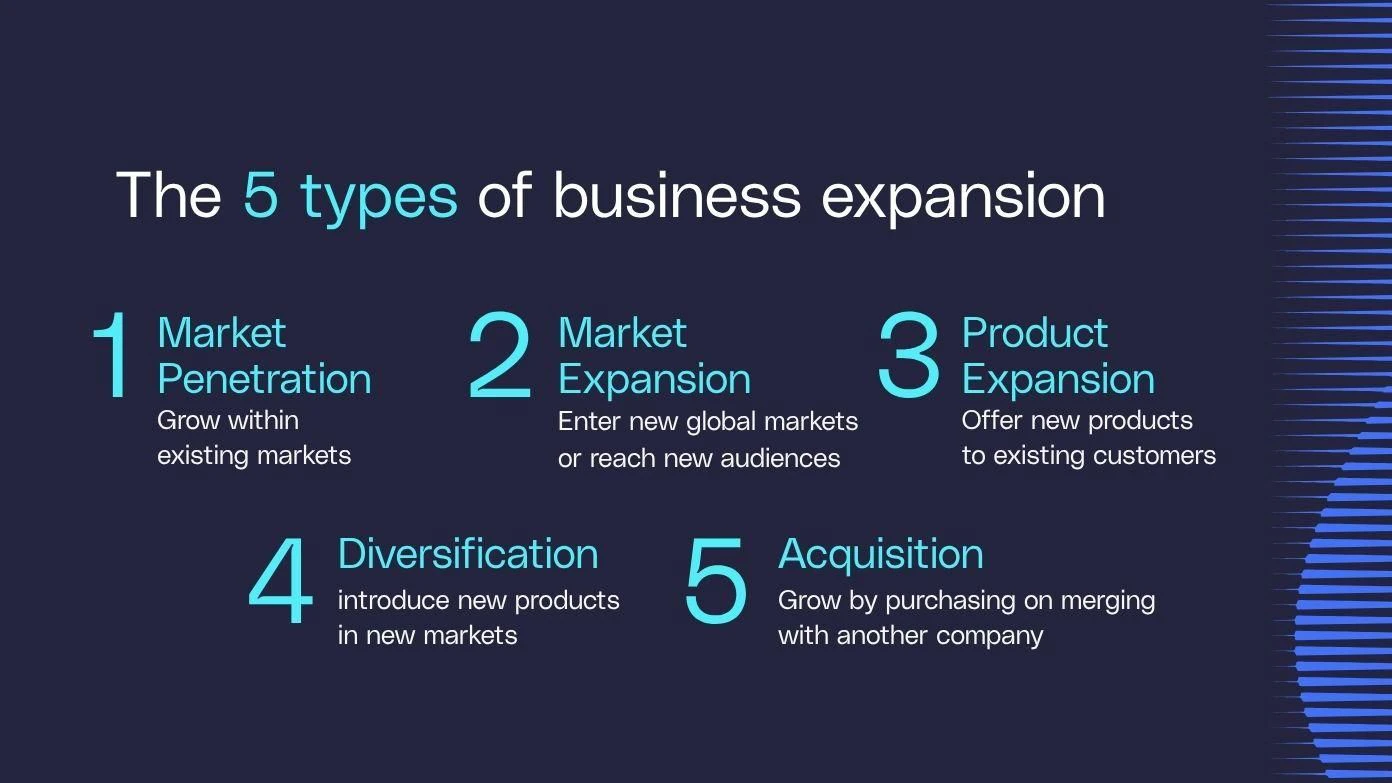
The five types of business expansion include market penetration, market expansion, product expansion, diversification, and acquisition. Each differs in its workforce requirements, costs, and compliance responsibilities.
1. Market penetration
- Mechanism: With market penetration, the goal is to gain a larger share of a market where you already operate. Maybe you're a U.S.-based company with large domestic operations and smaller operations in Germany. If your goal is to expand in the EU, you can use market penetration in Germany to grow your customer base in the region There are multiple ways to go about doing this, including adjusting prices to make your service more cost-effective, improving customer retention to generate more value from existing buyers, and accessing new distribution channels to broaden your service areas. In doing this, you're not expanding your geographic footprint, but you are increasing your market share outside of your home country.
- HR and people focus: When using the market penetration expansion strategy, prioritize resources to support the global market. This may involve expanding the local sales team or hiring new workers for customer service operations to address higher sales volumes. Some companies will make compensation adjustments based on local salary benchmarks to entice top local talent to join their growing teams.
2. Market expansion (geographic and demographic expansion)
- Mechanism: The market expansion strategy takes an existing product or service and introduces it to a new geographic location, making it perfect for global expansion into international markets and untouched demographics. You can use it to enter a single new market or multiple ones at the same time. But it requires careful planning since the new locations will require you to become familiar with local employment, tax, and business regulations. This model often works best when one or more people on the leadership team have extensive experience with the target market, including its culture and language.
- HR and people focus: You can choose between two approaches for staffing operations in the new market: Either recruit local talent or relocate existing employees. The overall scope and duration of your operations determine the better approach to take. Some companies use a mixture of both. Having local employees on-site while completing the initial market launch and afterward, when operations begin to scale. Your HR and finance teams will need clear processes in place to navigate local labor laws and determine how to hire, pay, and manage employees before recruiting begins.
3. Product expansion (product development)
- Mechanism: If you already have operations outside your home country, you can use this expansion model to drive more revenue from your international customers. The goal of this model is to introduce products that are new or have updated features to those customers. For example, if you sell software to international customers, you can offer updated versions that adapt the platform to local languages and regulatory requirements or a new, complementary product that works alongside the existing software.
- HR and people focus: Your HR department's focus is making sure you have enough employees to successfully launch and support the new or updated products. You may need to hire additional marketing professionals to advertise the product through local channels or logistics workers to transport physical products to distributors and retailers. Your R&D team may need to expand to account for the additional workload of developing, testing, and improving new product offerings.
4. Diversification
- Mechanism: Diversification involves taking a brand-new product or service into a completely new market. And because it entails developing a new offering while entering unfamiliar territory, it requires the most organizational planning. Leaders have to learn how to reach international customers and beat new competitors while navigating local business and employment regulations. And they must do this for an extended period before fully establishing the new operation.
- HR and people focus: When you have a brand-new product operating in new territory, companies often put together dedicated business units to recruit, staff, and administer the new operation. The new teams may have reporting structures and job roles that exist nowhere else in the company. This level of change requires flexible workforce planning, with HR regularly reassessing staffing needs and adjusting recruitment strategies as new roles and skills gaps emerge.
5. Acquisition (mergers and acquisitions)
- Mechanism: Acquisition is a common way to expand globally because it allows you to purchase or merge with a company that already has established operations in the target market. This means you don't have to take on every aspect of building an international operation from the ground up. You can use the acquired company's existing infrastructure to tap into its established customer base and distribution channels, intellectual property, physical assets, and recruiting networks.
- HR and people focus: HR teams will often use the acquired company's processes for cross-border employee integration. Some operations may involve taking different compensation and benefits structures and harmonizing them with the acquired company's programs to ensure employees are treated consistently across comparable roles. Key executives will often act as integration leaders to strengthen the relationship between teams and keep the transition moving forward.
 What questions should you ask before deciding to go global?
Companies expand internationally but often fall short due to a lack of thorough planning. You need a clear roadmap before you take the leap. Answering these questions can help.
What are the compliance and regulatory needs in your target countries?
Regulations affect your core operations and business strategy. The more countries you target, the more comprehensive your analysis must be. If you don’t know where to start, G-P Gia™ can help. Our AI-powered global HR agent can:
- Advise you on the HR, legal, and compliance requirements for hiring employees or contractors in new countries
- Give you up-to-date information on employment laws, mandatory benefits, payroll requirements, and local labor practices in your target markets
- Guide you on best practices for competitive compensation and benefits packages
- Advise you on visa, work permit, and relocation requirements for moving talent across borders
What’s the total expansion cost, including payroll, benefits, and taxes?
Predictable costs include salaries and registration fees. Other costs include taxes, legal fees, local mandatory benefits, and fluctuating exchange rates. Think about your company's financial capacity and whether the expansion's return on investment is worth the effort.
How will you manage and support a distributed workforce?
Strong remote work policies ensure that employees understand what you expect from them. Use technology and asynchronous communication tools to collaborate effectively with global teams.
What are the cultural, language, and operational challenges?
Cultural expectations vary. For instance, some cultures have a more direct communication style, while others are more reserved. Some may expect a democratic approach rather than a strict hierarchical structure. Individualistic cultures celebrate personal achievement, but collectivist cultures applaud team success. Train your team to adapt to new markets to maintain a positive workplace culture.
How will you ensure data security and IP protection?
Global IP theft is a risk, so clearly outline your security protocols and tools for your teams. Register your patents, copyrights, and trademarks to protect your assets. When onboarding employees, ask for nondisclosure agreements or similar contracts.
Is there a clear business case and executive buy-in for expansion?
An executive buy-in or top-level leadership support ensures that expansion aligns with the company’s long-term goals and priorities. In your proposal, include your consumer research, financial projections, and other studies to showcase market opportunity.
Best practices for expanding your company globally
When planning for global expansion, consider these practices:
- Prioritize cultural sensitivity and employee experience: When employees feel heard, it improves collaboration, creativity, and retention. Culturally competent employees can also navigate global markets and manage international teams with ease.
- Involve finance, HR, legal, and executive teams in planning and execution: A cross-functional team gives you the knowledge you need to cover all critical areas. For instance, legal experts advise on jurisdiction-specific requirements, while financial experts perform market research and build budgets. HR teams determine the right hiring approach for your business needs. If you’re an HR leader, the Society for Human Resource Management (SHRM) can help you navigate the global workforce through its research, guides, and seminars.
- Use technology to streamline global operations: AI-powered global HR agents like Gia provide expert global employment law guidance and help you draft employee handbooks, review contracts, and more in minutes. Reduce manual errors and save up to 95% of the time and costs of global compliance.
- Choose the right hiring model for employees and contractors: An EOR can help you hire, onboard, and manage eligible employees without establishing a local entity. If your expansion strategy includes independent contractors too, use a Global Employment Platform to manage all your hiring needs while addressing local classification requirements.
How to choose a country for expansion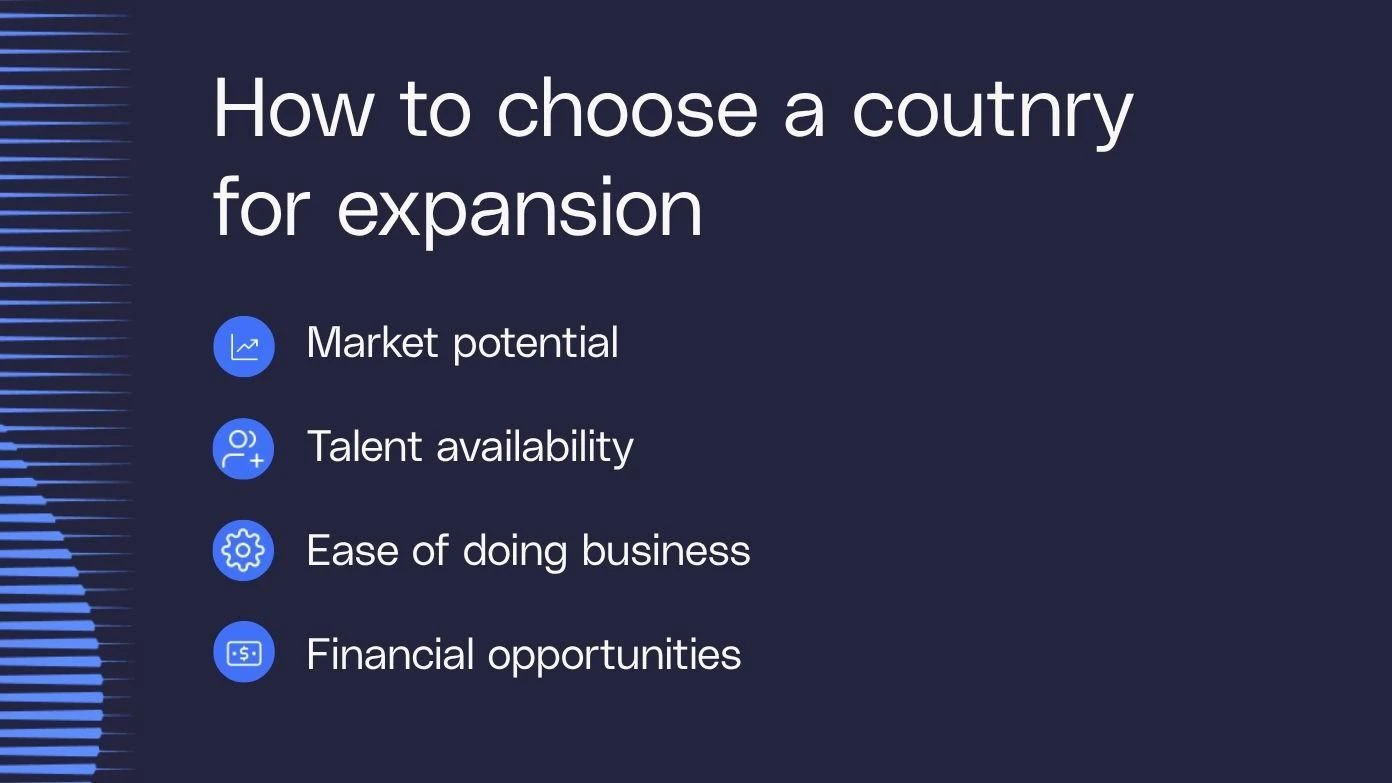
Some markets may be a better fit for your company than others. When evaluating a market, consider:
- Market potential: Market potential is one of the main reasons for global expansion. Perform a market segment analysis to assess potential and product demand. Country comparison resources, such as those of the World Bank Group and the International Labour Organization (ILO), can help.
- Talent availability: Analyze your target country’s existing industry hubs, education systems, and competitor strategies. A global hiring toolkit can help you get started.
- Ease of doing business: Regulatory considerations affect how easy it is to get started in a new market. Entity setup can be costly and time-consuming. Hiring remote employees through an EOR makes expansion easier.
- Financial opportunities: Global expansion may cost more than you expect. Government assistance, such as the State Trade Expansion Program (STEP) in the U.S. and the Enterprise Europe Network (EEN), may be available if you need it.
Streamline global expansion with G-P EOR
Setting up a legal entity can take months and locks you into a heavy commitment before you know if the market is a right fit. With G-P EOR, you can test a market, hire the right people, and move at the speed of opportunity, without the up-front commitment of building an entity first.
As the recognized leader in global employment, we help companies of all sizes hire, onboard, and manage international teams in 180+ countries. Our agentic Global Employment Platform is backed by the largest team of in-country HR, legal, and compliance experts to streamline and simplify the entire global employment life cycle.
Learn more about how we can help your company hire anywhere and scale everywhere, in minutes.
Frequently asked questions
How can I onboard and hire employees in a new country?
With an employer of record (EOR), you can easily onboard and hire employees anywhere. The EOR acts as the legal employer for your global team members, so you won't need to establish a local entity in your target country.
How can G-P help my company expand globally?
We can help you hire globally without an entity, manage employees, and comply with local laws. We have the largest team of HR and legal experts in the industry, so you can expand in 180+ countries quickly and compliantly. Explore G-P EOR to learn more.
What are the first steps to take when planning global expansion?
Ensure that global expansion aligns with your long-term goals. Get senior decision-makers on board. This ensures you'll have the resources for global expansion. Additionally, analyze your new target market, your company's financial capacities, and talent availability.