



Key takeaways
- Evaluate markets strategically. Look beyond market size when choosing which countries to enter. Assess cultural, regulatory, geographic, and economic factors that could impact your expansion goals.
- Choose the right entry model. Your timeline, workforce needs, and long-term goals can help you determine whether to establish a local entity, use an EOR, or engage contractors.
- Localize your approach. Adapt your go-to-market strategy, hiring practices, leadership style, and company policies to match local expectations and regulatory requirements.
- Plan for compliance and change. Build regulatory research, financial planning, risk management, and the right global employment technology into your international expansion strategy.
Tips for corporations to expand internationally
Expanding internationally can help your company reach new customers, access a wider pool of talent, and create new growth opportunities. However, you'll encounter cultural differences and unique legal nuances that your company will need to navigate. Entering a new country means understanding local regulations, market conditions, workforce needs, and the right operational model for your business goals.
This guide breaks down how to expand your business globally, including how to evaluate markets, choose an entry strategy, and build and manage global teams.
Global workforce trends
The global workforce is changing, and companies like yours are continually responding to new technologies, shifting skill needs, and persistent talent shortages.
The Future of Jobs Report 2025 from the World Economic Forum noted that 70% of employers expect to hire people with new skills by 2030. AI and big data rank among the fastest-growing skill areas, while analytical thinking remains a top priority.
At the same time, many companies struggle to find the skills they need locally. The 2025 G-P World at Work Report found that 84% of executives have difficulty finding skilled talent in their markets. That's why so many are expanding overseas and hiring professionals across international borders.
International market expansion can give you access to a wider talent pool, supporting both short- and long-term business goals. It can also help you build teams with specialized skills that are harder to find in your existing market.
Evaluating international markets with the CAGE distance framework
When your company decides to expand internationally, you need to choose your target market strategically. Your decision should involve more than comparing gross domestic product or population size. A large economy can look attractive on paper, but cultural, regulatory, geographic, and economic differences can affect how easily your company operates there.
Developed by global strategy professor Pankaj Ghemawat, the CAGE distance framework helps companies compare countries based on factors that can make cross-border expansion easier or more difficult. Rather than looking only at market size, the framework examines four dimensions that can influence consumer behaviors, operations, hiring, and ongoing logistics:
- Cultural distance: Consider differences in consumer behaviors, workplace expectations, communication styles, and language.
- Administrative distance: Review factors like bilateral trade agreements, legal systems, regulatory transparency, and currency stability.
- Geographic distance: Look beyond physical distance to transportation infrastructure, logistics hubs, and time zone differences.
- Economic distance: Compare purchasing power parity, local wage levels, digital infrastructure, and other indicators of economic development.
These four dimensions can help you compare markets more realistically as your company pursues international market expansion. Use them to identify potential friction points and decide where your strategy is most likely to fit.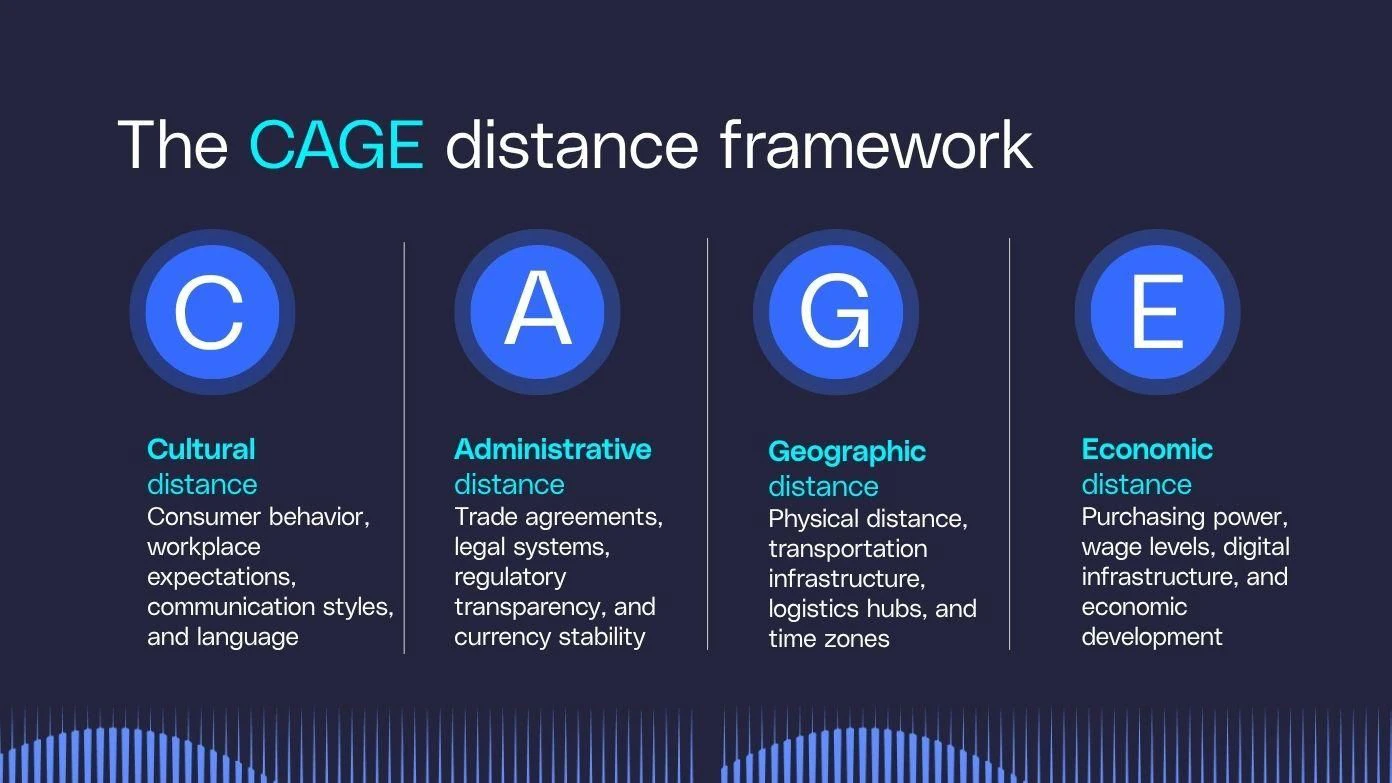
Choosing the right market entry vehicle
The right strategies for expanding internationally also depend on how you plan to operate and hire in each country. Companies expanding overseas and across borders generally choose one of three primary hiring and operating models based on their timeline, workforce needs, and long-term plans.
- Direct local legal entity: Establishing your own entity can make sense when you expect to do business long-term in your target country. It's also often appropriate when you have a larger headcount or complex physical commercial operations and asset ownership. However, entity setup can take several months, involves upfront setup and ongoing operating costs, and is subject to country-specific rules.
- Global employer of record (EOR): An EOR acts as the legal employer of the professionals you want to hire in countries where you don't have an established entity. The EOR handles core employer responsibilities while you manage the day-to-day operations of the hired professionals. G-P EOR supports localized employment contracts, payroll, benefits, and employment compliance in 180+ countries, helping you enter new markets faster. In many cases, you can enter new markets in days rather than months, allowing you to expand quickly and build your global team.
- Global independent contractor: Contractors offer flexibility for project-based or specialized work. However, classification rules vary by jurisdiction. Companies like yours need to assess the engagement and working relationship closely. Misclassification can create tax, employment, and other compliance risks. G-P Contractor™ helps manage and pay contractors while supporting classification checks across multiple countries.
The right model for international market expansion depends on several factors. You need to consider how quickly you want to enter the market, how many people you plan to hire, and whether you want to establish a permanent presence there.
Tips for expanding internationally
Expanding into a new country involves more than choosing a promising market. You need clear strategies for expanding internationally that cover how you'll structure operations, hire talent, and manage local regulatory requirements. Here are several tips that can help you build a stronger foundation for international growth.
1. Conduct an in-depth market analysis
Successful expansion starts with a deep understanding of the market you plan to enter. Research local demand, competitors, customer needs, purchasing power, and pricing before committing resources.
Your analysis should account for regulatory requirements that can affect market entry and ongoing operations. Consider:
- The size and growth potential of your target market
- Existing competitors and their market position
- Potential customers and buying behaviors
- Local purchasing power and pricing expectations
- Employment, tax, licensing, and other applicable regulations
Use this information to estimate realistic revenue potential instead of relying on market size alone. A thorough market analysis can help you identify potential risks early and determine whether the opportunity aligns with your company's broader strategies for international expansion.
2. Develop a localized go-to-market strategy
A go-to-market (GTM) strategy outlines how you'll introduce your product or service to a new market. It helps you identify the right audience to target, refine your broader market positioning, and choose appropriate sales channels. A strong GTM strategy can also help you avoid costly mistakes, such as entering a saturated market or targeting customers who are unlikely to buy.
When creating your localized GTM strategy, consider:
- Your ideal customer's needs and challenges
- How you'll create demand in the new market
- The problem your product or service solves
- Which sales and distribution channels you'll use
- How local competitors position similar offerings
- Whether pricing, messaging, or customer support needs to change
A strategy that worked in one country won't always translate well to another. Localizing your approach can help you respond to market conditions while keeping your broader brand and business goals consistent.
3. Reconsider your organizational setup
International expansion can change how your company needs to operate. Even if you're hiring remotely, you may need to adjust reporting lines, decision-making processes, and management responsibilities to support teams across different countries.
As you review your organizational structure:
- Identify the processes that are most important to your expansion goals.
- Define reporting lines and chains of command.
- Clarify managers' responsibilities and decision-making authority.
- Decide which functions should remain centralized and which ones local teams can handle.
- Make sure your structure reflects company priorities while allowing room for local differences.
A fully centralized model can create unnecessary bottlenecks. But a fully decentralized model can make it more difficult to maintain consistency. Many global companies use a combination of the two, keeping certain decisions centralized while giving local teams flexibility where it makes sense.
4. Familiarize yourself with local regulations
Each country has its own employment, tax, licensing, and business requirements. Understanding the rules of every market you enter can help you avoid delays, unexpected costs, and compliance problems later. You need to know how regulations affect your company, including taxation, liability, ownership, and operational flexibility.
Depending on the country and your industry, you may need to consider:
- Employment and labor laws
- Payroll and tax obligations
- Business licensing and permit requirements
- Ownership or investment restrictions
- Data protection and privacy rules
- Benefits and statutory leave requirements
You also need to understand how these rules affect the way you hire and manage professionals. G-P EOR can support localized employment contracts, payroll, benefits, and employment compliance, helping you expand internationally without first establishing a local entity.
“ G-P gave us the flexibility to move fast. Previously, we had to go through the process of trying to research things in new markets like benefits, legal processes, hiring, firing, etc. It was far easier to have G-P provide that in-country support and insight. There's no doubt we could not have expanded as fast and as effectively as we have if not for our partnership with G-P.
5. Consider cultural sensitivity in recruitment
Hiring across countries means working with different communication styles, workplace expectations, and cultural norms. Building cultural awareness in your recruitment process can help you create a more respectful and consistent candidate experience.
You can strengthen cultural sensitivity by:
- Using inclusive, locally appropriate language in job descriptions
- Providing unconscious bias training for hiring teams
- Using structured interviews and consistent evaluation criteria
- Learning how communication style and workplace expectations differ across markets
- Reviewing recruitment practices for compliance with local anti-discrimination requirements
G-P Gia™ can support global hiring teams with jurisdiction-specific HR and compliance guidance, including help with interview questions and employment documents. With Gia, you can translate essential documents in 50+ languages. Gia can also help you adapt your recruitment process while keeping local requirements in clear view.
6. Create a brand standard for international teams
As you expand internationally and your workforce grows across borders, clear brand standards can help keep teams aligned around your company's purpose, values, and customer experience. Give global teams practical guidance they can use consistently while still allowing room for local nuance.
Your company can support brand consistency by:
- Documenting core brand values, messaging, and communication standards
- Providing localized resources for teams in different markets
- Offering regular training through workshops, webinars, or internal learning programs
- Updating guidance as your company enters new countries or adjusts its positioning
Gia can support document creation and localization, helping international teams stay aligned as your company grows.
7. Avoid the one-size-fits-all leadership style
Leadership practices that work well in one country don't always work in others. Managing international teams requires flexibility because cultural norms can shape how team members communicate, respond to feedback, approach hierarchy, and make decisions.
As a global leader, you can adapt by:
- Encouraging professionals to work both independently and collaboratively
- Helping team members set goals that reflect their roles and career aspirations
- Adjusting communication and management styles to reflect local expectations
- Using different communication methods based on team needs and time zones
- Asking for feedback and listening to how local teams experience company processes
The goal isn't to abandon your company's leadership principles. Rather, it's to apply them in ways that respect local expectations while keeping global teams aligned with shared goals.
8. Adapt to emerging challenges
International expansion can expose your company to external challenges beyond your control. Geopolitical instability, economic volatility, supply chain disruptions, and currency fluctuations can all affect operations across markets.
You can prepare by:
- Identifying the risks most relevant to each market
- Building contingency plans for operational or financial disruptions
- Monitoring regulatory, political, and economic developments
- Reviewing supply chain and vendor dependencies
- Setting clear triggers for when teams should adjust plans or escalate issues
A flexible expansion strategy can help you respond faster to changes as they happen. Regularly review your plans to stay agile and manage risks.
Top challenges for corporations expanding globally and how to overcome them
International market expansion can create new opportunities, but it also introduces challenges that vary by country. Some of the most common are:
- Language barriers: Global teams may work across multiple languages. Gia can help translate documents and provide jurisdiction-specific HR guidance.
- Product or service adjustments: Products, pricing, messaging, or support may need to change for local markets. Use your market research to identify customer expectations and cultural considerations.
- Existing competition: It’s likely that local competitors already have strong customer relationships and brand recognition. Your GTM strategy should clearly define how your offerings differ.
- Financial investments: International expansion involves upfront and ongoing costs. Build these expenses into your financial plan and account for risks like currency volatility.
- Regulatory requirements: Employment, tax, and other rules vary by country. Review local requirements early and use qualified support where needed to reduce compliance risks.
Tips for developing an international expansion strategy
Developing strategies for international expansion is about aligning your market priorities, entry model, workforce needs, and operational goals. A strong strategy can include:
- Market research covering demand, competition, customer needs, costs, and local talent
- A localized GTM strategy for pricing, messaging, sales channels, and support
- An entry model, such as direct hiring, a local partner, an acquisition, or EOR
- A legal and compliance plan covering employment laws, taxes, benefits, permits, data, and intellectual property
- An organizational model that defines decision-making, reporting lines, and responsibilities
- A workforce plan for recruiting, onboarding, managing, and paying global professionals
- A financial plan covering estimated employment costs for setup, payroll, benefits, and taxes, as well as those for currency exposure and operating budgets
- A phased launch with milestones, risk controls, and success metrics
Review your plan regularly as market conditions, regulations, and business priorities change. G-P EOR can support a phased expansion strategy, giving you more flexibility as you test demand and build your workforce in new markets.
Balance local compliance with global policies
Review the legal and regulatory landscape in each country where you plan to expand. Local employment laws, payroll rules, benefits requirements, and data regulations can affect how you apply company-wide policies.
Identify where local requirements differ from your global standards and adjust policies where necessary. Building that flexibility into your strategies for expanding internationally can help you maintain consistency without overlooking country-specific obligations. G-P can support compliance with local employment requirements in multiple jurisdictions while managing payroll and supporting global hiring.
Build a culturally aware workforce
Cultural awareness can help international teams collaborate more effectively across regions. Encourage open communication, inclusive meeting practices, and opportunities for team members to learn from colleagues in different markets.
Accommodate time zones
Distributed teams need clear communication practices across working hours. Identify overlapping hours where possible, use asynchronous communication, rotate meeting times, and set expectations around response times.
Recording meetings and sharing summaries can also help global team members stay informed when they can't attend live.
Use technology for seamless expansion
The right technology can simplify global workforce management as your company expands beyond borders. Look for tools that help you centralize hiring, onboarding, payroll, contractor management, and compliance workflows across markets.
G-P's Global Employment Platform brings these functions together, helping you manage international teams through one connected system. G-P EOR helps you onboard and manage professionals, while Contractor simplifies invoice management and contractor payments for specialized projects.
Streamline global expansion with G-P
Expanding internationally can unlock new opportunities for your company, but it takes careful planning, local knowledge, and the right workforce strategy. G-P helps companies like yours hire, onboard, manage, and pay professionals across multiple countries while supporting compliance with local employment requirements. Our global employment solutions can help you expand into new markets and build teams without establishing a separate entity in each one.
With G-P EOR, Contractor, and AI-powered tools like Gia, you can build and manage global teams with less administrative complexity.
Book a demo today to see how G-P can support your plans for international market expansion.
FAQs
What should I consider when expanding a business internationally?
International expansion requires careful planning and research. Consider local regulations, market demand, product or service adaptations, organizational structure, hiring needs, costs, and cultural differences. Strategies for expanding internationally can help you identify risks early and decide how to enter and operate in each market.
How can I control costs and avoid unexpected expenses during global expansion?
Start with detailed market and regulatory research for each target country. Build a budget that accounts for setup costs, payroll, benefits, taxes, currency exposure, and ongoing operations. Review your expansion plan regularly as conditions and business priorities change. Using an EOR can also reduce the need for local entity setup while supporting payroll, benefits, and employment compliance.
How can I protect intellectual property (IP) when operating internationally?
Develop an IP strategy before entering a new market. Identify which patents, trademarks, copyrights, or other protections apply to your business and where you need to register them. You may also need anti-counterfeiting measures, local legal guidance, and a dedicated budget to protect IP across jurisdictions.