








Key takeaways
- Cultural awareness drives global growth: Understanding international business etiquette can help avoid misunderstandings and build trust across markets.
- Communication and expectations differ across cultures: Business in different cultures varies, and how you approach meetings, hierarchy, feedback, and negotiations influences how your teams will work together.
- Local expertise strengthens market entry: Hiring professionals who know and understand local customs gives your company insight into business practices and expectations.
- G-P simplifies global hiring: G-P EOR lets you hire and manage professionals in 180+ countries without establishing local entities, helping you build culturally informed teams faster.
International business etiquette includes the behavioral norms, communication styles, meeting protocols, and social customs that shape professional interactions across borders. Having cultural awareness in international business can help you prevent misunderstandings, foster trust, and build successful partnerships.
According to the G-P World at Work Report, 97% of executives agree that establishing an international market presence is crucial to remaining competitive, and the Global Growth Report found that 73% of C-Suite leaders prioritized growth in 2024. However, entering a new, international market involves more than developing a growth strategy. The success of your company will depend on how effectively you negotiate, communicate, and build relationships with local professionals. Global expansion frequently underperforms due to behavioral and cultural blind spots as well as regional assumptions.
Understanding international etiquette gives your company a competitive advantage. According to research by Harvard Business Review, companies championing cross-cultural diversity are 45% more likely to capture new market share.
Why cultural awareness in international business drives growth
Today’s modern distributed workforce combines professionals from different countries and cultural backgrounds. This setup creates opportunities to reach new customers and access international talent. It also introduces differences in the workplace.
For example, a manager who makes a suggestion to someone older in a meeting may be encouraging open and transparent communication skills. However, a colleague accustomed to a certain hierarchy, such as in South Korea, China, or Japan, might interpret this suggestion as disrespectful. There may be similar misunderstandings in your commercial relationships. A negotiation can stall when one side expects a quick decision while the other side prefers to build a relationship. As a result, lack of cultural awareness in international business can lead to lost deals, alienated partners, and high employee turnover.
Successful business in different cultures requires “cultural agility,” or the ability to recognize cultural differences and adapt your behavior. For growth leaders, cultural agility helps build inclusive teams where every professional feels respected.
Core dimensions of international business and cultural differences
Understanding international business and cultural differences starts with recognizing how cultures approach authority, communication, and time. These frameworks are general approaches rather than fixed rules.
Low-context versus high-context communication
Low-context cultures prioritize explicit, literal, and precise communication. Speakers explain their expectations clearly and use direct language to communicate meaning. Examples of low-context business environments include Germany, the U.S., and the Netherlands.
High-context cultures prioritize nuanced, layered, situational communication where nonverbal signals and tone are important. Communication relies heavily on context. Examples of high-context business environments include Japan, China, and Saudi Arabia.
For example, in a negotiation, a prospective partner responds to your proposal by saying, “That will be difficult.” Misinterpreting this polite high-context deflection as a positive buying signal is a mistake.
Linear time versus flexible scheduling
Time expectations also influence international business etiquette. In linear-time cultures,
schedules are fixed, punctuality is paramount, and agendas run sequentially. Germany, the U.S., and Switzerland favor this approach. In these environments, arriving late can signal poor preparation.
Flexible-time cultures place greater emphasis on adapting strict timelines to relationships and immediate circumstances. Business practices in Brazil, India, and Spain reflect this approach. Deadlines are just as important. However, professionals in these cultures prefer to balance schedules with interpersonal priorities.
Task-based versus relationship-based trust
Business relationships generally develop through two forms of trust. Cognitive or task-based trust develops through competence, execution, demonstrated performance, and adherence to contracts. Affective or relationship-based trust develops through personal connections, shared meals, and social time.
Task-based trust is prioritized in countries such as the U.S., the U.K., and Denmark, while relationship-based trust is common in Latin America and the Middle East.
Rushing straight to contract negotiations in Brazil or Dubai can seem impersonal when your partner expects time to build rapport.
Structural Element: Comparative framework table
|
Behavioral dimension |
Low-context / task-oriented framework |
High-context / relationship-oriented framework |
Representative global markets |
|---|---|---|---|
|
Communication style |
Explicit, literal, direct; meaning sits in spoken words |
Implicit, layered; meaning sits in context and nonverbal cues |
Low: U.S., Germany, Netherlands High: Japan, China, Saudi Arabia |
|
Trust formation |
Cognitive: proven operational track record and speed |
Affective: shared time, mutual respect, personal character |
Task: U.S., U.K., Denmark Relational: Brazil, India, UAE |
|
Time orientation |
Linear: strict agendas, hard deadlines, prompt arrivals |
Flexible: fluid schedules, relationships dictate timing |
Linear: Germany, Switzerland Flexible: India, Brazil, Spain |
|
Hierarchy |
Egalitarian: flat teams, open debate, direct pushback |
Hierarchical: deference to rank, consensus-led, senior authority |
Flat: Sweden, Denmark Hierarchical: Japan, South Korea, China |
International business manners across key global markets
Business in different cultures requires understanding the local culture while avoiding assumptions about communication styles and relationships.
Here are regional examples that offer guidance for negotiations, meetings, and international business manners.
Business etiquette in Europe: Germany and France
German business environments emphasize punctuality, structured agendas, and data-backed presentations. Hierarchy is important as well. In traditional settings, senior participants enter the room first. Use surnames and professional titles (Herr/Frau Doktor) until you’re invited to use first names. Keep humor and casual conversation limited during formal meetings and negotiations.
French business culture places value on analytical reasoning. Intellectual discussion is a sign of respect, not hostility. Schedule meetings weeks ahead, especially when executives are attending. Avoid unannounced drop-ins, and provide enough time for participants to prepare. Making an effort to greet and converse in French shows cultural respect. Even when discussions are in English, acknowledging the local language is important.
Business etiquette in the Asia-Pacific region: Japan and China
Japanese business etiquette emphasizes preparation and respect. The business card ritual, or meishi koukan, is particularly important. Offer and accept cards with both hands, study them carefully, and display them on the table rather than placing them in your pocket. Silence during discussions signals contemplation and respect, not disagreement or uncertainty. Avoid interrupting participants in business meetings or pressuring them to respond quickly. Japanese organizations also use nemawashi, which is an informal process of discussing proposals or building consensus behind the scenes before official meetings. Give stakeholders time to consult internally, and share materials in advance.
Business relationships in China are influenced by guanxi, which describes interpersonal networks and reciprocal obligations. Building these relationships requires trust and consistency. Another important concept is mianzi, or saving face. Avoid publicly criticizing or contradicting business counterparts, and address disagreements privately. Seating protocol reflects hierarchy. In formal settings, the host faces the entrance, while the highest-ranking guest sits directly to the host’s right. Specific arrangements vary by venue and occasion, though. Indirect refusals are another consideration. Navigate ambiguous statements to avoid public disagreement. Confirm decisions through follow-up meetings.
Business etiquette in Latin America: Brazil
Personal relationships carry substantial weight in Brazilian business culture. Deals are closed between individuals, and trust develops through conversation and shared experiences. When visiting Brazil, allow time for introductions and informal discussion. Avoid treating relationship-building as a delay to business negotiations. Close physical proximity and tactile communication, such as a hand on your shoulder, denote trust. Dining etiquette is important as well. The use of utensils and napkins is often a requirement at formal business meals. Avoid assuming you can eat pizza, sandwiches, or bread by hand. Always use utensils.
Business etiquette in the Middle East: Saudi Arabia and the UAE
Hospitality is central to business etiquette in the Middle East. Business meetings frequently begin with Arabic coffee, tea, and personal inquiries about well-being and family. These conversations establish rapport and show that you value the relationship beyond the immediate transaction taking place. Greetings are important as well. Handshakes are gentler or longer than in other regions. Allow your counterpart to establish the appropriate greeting, and avoid withdrawing your hand abruptly, as this can signal disinterest.
Cross-cultural negotiation and executive dealmaking
International business etiquette directly affects how you negotiate, resolve disagreements, and reach commercial agreements. Successful international negotiations require attention to seating arrangements, hierarchy, nonverbal communication, and body language.
For instance, familiar gestures in one country don’t have identical meanings worldwide. The North American “thumbs-up” and “OK” hand signs can be deeply offensive in parts of the Middle East, West Africa, and Brazil. Avoid relying on hand gestures to communicate agreement or approval.
While sustained eye contact signals confidence in countries like Germany, the U.K., and the U.S., prolonged eye contact can feel confrontational in Japan and South Korea. In the Arab world, strong eye contact communicates integrity. It’s always a good idea to observe your counterpart’s behavior before responding.
When navigating international business and cultural differences, consider seating arrangements. In many countries, meeting layouts follow a hierarchy, placing importance on seniority. Consult local hosts before making seating arrangements in high-context cultures, and consider angled or round tables to reduce tension.
Allow time for private consultation. In high-context cultures that emphasize consensus, participants need opportunities to discuss proposals privately. Schedule private recesses during complex negotiations.
Managing cross-cultural communication across remote global teams
Good international business manners extend to virtual collaboration. When you’re managing business in different cultures, you will need communication practices that accommodate different languages, workplace expectations, and time zones. Start by establishing a culture of shared documentation standards and select tools intentionally. Low-context tracking, such as status updates and task assignments, belongs in asynchronous project platforms, while video meetings work better for sensitive feedback and complex discussions.
Consider negative feedback carefully. Direct criticism works in the Netherlands but causes loss of face in Japan or South Korea. Deliver feedback privately, explain expectations clearly, and focus on constructive improvements.
For more guidance, explore our strategies to enhance communication across remote teams.
When onboarding employees globally, introduce communication expectations early. Explain meeting practices, feedback processes, reporting structures, and available support systems. Encourage international team members to share their preferences rather than assuming everyone follows the same cultural norms.
How local hiring through an employer of record bridges the cultural divide
Having cultural awareness in international business is a useful starting point. However, international business etiquette tips alone can’t replace first-hand market knowledge. Local professionals can bridge the cultural divide by bringing practical knowledge that generic guidance can’t replace. Local professionals understand regional communication styles, customer expectations, and cultural details that can affect business relationships.
Building a local entity can take 6-12 months and requires heavy capital. An employer of record provides an alternative. Through G-P EOR, you can hire native talent in 180+ countries in minutes without setting up local entities. G-P supports compliant employment contracts, payroll, benefits, and ongoing employment administration.
Local professionals contribute market knowledge and fluency while you focus on growth.
G-P Gia™ delivers instant, expert-vetted HR compliance insights across 50 countries and all 50 U.S. states, while G-P Assist provides global onboarding and localized employee support.
Kraft Sports + Entertainment (KSE) is an example of a successful expansion with local expertise. KSE needed professionals who understood the local environment in Germany and Brazil. Rather than establish local entities, KSE hired G-P to build authentic, culturally aligned fan connections without entity delays.
As Joe Dorant, Senior Director of Sales Operations at KSE, explained:
“Having a local representative in Germany allows us to establish a genuine connection with our international fans.”
The KSE customer story shows how cultural understanding can boost a company’s expansion.
Practical international business etiquette tips for executive teams
Understanding cultural differences is only valuable when you consistently apply that knowledge to your daily business interactions. Use these international business etiquette tips to prepare your company for cross-border negotiations and meetings.
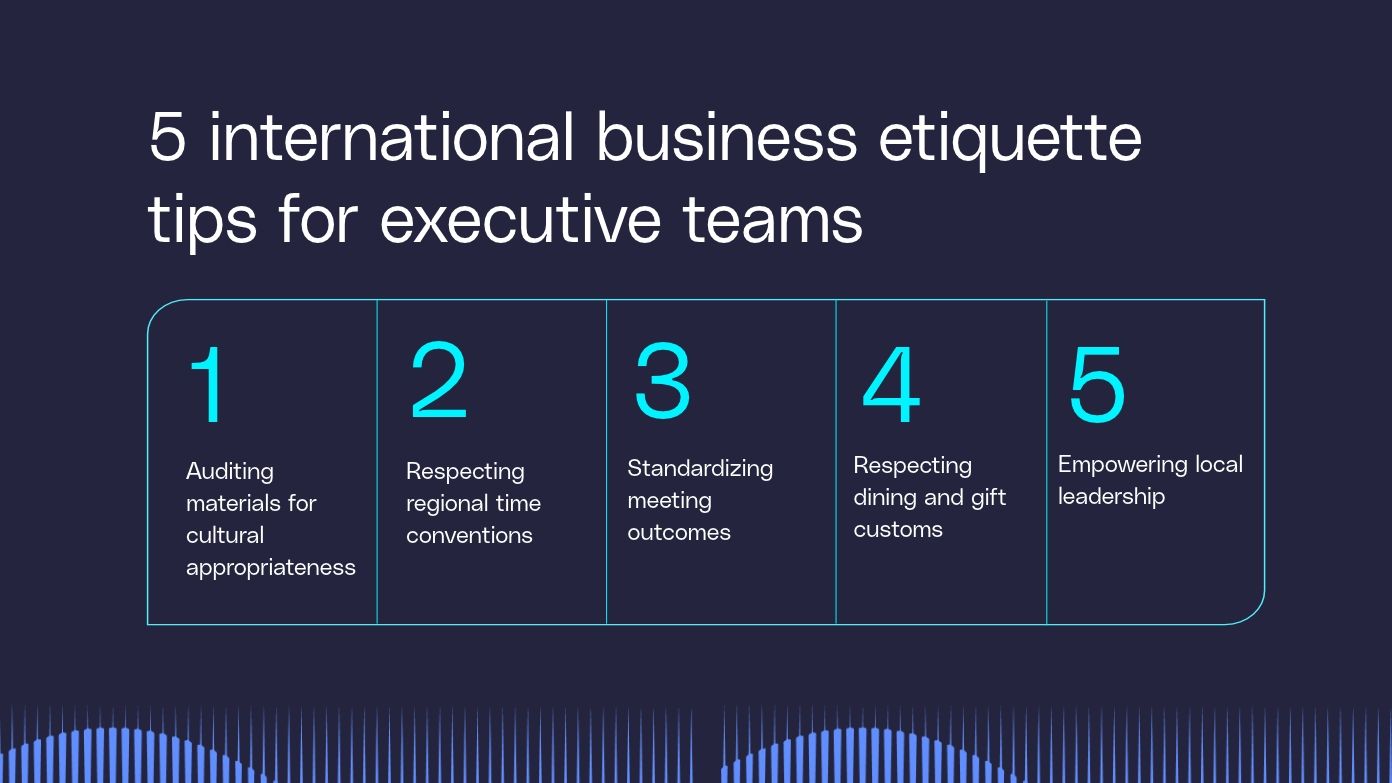
- Audit pre-meeting materials: Ask local professionals to review presentation decks, proposals, and marketing materials to remove offensive idioms, humor, images, or phrasing. Translate important materials when appropriate and confirm that examples resonate with the intended audience.
- Honor regional time conventions: Research local expectations around punctuality and meeting length. Align meeting agendas with local pacing. Allow time for introductions and discussions in relationship-first business environments, and always communicate deadlines clearly. Use structured agendas when participants expect detailed planning. Allow time for introductions and discussion when personal relationships influence business decisions. Always communicate deadlines clearly.
- Standardize post-meeting memos: Send written summaries after verbal discussions to ensure clarity for professionals working in a second language. Encourage participants to clear up misunderstandings before work proceeds.
- Respect dining and gift customs: Research local business meal etiquette, dietary considerations, and gift-giving traditions. Understand local gift-giving boundaries, taboo colors, and dining rituals before hosting clients. Check your company’s anti-bribery policies before exchanging gifts.
- Empower local leadership: Hire in-country professionals via G-P EOR to lead local client meetings and manage ground operations. Then combine your local knowledge with company standards to build effective international teams.
Build strong international teams with G-P
International business etiquette will influence how your company communicates, hires, negotiates, and grows. Understanding international business and cultural differences can help strengthen your professional relationships and establish trust.
But sustainable growth also depends on hiring the right professionals. G-P gives you the employment infrastructure and local expertise to build international teams without establishing legal entities in every country.
With G-P EOR, G-P Gia™, and G-P Assist, you can simplify global hiring and hire international professionals within minutes. Ready to grow your international team? Book a demo to see how G-P can support your global expansion goals.
 FAQs
What is international business etiquette?
International business etiquette refers to the communication styles, social expectations, professional customs, and meeting practices that influence business interactions in different countries. Understanding international business and cultural differences can help you communicate respectfully and develop productive international relationships.
Why is cultural awareness important in international business?
Cultural awareness helps you understand how professionals in different countries approach decision-making, negotiations, and communication. It also improves relationships and reduces misunderstandings.
How do communication styles differ between low-context and high-context cultures?
Low-context cultures prioritize direct and literal communication with clearly stated expectations, while high-context cultures prioritize relationships, tone, and body language. Adapting your communication style can help you avoid misunderstandings.
How can companies navigate cultural differences when expanding globally?
Companies can research local customs and adapt the appropriate communication practices. It’s also a good idea to hire professionals with local expertise. Working with an employer of record, such as G-P EOR, allows you to hire local professionals and expand your company without establishing local entities.

