








Key Takeaways
- Market entry strategy: A strong market entry strategy helps you focus resources on the most promising opportunities without the expensive trial and error.
- Research your target market: Analyze the market size, local competitors, customer needs, and regulations to ensure your value proposition is a good fit.
- How to grow: Prioritize value-based hiring, use AI-powered tools to ensure compliance, and partner with an employer of record (EOR) to grow from startup to mid-size company.
- Use G-P EOR: Put your growth plans into motion and build your global team quickly — without the risks.
Establishing a new market entry strategy is a natural next step for leaders in a fast-growing business. You believe in your product and services, you’ve hired a team of superstars, you’ve proven your value in the marketplace, and you’ve established partnerships that show you’re not alone in this belief. Success starts with a clear global market entry strategy. Now it’s time to consider unlocking new opportunities by expanding your business to new markets.
Market entry involves entering markets with an existing product or service. A strong market entry strategy outlines essential specifics on how to grow your business. A well-established strategy should also highlight business goals, an overview of the target market, sales goals, and a go-to-market plan for how you’ll drive ROI.
The next step? Share your company’s vision and product far and wide. Whether you’re a business with 10 employees or working from your kitchen table, all startups are built on promise, and they can develop into valuable entities with the right plan in place.
While your company is growing, it can also be a daunting task to transition from startup to mid-sized company. When you embark on a new market entry project, use this multi-step blueprint to build your go-to-market plan and accelerate value faster.
Growth vs. scale: What does it mean to scale a startup?
A common thread across all startups is walking the line between growth and scaling. Growth involves expansion and an increase in various aspects of the business, while scaling is more about optimizing operations to handle growth more efficiently.
As you seek to expand your early-stage startup into a mid-size business, growth will require a proportional increase in resources. Scaling, on the other hand, aims to achieve more output with the same (or even fewer) resources. From hiring more employees to expanding into new markets, growth manifests by expanding a company’s operations, customer base, and global market presence. While achieving growth seems daunting in today’s complex market ecosystem, successful market entry is possible with a long-term business model that is built to grow rapidly.
How to create a winning market entry strategy
When entering a new market, it’s essential to invest in capabilities to manage and spur growth, especially in often overlooked areas such as administrative tasks and human resources functions.
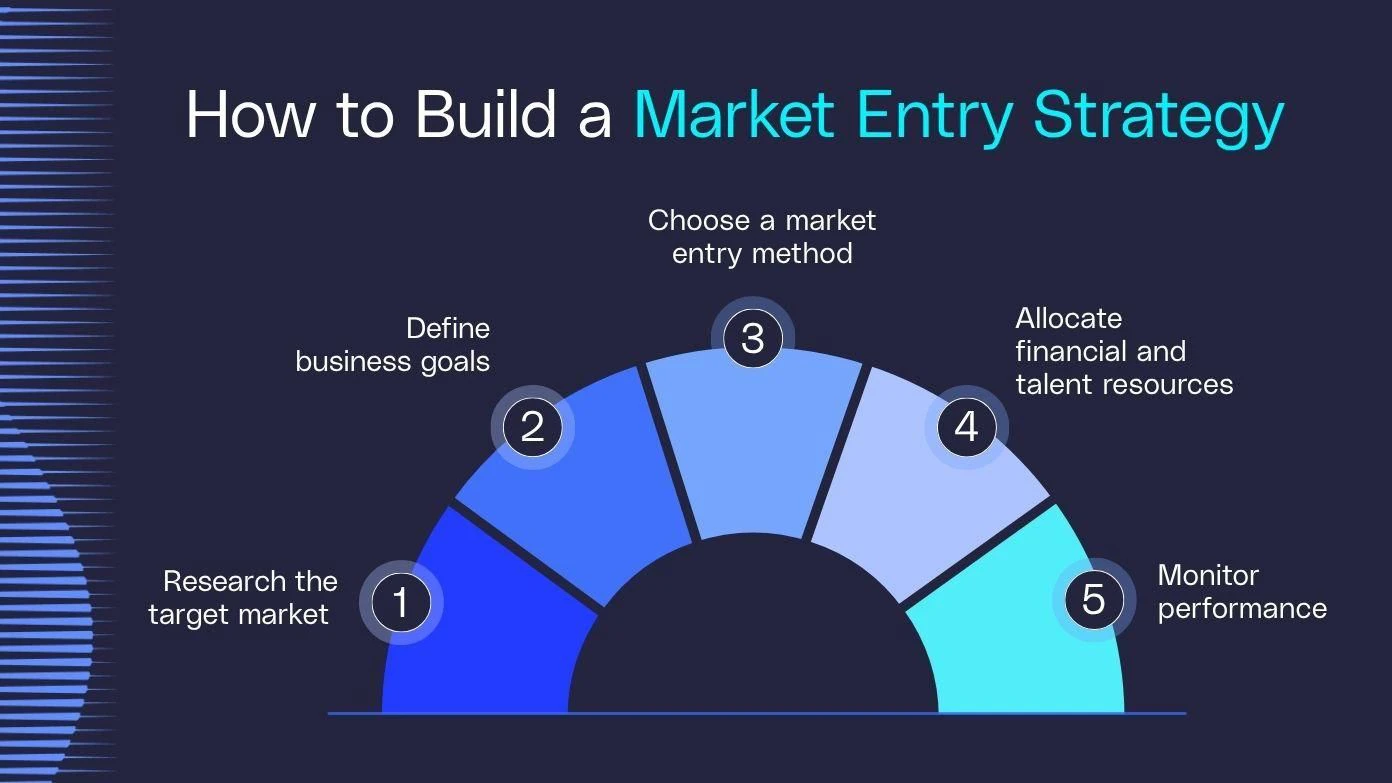
For businesses of all sizes, a new market entry strategy should include these common steps:
- Research the target market. Start with a market potential analysis to assess customer demand, market size, local competition, and regulatory requirements. Use these findings to identify opportunities and determine whether your product or service meets local needs.
- Define clear goals and objectives from the outset. Your target market analysis will inform your goals and objectives. Create precise and realistic business goals based on your company’s target growth KPIs.
- Determine your mode of entry. Your research and goals help in selecting how you enter the market. From exporting to partnering, how you choose to launch your business operations in your target market should be based on steps 1 and 2.
- Map your strategy to your financial needs. Success is built on the numbers. Ensure you have the right allocation of both financial and talent resources to meet your goals.
- Document, monitor, and assess performance. Keep organized documentation of your research, goals, and processes. Having this information on hand makes required adjustments identified in the monitoring and assessment process easier. Sometimes you need to look back to move ahead.
 How to grow from startup to mid-size in 6 simple steps
While there is no “one-size-fits-all” approach to running your own growth, startups embarking on a new market entry project should prioritize value-based hiring, focus on a global growth mindset, and give new hires a competitive advantage in a local market. And by engaging with an employer of record partner like G-P to help you, you’ll find that you can put your plans for growth into motion with more flexibility and efficiency than ever before.
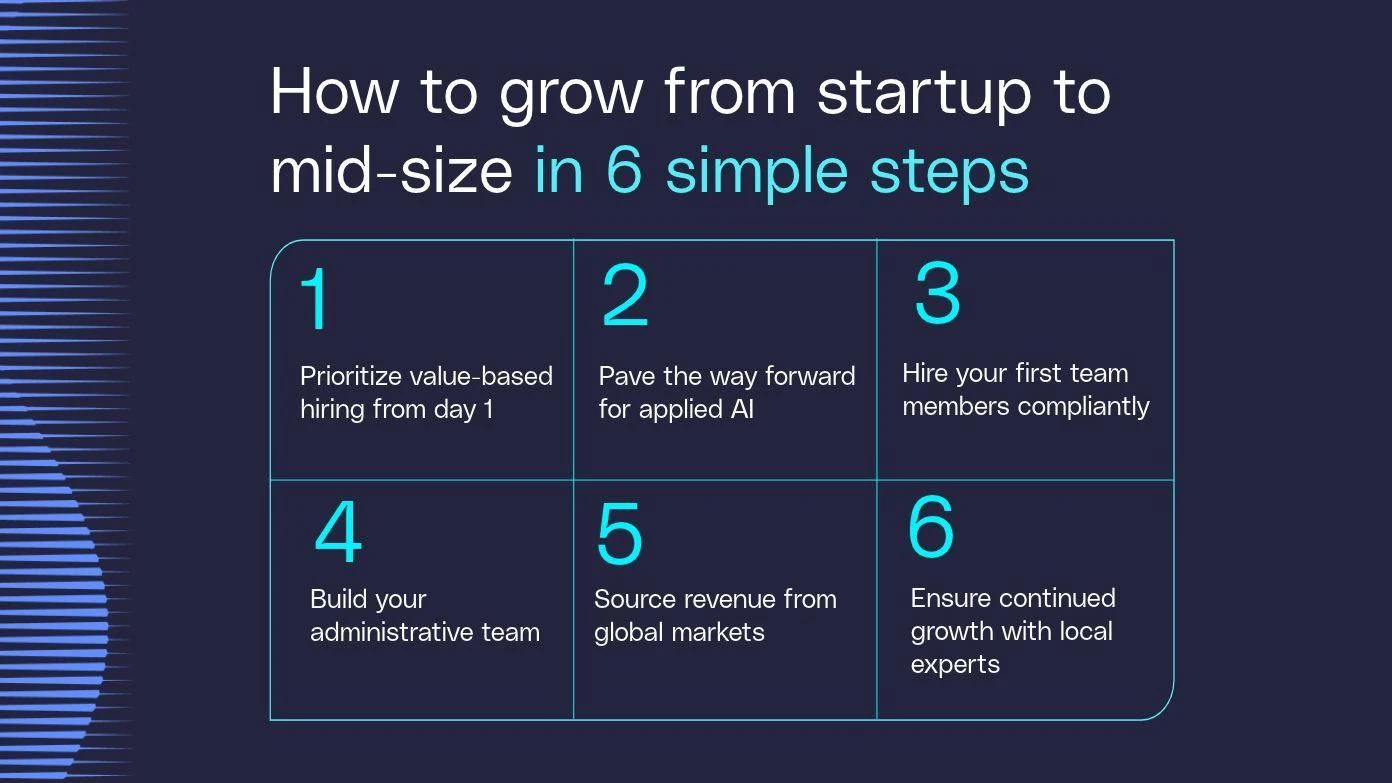
You can reinvigorate your company while expanding your team, product, or service offerings. Here’s how we recommend doing just that:
1. Prioritize value-based hiring from day one
As you expand your marketing efforts as a business owner, chances are you’ll need to grow your team. With 50% of surveyed U.S. adults ranking transparency about salary, benefits, and work culture among their top priorities when applying for a job, it is key to focus on fostering a positive and inclusive work environment that shines through your brand image to position your company as an appealing option for top talent. People are increasingly seeking out deeper meaning in their work, and startups are uniquely positioned to attract people with a passion for your mission.
Seek out candidates who are drawn to the guiding principles that define your organization and how it operates. According to PwC's Workforce Hopes and Fears Survey 2025, 72% of workers globally consider alignment with their personal values very or extremely important when evaluating a potential job. This is why you should clearly define your unique value proposition in your target market, adapt your interview process to speak openly, and ask behavioral questions that can better evaluate a candidate’s soft skills.
2. Pave the way forward for applied AI
Any successful business entering a new market should also adopt technology that drastically decreases the administrative burden of manual work. For example, you may want to simplify marketing strategies for your startup or small business by investing in a lead generation tool that automates email creation and deployment.
You can also free up time for product development by leveraging artificial intelligence (AI). Have you used ChatGPT to outline business plans or DALL-E 3 to build a paid social ad? Chances are you’re not alone. According to McKinsey & Company's State of AI 2026 report, 56% of respondents say their organizations use AI in three or more business functions. And this is exactly why you need to consider how AI can strengthen your talent pipeline, improve ways of working for existing talent, and scout new job seekers as you build out your joint venture.
New features and technology offered within the G-P suite of global employment products provide everything you need — including intuitive self-service and AI-enabled features — to streamline the administrative and legal complexities of global business expansion and new market entry, so you can focus on building your teams.
3. Hire your first team members compliantly
Your first hires in a new country are critical to success during expansion. You need someone with local knowledge, a passion for your company’s mission, and the ability to build and coach an entirely new team.
To get started, it’s important to understand the local talent market, including any benefits or perks that professionals in the area tend to prioritize during their job search. Then, leverage these key insights to attract top talent via job listings, during the interview process, and through referrals.
It’s also crucial to familiarize yourself with the local employment laws and regulations. For example, some countries have significant limitations around background checks, while others are less stringent with the information companies can inquire about. Similarly, employment contract requirements vary by country and can lead to serious problems down the road if you don’t follow them.
4. Build your administrative team
Once they have chosen the perfect candidates for the job, most companies need to contract support personnel, human capital management technology, internet providers, and other services for their teams. You will need to set up financial controls and an expense system. The new hires may expense equipment, networking, travel, local suppliers, and interviewing costs as they begin building their teams.
Here’s why you need to trust your first hires implicitly: Real team players can inform you about the best workspaces, service providers, and expense needs for their markets.
5. Source revenue from global markets
If you laid firm groundwork for your new market teams, they’ll be eager to get down to business, bring in clients, set up local partnerships to attract potential customers, and most importantly, generate cash flow. As you generate revenue in new markets, plan how you'll manage cross-border payments, currency conversions, and financial reporting. Compare transaction fees and exchange rates to control costs and protect profitability.
Opening a business bank account abroad can involve minimum deposit requirements, extensive paperwork, and even in-person visits from company executives. The exact requirements depend on the country and financial institution. Time and travel restrictions can make in-person visits difficult or impossible. A sound option is to open a multi-currency account, which can save companies time, administrative hassles, and costs while offering competitive exchange rates.
6. Ensure continued growth with local experts
If all goes well, your first hires will need to build a team quickly. Since new hires are entrepreneurs at heart, they’ll be looking for the next big challenge once the local team is settled in. To ensure employees maintain their momentum, it’s key to equip them with the proper support and expertise and prevent common growth obstacles from slowing them down.
Leverage the knowledge of in-country experts to free up valuable team members’ time. Local experts can handle the complexities surrounding onboarding, taxes, compliance, and intellectual property while your global team focuses on successfully scaling your company.
That’s where G-P comes in. Our in-region HR and legal experts have over a decade of experience helping companies at all stages build and manage global teams, anywhere in the world — starting in just minutes. As your guide to global growth, we handle the legal and administrative tasks that often get in the way of seamless market entry.
Solve the compliance challenges of entering a new market
Managing permanent establishment risk is a crucial part of entering a new market with less risk and greater confidence. You must also consider how local employment laws affect worker classification, so you can avoid misclassifying an employee as an independent contractor or vice versa. If you do, it can lead to fines, back taxes, and legal disputes.
Another common challenge that relates to global hiring is following strict labor laws so that you don't accidentally violate local employment requirements. One of the best ways to solve these challenges is to centralize your compliance controls, automate legal workflows, and manage employment requirements by using a global employment platform that already has in-country expertise.
Managing permanent establishment (PE) exposure:
To take your business to a new country, you don't always have to establish a local legal entity. For example, you can hire employees through an employer of record that already has a legal presence in the country. However, you must still evaluate all of your business activities to determine whether there's a permanent establishment risk. If some of your activities include negotiating contracts, signing agreements, or conducting core revenue-generating business, this can cause your company to establish a taxable presence, which may subject it to local corporate taxes and reporting obligations.
Top strategies for reducing permanent establishment risk:
- Review local tax laws and applicable tax treaties.
- Evaluate employees' responsibilities in foreign countries.
- Assess international remote work arrangements.
- Monitor employees' authority to negotiate and sign contracts.
- Review the use of offices and other fixed business locations.
- Distinguish preparatory activities from revenue-generating activities.
- Consult international tax professionals before expanding operations.
Navigating statutory benefits and labor laws
Employment termination requirements differ by country. Depending on the market, you need to account for mandatory notice periods, valid reasons for termination, severance pay, and employee consultation requirements. Review local laws before establishing employment contracts or making workforce changes.
Depending on the country, the following could be necessary:
- 13th- and 14th-month bonuses: Provide employees with one or two additional salary payments each year.
- Mandatory vacation minimums: Some local laws require more paid time off than your company normally provides.
- Local pension contributions: Contribute part of each employee's earnings toward a local retirement program.
Once you have established your business in a new market, you can't assume your compliance responsibilities will stay the same. Many of the local employment laws and regulations change over time. If your HR team is constantly researching legal requirements, reviewing government websites, and cross-referencing different sources, that type of “triple-check tax” can take valuable time away from hiring new employees and supporting your growing workforce. And this is another reason that automated compliance monitoring is so valuable for businesses expanding into international markets.
Agentic compliance automation
G-P Gia™ is an intelligent global HR compliance agent that focuses on helping businesses manage and navigate the complexities of international employment laws and regulatory requirements. Gia provides country-specific compliance guidance thanks to its Global Compliance Engine (GCE), which encodes over 10,000 labor regulations across 180+ countries. The engine is constantly updated to stay current with changing employment laws and regulations. You'll receive real-time regulatory alerts when relevant legal changes could affect your company's compliance obligations.
Grow your startup with G-P
G-P's Global Employment Platform™ offers everything your startup needs to rapidly find, hire, and manage global teams in 180+ countries. Transitioning from a startup to a mid-size business can be challenging, but with G-P by your side, the new market entry that comes with this kind of growth can be faster and easier than you ever imagined.
FAQs
What are the main global market access strategies?
Companies have several ways to enter a new global market, including exporting, licensing, franchising, joint ventures, strategic partnerships, and establishing a local business presence. If you want to hire new employees in the new market without establishing your own local entity, it can be helpful to consider the advantages of using an EOR.
What is a strategic market entry strategy?
It's a detailed plan that clearly outlines all of your strategies relating to introducing your products or services to a new market and achieving your business goals. The plan typically covers how you will conduct market research and the types of entry methods that you'll use for expansion. Many businesses also outline their financial resources and how they will use those funds to support growth and long-term success.
How do you choose the right new market to enter?
There are five main factors to evaluate when entering a new market: market demand, local competition, customer preferences, potential profitability, and local regulations surrounding hiring and employment.
How do you build a go-to-market plan for a new market?
Your go-to-market plan should clearly identify your target customers and include a detailed value proposition. It should also have measurable goals for sales and revenue growth that you can track to evaluate your progress. Other important elements to include in the plan are the sales and marketing channels available to reach your target audience.
What are the biggest challenges of entering a new market?
Some of the biggest hurdles involve understanding local employment laws, classifying workers correctly, and avoiding permanent establishment risks.


