







Key takeaways
- Pressure testing over experimental adoption: Companies in 2026 are shifting from pilot-everything strategies to rigorous evaluation, demanding proven ROI before committing budgets.
- Accuracy is the new competitive advantage: While AI speeds up workflows, human oversight is critical to mitigate risk and ensure quality.
- AI must be paired with trusted expertise: Tools like G-P Gia™ bridge the execution gap by combining AI speed with legally vetted guidance, allowing you to scale global teams with compliance and confidence.
The third-annual AI at Work report dives deep into how AI trust, adoption, and ethics have changed in 2026. The results deliver critical insights for business and HR leaders looking to turn the pushes and pulls of AI into a clear path forward.
Methodology
The 2026 G-P AI at Work survey was conducted by Wakefield Research among 2,850 executives with a minimum seniority of VP, in the U.S., Germany, Singapore, Australia, and France, including a separate audience of 500 U.S. HR professionals. The questionnaire was fielded between March 6 and March 16 2026, using an email invitation and an online survey.
Report overview
Last year, executives leaned into AI with excitement. Adoption and experimentation were the top strategies. Today, AI has to earn its keep. And although the hype hasn’t faded, the market now demands tangible, ethical, and accurate ROI.
| Metric | 2026 finding |
|---|---|
| Aggressive innovation | 42% of execs are aggressively using AI (down from 60% in 2025) |
| Underperformance | 73% of AI spending fell short of expectations |
| The “bubble” fear | 44% of global leaders expect the AI bubble to burst in 2026 |
| Monitoring tax | 69% report a growing human oversight burden |
| Human value | 82% admit AI has lowered the value placed on human employees |
| Global mobility | 82% would hire in countries with no physical presence to secure AI talent |
These numbers only tell part of the story. Explore the sections below for a detailed analysis of our key findings.
Finding 1. Full throttle is out. Pressure testing is in.
From experimental adoption to an intentional approach
AI is the most transformative force of our time, but its nature has shifted from a sense of wonder to a high-stakes reckoning.
Adoption and testing were the cornerstone strategies of 2025. In 2026, AI must show results. While 100% of surveyed executives use AI, many are trading last year’s aggressive push for measurable impact.
Data snapshot
- No more experimental play: The 20-point drop in aggressive AI approaches shows companies are no longer innovating for the sake of innovation. They want proven ROI blueprints before committing their budgets.
-
Pressure over purpose: 62% of executives admitted to feeling somewhat pressured by their organizations to use AI, while 38% only use AI tools because they’re personally beneficial.
-
Build vs. buy: 11% of executives are building their own AI solutions, up from 7%. Companies are ditching off-the-shelf AI solutions for customized tools to meet their unique security and compliance needs.
Innovation vs. imitation
The approach to AI adoption has shifted year-over-year, but it’s clear that the investment is primarily motivated by the desire to enhance profit margins.
Survey highlight: How global executives characterize their organization’s approach to AI adoption
| Executive AI adoption strategy | 2025 | 2026 | Year-over-year change |
|---|---|---|---|
| Aggressively using AI to innovate in their industry | 60% | 42% | -18% |
| Following industry lead | 47% | 33% | -14% |
| Building proprietary AI | 7% | 11% | +4% |
Survey highlight: Executive motivation for AI investment
| Improve profit margins | 39% |
|---|---|
| Increase talent retention | 24% |
| Close the gap with competition | 24% |
| Investor pressure | 14% |
Key takeaway
Trade the AI hype for AI utility. Prioritize tools that fix your team’s specific challenges over a pilot everything approach.
“AI isn’t one-size-fits-all. A sophisticated strategy identifies high-impact AI use cases and builds the necessary organizational foundation before the plan is written. That’s the difference between a perpetual proof of concept and a successful, transformative deployment.” Nat Natarajan, COO, G-P
Finding 2. The honeymoon phase is over
The performance ultimatum
Despite the hype surrounding AI, the payout isn't hitting the balance sheet. Most AI spending has underdelivered, leaving execs feeling like they’re burning cash.
Data snapshot
- ROI reality check: 16% of companies saw a negative ROI from AI investments last year, and 73% of executives revealed the ROI fell short of expectations.
- The final warning: Nearly 70% of global executives are prepared to scale back AI budgets if company goals aren’t met this year.
The P&L pressure
No matter the currency, the majority of global executives are ready to scale back AI budget if 2026 profit goals aren't met.
Survey highlight: Likelihood of executives scaling back AI budgets if 2026 profit goals aren’t met
| U.S. | 75% |
|---|---|
| Singapore | 65% |
| Australia | 64% |
| U.K. | 64% |
| France | 62% |
| Germany | 58% |
Survey highlight: Executive expectations for an AI bubble burst in 2026
| Executives view AI as long-term | 69% |
|---|---|
| Executives predict a bubble burst | 31% |
Globally, executives are divided on whether the AI bubble will burst this year, but 69% of U.S. HR executives view AI as a long-term structural shift, highlighting that their function sees this as an integral part of the future of work.
Key takeaway
Leaders shouldn’t view AI budget reallocations as a tech failure, but as a refinement of strategy. Rigorous pressure testing ensures every investment has visible returns and protects the organization from the volatility of the hype cycle.
“AI is increasingly being measured by trust, accountability, and business impact. For global employers, that means focusing AI on navigating complexity, reducing risk, enabling better decisions, and expanding access to talent across borders. The future belongs to companies that pair AI with the right expertise, governance, and operational discipline to turn opportunity into real business outcomes.”
Finding 3. AI needs a human boss
AI speeds up work. But only 23% of global executives have total confidence in the accuracy of AI output. Companies are doubling down on oversight to make sure speed doesn't come at the cost of quality, signaling that 2026 is the year of the human editor.
Data snapshot
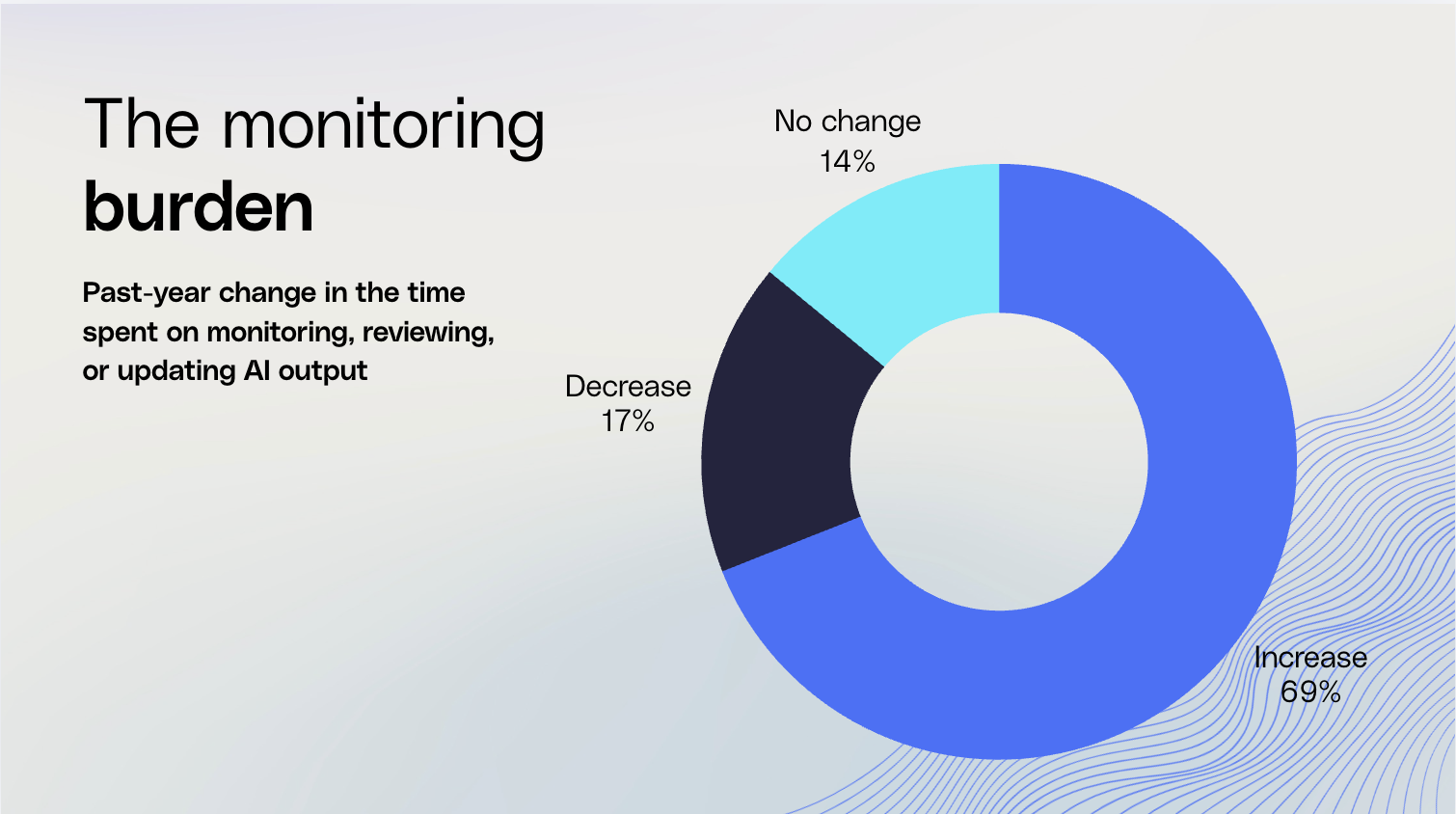
- Human oversight: 69% of executives say they spend more time monitoring and acting as high-level editors for unvetted AI.
- Shadow AI: 90% of leaders fear employees are using unvetted tools.
- A crisis of ethics: 61% of executives feel moral distress when using AI to draft sensitive documents because they aren't sure if the output is legally accurate.
Survey highlight: Executive trust in AI for high-stakes functions
| Would trust AI with risk management | 51% |
|---|---|
| Would trust AI with financial budgeting | 54% |
| Would trust AI with talent management | 57% |
Survey highlight: Employee time spent overseeing AI-generated work
| Increased | 69% |
|---|---|
| Decreased | 17% |
| No change | 14% |
Real-world AI: Customer applications
Boston Dynamics’ long-term partnership with G-P allowed the company to find specialized talent, confidently manage risk, and use AI for strategic agility.
Key takeaway
Speed is a commodity; accuracy is a competitive advantage. With hidden liabilities, leaders must formalize their human-in-the-loop model. Build a decision-making firewall where AI accelerates the workflow and humans validate the output.
“Don't wait. The longer you wait, you're just losing out on the opportunity for you to drive your business goals forward.” Eduardo Ramos, Head of Total Rewards, Boston Dynamics
Finding 4. The devaluation nobody’s talking about
While humans sit firmly in the driver’s seat for high-stakes decisions, 82% of executives admit AI has lowered the value they place on human employees. This startling admission suggests that as algorithms become more capable, the human element is increasingly viewed as a secondary asset.
Data snapshot
- Productivity paranoia: 88% of executives are concerned that employees are using AI to "perform productivity" rather than adding true business value.
- Privacy sacrifice: Only 12% of executives strongly agree that sacrificing employee privacy for AI monitoring is worth it to reach business goals.
Survey highlight: Executives' view of their company's relationship with AI
Humans lead the work (60%)
████████████
AI is integrated into most tasks to provide data and speed.
Humans do the work (23%)
█████
AI is used selectively as a basic support tool.
AI drives core processes (17%)
███
Humans oversee the system and handle exceptions.
Real-world AI: Customer applications
Rackspace quickly saw the need to get involved and upskill employees. The company created an AI literacy program called Foundry AI by Rackspace.
Key takeaway
As AI becomes more capable, human-only skills become more valuable. High-stakes roles require empathy, ethics, and strategic nuance that algorithms can’t replicate. Get ahead of productivity paranoia the right way by reinvesting in human-centric skills.
“We had four different training tracks depending on your role in the organization. We wanted to get our employees up to speed on AI and make sure they were equipped with the knowledge and resources before we started solutioning.”
Finding 5.Going global for AI
AI is simultaneously devaluing the existing workforce while intensifying a cutthroat competition for a specific subset of human talent. The quest for specialized skills like AI experts has triggered a strategic move toward a borderless workforce.
Data snapshot
- The borderless solution: 82% of global executives would hire in a country where they don’t have existing employees to secure top AI talent.
- Risk-reward balance: 41% of executives say AI makes talent access easier but also creates new risks they aren't prepared for.
- The talent barrier: 52% of leaders say AI talent shortages and lack of data literacy are top barriers to their AI goals.
Key takeaway
Solve the AI talent shortage by adopting a borderless hiring strategy. Go where the talent lives and tap into global talent pools.
“The competition for specialized AI talent is no longer a local battle; it’s a global one. By expanding your reach beyond traditional borders, you don’t just solve local talent shortages — you gain the agility and diverse perspectives required to lead in the AI era.” Laura Maffucci, Head of HR, G-P
Real-world AI: Product feature
G-P Gia™ is built to turn distress into compliance certainty. Unlike general LLMs, Gia combines over a decade of proprietary expertise, 100,000+ legally vetted articles, and 1,500+ government sources to give you guidance you can trust.
- Get instant, vetted answers: Gia gives you context-specific guidance vetted by experts, eliminating the need for constant human review.
- Draft with confidence: Review and generate HR documents across 50 countries and all 50 U.S. states with total legal accuracy.
- Bridge the execution gap: From expert-vetted guidance to automated compliance, Gia steps in where you’d normally rely on external counsel, cutting legal spend and admin time by up to 95%.
"When you're dealing with 180+ countries, compliance is a moving target. AI allows us to process changes in labor laws at a speed that was previously impossible for a human team alone." — Adrienne Drew, VP, Product Counsel Head of Legal for Gia, G-P
Bridge the execution gap
Leaders must decouple talent acquisition from geographic constraints. The goal is a borderless workforce where the human premium — judgment, ethics, and strategic nuance — is amplified, not replaced. When you remove the friction of borders, you transform your workforce into a global competitive advantage.
While AI can draft code and analyze data in seconds, legacy expansion processes — like entity setup and local tax registrations — take months. This execution gap is where strategic momentum goes to die. At G-P, we’ve spent 14+ years perfecting the balance of industry-leading technology and human expertise so you can build global teams at the speed of your strategy.
If you’re part of the 82% ready to hire across borders to win the AI race, you shouldn't be held back by entity setup or red tape. G-P’s Global Employment Platform provides the critical foundation you need to operate globally with confidence and compliance.