




AI is now built into almost every software and system. But adding a conversational interface doesn’t automatically make it agentic.
An agentic AI Global Employment Platform connects information to defined workflows, supports permitted actions, and surfaces situations that require additional review.
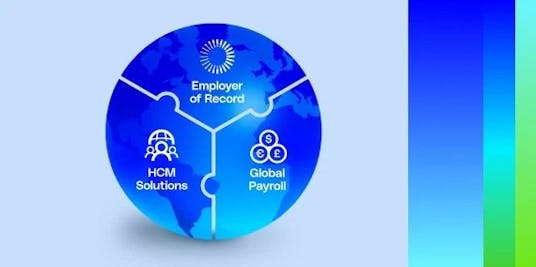
G-P is the world’s first agentic Global Employment Platform. It brings together innovative products — including G-P EOR, G-P Contractor™, G-P Gia™ — integrations, APIs, global employment knowledge, and AI-supported workflows to streamline every global need.
We introduced our next generation of AI capabilities in June 2026, but what makes a platform truly agentic?
What makes a Global Employment Platform “agentic”?
A Global Employment Platform is a technology and operating environment designed to support employment and workforce processes across countries.
An agentic AI Global Employment Platform adds AI capabilities that can interpret context, support defined workflows, use connected information or tools, and help determine an appropriate next step within established controls.
Let’s say you need guidance on onboarding an employee in Germany. A chatbot would likely give you a general overview of key employment laws.
Agentic AI will connect that question to relevant context, workflow steps, required information, approvals, or a point of escalation.
The difference isn’t simply a conversational quality. It’s whether AI can stay connected to the work that follows the answer.
For more on agentic AI technology, check out What are HR AI agents and how do they impact global hiring? and How AI is used in HR: A 2026 guide for global leaders.
A Global Employment Platform isn’t the same thing as an EOR
An employer of record (EOR) serves as the legal employer for global professionals, allowing companies to hire anyone, anywhere, regardless of entity status.
A Global Employment Platform operates at a broader level and acts as the technology backbone for your international needs.
We created the EOR industry 14+ years ago and have continued to evolve our EOR technology ever since — read more in The end of the tradeoff: Why we rebuilt G-P EOR.
G-P EOR is one of many important components of our Global Employment Platform.
But a global workforce involves other needs as well. A company may also need to engage independent contractors, employ people through its own entities, need country-specific HR or compliance guidance, or connect global-employment activity with existing workforce systems.
That’s why companies need a broader Global Employment Platform.
A Global Employment Platform isn’t the same thing as an HRIS
A Human Resources Information System, or HRIS, centralizes employee information and supports core HR processes.
A Global Employment Platform like G-P uses integrations and APIs to support employment across countries while connecting with the tools you already use, including:
- An HRIS or HCM
- An applicant-tracking system
- Payroll
- Benefits technology
- Finance applications
- Identity and access systems
- Workforce-planning tools
- Other specialist HR applications
A Global Employment Platform doesn’t have to replace all of those systems to be useful. It can instead connect with the systems that matter to the relevant employment workflow.
Check out The power of an integrated HR ecosystem for more on G-P’s approach to connected specialist technology.
What should companies look for in a Global Employment Platform?
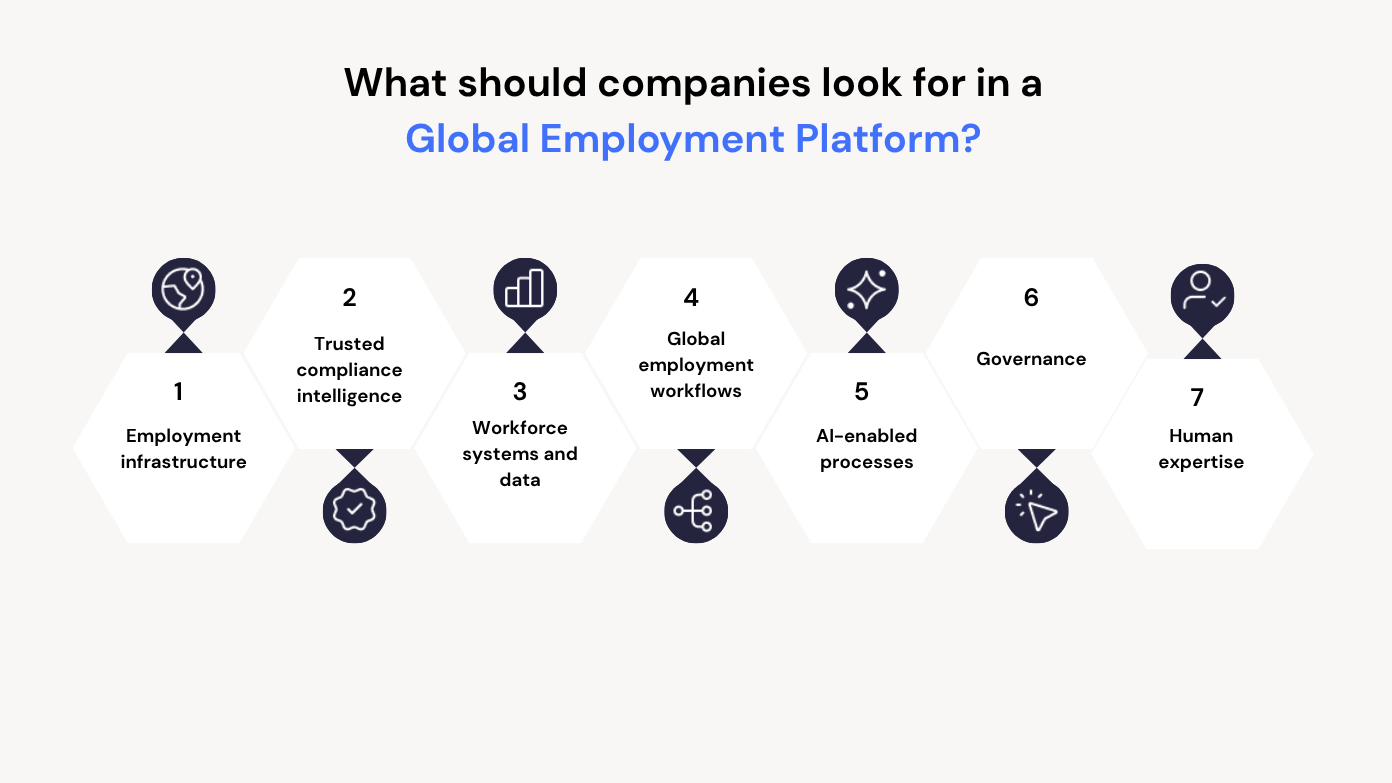
1. Employment infrastructure
Global hiring starts with the underlying workforce relationship.
An employee hired through an EOR, an eligible independent contractor, and an employee of the company’s own entity aren’t the same thing.
The relevant employment model affects the workflow, responsibilities, documentation, and applicable requirements.
At G-P, those distinctions are reflected in separate products. G-P EOR supports the full employment lifecycle, while G-P Contractor supports contractor engagement, contracts, invoicing, payments, and tools designed to help identify classification risk.
2. Trusted compliance intelligence
Global HR isn’t one-size-fits-all. Different factors come into play, such as:
- Jurisdiction
- Worker status
- Employment model
- Company circumstances
- Effective date
G-P’s Global Compliance Engine applies digitized country-specific employment rules to every workflow.
Separately, G-P Gia provides expert-vetted HR and compliance guidance across 50 countries and all 50 U.S. states.
For more on how Gia delivers accurate results that are 10x better than the AI industry, see Legal expert interview: G-P Verified Sources and G-P Gia.
3. Workforce systems and data
Global employment rarely begins and ends in a single application.
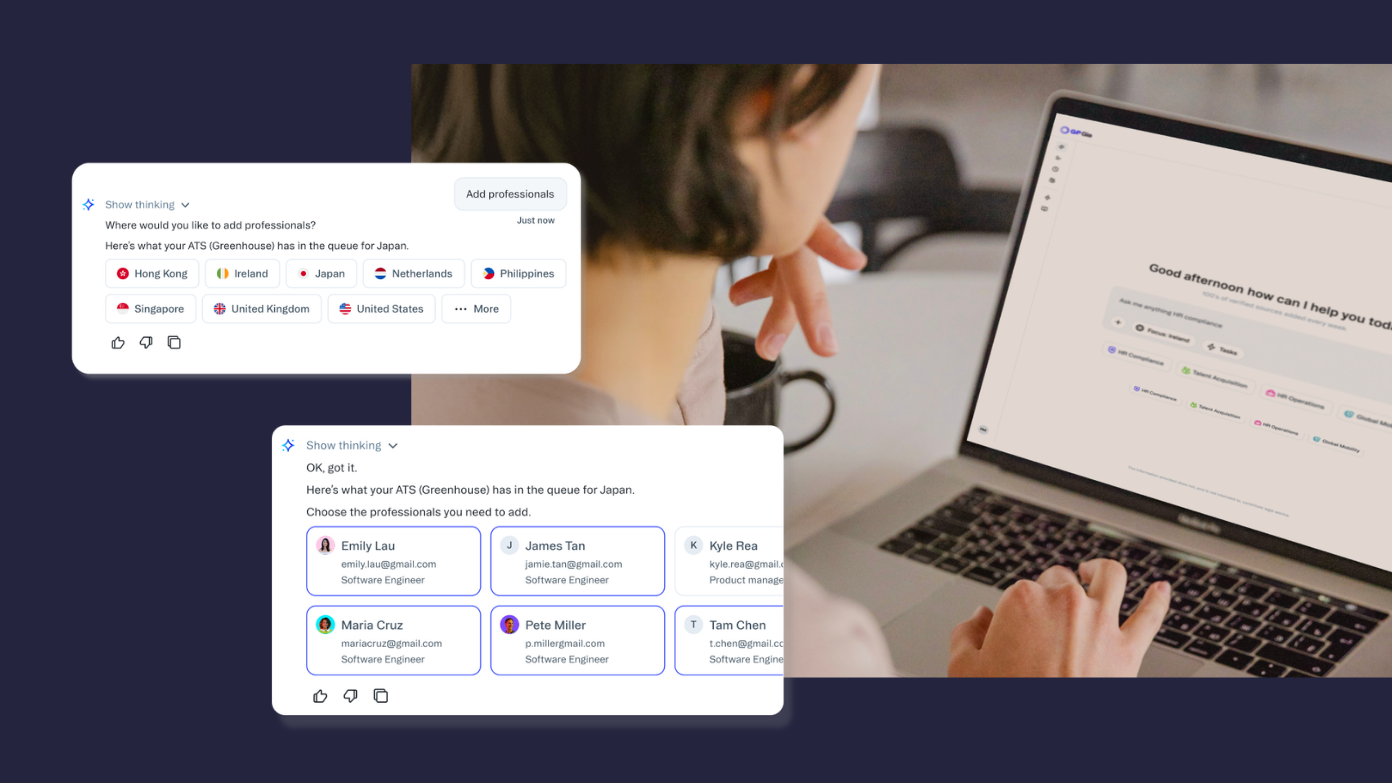
A candidate may originate in an ATS. Employee information may live in an HRIS. Payroll, benefits, finance, identity, and reporting may involve additional systems.
When those environments are disconnected, HR teams have to re-enter information, reconcile changes, or manually reconstruct context between systems.
Integrations reduce that burden.
G-P’s integrations and APIs support connections between the platform and your existing workforce systems.
For a deep dive into connected global employment technology, see How AI is reshaping global employment and technologies powering the future of global EOR.
4. Global hiring and employment workflows
A Global Employment Platform does more than streamline hiring.It handles employment documentation, local requirements, onboarding activities, benefits setup, payroll, and more.
G-P describes its broader global-employment capabilities at Global Employment Solutions.
The exact workflows and timeline will vary based on jurisdiction, employment model, documentation, individual circumstances, and other dependencies.
The useful question isn’t only “How fast is onboarding?” but whether the underlying process is visible, connected, and appropriately managed.
5. AI that can support work beyond information retrieval
AI can reduce the gap between finding information and completing the work that information implies.
Depending on the system and use case, AI can help:
- Retrieve relevant information
- Interpret intent
- Prepare documents
- Guide defined workflows
- Identify missing inputs
- Summarize requirements
- Support next steps
- Route exceptions for additional review
G-P’s What are HR AI agents explains how AI agents differ from more traditional forms of automation.
G-P’s Using AI in HR Guide provides broader examples of how AI can support HR work.
And How AI Is Reshaping Global Employment explores the broader shift in global-employment technology.
6. Governance
As AI is embedded into more workflows, the controls around that activity are more important than ever.
Companies evaluating AI-enabled HR technology should assess:
- What information the system can access
- What actions it can support or complete
- What requires approval
- What gets logged
- How exceptions are handled
- When additional human review is required
These questions matter because global employment involves worker data, contracts, payroll, classification, and country-specific employment requirements.
AI can support those workflows, but it doesn’t eliminate the need for appropriate controls, evidence, or human judgment.
7. Human expertise
Not every global employment situation is repeatable or deterministic.
Some workflows can be automated within defined parameters. But a credible Global Employment Platform should have a process to escalate situations that require additional expertise.
G-P takes a human-in-the-loop approach. We have the largest team of HR and legal experts in the industry. Customers get dedicated account managers, 24/7 availability, and localized HR experts to troubleshoot issues in real time. Self-serve intelligent support is also available through G-P Assist, and human experts are always ready to help with complex situations.
Why does this matter for global employment?
Global employment combines multiple layers that can easily become fragmented:
employment infrastructure + country-specific knowledge + workforce systems + workflows + governance + human expertise
AI can make those elements easier to navigate when it remains connected to the relevant context and workflow.
That’s why an agentic AI Global Employment Platform is more useful to evaluate as an operating architecture than simply as a chatbot, an EOR portal, or an isolated AI feature.
G-P has already published material addressing individual parts of this environment, including:
- Using AI in HR Guide
- What Are HR AI Agents?
- How AI Is Reshaping Global Employment
- Technologies Powering the Future of Global EOR
- The End of the Tradeoff: Why We Rebuilt G-P EOR
- Legal Expert Interview: G-P Verified Sources & G-P Gia
- The Power of an Integrated HR Ecosystem
- Global Compliance Engine
How G-P’s agentic Global Employment Platform works
Our platform brings together different products and capabilities.
G-P EOR supports companies hiring employees in countries where they don’t have a local entity.
G-P Contractor supports contractor engagement, contracts, invoicing, and payments.
G-P Gia provides AI-supported HR and compliance guidance across 50 countries and all 50 U.S. states using G-P Verified Sources.
G-P API+ and integrations connect G-P with your existing workforce systems for a unified tech stack.
The Global Compliance Engine applies digitized country-specific employment rules within every workflow to ensure compliance anywhere you hire.
The new standard is agentic
The first generation of enterprise AI made information easier to generate. The next challenge is making work easier to accomplish. For global employment, that requires more than a conversational interface or an isolated AI feature. A useful standard for evaluating an agentic AI Global Employment Platform is whether it connects:
employment infrastructure + trusted intelligence + workforce systems + global employment workflows + governance + human expertise
G-P is the world’s first agentic AI Global Employment Platform that turns global HR and compliance into a growth engine. Powered by 14+ years of expertise, our platform embeds labor law intelligence directly into your existing tech stack, allowing you to hire and scale compliantly in 180+ countries in minutes.
 Frequently asked questions
What is an agentic AI Global Employment Platform?
An agentic AI Global Employment Platform is a technology and operating environment that combines global workforce capabilities with AI to interpret context, support defined workflows, connect information across systems, and escalate work when human judgment is required. Exact capabilities vary by provider and product.
Is a Global Employment Platform the same as an employer of record?
No. An employer of record is an employment model. A Global Employment Platform is a broader technology and operating environment that may include EOR capability alongside other global workforce products, intelligence, integrations, and workflows.
Is a Global Employment Platform the same as an HRIS?
No. An HRIS generally centralizes employee information and core HR processes. A Global Employment Platform supports global employment infrastructure, knowledge, and workflows and may integrate with an existing HRIS rather than replace it.
Is agentic AI just a chatbot?
No. A chatbot can be one interface to an AI system. Depending on the system and use case, agentic AI can go further by interpreting context, supporting defined workflows, using connected tools or systems, completing permitted actions, and escalating exceptions within established controls.
What should companies look for in a Global Employment Platform?
Companies should evaluate whether the platform supports the employment models and countries they need and how it connects global employment infrastructure, compliance intelligence, workforce systems, workflows, AI, governance, and human expertise.