



Key takeaways
- What is an AOR: An agent of record (AOR) manages a company’s independent contractor relationships and payment oversight.
- What is an EOR: An employer of record (EOR) serves as the legal employer for your global workforce, allowing you to hire internationally without setting up a local entity.
- AOR vs. EOR scope differences: While AORs manage independent contractor relationships, EORs typically support both full-time employees and contractors.
- How to make the right choice: Choose an AOR if you only work with contractors and want to offload admin tasks. Choose an EOR if you want an end-to-end solution for blended workforces and compliance assurance.
Productivity never stops when teams are spread across different time zones. But few companies are prepared for the legal and administrative tangle that comes with global employment, including complying with local labor laws, tax regulations, and local employment practices.
Agents of record (AOR) and employers of record (EOR) are two ways of managing a global workforce. This guide will help you understand the differences between EOR and AOR, so you can choose the right approach for your needs.
What is an AOR?
An agent of record manages a company's independent contractor relationships. This differs from an insurance agent of record, which represents a policyholder with their insurance company.
AOR services provide a framework for engaging contractors. An agent of record acts as an intermediary to reduce compliance risks by handling administrative tasks.
The core functions of an AOR platform are:
- Classification: An agent of record provides guidance to help companies ensure proper contractor classification and adhere to local regulations. These classifications are based on the nature of the work, the level of control exerted by the company, and the contractor's autonomy. By keeping up with regulations, AOR services can help companies avoid worker misclassification. This protects your reputation and financial stability.
- Contract management: AOR platforms help create compliant contracts and implement essential clauses related to intellectual property, confidentiality, and data protection. They draft, review, and manage agreements, ensuring all terms are valid and legally sound.
- Setup: An AOR can support contractor setup by gathering each new contractor's personal details, bank information, tax reference numbers, background checks, and reference reviews.
- Payment oversight: AOR services oversee invoicing, payment processing, currency conversions, and expense management. They help ensure contractors receive accurate, timely payments.
What is an EOR?
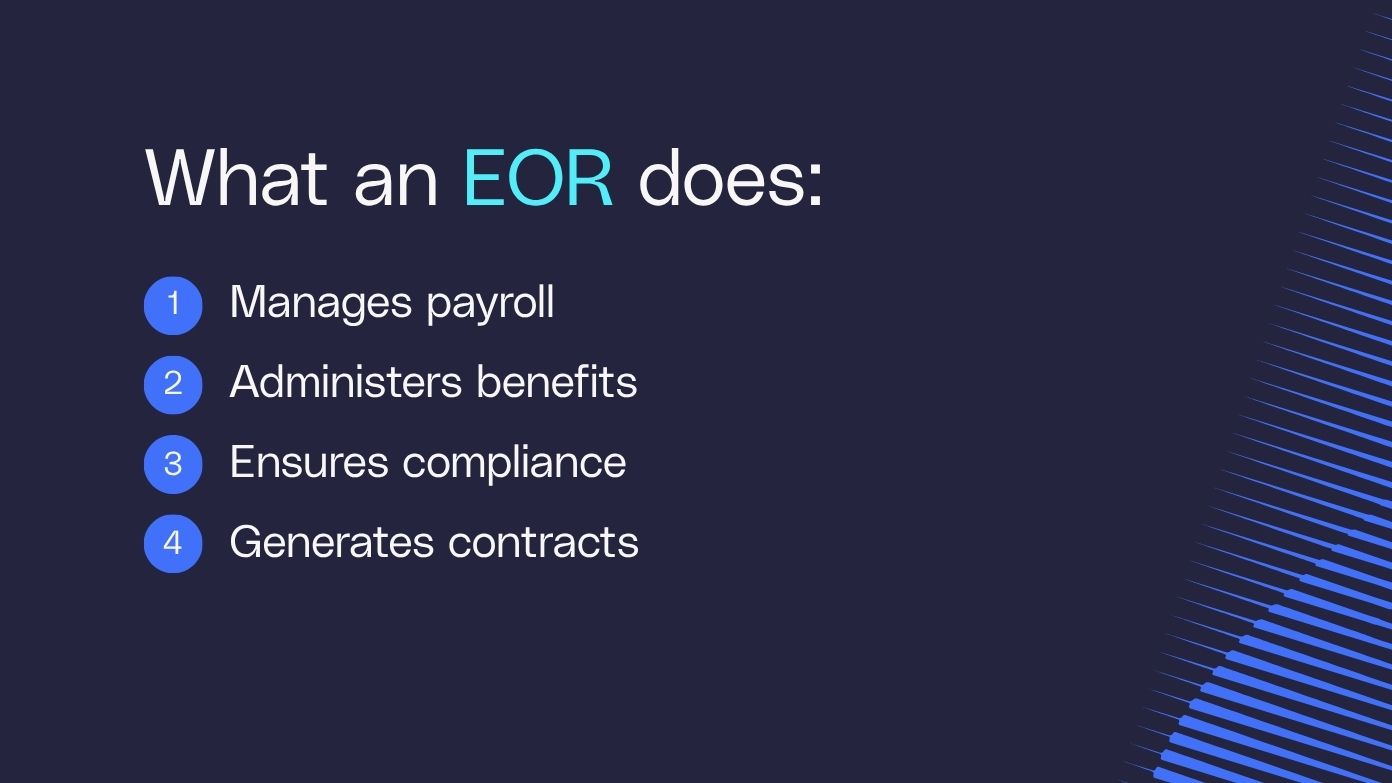
An EOR's key responsibilities include:
- Managing payroll: EORs streamline global payroll processes, providing timely payments in local currencies. This involves calculating, remitting, and documenting payments, withholding taxes, and staying current on relevant employment and tax laws.
- Administering benefits: EOR benefits administration services include tailoring compensation to local expectations, healthcare enrollment, and managing employer contributions.
- Ensuring labor law compliance: EORs stay on top of evolving labor, employment, and tax regulations. Using an EOR is the simplest way to protect your company from costly mistakes.
- Generating contracts: EORs generate compliant contracts and provide country-specific templates for easy customization.
Key differences between AORs and EORs
An EOR takes on employer responsibilities. An agent of record helps manage contractor relationships, but companies retain liability.
AOR platforms are dedicated to managing contractor relationships, while EOR services are equipped to serve companies hiring full-time employees and/or contractors. This means an agent of record can help scale project-based workforces, while an EOR can support both worker types and is ideal for entering new markets.
As the legal employer, EORs take on a broader range of responsibilities and functions compared to an AOR. These include:
- Ensuring labor law compliance
- Administering benefits
- Streamlining payments
You can't hire employees through an agent of record. Companies wanting to hire in a new global location have to set up an entity or partner with an EOR.
EORs have a global entity infrastructure that you can use to hire employees or contractors quickly and compliantly.
AOR vs. EOR: top differences
| Feature | Agent of record (AOR) | Employer of record (EOR) |
|---|---|---|
| Worker type | Independent contractors | Full-time or part-time employees and independent contractors |
| Legal relationship | Contractors are self-employed, so the AOR acts as an intermediary | The EOR becomes the worker’s official legal employer in that jurisdiction. |
| Main function | Ensures contractor status, manages service agreements, and handles cross-border payments. | Manages the entire global employment life cycle, including localized payroll, tax withholding, compliance, employment contracts, and contractor hiring and payment. |
| Risk mitigation | Minimizes the risk of contractor misclassification penalties and tax audits. | Assumes employer liabilities (e.g., wrongful termination risks, statutory adherence). |
| Payroll and taxes | Facilitates invoice payouts. Contractors handle their own tax obligations. | Processes payroll, calculates and deducts income tax, social security, and health contributions for employees. Handles invoicing and crossborder payments for contractors. |
| Benefits and leave | No statutory benefits, paid time off (PTO), or healthcare apply as contractors are self-employed business entities. | Administers all statutory benefits (PTO, sick leave, parental leave) and supplementary insurance for employees. |
| Best for | Companies that need project-based workers but want to offload the admin responsibilities. | Companies of all sizes that need flexibility to hire employees and/or contractors, without the risk of misclassification or hassle of entity setup. |
AOR vs. EOR: 5 misconceptions
Here are common misconceptions worth clearing up before you choose between an AOR and an EOR.
Misconception 1. EOR employees are separate from the core team
EOR professionals are integrated into your operational workflows and team culture. They go to meetings, follow your processes, and work under your leadership, just like any other team member. While the EOR handles administrative tasks like benefits and payroll administration, your company is responsible for workloads, performance, and daily operations.
Misconception 2. Partnering with an EOR means giving up control over employment decisions
Companies partnering with an EOR retain control around talent selection, role changes, and offboarding strategy, while the EOR manages the underlying legal employment and administrative requirements.
Misconception 3. EORs are only for international hiring
The most common reason companies partner with an EOR is when they want to hire in a new country but lack the legal presence and regulatory expertise. Some countries, including the U.S., have complex state-to-state variations in employment laws.
An EOR can streamline market access while ensuring compliance with municipal and state regulations. This makes EOR services useful for domestic growth as well as global scaling.
Misconception 4. AOR services are only for insurance and benefits management
Some AOR services specialize in insurance policy. Others have a broader scope of contractor services and can help with classification, contract management, and payment oversight.
Misconception 5. An AOR absolves you of legal liabilities
An agent of record can help with compliance in contractor relationships, but liability remains with the company.
For example, an agent of record can help reduce the risk of worker misclassification by advising you on local classification rules and how they apply to your company. However, your company — not the AOR — will be responsible for any mistakes. You may need to consider further measures to protect your brand reputation and assets.
EOR vs. AOR: Which one should you choose?
Deciding between an EOR or AOR depends on your workforce needs, compliance requirements, and growth objectives. Use the following hiring scenarios to guide your decision:
| Hiring scenario | Choose | Why? |
|---|---|---|
| You’re hiring an employee in a country where you don’t have an entity. | EOR (employer of record) | Only an EOR can legally employ the worker on your behalf and administer benefits. |
| You’re hiring a contractor for a 2-month project. | AOR (agent of record) or EOR (employer of record) | An AOR could handle this engagement or an EOR with a contractor offering could also hire the contractor, generate the agreement, process invoices, and make payments. |
| You work with contractors but want the option to convert them to full-time employees later | EOR (employer of record) | Supporting both contractor and employee hiring under one EOR relationship makes the transition smoother if the role evolves. |
| You're paying a contractor through their own registered business entity, not as an individual. | AOR (agent of record) | Business-to-business (B2B) contracts are easily managed through an AOR framework. |
| You’re hiring in a country with strict labor laws (e.g., Germany, France, Brazil). | EOR (employer of record) | EORs ensure strict adherence to local labor laws from day one. |
| You need to verify a contractor's own business credentials — professional licenses, certifications, business registration, liability insurance — before engagement. | AOR (agent of record) | This is a contractor-specific compliance check AORs can manage, although some EORs offer contractor-compliance services too. |
If you're looking for fast and compliant global hiring for full-time employees and contractors, EORs offer significant advantages, including:
- Quick market entry: Working with an EOR is a fast, direct route to enter your target market. An EOR allows you to skip entity setup for immediate hiring.
- Risk mitigation: An EOR offers risk mitigation by assuming the compliance responsibilities of an employer. This offers superior assurance when entering new and complex regulatory environments.
- Streamlined operational focus: By managing a wider range of HR and administrative tasks, an EOR is the most effective approach for global team management. An EOR frees you to focus on core business activities.
- Local expertise: EORs have deep local expertise regarding employment practices, market conditions, cultural nuances, and labor regulations.
- Flexible growth: Using an EOR lets you scale up or down, depending on strategic priorities, needs, and market fluctuations.
- Payroll and benefits administration: From providing local benefits packages to managing payroll deductions and contributions, an EOR can help attract and retain top talent while ensuring compliance.
- Resource optimization: An EOR removes the need for a local entity and streamlines every aspect of employment. This reduces initial expenses, so you can use these resources for profit-driving operations.
An EOR provides a more comprehensive solution for managing global teams and mitigating risks associated with global employment. EORs outperform AORs most when blended workforces play a major role in your growth strategy or you're navigating complex regulatory environments.
An AOR can benefit businesses that rely mainly on independent contractors and already have a strong grasp of the new market's legal and employment landscape.
Why trust G-P
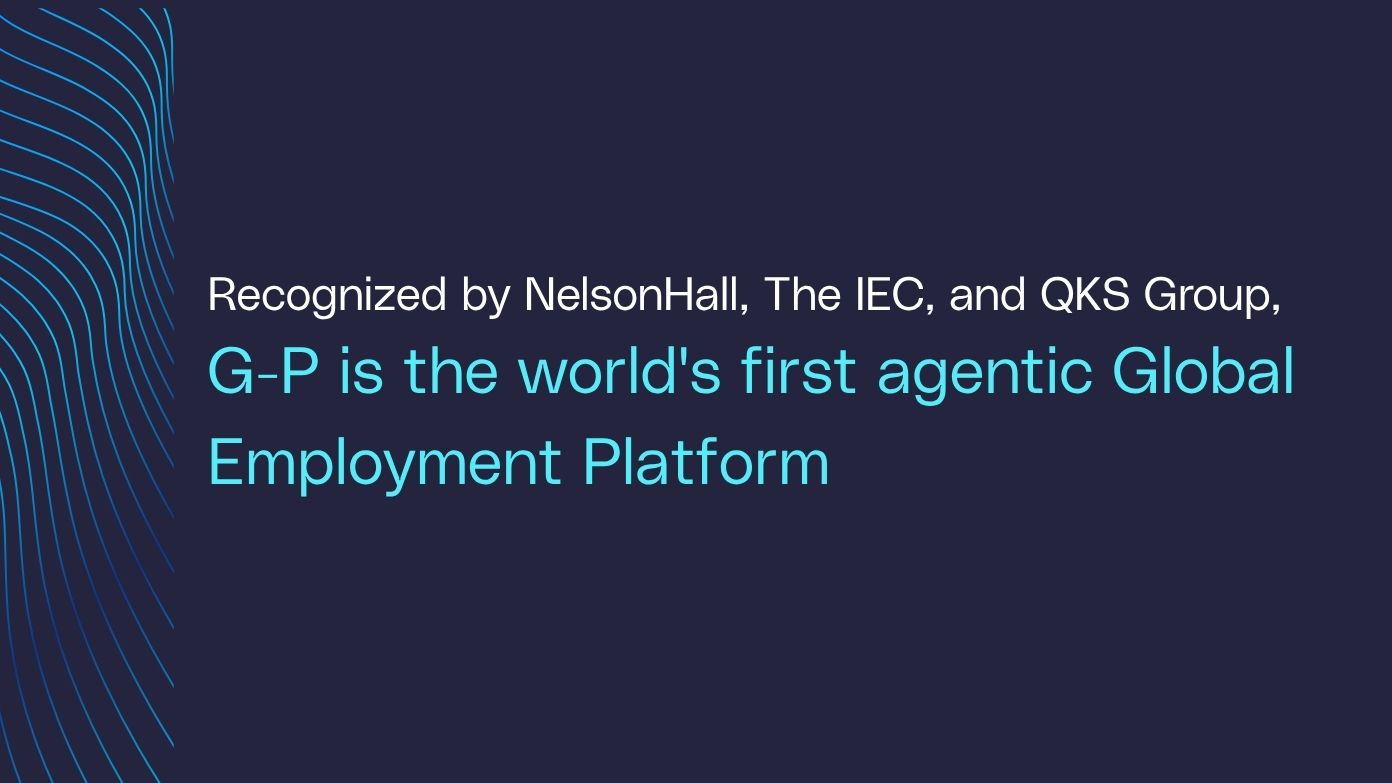
G-P has also been recognized by top industry analysts, including:
- NelsonHall Global EOR Services NEAT evaluation report: 2020, 2022, 2023, 2024, 2025
- Everest Group Employer of Record (EOR) Solutions PEAK Matrix Assessment: 2022, 2023, 2024, 2025
- IEC Group Global EOR Study: 2023, 2024, 2025, 2026
- QKS Group SPARK Matrix for Employer of Record (EOR) Solutions: 2025, 2026
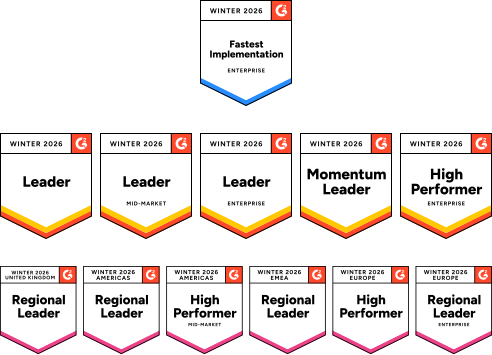
We're also the proud owners of numerous G-2 badges, including:
 Our industry-leading Global Employment Platform pairs the most innovative AI technology with the largest team of HR and legal experts to give you everything you need to operate globally with ease.
With G-P, you can:
- Build global teams anywhere without establishing new entities.
- Go from offer to onboarding 87% faster with our self-service capabilities and automated workflows.
- Hire and pay contractors in 190+ countries.
- Make accurate, compliant payments to your teams in the local currency.
- Offer competitive benefits plans that meet local rules and expectations.
- Plug into leading HCMs like Workday and ADP to avoid system jumping.
- Automate compliance and validate every employment action — from contracts and onboarding to payroll and benefits — with our Global Compliance Engine (GCE).
Build your global team with G-P
G-P is the first agentic Global Employment Platform that turns global HR and compliance into a growth engine. Powered by 14+ years of expertise, our platform embeds labor law intelligence directly into your existing tech stack, allowing you to hire and scale compliantly in 180+ countries in minutes.
Partnering with G-P is the easiest way to hire full-time employees and contractors, without setting up new entities.
Contact us to start building your global team today.
 Frequently asked questions
What does AOR stand for?
AOR stands for agent of record. In HR, an AOR helps companies manage their relationships with independent contractors. They support compliance in classification, contract management, and payment oversight.
Does an AOR remove the need for a local entity?
No, an AOR and a local entity have different functions. You can use an AOR to recruit independent contractors in new countries without needing a local entity. But hiring full-time employees requires either a local entity or a partnership with an EOR.
How does EOR pricing compare to AOR pricing?
Total AOR costs include contractor rates, project fees, and vendor service charges.
The G-P EOR starting rate begins at USD $599 per month. Beyond this platform fee, total EOR expenses include compensation for supported talent, statutory employer payroll taxes, social security contributions, and mandatory localized benefits.
While AOR pricing covers contractor task execution, EOR pricing covers complete legal employment, payroll execution, and full compliance protection without local entity setup.
Do AOR services only apply to international hiring?
No, an AOR can also help manage domestic contractor relationships.
Is an AOR the same as a PEO?
No, an AOR differs from a professional employment organization (PEO), though both can help streamline HR tasks.
An AOR is an intermediary that helps a company manage contractor relationships. A PEO enters into a co-employment relationship with your company, sharing responsibilities and liabilities.
Can I switch from an AOR to an EOR?
Yes, you can switch from an AOR to an EOR. Transitioning from an AOR to an EOR can be a straightforward and beneficial move if you:
Want to hire employees in multiple global locations.
Need compliance assurance.
Want to streamline HR tasks like onboarding, payroll, and benefits administration.