
Key takeaways
- Asynchronous vs. synchronous communication: The main difference between asynchronous and synchronous communication is the timing. Asynchronous communication allows workers to respond on their own schedules, while synchronous communication requires participants to interact in real time.
- Choosing the right communication framework: Synchronous communication usually works best for urgent discussions and complex problem-solving, while asynchronous communication is ideal for routine updates and tasks that require deep concentration.
- Creating clear communication guidelines: When remote workers have clear policies in place to guide them on response times, meeting schedules, and documentation requirements, it becomes easier for them to collaborate without unnecessary interruptions.
When your company or organization operates on a global level, it's crucial to understand the difference between synchronous and asynchronous communication. Each approach has its own set of pros and cons. Your daily operations, employees' time zones, and collaboration needs all play a part in which method works best for your remote workplace. Many companies use a mixture of both approaches to increase productivity, reduce the risk of misunderstandings, and improve teamwork.
What is the difference between synchronous and asynchronous communication?
Timing is the main difference between synchronous and asynchronous communication. When taking part in synchronous communication, the responses occur in real time between the different participants. Examples include live video conferences, team meetings, and phone calls. During asynchronous communication, the participants have time to carefully review information and formulate their responses because they respond to one another on their own schedules, allowing them to better manage their workloads thanks to greater flexibility and fewer interruptions.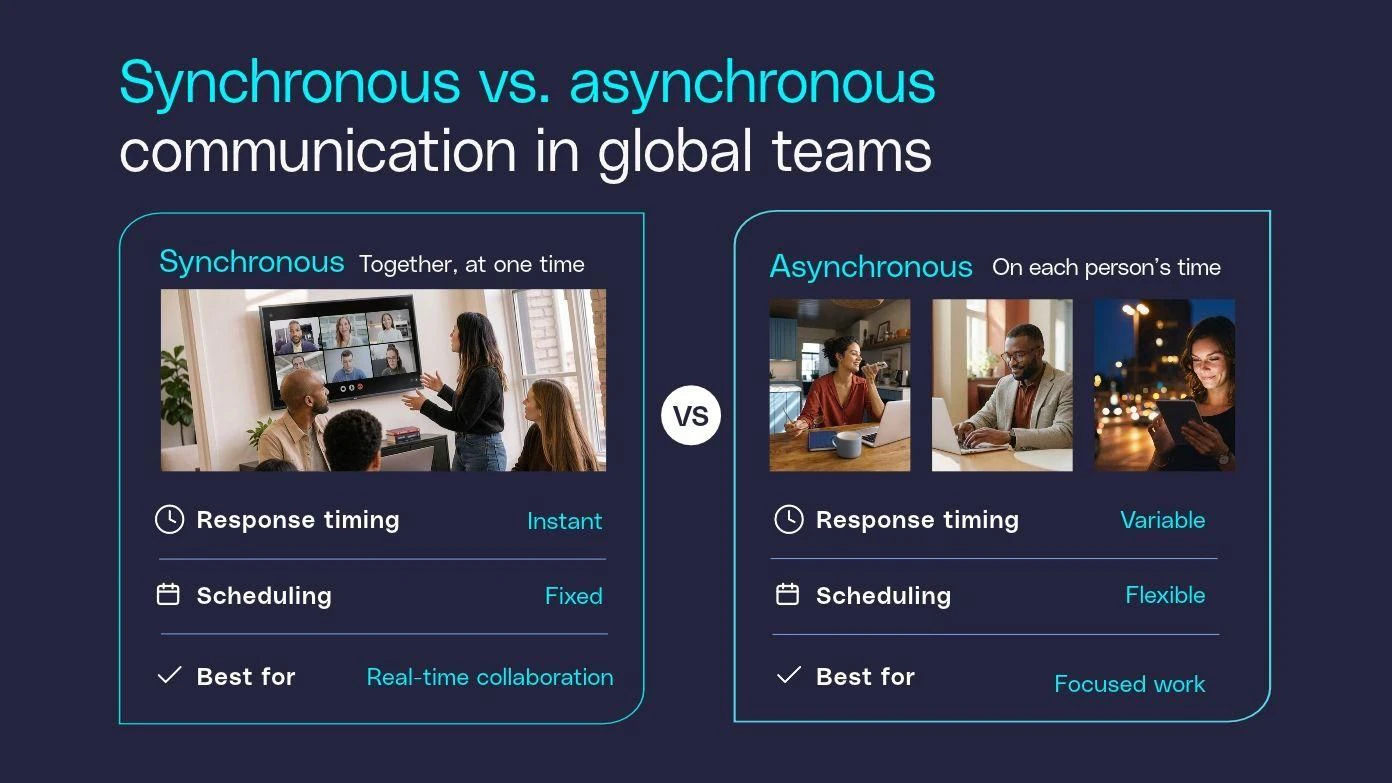
Understanding synchronous communication
Synchronous communication has multiple pros and cons. You can collaborate through video conferencing, live huddles, and phone calls, or by co-editing live spreadsheets in real time. However, this form of communication can block workflows, as participants must halt their other analytical tasks to wait for real-time input. This can easily interfere with productivity, especially during busy workdays and when trying to complete tasks that require deep concentration. Another drawback of synchronous communication is that it depends heavily on participants having overlapping calendar availability. For those operating in different time zones, the lack of overlapping work hours can make collaboration difficult.
The value of synchronous communication stems from immediate feedback loops, which are often essential to making quick decisions and completing tasks that need urgent attention. Participants can easily clarify misunderstandings and adjust their responses on the spot, making this type of communication particularly useful for brainstorming sessions and live conflict mediation. It's also valuable for spontaneous relationship building because of its personal, interactive nature. This is especially beneficial for workflows that depend on teamwork and strong interpersonal connections.
Understanding asynchronous communication
Unlike synchronous communication, asynchronous communication has a non-blocking structure. Participants can send and receive information from one another without having to keep the connection live.
These are common examples of tools that allow for asynchronous communication:
● Centralized documentation systems like Notion and Confluence
● Project management platforms like Asana and Jira
● Recorded screen shares through Loom
● Structured email exchanges.
The main drawback of this form of communication is that it can slow resolution times because each participant responds on their own schedule. For tasks involving urgent decisions or complex problems, this can result in lengthy back-and-forth exchanges. Plus, the repeated cycle of sending messages and waiting for responses can make it difficult to maintain momentum, leading to project delays and missed deadlines.
The enhanced flexibility for collaboration that you can achieve through asynchronous communication is one of its main advantages. Rather than having to respond immediately, participants can assess information on a schedule that aligns with their workloads, so they can more thoroughly review details and carefully formulate answers to important questions. Workers don't have to deal with constant interruptions or worry about responding immediately because their responses aren't expected in real time.
This type of communication is particularly beneficial for non-native English speakers who are participating in discussions with colleagues from different countries. Asynchronous communication is also advantageous because discussions and responses remain documented in shared platforms. If you need to review a previous decision or clarify project requirements, you can simply refer to earlier messages to get the information you need to move forward. Businesses can use these records to build organizational memory and make informed operational, strategic, and financial decisions.
Comparative overview: Synchronous vs. asynchronous at a glance
|
Operational dimension |
Synchronous communication |
Asynchronous communication |
|---|---|---|
|
Response timing |
Immediate (seconds to minutes) |
Flexible (minutes to days, depending on expectations) |
|
Presence requirement |
Concurrent digital presence required |
Independent; zero schedule overlap required |
|
Primary channels |
Video calls, phone, instant live chat |
Project tickets, wikis, recorded videos, email |
|
Impact on focus |
Can interrupt workflows and fragment attention |
Protected; promotes long blocks of deep work |
|
Organizational record |
May require recording or documentation to preserve discussions |
Persistent, searchable, and centrally indexed |
|
Global scalability |
Constrained by time zone overlap |
Scalable across continuous 24-hour operations |
The cognitive cost of default synchronous collaboration
A workflow that relies too heavily on synchronous communication hinders employees’ ability to focus on tasks that require careful analysis and problem-solving. The 2025 Work Trend Index Annual Report noted that the most heavily interrupted users of Microsoft 365 receive a meeting invitation, email, or chat notification every two minutes during regular working hours. Those constant distractions can make it difficult to maintain concentration because workers must shift their attention from their primary assignments to incoming messages and meeting requests.
Synchronous communication in the form of excessive meetings can also leave workers mentally exhausted. Preparing for, participating in, and following up after a meeting can be a demanding process. The negative effects from unproductive or stressful meetings may linger for hours after the meeting ends, limiting the worker's ability to concentrate on important assignments and meet project deadlines.
The financial impact of excessive synchronous collaboration can be substantial. When workers spend too much time in meetings and coordinating routine updates, they have less time for focused, productive work. Reducing unnecessary meetings and moving routine status updates to asynchronous channels can help protect employee time and attention.
Cultural nuances and interpersonal dynamics in global teams
Global teams often rely on asynchronous communication because of the flexibility that it gives them for collaborating across different time zones. And while it offers opportunities for better scheduling and improved productivity, it can result in communication challenges. Team members miss out on important nonverbal cues, like facial expressions, body language, and vocal tone, that occur during live conversations.
When you lack these visual and verbal cues, it becomes much harder to assess a colleague's actual intentions when responding to questions or discussing concerns. The worker may be upset about a project delay but fail to communicate their frustration through a written message. If you're able to discuss the issue through a video call, you'll have a much clearer understanding of how the person feels about the situation.
There's also the risk of social isolation that comes with limited face-to-face interaction. A 2025 research review on remote work found that reduced social interaction among remote employees may result in feelings of loneliness and reduced well-being. It concluded that the future of work “will depend not solely on digital tools and platforms, but on the ability of organizations to humanize remote work — by designing systems that protect well-being, promote social connection, and cultivate a shared sense of purpose and belonging, even at a distance.”
When you consider cultural challenges that exist within global operations, this makes communication between team members even more complicated. As explained in Erin Meyer's book "The Culture Map", many cultures prefer communication processes that emphasize direct messages and clearly documented instructions, while others prioritize personal interactions because of their emphasis on relationships and social context.
If you're trying to communicate with colleagues from high-context cultures, there's a greater emphasis on personal relationships, indirect messages, vocal inflections, and subtle social cues. One worker may send a brief email with straightforward instructions, only to find that it doesn't communicate the intended message because of the receiver's cultural expectations. Research published in 2025 reinforces the importance of understanding cultural differences when managing communication across global virtual teams.
All these challenges highlight the importance of using synchronous communication techniques with intention and in moderation. If you're going to conduct important discussions with colleagues from different cultural backgrounds, you may want to use live video conferencing. This way, all team members have the chance to ask questions, clarify misunderstandings, and build stronger working relationships.
Global compliance: Navigating right-to-disconnect laws
You can't just consider your company preferences for communication when operating on a global level. You must also take into account any legally enforceable workplace requirements that apply in the countries you operate in. Several countries have right-to-disconnect laws and workplace protections in place to establish boundaries concerning work-related communication outside of normal working hours. And since these requirements vary from one country to the next, you must review the applicable local laws to avoid violating employment regulations.
For example, Australia has Fair Work Act amendments that give workers the right to refuse to monitor, read, or respond to work-related communications outside their normal working hours unless their refusal is unreasonable. These protections took effect for larger employers in August 2024 and smaller employers in August 2025.
In France, the right to disconnect appears under Labour Code Article L. 2242-17. This establishes requirements for negotiating employees' right to disconnect and the use of digital communication tools. And if no agreement is reached during the required negotiations, employers subject to these provisions must establish a disconnection charter after consulting employee representatives.
In Spain, Article 88 of its data protection legislation requires companies to establish internal policies regarding employees' right to digital disconnection. And in Portugal, Labour Code Article 199-A generally prohibits employers from contacting employees during their rest periods. There are exceptions in cases of force majeure (extraordinary circumstances that make immediate contact necessary).
As global employers start to expand their international operations, they must assess the unique employment laws in each country where their employees work. Administrative penalties and other legal consequences can be enforced for violations of applicable right-to-disconnect requirements.
With G-P Gia™, you get an AI-powered global HR compliance agent that helps you research and monitor employment law requirements. This includes local regulations, workplace policies, and compliance obligations that relate to managing international employees. For your HR and compliance teams, this means less time spent researching unfamiliar employment laws and greater focus on developing compliant workplace policies.
Operational playbook: How to build a balanced communication matrix
Having a clear remote work policy in place is crucial for global teams switching to an async-first communication model. You want to reduce how often unnecessary meetings occur without taking away from your workers' ability to collaborate in real time when needed.
Follow these four core rules:
- Set an overlap window: For each workday, have a set two-to-four-hour window during which all workers can communicate in real time with one another via video conferences, phone calls, or live chat. The rest of each worker's daily work schedule should be geared toward completing assignments without unnecessary interruptions.
- Define response SLAs: All asynchronous messages should have a 12-to-24-hour window during which each worker is expected to respond. This speeds up communication and keeps projects moving forward while still giving each worker plenty of time to review information and prepare thoughtful responses.
- Enforce the 24-hour meeting rule: Workers who wait until the last minute to submit meeting agendas or supporting documents end up causing unnecessary scheduling and preparation issues. If you have a 24-hour meeting rule in place, everyone will need to submit agendas and reading materials ahead of time. This allows all other meeting participants to review the information and prepare questions before the discussion. Cancel meetings that are only for sharing informational updates.
- Consolidate documentation: Make sure all project decisions, task assignments, and important updates go into a centralized project management tool. This way, all workers have a single location for accessing the latest project information.
|
Scenario / Task |
Recommended modality |
Preferred tool / Channel |
Required documentation artifact |
|---|---|---|---|
|
Incident triage / emergency |
Synchronous |
Live bridge / Phone call |
Incident post-mortem ticket |
|
Performance review / 1-on-1 |
Synchronous |
Video meeting |
Written review summary |
|
Project kickoff |
Hybrid (Async prep + Sync) |
Briefing doc, then short call |
Central project charter |
|
Status updates / handoffs |
Asynchronous |
Project board (Jira, Asana) |
Updated task card |
|
Technical spec review |
Asynchronous |
Collaborative doc with inline notes |
Architecture review record |
|
Process training / tool demo |
Asynchronous |
Recorded screen share |
Video link in internal wiki |
Streamline global workforce management with G-P
Taking time to set up a clear communication framework for your company is one of the best moves you can make for improving collaboration, especially when expanding globally. You want clear policies so that all team members understand exactly what you expect of them regarding response times for asynchronous messages and attending real-time meetings. And this is the exact area of global workforce management that G-P can help with.
G-P brings more than 14 years of cross-border HR and legal expertise to every international expansion. G-P's Global Employment Platform offers agentic hiring and workforce management solutions for more than 180 countries. If you want to hire international employees without having a local legal entity, you can use G-P EOR to handle local employment responsibilities for you. We'll act as the legal employer so that you can focus on managing your team's daily operations.
With G-P Assist, you get instant answers and automated support for your employment-related questions. You can use the platform to route your workflows according to your team's needs in each country. G-P Gia is an AI-powered compliance agent that takes global workforce management even further with its legal expertise and ability to draft policies, review employment documents, and research local labor laws. Together, these tools enhance workforce efficiency and help reduce compliance risks across international hiring, onboarding, and employee management. If you're struggling to manage employees across multiple countries, request a proposal from G-P to explore options for simplifying your international operations.
 FAQs
What is the main difference between synchronous and asynchronous communication?
Timing is the primary difference. When team members use synchronous communication, they are communicating with one another in real time. Examples include video conferences, phone calls, and other live discussions that allow for immediate feedback. Asynchronous communication doesn't require an immediate response. Instead, participants can respond to messages at a time that best fits their schedules, allowing them to manage their workloads with fewer interruptions. Examples of asynchronous methods include emails, shared documents, and project management platforms.
When should a team use synchronous communication over asynchronous?
It's best to use synchronous communication when you need to make quick decisions or have discussions that require immediate feedback. This includes brainstorming meetings and other situations involving urgent problems, sensitive topics, or complex projects. When team members interact in real time, it speeds up problem-solving, reduces back-and-forth exchanges, and results in a better understanding of expectations for both managers and employees.
How does asynchronous communication improve remote work productivity?
Asynchronous communication improves remote work productivity by reducing the constant interruptions that come with real-time discussions (unexpected phone calls, last-minute meeting requests, and frequent chat notifications). It also minimizes calendar fragmentation because teams don't have to schedule meetings for every discussion or project update. Workers can focus on their assignments and respond to messages as their schedules allow.
What are right-to-disconnect laws, and how do they impact remote communication?
Right-to-disconnect laws were created to give workers greater control over their personal time and how their employers contact them outside of normal working hours. Many countries have varying regulations concerning after-hours work-related communications; these include Australia, France, Spain, and Portugal. Understanding the local employment laws in each country where you hire workers is essential to maintaining compliance and avoiding potential legal penalties.
Can remote teams rely entirely on asynchronous communication?
An async-first approach is a great communication framework to follow for global teams because it allows for greater flexibility, but using it as the only form of collaboration can lead to social isolation and delays in decision-making. A hybrid approach that allows for real-time discussions during urgent situations and asynchronous exchanges for routine updates is an excellent way to improve productivity while keeping team members connected.