






An employer of record (EOR) does more than stay up to date on local employment laws. It must turn those laws into the right action throughout the employment lifecycle — from drafting contracts to onboarding, payroll, benefits, leave, and termination.
That’s the purpose of G-P’s Global Compliance Engine (GCE). The GCE powers our Global Employment Platform and translates complex, evolving employment requirements into product rules and workflows across 180+ countries.
The technology side of it is impressive. But in my role leading the teams responsible for compliance, entity operations, and legal risk across 180+ countries, I see the human work behind the technology every day. My team works with local counsel, internal legal and HR experts, knowledge specialists, and product teams to determine not only when laws change, but what that change means in practice.
In this blog, I’ll take you behind the build of the Global Compliance Engine. I’ll walk through the process of a regulatory change, as it transforms from a legal update into a functional product experience — and why human judgment is an essential part of that process.
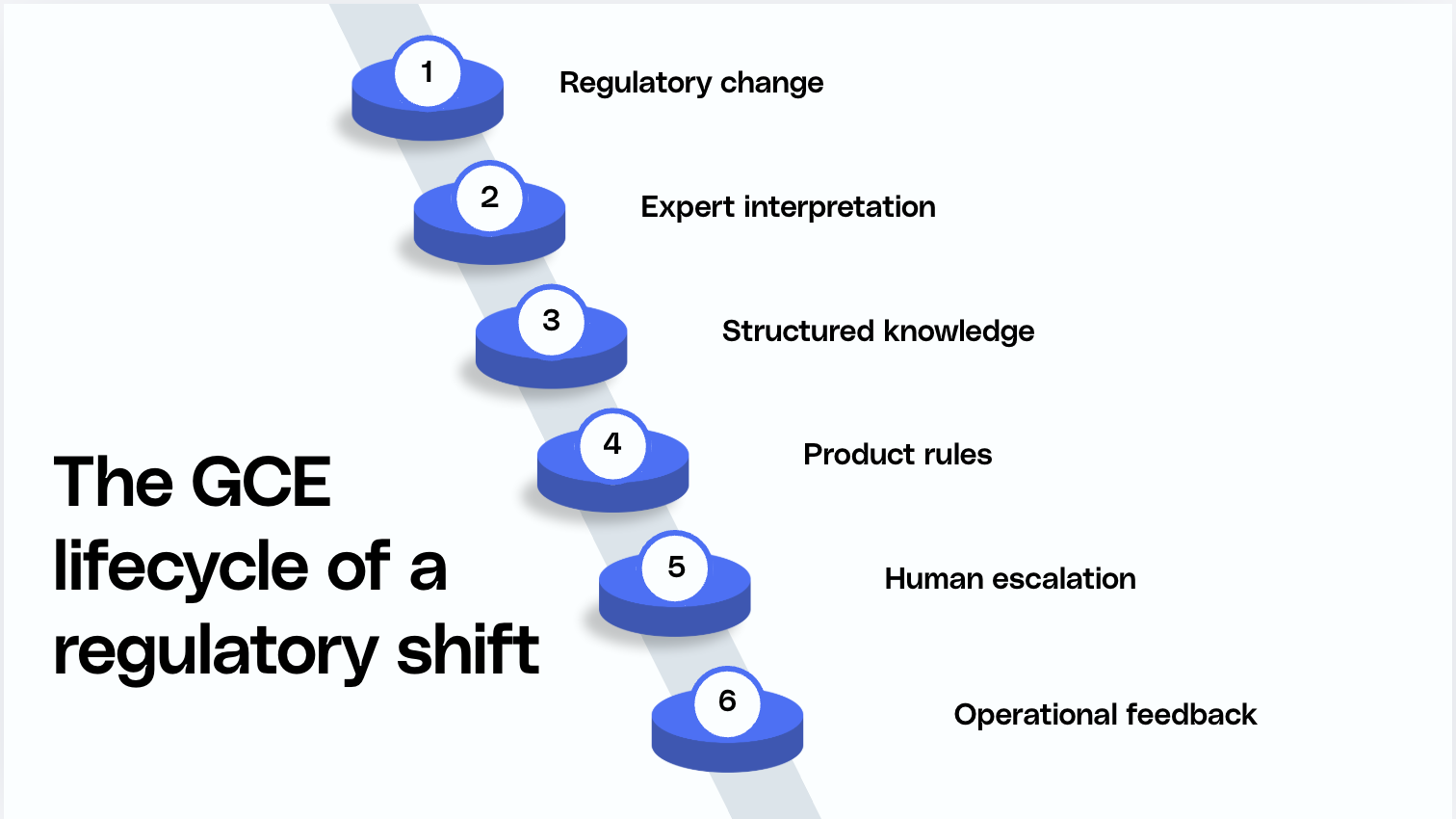
The GCE lifecycle of a regulatory shift
Every regulatory shift follows a lifecycle — from the first signal that something is changing to the moment it comes into effect and is then applied to employment workflows.
The process typically looks like this:
Regulatory change → expert interpretation → structured knowledge → product rules → human escalation → operational feedback
1. Regulatory change: Discovering a policy shift
The process begins with a regulatory change. Say a legislature introduces a new leave entitlement. Or a regulator changes its position on worker classification. Or a court decision alters termination risk.
We get these updates through a global network that includes G-P’s legal, HR, compliance, and entity operations teams, local counsel, international employment associations, real-life examples from our EOR experience, and through G-P Gia’s HR and legal intelligence.
This network and real-time intelligence is important because regulatory change doesn’t always arrive in a clean, machine-readable format. Sometimes the first signal is a newly published law. Other times, it’s practical guidance from local counsel or a change in how an authority interprets an existing requirement.
Identifying the development is only the first step. The hard part is determining what it means.
2. Expert interpretation: Moving from legal text to operational meaning
One of the most important lessons from operating globally is that employment law is rarely black and white.
Imagine that a country reduces its maximum probation period. The headline appears straightforward, but it triggers a much larger set of questions for my team:
- When does the new limit take effect?
- Does it apply to existing employees or only new contracts?
- Are different limits permitted for certain roles?
- Can the period be extended or renewed?
- Does a Collective Bargaining Agreement (CBA) change the answer?
The law provides the starting point. Applying it requires local context, legal interpretation, regulatory guidance, and operational experience.
Contract-language requirements offer another example. It would be easy to create a rule that says, “Translate contracts for this country.” In reality, jurisdictions take very different approaches.
In France, written employment contracts must be in French, while international employees may request a translation into their own language. Local rules determine which text can be enforced if the versions conflict.
In Belgium, the required language depends on the employee’s base location. Depending on the region, the contract may need to be in Dutch, French, or German or a combination of the three. Using the wrong language can have legal consequences.
In Quebec, the requirement may affect the sequence of the contracting process. For standard-form employment contracts, the employee must first receive the contract in French, but they can provide consent or request the contract in another language as well and expressly choose to be bound by another-language version.
These are the nuances my team works through. We’re not simply collecting laws. We’re analyzing, interpreting, and determining how those laws affect employment decisions and processes.
3. Structured knowledge: Making expert reasoning usable
Once we have an operational interpretation, we make that expertise usable beyond the individual experts who developed it.
This is where legal guidance becomes structured knowledge.
A contract-language requirement, for example, may depend on: country and subnational jurisdiction, employer or operating-unit location, employee language and comprehension, contract type, statutory required language, whether another version is permitted or required, etc.
Capturing those distinctions is a collaborative process. My team provides the legal and operational reasoning. Our knowledge teams help organize that reasoning so it can be maintained and retrieved. Product and technology teams determine how it affects our customers’ and professionals’ experience in the platform.
This collaboration turns knowledge held by individual experts into a repeatable organizational capability. It also helps preserve the reasoning behind a requirement, rather than reducing it to a yes-or-no answer without context.
4. Product rules: Putting the interpretation into action
Structured knowledge creates value when it changes what happens in the G-P platform.
Let’s go back to the probation period example. An approved change in probation period lengths has a ripple effect across several parts of the EOR experience — from the options available during contract creation, to the language in the final approved contracts, and the guidance shown to the professional during onboarding.
GCE does more than guide the user. It enforces legal standards directly in the workflow. The platform prohibits customers from entering terms that fall below those requirements. For example, if the maximum probation period in a country is three months, the platform won’t allow a customer to enter six months.
This is where GCE differs from a traditional legal library.
“A library provides information that someone must locate, interpret, and apply. GCE brings that interpretation into the workflows where the employment action occurs.
For a hire in Belgium, the relevant product logic may need to identify the applicable operating unit or the location of the employee before generating the contract in the correct language.
Compliance isn’t added as a final review after the decision has been made. It’s built into how users interact with the platform to get to employment decisions.
5. Human escalation: Knowing when a rule isn’t enough
Technology can apply repeatable requirements consistently, but not every employment scenario should be treated as a deterministic rule.
A case may need human review when:
- An employee works across multiple jurisdictions
- Local law interacts with a CBA
- A contract contains a unique negotiated provision
- A new regulation hasn’t received authoritative interpretation
International employment often operates in these gray areas. The responsible response isn’t to force an automated answer where the facts require judgment.
That’s why G-P views human involvement as a critical part of the Global Compliance Engine, not a fallback when the technology fails. GCE handles the requirements that can be applied consistently. Our legal, compliance, HR, and entity operations experts address the exceptions, ambiguities, and higher-risk decisions.
“The technology gives our experts scale. Our experts give the technology judgment.
6. Operational feedback: Turning experience into better guidance
The process doesn’t end when an employment action is completed or an expert resolves a difficult case.
Real situations reveal questions that legislation alone doesn’t anticipate. A complex termination or an unusual benefits arrangement may expose a gap in existing guidance.
When that happens, we bring the insight back into the compliance lifecycle and repeat steps one through five to determine if it represents a reusable rule, an exception, or a scenario that should always be escalated.
This feedback loop is one of the most valuable parts of the system. GCE is informed not only by published laws, but also by more than a decade of experience applying those laws to global employment.
Every edge case makes the system more precise.
The human expertise behind the build
It’s tempting to describe a compliance engine primarily in terms of automation or AI. But technology is only as reliable as the knowledge, governance, and judgment behind it.
GCE is brought to life through a comprehensive process: Our network identifies regulatory updates, experts interpret their practical effect, teams convert that reasoning into structured knowledge, product rules apply it during employment workflows, complex cases reach human experts, and operational experience feeds back into the system.
For customers and professionals, this means compliance is incorporated throughout the employment experience rather than treated as a manual check at the end.
For me, it demonstrates what makes the system difficult to replicate. The technology matters, but so do the years of legal relationships, entity operations, resolved edge cases, and collaboration behind it. That human expertise isn’t separate from GCE. It’s what powers it.