







Key takeaways
- New regulations and priorities vary widely between countries, from Environmental, Social, and Governance (ESG) legislation in the Netherlands to pay transparency regulations in the EU.
- AI and data privacy are major points of concern, with tighter regulations in both China and the EU.
- An employer of record (EOR) helps you stay compliant, no matter how quickly global regulations change.
2026 was a big year for global compliance requirements. Developments in AI and the gig economy sparked legislative changes and new labor standards around the world.
From cybersecurity law amendments in China to immigration reforms in Spain, let’s take a look at the biggest compliance shifts in 2026.
What is global compliance?
Global compliance means following the laws, standards, and regulations wherever your business operates. These include tax and payroll regulations, immigration laws, data privacy standards, and corporate governance. Laws change often, so it’s important to monitor them closely.
2026 global workforce compliance trends
Many new global compliance policies were enacted in 2026. This table breaks down some of the biggest themes, new requirements, and what you need to do right now to keep your company compliant.
| Trend | 2026 developments | Regulation examples | Risks for employers |
|---|---|---|---|
| AI in employment |
Modern AI regulations include: -More voluntary governance -Documented risk management -More transparent usage -Human oversight regulations -Stronger bias controls |
The EU AI act |
-Discrimination claims -Invalid hiring decisions -Privacy breaches -Issues with vendor accountability |
| Pay transparency and equity |
Pay transparency acts require: -Upfront pay range disclosures -Salary history limits -Gender pay gap reporting
|
The EU pay transparency act |
-Posting violations -Pay discrimination claims -Employee relations issues -Reputational harm |
| Privacy concerns |
New regulations are emerging around: -Employee monitoring -Biometrics -Remote access -International HR data transfers |
China’s updated cybersecurity laws |
-Data protection fines -Unlawful surveillance claims -Collecting inadmissible evidence -Eroding employee trust |
| Cross-border remote work |
Work-from-anywhere arrangements can trigger issues with: -Immigration law -Payroll regulations -Social security withholdings -Tax residency -Permanent-establishment (PE) |
Spain’s remote-work pathways
|
-Unauthorized work -Dual payroll obligations -PE tax exposure -Benefit and labor-law conflicts |
| Supply-chain and sustainability |
Workforce and value-chain due diligence must be: -Reportable -Auditable -Board-owned |
The Netherlands’ ESG reporting requirements |
-Public reporting failures -Procurement exclusion -Investor pressure -Supplier disruption -Civil liability |
| Audit readiness |
Employers have new regulations for: -Data matching -Public registries -Targeted inspections -Required reporting |
-India’s labor code transition |
-Back pay -Legal penalties -Debarment -Injunctions -Litigation costs -Operational delays |
India: the labor code transition
India merged 29 federal labor laws into four main codes. The codes replace 29 older laws and introduce new definitions, requirements, and compliance standards for wages, social security, industrial relations, and workplace safety. Employers have to update policies, contracts, and payroll systems to align with the new framework, both at the national and state levels.
Your priority actions:
- Audit payroll: Check that your systems use the new wage standard for benefits and contributions.
- Expand benefits: Give social security to qualifying independent contractors.
- Update documents: Change employment contracts and HR policies to match new legal standards.
G-P pro tip: Transitioning 29 laws is a big lift for any HR team. With G-P EOR, you don’t have to worry about changing regulations. We handle payroll, document updates, and state-level tracking so you don't have to.
The Netherlands: IP and ESG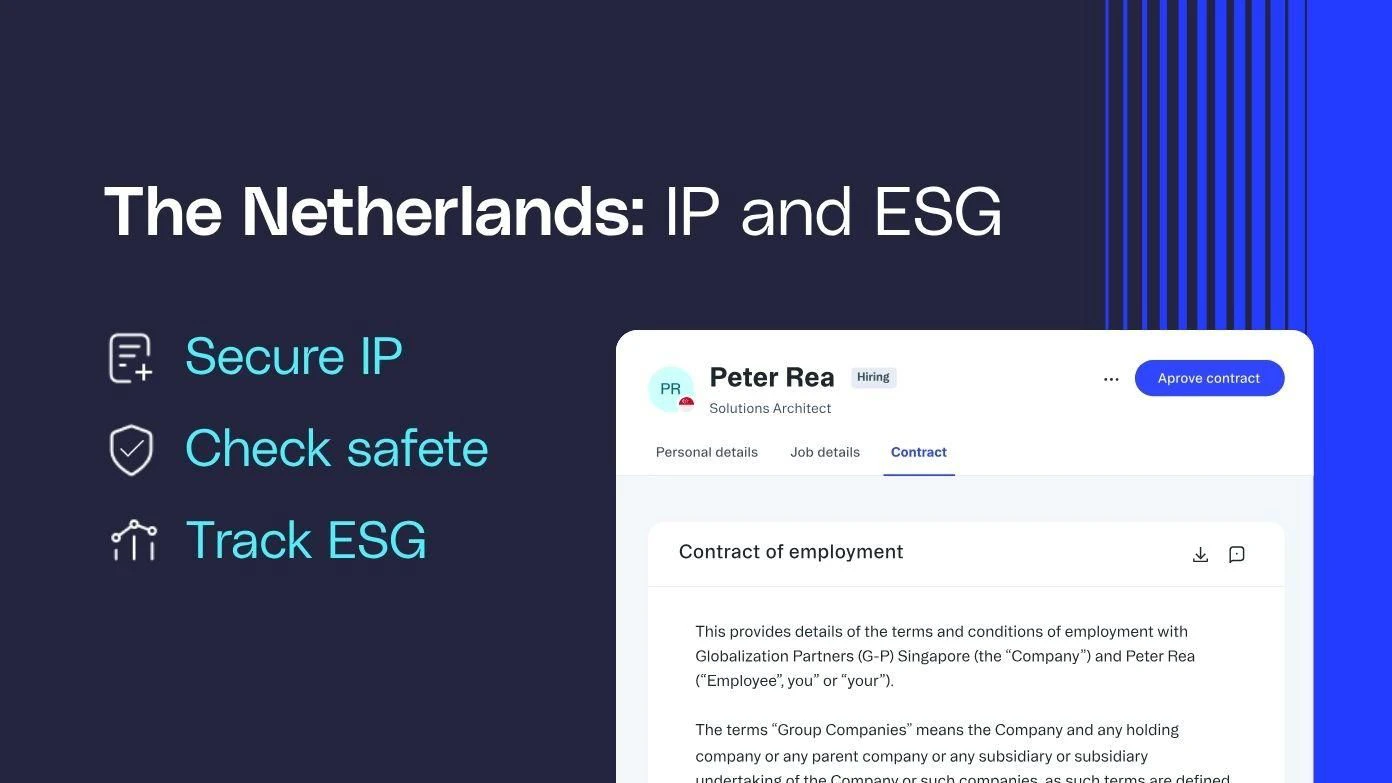
Three changes to employment law happened in the Netherlands this year. A new copyright contract law took effect on January 1. The law requires explicit, written agreements for copyright transfers.
As of April 2026, workplace safety regulations are ramping up in the country. A new law will lower exposure limits for hazardous substances. And finally, ESG (environmental, social, governance) reporting requirements are expanding under the EU corporate sustainability reporting directive. This means more companies have to collect, track, and publicly report on their sustainability and social responsibility practices.
Your priority actions:
- Secure IP: Make sure all new and existing IP arrangements are properly documented to avoid legal disputes.
- Update safety policies: Provide extra training and set up new controls or equipment to meet the stricter hazardous substances standards.
- Track ESG: Build systems to report the social and environmental data required by the EU.
G-P pro tip: In the Netherlands, independent contractors retain ownership of the IP they create, not the hiring company. It's essential to include a clear, written assignment of IP rights in the contract to ensure your company owns the work product.
Get contract templates through G-P Contractor™ to stay compliant with the new Dutch copyright contract law.
China: data privacy and AI
China’s updated cybersecurity law took effect on January 1 of this year. The amendment increases penalties for data breaches and strengthens AI governance. The new rules limit data that can be used in background checks and standardize credit information handling. Regional antidiscrimination laws are also expanding regarding fair treatment and equal opportunity.
Your priority actions:
- Boost security: Upgrade your incident response to avoid high fines.
- Refine hiring: Adjust background checks to meet new limits on data and credit handling.
- Train managers: Revise your equality policies to align with regional laws.
G-P pro tip: China's stricter penalties make compliance slip-ups far more expensive.
Use G-P Gia™ to get real-time guidance on best practices, legal considerations, and requirements for background checks under these new rules.
ProtoPie, a leading prototyping software company, wanted to expand into the U.S., U.K., and China, the largest markets for UX design. But managing hiring in new countries without local entities or deep knowledge of labor laws was complex. See how G-P helped them do it.
Colombia: identity markers
In Colombia, the right to a non-binary marker on official IDs was enacted in January 2026. It was first established by the Constitutional Court in 2022. This policy allows the labels "trans" and "no binario" to appear directly in the "sex" field of the national ID card, rather than just an "X." Under the Labor Reform (Law 2466 of 2025), the Colombian Ministry of Labor established that companies:
- Have to update their HR databases and forms to include the new legal categories (X, NB, or Trans).
- Employers were required to refresh their internal work regulations, including updating antidiscrimination protocols, by June 25, 2026.
Your priority actions:
- Adapt HR systems: Make sure all forms, onboarding documents, and internal communications reflect inclusive gender options.
- Protect historical records: After an employee changes their legal gender marker, they may not want documents with their previous gender marker easily accessible. Be sure to monitor access to these records to protect employee privacy.
- Talk to your people: Train HR staff and managers on new gender recognition standards and inclusive practices.
G-P pro tip: Updating global HRIS systems for new gender markers is labor-intensive. Offload that administrative work to G-P. We manage the inclusive onboarding and precise payroll adjustments on your behalf.
The U.K.: worker rights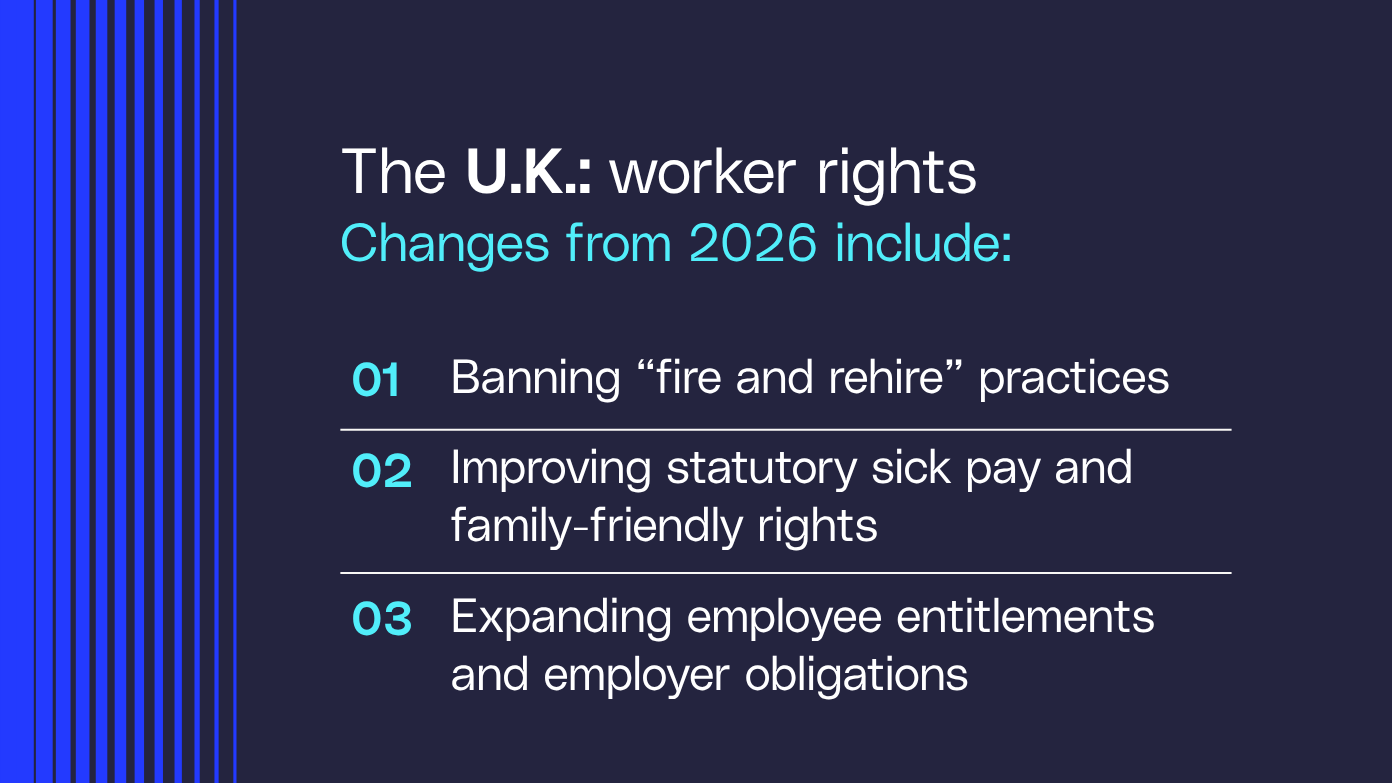
The U.K. has major reforms scheduled for phased implementation under the employment rights bill. Changes for 2026 include:
- Banning “fire and rehire” practices
- Improving statutory sick pay and family-friendly rights
- Expanding employee entitlements and employer obligations
Your priority actions:
- Renegotiate contract terms legally: Make sure any new contract changes are made through proper consultation and agreement.
- Update processes: Adjust your policies and payroll systems to comply with new statutory sick pay rules and expanded family-friendly rights.
- Offer training: Provide training for managers on the new entitlements.
G-P pro tip: Use Gia to get real-time guidance on U.K. employment law changes and check your current policies, contracts, and processes for regulatory gaps.
“
“Before Gia, I would spend hours searching government websites to find what I needed. Now, I can get the information in minutes with links to the official sources. I can move forward with confidence that I have the correct information for each country or state.”
Jennifer Fisher
Director of People and Culture at ISTS
Spain: faster immigration
Spain recently introduced new immigration reforms to streamline work permits for international workers. This move allows more flexibility in employment and self-employment, and expands family reunification rights. The country’s updated seasonal worker rules were also updated.
Your priority actions:
- Use new visas: Broaden your talent pool with seasonal worker and digital nomad options.
- Review relocation: Adjust your policies to support expanded family rights for international workers.
- Hire faster: Use streamlined permit processes to cut your time-to-hire.
G-P pro tip: Use Gia for instant clarity on which Spanish visas fit your needs.
The EU: AI regulations
The EU AI act came into effect in August 2026. The act aims to create clear rules for AI use across the EU. It introduces new compliance obligations for employers using AI in recruitment, promotion, dismissal, task allocation, and employee monitoring. There will be substantial penalties for noncompliance. Fines can be as high as EUR 35M, or 7% of global annual turnover.
Your priority actions:
- Prioritize data governance: Make sure your AI systems use expert-vetted data and verified sources.
- Store documents long-term: Keep detailed technical documentation and logs for high-risk AI systems, and store records for at least 10 years.
- Prepare for transparency: Inform employees and their representatives before deploying AI systems, and provide clear information about how these systems impact them.
G-P pro tip: Gia can help you stay compliant with the EU AI act in several ways. For instance, it can offer policy templates for data governance and regular data audits, or assist in setting up processes for ongoing data review and documentation.
The EU: pay transparency regulations
The EU pay transparency act is an EU-wide law that all member states were required to implement by June 2026. The act’s goal is to make sure that equal pay is given for equal work or work of equal value.
Employers will have new obligations to disclose pay information, both to job applicants and to current employees. Companies with 100 or more employees will be required to report on their gender pay gap. Additionally, employers will no longer be allowed to ask job candidates about their pay history.
Your priority actions:
- Update recruitment practices: State the starting salary or salary range in all job advertisements.
- Review pay structures: Make sure your job evaluation and pay classification systems are based on gender-neutral criteria.
- Prepare access to information: Employees can request information about their individual pay and the average pay for colleagues doing the same work. You have to give them access to this information.
G-P pro tip: Use Gia to get up-to-date guidance on building gender-neutral pay structures and reporting requirements, so you can easily update policies and prepare for EU pay transparency compliance.
Don’t let compliance slow you down
Depending on where your business expands in 2026, you may need to adjust your background checks to meet new limits on data handling, train your HR team on new gender recognition standards, or rewrite contracts in local languages to make sure they’re legally binding. The common denominator is proactive planning.
To put compliance into action and gain an edge over your competitors, use a consistent international hiring framework:
1. Confirm where employees will work: Identify the country, state, or province where each employee performs their work. This determines which employment law, payroll-tax, registration, leave, and benefits requirements apply.
2. Check worker classification: Decide whether each person should be hired as an employee or engaged as an independent contractor under local rules. Misclassification can lead to back taxes, unpaid benefits, penalties, and employment claims.
3. Review local hiring requirements: Confirm whether you need a local entity, employer registration, or an employer of record (EOR). Check rules for contracts, minimum wage, working time, leave, social security, background checks, and immigration.
4. Use compliant employment documents: Provide contracts and policies that meet local requirements, in the required language and format. Include clear terms for pay, benefits, confidentiality, intellectual property, data protection, and termination.
5. Set up payroll and benefits correctly: Register with the relevant authorities, withhold and report taxes, make required social security contributions, and provide statutory benefits from the employee’s first day when required.
6. Protect employee data: Collect only the personal information you need, secure it appropriately, and follow local privacy rules when transferring data across borders.
7. Monitor changes and train managers: Schedule regular compliance reviews, keep records, and support HR teams and managers with current guidance before they hire or manage international employees.
Use G-P EOR to hire employees internationally without establishing a local entity. We handle compliant contracts, payroll, benefits, tax filings, and ongoing regulatory updates while you focus on supporting your global workforce.
Manage cross-border payroll and tax compliance
Use a consistent payroll checklist for every country, state, or province where employees work:
- Confirm worker status and location: Verify whether each person is an employee or contractor and identify where they perform their work. These details determine payroll tax, wage, benefits, and reporting obligations.
- Complete local registrations: Check whether your company or the EOR must register as an employer with tax, social security, or labor authorities before the first payroll run.
- Calculate withholding and contributions: Apply local income tax, social security, pension, health insurance, and other required deductions. Review currency, exchange rates, pay frequency, minimum wage, overtime, and statutory benefits.
- File and pay on time: Track deadlines for payroll tax returns, employer contributions, year-end forms, and employee statements. Assign ownership for each filing and keep proof of payment.
- Maintain payroll records: Store contracts, timesheets, pay calculations, tax forms, contribution records, and payment confirmations for the required retention period. Limit access to sensitive employee data and follow local privacy rules.
- Reconcile regularly: Compare payroll reports with bank payments, accounting records, and HR data. Investigate discrepancies quickly and audit changes when employees move, change status, or receive new benefits.
Build policies for ongoing global compliance
Turn country-specific requirements into a repeatable governance process:
- Create a country compliance register: Record applicable employment law, regulatory deadlines, required benefits, working-time rules, leave, data protection, immigration, and termination requirements for each location.
- Set approval controls: Require HR, payroll, finance, and legal review before launching a new hiring location, changing worker classification, or updating pay and benefits.
- Standardize core policies locally: Use global principles for conduct, equality, data security, health and safety, and reporting concerns, then adapt each policy to local law and language.
- Train managers and employees: Provide regular training on hiring, pay, leave, workplace conduct, data handling, and escalation procedures. Keep attendance records and refresh training when rules change.
- Schedule recurring audits: Review contracts, payroll, worker classification, registrations, benefits, and required filings at least annually and/or after major regulatory changes.
- Document corrective action: Track identified gaps, owners, deadlines, and evidence of completion. Escalate material risks and update policies after each audit.
These controls help employees and managers follow employment law consistently while giving your business a clear record of its regulatory decisions and actions.
To put compliance into action and gain an edge over your competitors:
- Shift the burden: Partner with G-P EOR and leave the HR and legal complexities to us.
- Boost flexibility: Add independent contractors to your workforce to quickly scale your team and adapt to changing business needs while maintaining compliance.
- Use agentic AI: Use our global HR agent Gia to reduce the cost and time of compliance by up to 95%.
- Integrate your systems: Reduce blind spots by moving away from disconnected payroll and HR tools.
Build your global team compliantly with G-P
International hiring can unlock many competitive advantages, but only when local legal, financial, and operational best practices are followed.
Our Global Employment Platform and its AI-powered products, EOR, Contractor, and Gia, enable companies of all sizes to build and manage global teams in 180+ countries.
As the recognized leader in global employment with more than a decade of experience, we can help you grow compliantly and sustainably, despite quickly changing international regulations.
Make your global expansion easier with G-P. Contact us or book a demo today.
FAQs
What is global compliance?
Global compliance is the practice of following local laws, regulations, and standards. This includes tax and payroll regulations, immigration laws, data privacy standards, and corporate governance.
What are global employment laws?
Global employment laws are the country-specific rules that govern employer-employee relationships. They include regulations for employment contracts, pay schedules, working hours, leave, required benefits, employee discrimination, workplace safety, and termination. To stay compliant, employers must follow the laws where each employee works, as well as any additional cross-border regulations.
What is international compliance?
International compliance means following the legal and regulatory requirements governing business conducted across national borders. This includes trade, employment, taxation, immigration, and data protection. To stay compliant internationally, you need to identify applicable rules, put controls in place, and review your operations against changing regulations.
What is international employment law?
International employment law is the set of rules and regulations governing cross-border employment relationships. This includes international work assignments, working remotely from another country, or multinational employees. Compliance requirements depend on work location, contract terms, employer structure, and other factors.