








Key takeaways
- Contractor service agreements define relationships, clarify expectations, and provide legal protection for your global contractors.
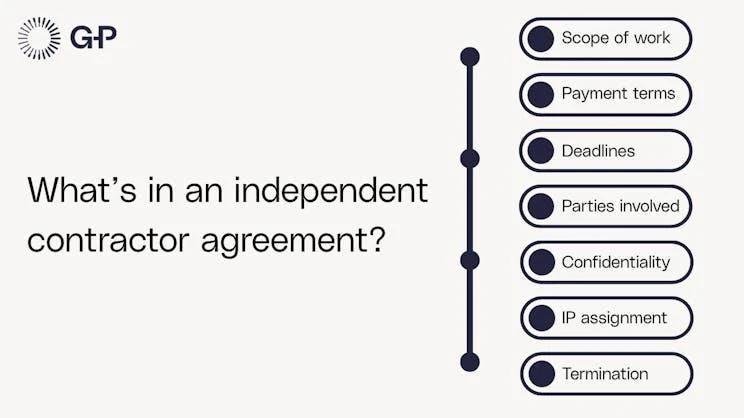
- Strong contractor agreements outline scope of work, payment terms, IP protections, confidentiality, and governing laws.
- Use G-P Contractor™ to hire and pay project-based workers in 190+ countries and create compliant agreements in seconds.
Independent contractors now play a vital role in companies of all sizes. As you expand your business across borders, adding these professionals to your team is a smart way to scale quickly. With contractors, you can ramp up when demand spikes and pull back when it slows.
We’ll walk you through how to write a clear, compliant independent contractor agreement, as well as the 2026 global updates impacting your contracts today.
What is an independent contractor agreement?
An independent contractor agreement is a legally binding contract between an individual contractor, or the contractor’s own business entity, and a company. An independent contractor agreement outlines the scope of work and the terms under which the contractor will perform services.
In some countries, a verbal agreement can constitute a binding contract. However, we recommend drafting a strong, written independent contractor agreement to protect the interests of both the contractor and your company.
Independent contractor agreement vs. employment contract
A contract for services is a B2B commercial deal with an independent contractor. A contract of service is a direct employment contract. An individual with a contract of service works directly under the employer’s direction and authority. The nature of the working relationship also determines the worker’s legal status, not just the contract terms themself.
This table outlines other key differences between independent contractor agreements and employment contracts:
|
|
Independent contractor agreements |
Employment contracts |
|---|---|---|
|
Nature of contract |
B2B commercial contract for services or deliverables. |
Direct employment relationship under local labor laws. |
|
Control of work |
Contractor controls methods, tools, timing, and execution of work. |
Employer supervises work methods, schedule, and performance. |
|
Substitution rights |
Contractor may delegate or substitute a worker, subject to contract terms and required qualifications. |
Employee is required to provide the services themself. |
|
Payment structure |
Paid against tax invoices, deliverables, projects, or milestones. |
Paid through set, recurring payroll cycles. |
|
Taxes and benefits |
Contractor handles own taxes and social protections, subject to local withholding rules. |
Employer withholds taxes and provides statutory benefits. |
|
Intellectual property |
IP ownership depends on the contract, the type of IP, and the governing jurisdiction. |
Companies usually own IP created by employees but ownership still varies by country and IP type. Employers automatically own in-scope work in some countries. |
10 steps for a compliant independent contractor agreement template
Building a strong independent contractor agreement protects your business and clarifies your professional relationships. Use this guide to update your agreements and stay compliant.
1. Define the working relationship
Start by listing the full legal names and contact details for both you and the contractor. State that the professional is an independent contractor, not an employee. This makes sure you both agree that the contractor controls their own schedule, methods, and location.
2. Write a clear scope of work section
Detail the specific tasks, deliverables, and project milestones you expect. When you define exactly what success looks like, you ensure you get the results you're paying for.
3. Include detailed payment terms to avoid disputes
Outline how and when you’ll pay — whether by the hour, project, or milestone. If you’re hiring internationally, specify the currency to avoid exchange rate disputes. State that the contractor handles their own taxes and insurance; this protects you from unexpected liabilities.
4. Define who owns the work product and IP
Clarifying intellectual property (IP) rights now prevents ownership battles later. You should also include a clause requiring the contractor to help with any formal IP registrations if needed.
5. Include a non-disclosure agreement
Your trade secrets are valuable. Include a non-disclosure clause to protect sensitive information shared during the project. This legal layer keeps your proprietary data safe within the relationship.
6. Outline termination rights and notice terms
Define how either party can end the contract. Include the required notice period and the payment process for work completed up to that point. Remember, contractors generally aren't entitled to severance, so clear terms save you from any misunderstandings.
7. Consider governing laws and dispute resolution clauses
If you work across borders, pick which country’s laws will apply to your contract. Keep in mind that some countries may require disputes involving local contractors to be resolved in their courts, regardless of contract terms. Consider adding a dispute resolution clause. This allows you to use mediation or arbitration to settle disagreements without going straight to court.
8. Address liability and indemnification
An indemnification clause protects you if a contractor’s work accidentally infringes on someone else's copyright. It ensures the contractor is responsible for the legal costs of their own mistakes.
9. Consider a non-compete clause
Contractors work for multiple clients at once. If you need their undivided attention, include a conflict of interest clause. While non-competes are hard to enforce, you can restrict them from working for direct competitors during your project.
10. Confirm when your agreement should be signed
Review your jurisdiction’s latest labor laws to ensure your contractor isn't legally an employee. Before signing, have a legal professional customize your draft. Taking this final step ensures your rights are fully protected before work begins.
Why do companies need independent contractor agreements?
Contractor agreements protect you by defining your professional relationships and setting clear expectations. A formal contract has several advantages:
- Project clarity: You define the specific services required. This distinguishes contractors from employees and ensures both of you understand the terms.
- Greater flexibility: You and your contractor can easily agree on project timelines and milestones, so you get access to top talent without the obligations and oversight required for full-time employees.
- Legal protection: A formal agreement defines your rights and responsibilities. It also limits your company’s liability if the partnership doesn't work out.
- Faster payments: You pay contractors once you approve their invoices. This simplifies your accounting and removes the need to manage payroll taxes or benefits.
- Reduced costs: You improve your bottom line by eliminating expenses like health insurance and paid time off. Clear contracts also lower your risk of costly misclassification claims.
- Easier administration: Contractors handle their own taxes and insurance, which lightens your workload.
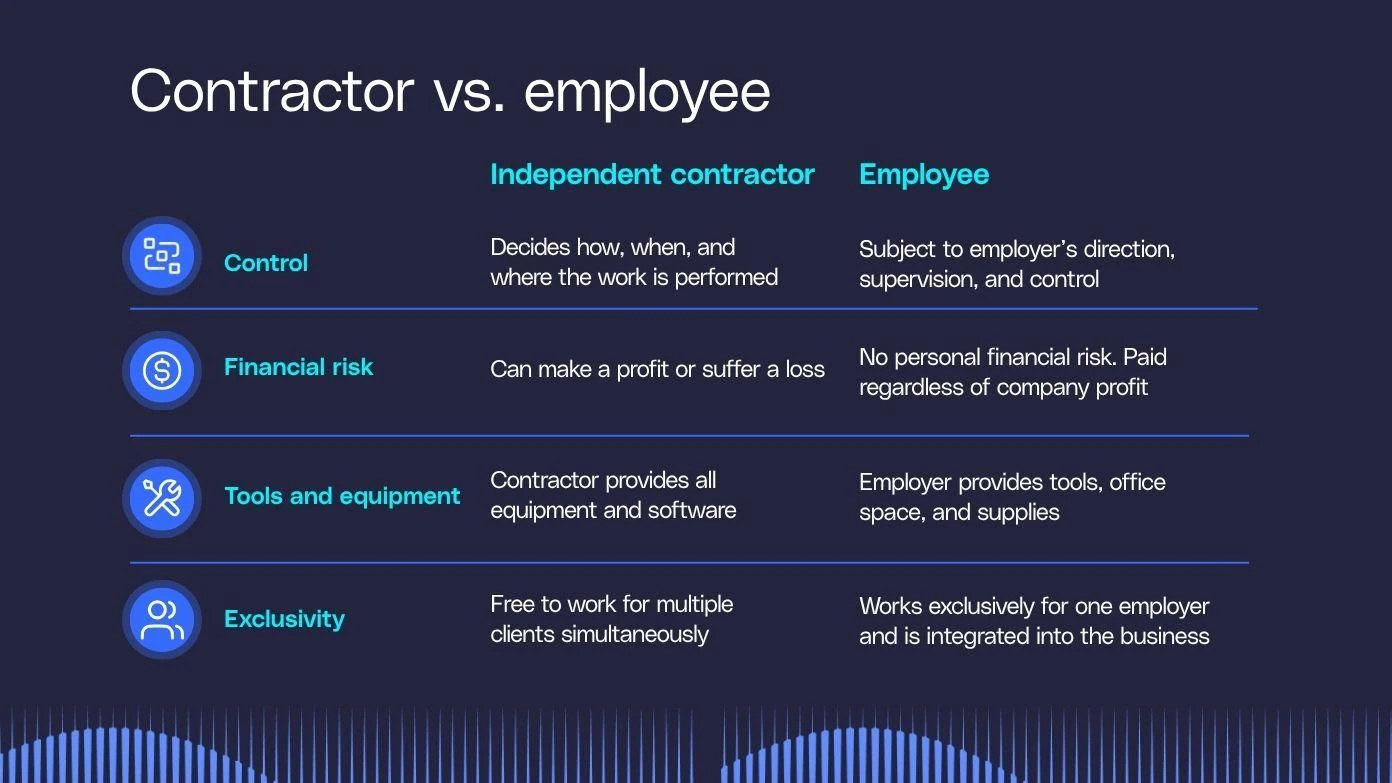
2026 worker classification framework
Our table compares how contractors differ from employees across the main classification areas.
Who qualifies as an independent contractor?
Understanding the difference between independent contractors and employees helps you stay compliant and avoids costly legal errors. In the U.S., roughly 10–30% of employers misclassify their workers. This mistake can lead to significant fines.
Independent contractors provide specific services. However, classification criteria change based on your country and local laws.
Focus on these three factors to determine the right fit for your needs:
- Autonomy: You direct the results, but contractors decide how, when, and where they work. Unlike employees, they operate with high independence.
- Benefits: Employees get country-specific benefits like health insurance and paid leave. Contractors handle their own coverage, saving you these costs.
- Payroll taxes: You pay contractors per project or milestone. They’re responsible for managing their own income taxes and local filings, which reduces your tax administration.
New 2026 global regulations
New Zealand
New Zealand’s 2026 reforms include a 5-step gateway test framework to determine whether a worker is a contractor rather than an employee. You can minimize the risk of misclassification by ensuring your agreements are in writing and allow for subcontracting. Avoid restricting the contractor from working for others to further protect your business. This approach is becoming a global standard for drafting compliant contracts.
U.S.
In early 2026, the U.S. Department of Labor proposed returning to an economic reality test. This shift means you should focus on whether a worker truly operates an independent business. Ensure the worker isn’t economically dependent on your company to avoid potential legal issues.
EU
The EU Platform Work Directive brings major changes for platform workers. Member states must implement these rules by December 2026. If you exercise too much control or direction over a worker, they may be presumed an employee. Review your engagement models to stay ahead of these requirements.
The Netherlands
The Vbar legislation came into effect in the Netherlands in July 2026. It introduced a new presumption of employment for contractors earning below a certain hourly rate — currently EUR 36 an hour. If a contractor earns less than this, Dutch authorities may presume an employment relationship unless proven otherwise. Careful contract structuring helps you navigate these local laws with confidence.
Avoid PE risk and cross-border tax exposure
When hiring contractors, worker misclassification shouldn’t be your only concern. It’s also important to avoid permanent establishment (PE) risk and cross-border tax exposure.
Working with global contractors can create Dependent Agent Permanent Establishment (DAPE) under Article 5 of the OECD Model Tax Convention. It’s important that contractors don’t negotiate commercial contracts on behalf of your business, execute deals, or present themselves as company officers. While they can be responsible for auxiliary, technical, or advisory work, they can’t be responsible for essential revenue-generating sales activities.
How to stay compliant when working with contractors
There are certain regulations that should be left out of your independent contractor agreements in order to stay compliant. Including these clauses can trigger regulatory audits or employee misclassification issues.
Be sure to avoid these common mistakes:
- Setting fixed working hours or requiring attendance at internal team meetings.
- Reimbursing business expenses or providing corporate laptops without clear security requirements.
- Restricting the contractor from working with external customers.
- Paying fixed weekly or monthly salaries through payroll systems instead of approving invoices.
Engage and pay contractors with G-P Contractor™
Simplify contract generation, ensure worker classification, and pay contractors in minutes instead of hours with G-P Contractor™. Get peace of mind with real-time status updates on your payments; G-P Pay gives you end-to-end payment visibility, transparent FX costs, and instant local currency payouts across multiple markets.
It's fantastic that I can download a template, add in all the contractor info, and G-P creates the contract for me. I just have to review, sign, and send it to our contractors. It makes onboarding so simple.”
Get your contractor playbook for easy and compliant scaling
Hiring global contractors allows you to scale up or down without the heavy anchor of permanent headcount or complex entity setup.
Don't let concerns about IP, regional customs, or compliance hold you back. Move forward with confidence with our contractor playbook. Get the basics of contractor hiring and common missteps to look out for.

What’s the EU Platform Work Directive 2026 deadline?
Member states must implement the EU Platform Work Directive by December 2026.
What’s the gateway test for contractors?
The gateway test is a five-part framework in New Zealand that helps determine contractor status.
How do I create an independent contractor agreement template?
Start with a clear scope of work, payment terms, IP ownership, confidentiality, termination rights, and make sure the agreement reflects the contractor’s independence. Use G-P Gia™ to spot compliance risks in your existing corporate documents. Gia analyzes policies and contracts to identify legal risks in seconds, saving your teams hours of manual verification while ensuring strong governance.
What are the penalties for contractor misclassification in 2026?
Penalties can include fines, back taxes, social contributions, and potential legal claims, with severity depending on the jurisdiction.
Does a written contract prevent misclassification?
No. A written contract alone doesn’t prevent misclassification. The actual working relationship and supporting documentation also determine status.
What documentation should I keep for contractor compliance in 2026?
Keep proof of business insurance, marketing materials showing multiple clients, invoices to other clients, and evidence of independent work tools.


