


Key takeaways
- Two global hiring options: Choosing between local entities or an employer of record (EOR) affects hiring speed, costs, and compliance responsibilities.
- CHROs manage more than regulatory compliance: Equitable compensation, multi-country payroll, cultural differences, data privacy, and AI governance all influence workforce success.
- Connecting people, processes, and technology: Integrated systems, localized workplace practices, and G-P's Global Employment Platform help CHROs manage international teams.
Global hiring gives you a way to access broader talent pools, specialized skills, and new market opportunities. But for chief human resources officers, building a global workforce introduces legal, financial, and operational challenges that go beyond recruitment.
CHROs must balance two competing priorities:
- Business expansion: Access global talent, enter new markets, and build agile teams.
- Risk management: Navigate local employment laws, control costs, and maintain compliance across jurisdictions.
From worker misclassification and permanent establishment risks to payroll complexity and cultural differences, global HR challenges demand a coordinated approach. This guide explores the major challenges of global human resource management and practical strategies to help you build teams with confidence.
Navigating jurisdictional compliance and cross-border legal complexity
Employment laws vary across countries, making regulatory compliance one of the biggest challenges of managing a global workforce. CHROs need to account for local contract requirements, employee protections, tax obligations, and a host of other country-specific rules before hiring in new markets.
Common law versus civil law: the end of standardized contracts
One of many global HR challenges to consider is that employment practices working in one country can create legal headaches in another. For example, many U.S. employment relationships allow at-will termination. In contrast, European countries like Germany and France impose statutory notice periods and dismissal protections.
Employee representation also creates a new layer of complexity. In Germany, for instance, works councils (Betriebsrat) have consultation and codetermination rights over certain employment decisions. France also mandates consultation with employee representative bodies (CSE) in qualifying circumstances.
|
Consideration |
U.S. at-will employment |
Germany and France |
|---|---|---|
|
Termination |
Generally allows termination without cause, subject to legal exceptions. |
Statutory notice periods and dismissal protections apply, subject to local requirements. |
|
Employment contracts |
Written employment contracts aren't universally mandatory. |
Employers must provide written employment terms under applicable local rules. |
|
Employee representation |
No general statutory works council system exists. |
German works councils and French CSEs have defined consultation rights where established. |
|
Workforce changes |
Consultation duties depend on applicable laws and agreements. |
Employee consultation is mandatory for certain qualifying organizational changes. |
OurGlobal Compliance Engine (GCE) powers our platform by digitizing and applying local labor laws across 180+ countries in real time. It acts as a compliance shield and validates every employment action — from contracts and onboarding to payroll and offboarding — against the most current local requirements.
Permanent establishment risks: fixed place and dependent agent exposure
Global hiring can also create permanent establishment (PE) risk, potentially exposing your company to tax obligations in another country. Article 5 of the Organisation for Economic Co-operation and Development (OECD) Model Tax Convention identifies two common PE triggers:
- Fixed place of business: A location, including a qualifying home office, through which your company conducts business. Under the OECD's 2025 guidance, remote work accounting for 50% or more of working time warrants closer examination, but it's not an automatic PE trigger. Commercial reasons for working in that location also matter.
- Dependent agent: A person who habitually concludes contracts or plays a principal role leading to their conclusion on behalf of your company, subject to applicable treaty conditions. Negotiating or signing client agreements can increase PE exposure.
As part of your global HR management strategies, you need to assess permanent establishment risk before assigning international roles or granting contract authority.
Worker misclassification: regulatory scrutiny and financial exposure
Misclassification occurs when you engage professionals as independent contractors, but the working arrangement meets the legal definition of employment. Contract titles alone don't determine worker status. Authorities examine how the relationship operates in practice, and misclassification, whether intentional or not, can create legal problems.
The economic reality test across major jurisdictions
Classification rules differ by country, and getting things right is one of the challenges of managing a global workforce you don't want to ignore. CHROs need to evaluate three important factors:
1. Behavioral control: Does your company dictate working hours, supervise daily tasks, or control how work gets done?
2. Economic independence: Does the contractor rely heavily on one client for income, or can they serve multiple clients, make independent business decisions, and earn profits or incur business losses?
3. Operational integration: Does the contractor perform ongoing work embedded in your company's core operations?
2026 classification updates
In February 2026, the U.S. Department of Labor proposed changes to its Fair Labor Standards Act (FLSA) classification framework that would place greater weight on worker controls and opportunities for profit or loss.
According to Fisher Phillips LLP, a prominent U.S. law firm that advises and advocates for employers regarding labor, employment, and workplace issues, the proposed rule would “make it easier for businesses to engage with independent contractors — including freelancers and gig workers — while providing clearer lines on what aspects of the working relationship can trigger employee status.”
The Department of Labor plans to issue a final rule on independent contractor status under the Fair Labor Standards Act before the end of October 2026. Employers need to stay alert for developments.
Meanwhile, the EU Platform Work Directive introduces a rebuttable presumption of employment for qualifying digital platform workers. EU member states need to transpose the directive into national law by December 2, 2026. When that presumption applies, platforms bear the burden of proving the relationship isn't employment.
G-P Contractor™ uses an AI-powered classification engine to analyze contractor agreements, flag potential misclassification risks, and recommend corrective action before engagement.
Real-world penalty quantum: fines, back taxes, and personal officer liability
Worker misclassification carries serious financial consequences. Depending on the jurisdiction, your company can face unpaid wages, back taxes, social security contributions, interest, and regulatory fines.
In the U.S., employers that misclassify workers under the FLSA can owe back wages plus liquidated damages equal to those unpaid wages. That can double the wage-related liability before legal fees and other penalties even come into play.
Personal liability is another concern. Under the IRS Trust Fund Recovery Penalty (TFRP), responsible company officers who willfully fail to collect or remit certain employment taxes may face penalties of up to 100% of the unpaid trust fund taxes. The penalty can expose responsible officers to personal liability, even when the company itself remains liable for the unpaid taxes.
These risks make regular independent contractor misclassification reviews essential, particularly when engaging contractors across multiple jurisdictions.
Evaluating structural employment models: subsidiaries versus employer of record
Choosing the right hiring approach affects your hiring speed, operating costs, and long-term flexibility. CHROs need to align their global HRM strategies with the organization's business goals in each market.
The entity anchor: hidden costs and timeline delays of subsidiary setup
Establishing a local subsidiary gives you more direct control over local operations. However, incorporation, banking, tax registration, and other requirements can delay hiring for months.
G-P estimates that entity setup can take 12–16 weeks and cost USD ~75,000. Annual maintenance costs can range from USD 25,000–60,000. Costs and timelines vary by country, industry, and business structure.
Ongoing corporate filings, statutory audits where applicable, and legal administration add to the workload. For small or distributed teams, these commitments can outweigh the benefits of direct ownership.
Wholly owned EOR infrastructure versus aggregator broker networks
An employer of record offers another route. With an EOR, you can hire globally without setting up new entities. The EOR acts as the legal employer, handling employment contracts, payroll, and statutory benefits while your company manages day-to-day operations.
EOR operating models can differ. Some EORs have wholly owned local entities, while aggregators coordinate services through third-party partners. Both support international hiring, but choosing the right model depends on your global HRM strategies. Key differences include oversight, accountability, and system integration.
G-P EOR operates through 100+ wholly owned entities, supporting international hiring without the need to establish your own local subsidiaries.
|
Factor |
Company-owned subsidiary |
Direct EOR |
Aggregator network |
|---|---|---|---|
|
Setup speed |
Entity registration can take months. |
Hiring can begin in minutes without entity setup. |
Hiring can begin without customer entity setup. |
|
Employment liability |
Company holds direct employer obligations. |
EOR assumes legal employer responsibilities; customer retains applicable obligations. |
Local partner acts as legal employer; responsibilities depend on the arrangement. |
|
HCM integration |
Requires company-managed systems or integrations. |
May offer centralized integrations. |
Integration capabilities vary across providers and partners. |
|
Operational oversight |
Direct control over employment administration. |
G-P EOR manages operations directly through 100+ wholly owned entities rather than third-party brokers. This direct operational oversight delivers 99% payroll accuracy, uniform service standards, and strict legal compliance across every market. |
Coordinated across third-party partners — less control over quality and consistency. |
Effective management strategies for a global workforce start with choosing global employment solutions that align with your hiring timelines, employment responsibilities, integration capabilities, and long-term workforce goals. Unlike providers that rely on third-parties, G-P owns infrastructure in 100+ countries, ensuring fewer manual layers and legal accountability for easy global hiring.
Multicountry payroll, total rewards, and currency dynamics
Managing compensation across multiple countries means balancing internal pay equity with local market expectations. As a CHRO, you need to develop policies that support competitive compensation while controlling workforce costs.
Designing equitable cross-border compensation frameworks
Creating equitable compensation frameworks is one of the central challenges of global human resource management. Three common approaches can guide your international compensation strategy.
- Headquarters-based pay: Use compensation benchmarks from your company's home market. This supports consistency but can create local pay disparities.
- Local-market pay: Set compensation according to regional salary benchmarks and talent competition. This approach improves market alignment, but it can also produce differences across countries.
- Hybrid pay: Combine global compensation standards with adjustments for local market rates, living costs, and role requirements.
Your global HR management strategy needs to balance internal fairness, local competitiveness, and your company's financial goals.
Currency volatility, statutory bonuses, and mandatory benefits coordination
Payroll complexity extends beyond salaries. Inflation and exchange-rate fluctuations affect costs, while some countries mandate 13th- or 14th-month payments. Employers also need to account for statutory social contributions, such as India's Employees' Provident Fund (EPF).
Local currency requirements, including those for paying wages in a specific currency, payment deadlines, and disconnected payroll providers, can further complicate financial reporting. Fragmented systems create data silos and reporting delays that limit visibility of global workforce spending.
G-P EOR supports compliant global payroll with 99% accuracy and payments in 150+ currencies.
Cultivating organizational cohesion, microcultures, and asynchronous leadership
Building a global workforce means bringing together professionals with different cultural expectations, communication styles, and working habits. As a CHRO, it's your job to create a unified organizational culture without imposing your HQ practices across locations.
Avoiding cultural imperialism: the power of localized microcultures
One of the challenges of managing a global workforce is maintaining employee engagement across diverse cultures. Headquarters-driven policies and workplace rituals don't always translate effectively into other markets.
A better approach combines shared company values with flexibility for local teams. Regional managers can adapt communication practices, recognition programs, and team activities to local expectations.
This balance maintains organizational stability while giving teams the agility they need to adapt without creating unnecessary stress or burnout.
Designing asynchronous collaboration to combat time-zone fatigue
Effective management strategies for a global workforce need to account for employees working across APAC, EMEA, and the Americas. Constant meetings across time zones can contribute to fatigue and disengagement.
To improve collaboration:
- Document decisions: Maintain accessible records of project updates, responsibilities, and deadlines.
- Prioritize asynchronous communication: Use shared platforms for updates that don't need immediate responses.
- Rotate meeting schedules: Distribute inconvenient meeting times fairly across regions.
- Protect focus time: Establish reasonable response expectations and avoid unnecessary after-hours meetings.
These practices improve coordination while giving distributed teams greater autonomy.
Data privacy, AI governance, and the modernized HR tech stack
Centralized global HR data improves workforce visibility, but it can also introduce privacy and security obligations you can't ignore. The #1 priority as CHRO is to protect sensitive employee information as you adopt new HR technologies.
Cross-border data sovereignty: GDPR, transfer mechanisms, and PII protection
The EU's General Data Protection Regulation (GDPR) governs the processing of personal data. When transferring employee information outside the European Economic Area, companies need to follow applicable GDPR transfer rules, including adequacy decisions or the use of Standard Contractual Clauses (SCCs).
Security also matters. Evaluate HR technology providers against recognized standards, including SOC 2 Type II, ISO/IEC 27001 for information security, and ISO/IEC 42001 for AI management.
An integrated global HR tech stack can improve visibility while supporting consistent data protections and access controls.
The EU AI Act and high-risk algorithmic hiring regulations
The EU AI Act employment regulations introduce additional obligations for companies that use AI in recruitment and workforce decisions. Annex III, Point 4 classifies qualifying employment AI systems as high risk.
Key requirements include human oversight under Article 14 and disclosures to affected individuals and workers under Article 26. Article 5 also prohibits workplace emotion-recognition AI, subject to limited exceptions.
Following the 2026 amendments, Annex III high-risk requirements are currently scheduled to take effect on December 2, 2027. Certain prohibited AI practices are already restricted.
|
EU AI Act requirement |
Action for CHROs |
Effective date |
Maximum penalty tier |
|---|---|---|---|
|
Article 5: Prohibited AI practices |
Prohibit workplace emotion-recognition AI except for permitted medical or safety purposes. |
February 2, 2025 |
EUR 35M or 7% |
|
Annex III, Point 4: Employment AI |
Identify and assess qualifying AI tools used for recruitment, selection, and workforce decisions. |
December 2, 2027 |
Depends on the obligation breached. |
|
Article 14: Human oversight |
Establish qualified human oversight and procedures to review or override AI outputs. |
December 2, 2027 |
Depends on the obligation breached. |
|
Article 26: Deployer obligations |
Inform affected workers and candidates where applicable; monitor AI tools and maintain required records. |
December 2, 2027 |
EUR 15M or 3% |
*Penalty figures are statutory upper tiers or the applicable percentage of worldwide annual turnover, whichever is higher for covered undertakings. Actual penalties depend on the infringement and applicable rules.
As a CHRO, make sure to review algorithmic hiring tools, verify candidate information, establish human review procedures, and document AI-related decisions before deploying these systems.
Effective management strategies for a global workforce
Overcoming global HR challenges takes more than addressing individual compliance and operational issues. You need a coordinated strategy that connects workforce planning, technology, and employee experience with business goals.
Five strategic pillars can guide your approach:
- Align employment structures with growth plans. Consider G-P EOR for smaller teams spread across different countries or local entities for established markets with larger workforces. G-P EOR lets you hire across 180+ countries without establishing your own local entities. Base decisions on operational needs, costs, and local regulations rather than headcount alone.
- Unify your global HR technology. Connect workforce data through integrated human capital management (HCM) systems such as Workday, ADP, or SAP. Centralized reporting improves visibility and reduces administrative duplication.
- Build adaptable workplace cultures. Establish shared organizational values that apply to all locations while allowing regional teams to adapt communication practices, asynchronous communication standards, schedules, and employee engagement initiatives.
- Prioritize skills-based workforce planning. Identify capability gaps and establish internal talent marketplaces that connect professionals with projects, development opportunities, and roles across your organization.
- Use AI with human oversight. G-P Gia™ provides AI-powered global HR and compliance guidance across 50 countries and all 50 U.S. states. Apply AI tools with human oversight and clear accountability for employment decisions.
Together, these global HRM strategies help you move past administrative management, allowing you to take a more strategic role in your company's international growth.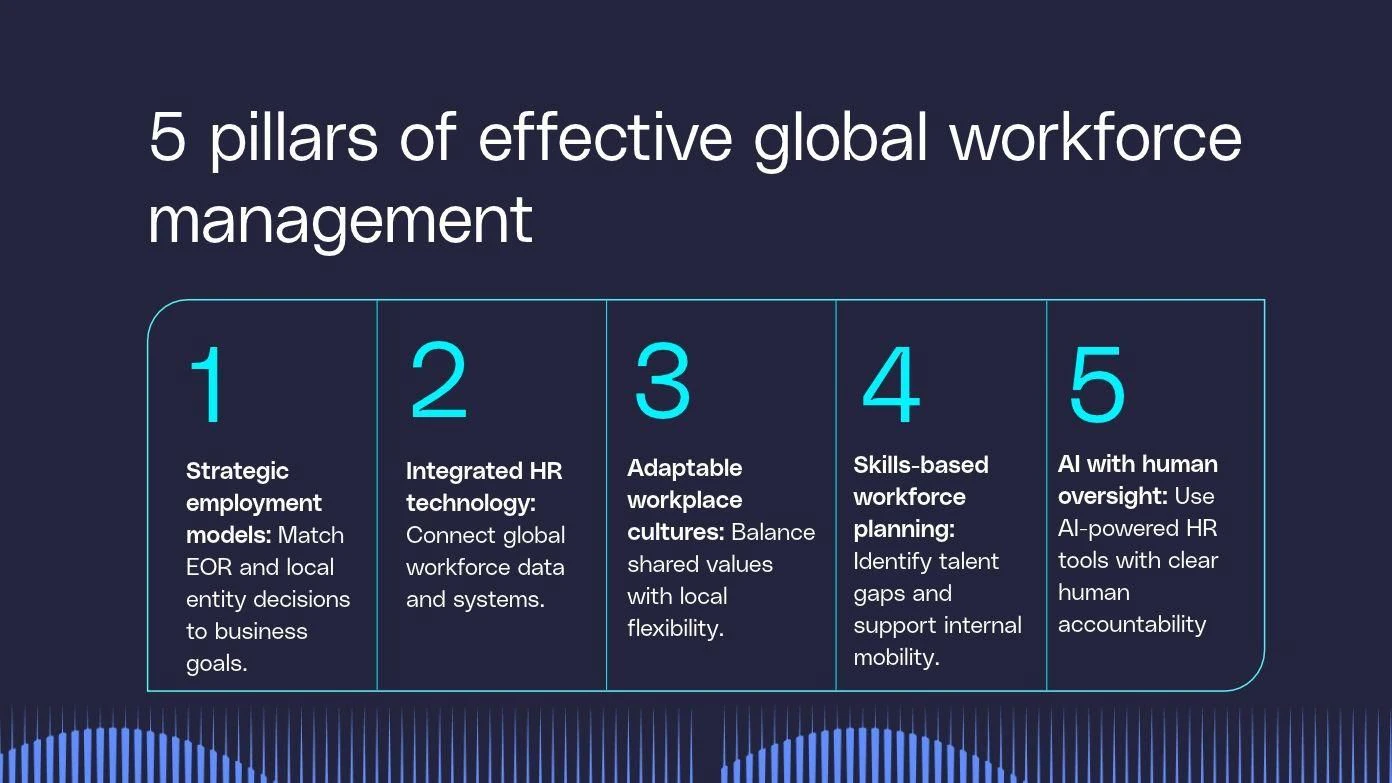
Knowing that Gia's guidance is based on expert-reviewed, legally vetted sources gives me peace of mind. It lets me spend less time on paperwork and more time on strategic initiatives.
Build your global workforce with G-P
Managing global HR challenges takes the right expertise, technology, and employment infrastructure. For CHROs, the key is finding solutions that simplify cross-border hiring, reduce administrative burdens, and support compliance across jurisdictions.
G-P is the world’s first agentic Global Employment Platform. Our platform and its AI-powered products — EOR, Contractor, and Gia — that help companies of all sizes hire, onboard, and manage international teams in 180+ countries. G-P is the #1 EOR according to all industry analyst reports. With G-P EOR, you have access to in-country HR and legal specialists, so you can make informed workforce decisions with greater confidence.
Book a demo to explore G-P's Global Employment Platform and kickstart your expansion strategy today.
FAQs
What are the most critical global HR challenges CHROs face?
The biggest global HR challenges include navigating different employment laws, managing permanent establishment risks, preventing worker misclassification, and coordinating payroll across multiple countries. CHROs also need to address cultural differences, data privacy requirements, and emerging AI regulations while aligning workforce strategies with business goals.
How does remote global hiring trigger permanent establishment risk?
Remote hiring can create permanent establishment (PE) risk when a home office qualifies as a fixed place of business, or an employee habitually concludes contracts on behalf of your company in another country. Under the OECD's 2025 guidance, working remotely for 50% or more of working time warrants closer examination but doesn't automatically create a PE. Commercial circumstances and applicable tax treaties also matter.
What is the difference between an employer of record and a subsidiary?
A subsidiary is a company-owned legal entity that involves incorporation, registration, and ongoing administrative costs. An employer of record (EOR) acts as a legal employer. It handles employment contracts, payroll, and statutory benefits, while you manage day-to-day operations. G-P EOR lets you hire professionals across 180+ countries without establishing new local entities.
How can I avoid worker misclassification penalties when engaging international talent?
Companies can reduce misclassification risks by evaluating working relationships based on behavioral control, economic independence, and operational integration rather than contract titles alone. G-P Contractor™ has AI contract checks that deliver guidance on what clauses need changes to ensure compliance.
What are effective management strategies for a global workforce?
Effective strategies include choosing appropriate hiring models, integrating global HR systems, establishing asynchronous communication standards, and adapting workplace practices to local cultures. CHROs like you can also use skills-based workforce planning and AI-powered HR agents, such as G-P Gia™, while maintaining human oversight of employment decisions.