







Key takeaways
- EU pay transparency is no longer a voluntary initiative, but a legal mandate with serious financial penalties for non-compliance.
- Employers are now responsible for meeting regulations across the employee lifecycle, including periodic reporting, to ensure there are no gender-based pay gaps in their organizations.
- AI and HR tech products, such as G-P EOR and G-P Gia™, can help you navigate these new mandates and stay compliant under the European Pay Transparency Directive.
The EU Pay Transparency Directive is a landmark legislation that redefines gender pay equality across workplaces in the EU. It aims to reduce the gender pay gap by improving pay transparency and increasing reporting obligations.
To prepare for these new regulations, companies across the EU need to understand the challenges, implications, and opportunities that the Pay Transparency Directive brings to the employment market.
We've recapped some of the Directive's most pressing issues to help you prepare to meet the new pay reporting requirements and other benchmarks mandated by this legislation.
5 EU Pay Transparency Directive requirements
Here is a breakdown of the new mandates and regulations under the EU Gender Pay Transparency Directive:
1. Pre-employment transparency (Article 5)
- Employers must disclose starting salaries or gender-neutral salary bands in job postings or before the first interview.
- Employers can't ask about candidates' current or previous compensation.
- Job postings and recruitment materials must be written in gender-neutral language.
2. Employee information rights and ban on pay secrecy (Articles 6 and 7)
- Employees have a right to request salary information for others performing equal work or work of equal value. Under the EU Pay Transparency Directive, "equal value" is defined by the following four pillars: skills, effort, responsibility, and working conditions (Article 4).
- Employers must provide this information within two months of the request.
- Employers must inform workers of their rights to this information annually.
- Employers can face financial or legal consequences for wage confidentiality and non-disclosure.
3. Tiered reporting timelines by company headcount (Article 9)
Employers have varied reporting schedules based on company size under the new directive. The required reporting frequencies are as follows:
|
Employer size |
Frequency |
First reporting date |
Data basis |
|---|---|---|---|
|
250+ workers |
Annually |
7 June 2027 |
Previous calendar year |
|
150–249 workers |
Every three years |
7 June 2027 |
Previous calendar year |
|
100–149 workers |
Every three years |
7 June 2031 |
Previous calendar year |
There are also reporting requirements related to base pay, bonuses, variable allowances, and quartile breakdowns.
4. The 5% disparity threshold and joint pay assessments (Article 10)
- Unjustified category pay gaps of 5% or more will trigger noncompliance alerts if not corrected within six months.
- Employers and work councils or trade unions must collaborate on pay audits and joint remediation plans.
5. Consequences for non-compliance (Articles 16, 21, and 24)
- Uncapped retroactive back pay and variable pay arrears, including interest, and other non-material damages.
- Suspension of the three-year minimum statute of limitations if data was purposefully concealed.
- Public procurement disqualification and loss of state subsidies.
4 challenges for global employers in the EU
Global employers may face obstacles as they work to stay compliant across borders. Challenges to creating pay transparency in the EU can include:
1. Standardizing multinational job applications
- Employers must create compliant applications for prospective employees across the EU, regardless of where their global headquarters or parent companies are located.
- These applications must comply with local mandates for each country.
2. Accurately calculating employee pay data
- Employers may need to account for cost-of-living adjustments (COLA), relocation packages, tax equalizations, expatriate packages, and allowances when calculating pay to avoid compensation distortions.
- Employers also need to ensure that mobility-linked compensation doesn't distort gender pay equity data.
3. Navigating additional regulations across countries
- Countries such as Germany, France, Spain, Sweden, Italy, and Poland have their own pay transparency requirements, in addition to the new EU-wide mandates.
4. Facing data silos and legacy discrepancies
- Some HRIS systems may not be able to run complex analysis of past pay data or connect performance data to pay history.
- There is also a risk of internal peer pay compression when addressing past pay gaps.
How an employer of record (EOR) can support EU pay transparency compliance
EORs support compliance by streamlining and automating HR and payroll processes. An EOR lets you:
- Use established local legal entities and their up-to-date contracts, policies, and statutory filings to hire anywhere compliantly.
- Automate auditing and redrafting of employment agreements across all 27 EU Member States to flag non-compliant pay-related clauses.
- Simplify data architecture and reporting, with a centralized system for payroll, bonus information, allowances, and gender-disaggregated data across countries.
- Streamline responses for employee inquiries, granting secure access to requested pay information.
- Help with local labor relations expertise, which can support joint pay assessments, work council consultations, and remediation plans.
Best practices for EU pay transparency compliance
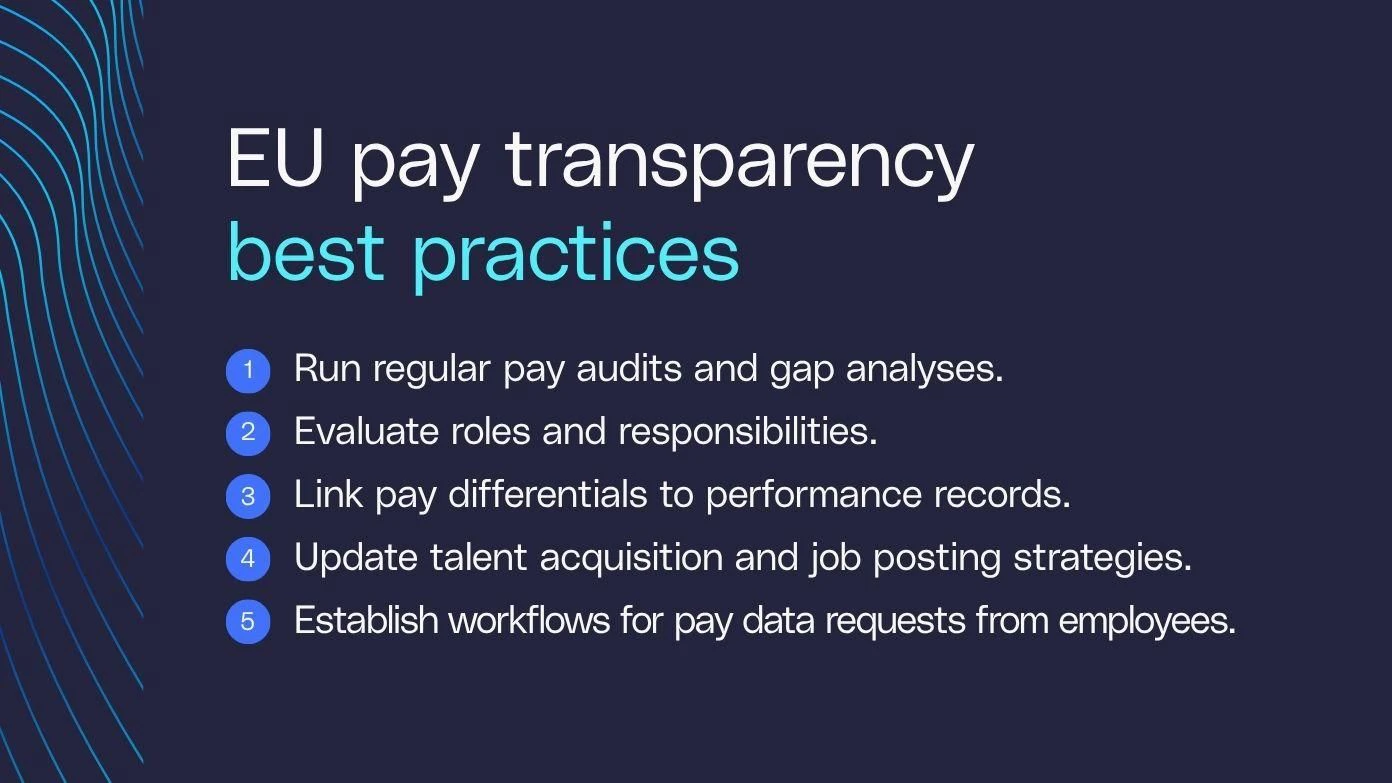
These strategies can help you stay compliant and minimize legal risk under the directive:
1. Run regular pay audits and gap analyses
- Conduct internal pay equity analyses before mandatory deadlines to find and fix any unjustified gender pay gaps.
- Flag any worker categories with pay differentials near or over 5% so you can see if they are justified, and if needed, address them internally before public reports are due.
2. Evaluate roles and responsibilities
- Build frameworks around work value based on the four mandatory criteria: skills, effort, responsibility, and working conditions. Other soft skills should also be considered where appropriate.
- Ensure that roles in functions like HR and customer support are evaluated fairly alongside technical roles, regardless of historical gender associations.
3. Link pay differentials to performance records
- Make sure that salary variations within a band can be explained by difference in tenure, skills, and measurable performance.
- Prepare documentation that can serve as legal proof, if needed.
4. Update talent acquisition and job posting strategies
- Make sure all job postings across EU markets include pay level or range information.
- Remove all salary history questions from application forms, recruiter screening templates, and background check procedures.
5. Establish workflows for pay data requests from employees
- Create an internal ticketing and data retrieval system to make sure that data requests are met within the required two-month timeframe.
- Draft standardized report templates that meet all local requirements.
6. Audit employment contracts
- Be sure to remove any compensation-specific verbiage that restricts employees from talking about pay.
7. Retrain people managers and hiring leaders
- Teach frontline managers how the company's compensation structure works and how to conduct transparent pay conversations.
- Train recruiters to negotiate pay based on role value, not the worker's pay history.
8. Run periodic test reports
- Simulate reports using the previous year's data to help you ensure that data aggregation systems are working and identify any reporting anomalies before official reports are due.
9. Speak proactively with employee representatives
- Actively engage with work councils and trade unions to foster strong relationships and reduce potential friction.
AI solutions to support the EU Pay Transparency Directive
There are many AI solutions and HR tech platforms designed to support compliance for changing pay regulations. These highly specialized tools can automate complicated HR, payroll, and reporting functions, helping you avoid hefty fines and other legal consequences.
Some core capabilities to look for in an AI-powered pay equity platform are:
- Equal value job mapping: Natural Language Processing (NLP) capabilities can rewrite current job descriptions so they're up to date under the new directive.
- Multi-variable regression analysis: pay data analysis functions can examine gender pay disparities by sorting employees' experience, performance, and geography.
- ATS/HRIS offer guardrails: these tools can simulate offers and promotions to alert managers to potential compliance issues.
- Budget allocation support: this function can create models to show how unjustified wage gaps can be closed to stay compliant and prevent wage compression.
- Automated regulatory reporting: these tools can generate required reports as needed.
G-P Gia™
G-P Gia™, our AI-powered global HR agent, can answer your toughest compliance questions across 50 countries, including many in the EU. Reduce your reliance on outside counsel and cut the time and cost of compliance by up to 95% with Gia.
Gia can support your global team by:
- Providing country-specific legal expertise, including information on EU transposition differences, collective bargaining agreements, and pay reporting criteria.
- Generating compliant HR documents, such as job descriptions, offer letters, and employment contracts that align with the Directive.
Manage changing regulations with G-P
As the EU Pay Transparency Directive reshapes compensation practices across Europe, our agentic global employment platform and its AI-powered products — G-P EOR, G-P Contractor™, and G-P Gia™ — give you everything you need to evaluate roles fairly, close pay gaps, and document compliance with ease.
G-P is the world's first agentic global employment platform that embeds labor law intelligence directly into your existing tech stack, so you can hire and scale compliantly in 180+ countries in minutes.
 Frequently asked questions
What is EU pay transparency?
EU pay transparency is an HR and legal framework designed to make pay practices more clear and equitable. This framework supports employees earning equal pay for equal work, regardless of their gender. It holds employers accountable for explaining and reporting on how pay rates are set and progress throughout the employee lifecycle.
What is the EU Gender Pay Transparency Directive?
Starting June 7, 2026, all Member States of the EU are required to meet minimum standards for pay transparency and gender pay gap reporting. This gives employees more power to ensure they’re being paid fairly.
Who must comply with the EU Pay Transparency Directive?
All employers must comply, regardless of company size or whether they’re public or private. However, only employers with 100 or more workers are currently responsible for minimum reporting.
What are the EU Pay Transparency Directive requirements?
The EU Pay Transparency Directive has requirements at every stage of the employee lifecycle. Employers must provide job applicants with accurate initial pay levels or ranges and can’t ask them about their personal pay histories. Workers have the right to request pay information and be given clear information on how to do so. Employers also can’t discourage employees from talking to one another about pay. Lastly, employers are held to strict reporting requirements and pay assessments, and may face penalties if certain criteria aren’t met.
What are the reporting deadlines under the EU Pay Transparency Directive?
Mandatory reporting deadlines vary by employer size. Reports are based on the previous calendar year’s data. The current deadlines and minimum frequency requirements are as follows: Employer size Frequency First reporting date Data basis 250+ workers Annually 7 June 2027 Previous calendar year 150–249 workers Every three years 7 June 2027 Previous calendar year 100–149 workers Every three years 7 June 2031 Previous calendar year
What is EU pay transparency?
EU pay transparency is an HR and legal framework designed to make pay practices more clear and equitable. This framework supports employees earning equal pay for equal work, regardless of their gender. It holds employers accountable for explaining and reporting on how pay rates are set and progress throughout the employee lifecycle.
What is the EU Gender Pay Transparency Directive?
Starting June 7, 2026, all Member States of the EU are required to meet minimum standards for pay transparency and gender pay gap reporting. This gives employees more power to ensure they're being paid fairly.
Who must comply with the EU Pay Transparency Directive?
All employers must comply, regardless of company size or whether they're public or private. However, only employers with 100 or more workers are currently responsible for minimum reporting.
What are the EU Pay Transparency Directive requirements?
The EU Pay Transparency Directive has requirements at every stage of the employee lifecycle. Employers must provide job applicants with accurate initial pay levels or ranges and can't ask them about their personal pay histories. Workers have the right to request pay information and be given clear information on how to do so. Employers also can't discourage employees from talking to one another about pay. Lastly, employers are held to strict reporting requirements and pay assessments, and may face penalties if certain criteria aren't met.
What are the reporting deadlines under the EU Pay Transparency Directive?
Mandatory reporting deadlines vary by employer size. Reports are based on the previous calendar year's data. The current deadlines and minimum frequency requirements are as follows:
250+ workers: Annually, first reporting date 7 June 2027 150–249 workers: Every three years, first reporting date 7 June 2027 100–149 workers: Every three years, first reporting date 7 June 2031