
Key takeaways
- Benefits go beyond salary: When you hire in Europe, benefits like flexible schedules and generous paid leave matter just as much as salary for job seekers.
- Shorter workweeks are trending: Countries like the U.K. Iceland, Portugal, Germany, and Belgium have launched pilot programs to test flexible schedules and shorter workweeks.
- Work-life balance varies: Even though labor laws and workplace cultures vary across Europe, there's a strong focus on giving employees enough time for life outside of work.
Today, most employee benefits plans incorporate a set of non-wage perks that have become a key component of the overall total compensation package. Your company's benefits offering serves as a reflection of your core values.
For instance, a company that prioritizes employee well-being by offering health and wellness benefits, such as gym memberships, mental health support, and nutritional guidance, reinforces that commitment. Or if a company places importance on ongoing learning and development, it may provide support through educational assistance, training initiatives, or avenues for professional growth.
Naturally, benefits packages serve as a guide for job seekers to quickly gauge a company's ethos and play a role in attracting top talent that aligns with those values. Employee benefits are one of the most influential decision factors for job applicants in Europe.
Why Europe is looking beyond wages and toward total compensation
Employee perks are important, particularly as workers across Europe continue to recover purchasing power lost during the post-pandemic inflation surge. According to the OECD, real wages continue to rise in virtually all OECD countries, but the pace of recovery is slowing. Real wages also remain below early 2021 levels in half of the countries analyzed. These trends demonstrate why salary isn't the only consideration for employers looking to build attractive compensation packages.
As wages continue to recover, many companies have reacted by turning to benefits to provide additional value beyond salary and pay raises. This is because companies that offer solid benefits can boost employee morale and retention rates. Even with a steady salary, an excellent benefits package can help demonstrate your company's commitment to putting employees first and create a positive workplace that encourages people to stay.

Europe's exceptional mandatory benefits
A work-life balance in Europe effectively combines flexible schedules, health coverage, retirement plans, and paid time off. For example, Eurofound reports that Austria, Denmark, France, and Sweden offer a statutory minimum of 25 paid vacation days per year, while Luxembourg offers 26. Additional benefits such as life insurance, disability protection, critical illness coverage, private medical insurance, dental insurance, and more are also offered. However, the statutory benefits in each country vary.
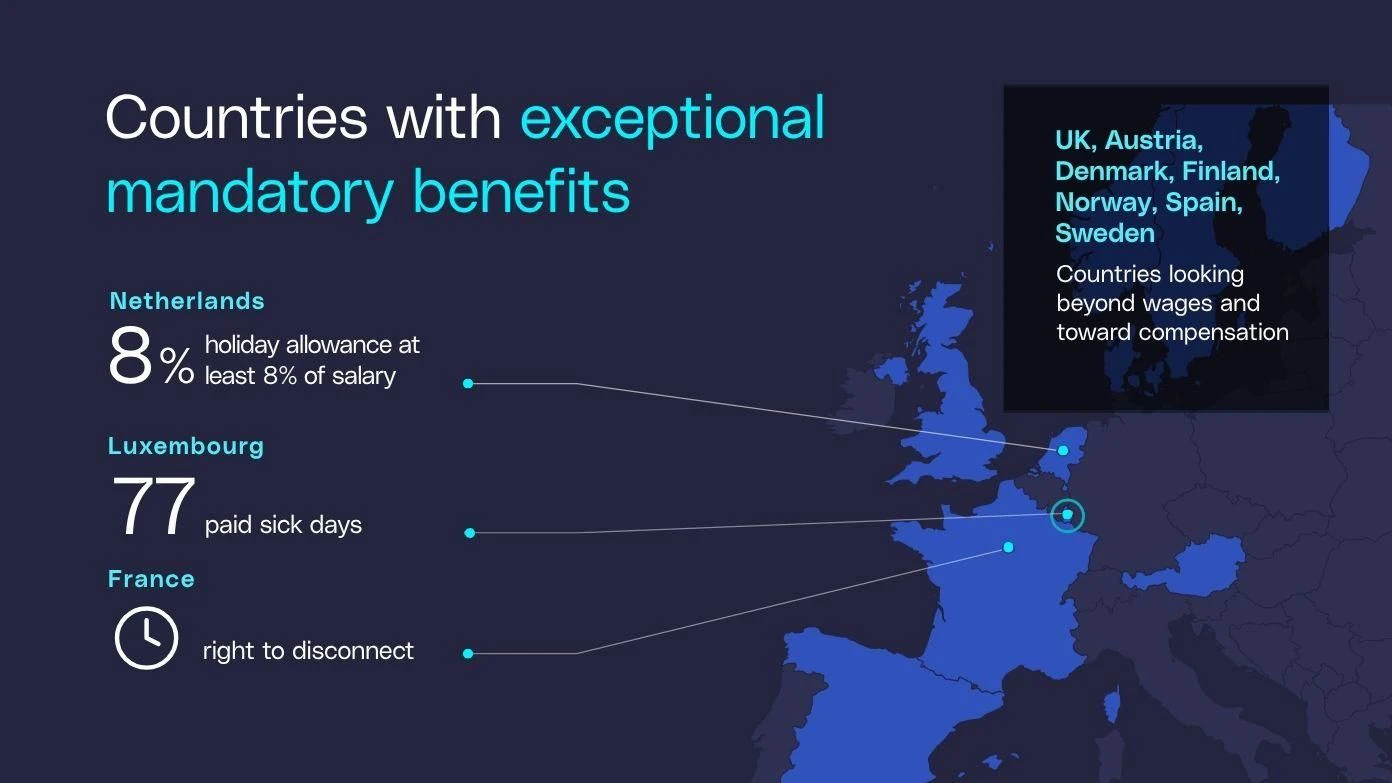
For instance, in Luxembourg, companies must continue paying sick employees their salary until the end of the month in which the 77th day of sick leave occurs within an 18-month reference period.
In the Netherlands, employees are entitled to a holiday allowance of at least 8% of their gross annual salary. Meanwhile, in France, there's a "right to disconnect", which establishes rules around employees' use of digital work tools outside working hours. As European workers are afforded a great amount of mandatory benefits by law, you must offer competitive packages to attract top talent.
Europe's work-life balance culture leads the world
Europe has developed a blueprint that stretches far beyond salary and can serve as a template for companies all over the world looking to attract and retain skilled talent. G-P's 2025 World at Work Report delved into the perspectives of global workers and executives to better understand evolving employee expectations and global employment trends.
We found that 52% of employees globally are actively searching or likely to search for a new job within the next six months. Meanwhile, 62% would be willing to move to another country if their employer offered the opportunity to advance their career. Pay also remains an important consideration, with 68% saying a guaranteed annual raise above cost-of-living adjustments would keep them with their organization for the next four years.
When it comes to work-life balance, Europe-based workers report relatively short average working weeks in several countries, although working hours and employment conditions vary widely across the region. For example, according to Eurostat, workers in the EU averaged 35.9 actual working hours per week in 2025. The Netherlands had the shortest average workweek at 31.9 hours, followed by Denmark and Germany at 33.9 hours and Austria at 34 hours.
Real-world benefits: Europe vs. the U.S.
European countries take different approaches to working hours, leave, and employee protections. Littler, the largest labor and employment law practice in the world, regularly surveys employers to analyze emerging workplace trends in the U.S. and Europe.
While employers on both sides of the Atlantic continue to focus on worker well-being, mental health remains a significant workplace concern in the U.S. Littler's 2025 Annual Employer Survey found that 70% of U.S.-based employers saw an increase in requests for leaves of absence or accommodations related to mental health conditions. The relationship between worker well-being and burnout is closely intertwined, each exerting a substantial impact on the other.
This view is supported by the 2025 DHR Global Workforce Trends Report. The research found that working too many hours was the leading cause of employee burnout, cited by 58% of respondents. Other leading causes included overwhelming workloads at 35% and difficulty balancing work obligations with personal and family life at 34%, all signs of work-life instability.
How Europe is continuing to evolve traditional work models
Europe continues to lead the evolution of work flexibility — the push for shorter workweeks. From 2015 to 2019, Iceland initiated a testing phase for a shorter workweek. Hours were reduced from 40 to 35 or 36 without cutting pay.
The trial was considered a success, showing that the shorter workweek reduced stress and burnout while improving work-life balance. As a result, trade unions in Iceland negotiated reductions in working hours, and 86% of the workforce gained the right to shorter working hours or were offered the opportunity to negotiate reduced hours.
A 2022 U.K. trial produced similar findings. Of the 61 participating companies, 56 were still operating a four-day week a year after the pilot. Moreover, before-and-after data showed that 39% of employees were less stressed, and 71% had reduced levels of burnout at the end of the trial.
Other European countries have also tested shorter-workweek models. In 2022, Belgium introduced a law allowing eligible full-time employees to request working their normal weekly hours over four days instead of five by working longer days. Other countries like Portugal and Germany have also experimented with shorter workweeks.
The best European countries for work-life balance
There isn't a universal answer to which country has the best work-life balance in Europe due to differing priorities and lifestyles. However, several countries stand out because of their generous leave policies and shorter working hours.
Here are the top European countries for work-life balance:
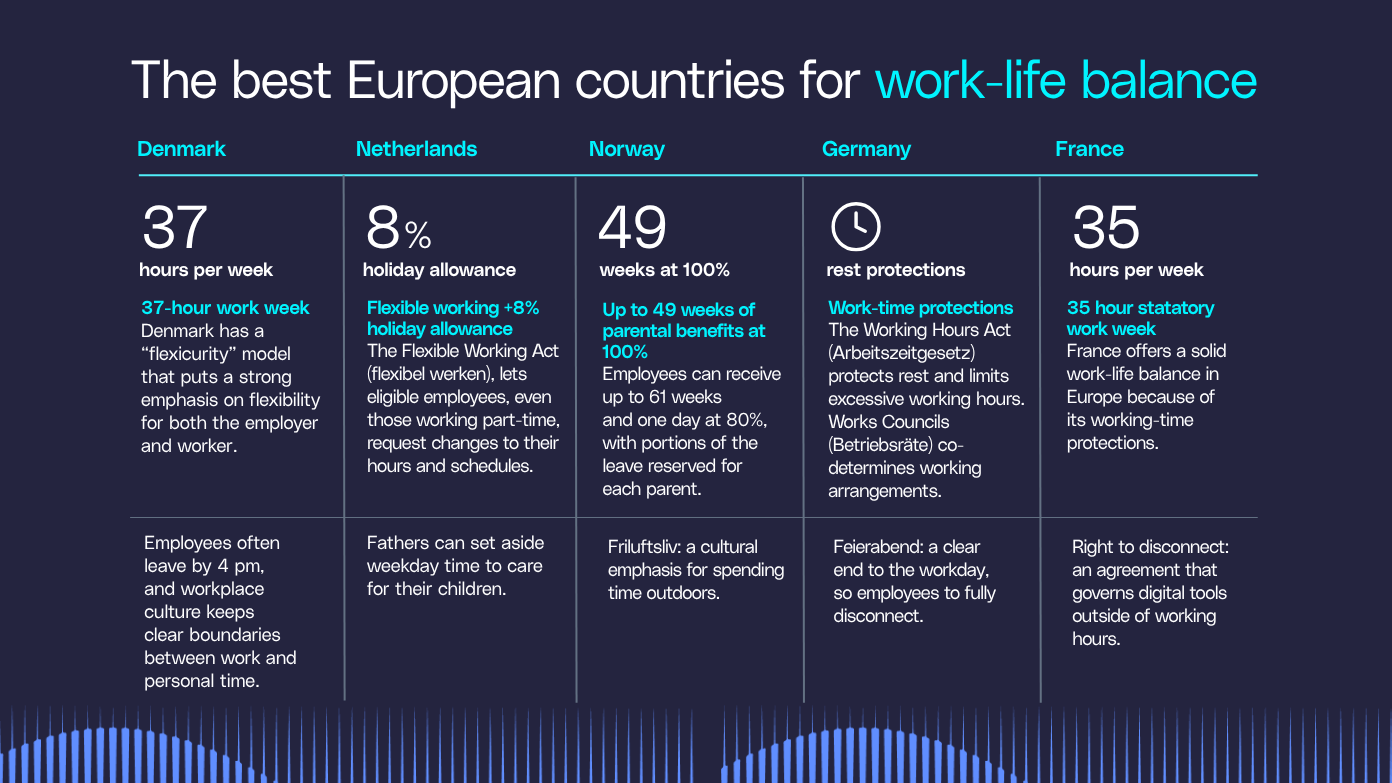
- Denmark: Denmark has a "flexicurity" model that puts a strong emphasis on flexibility for both the employer and worker. The standard is a 37-hour workweek, with employees often leaving by 4 p.m. each workday. Danish workplace culture generally emphasizes maintaining boundaries between work and personal time.
- Netherlands: With the Wet flexibel werken (Flexible Working Act), eligible employees, even those working part-time, are able to request changes to their hours and schedules. The country also has a cultural practice that allows fathers to set aside a weekday to care for their children. A holiday allowance equal to at least 8% of gross annual salary is given through vakantiegeld.
- Norway: In Norway, eligible parents get a maximum of 49 weeks of parental benefits at 100%. Or they can tap into 61 weeks and one day at 80%, with portions of the leave reserved for each parent. The concept of friluftsliv emphasizes spending time outdoors and provides a cultural foundation for maintaining a healthy balance between work and personal life.
- Germany: Germany's Arbeitszeitgesetz (Working Hours Act) puts a focus on boundaries that allow workers to maintain adequate rest and avoid excessive working hours. Co-determination rights over working-time arrangements are granted to Works Councils (Betriebsräte) through German labor law. Feierabend is also worth noting, with its goal of allowing employees to fully disconnect at the end of the workday.
- France: France offers a solid work-life balance in Europe because of its working-time protections. For example, there's a statutory baseline of 35 hours per week, and eligible employees can access compensatory days off through Réduction du Temps de Travail (RTT). There's also a right-to-disconnect agreement or charter that provides governance over the use of digital tools outside of working hours.
Create competitive benefits packages with G-P
When you expand globally and explore new models of work, you need a competitive benefits package to attract and retain skilled talent. And when it comes to navigating the journey of global compensation, nobody is as experienced as G-P.
G-P is the first agentic Global Employment Platform. Our platform supports the full employee lifecycle — from compliant contracts to payroll and benefits.
With us, you get a full view of available benefits by country — both mandatory and supplementary — making it easy to offer your global teams competitive and up-to-date benefits. Beat the competition and expand today.
Contact us to learn more about our platform.
FAQs
What is the average workday in Europe?
The average workday in Europe depends on the country. But in 2025, most workers averaged 35.9 hours per week (7.2 hours per day) when working a 5-day work week.
How do you compare work–life balance rankings?
When comparing work-life balance rankings, look at working hours, paid leave, the flexibility of the work arrangement, and the types of worker protections provided. This gives a clearer picture of the overall employee experience rather than relying on a single factor.
Why do average working hours vary so much across Europe?
It mostly comes down to the differences in labor laws, cultural expectations, collective bargaining arrangements, and how common part-time work is. Some countries put more focus on shorter working hours and flexible schedules, while others prioritize longer periods of paid leave and other worker protections.
Which European countries have the shortest working weeks?
According to 2025 Eurostat data, the countries with the shortest average working week in the EU are the Netherlands (31.9 hours), Denmark and Germany (33.9 hours), followed by Austria at 34 hours.
Which countries have the best work–life balance in Europe?
Denmark, the Netherlands, Norway, Germany, and France have labor protections and workplace cultures that frequently make them stand out for work-life balance. Some of the benefits that these countries provide include shorter working hours, generous parental leave, and greater flexibility over when and how employees work.